Military Factory
Military Pay Chart
Global Firepower
Military Industrial Complex
Second World War
Home
Military Pay Scale
Military Ranks
Small Arms
Aircraft
Land Systems
Navy
Education
Military Factory Facebook Logo
flag of United States

Little David Heavy Siege Mortar (1944)

Authored By JR Potts, AUS 173d AB | Last Updated: 10/28/2010

The Little David Heavy Siege Mortar was developed to combat the expected fortifications on the Japanese mainland.

Find a School Near You
Follow Military Factory on Facebook:
Trending on Military Factory:
Recent Articles:
In 1944, the United States War Department was planning for the invasion of the Japanese mainland and expecting to encounter very strong fortifications. As such, the Army wuld need a heavy weapon to combat such structures. Specifications were drawn up and the Army figured on a weapon larger weapon than the 16-inch (410mm) guns as found on the Iowa-class battleships shooting a 2,700 lb (1,200kg) shell as these massive weapons had proven ineffective against Japanese bunkers at Iwo Jima.

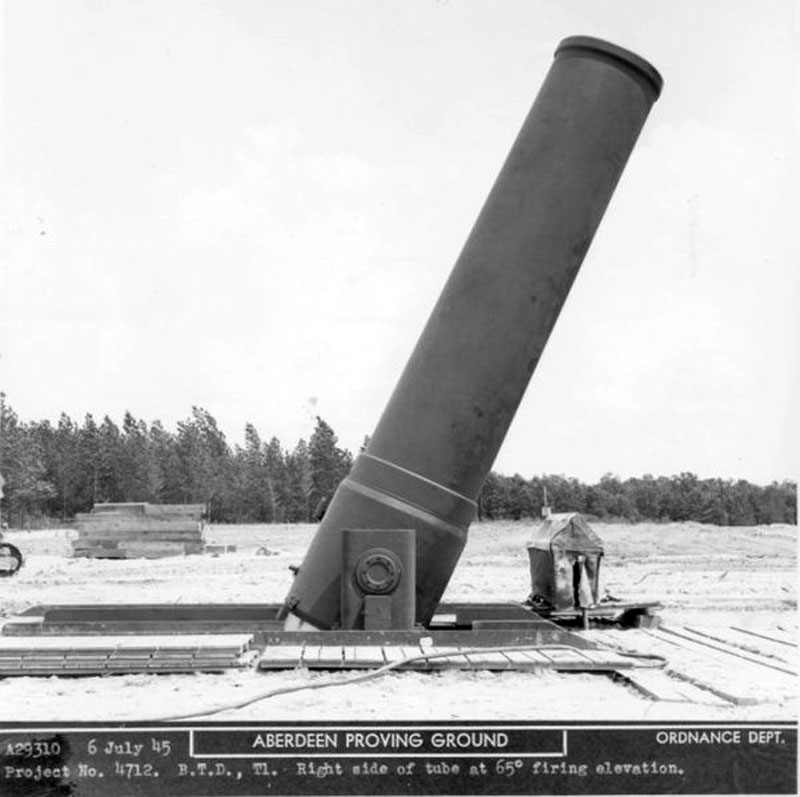
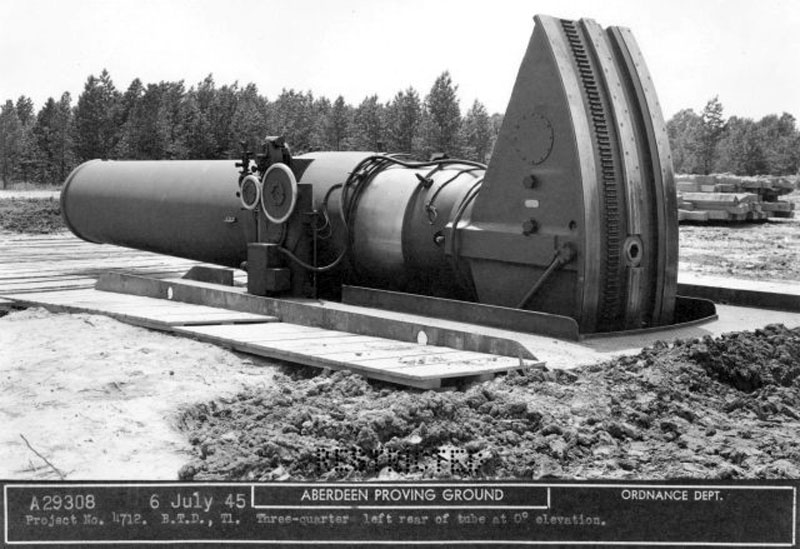
The new weapon was called "Little David", an American 36-inch (914 mm) caliber mortar, becoming the largest gun ever built (beating both the German "Dora" and "Karl" mega-guns). First used for test firing bombs during World War II, Little David was modified to serve as a siege mortar and it was planned to turn the instrument into an effective "bunker buster". When Japan surrendered, the mainland invasion became unnecessary and Little David was therefore never actually used in combat.

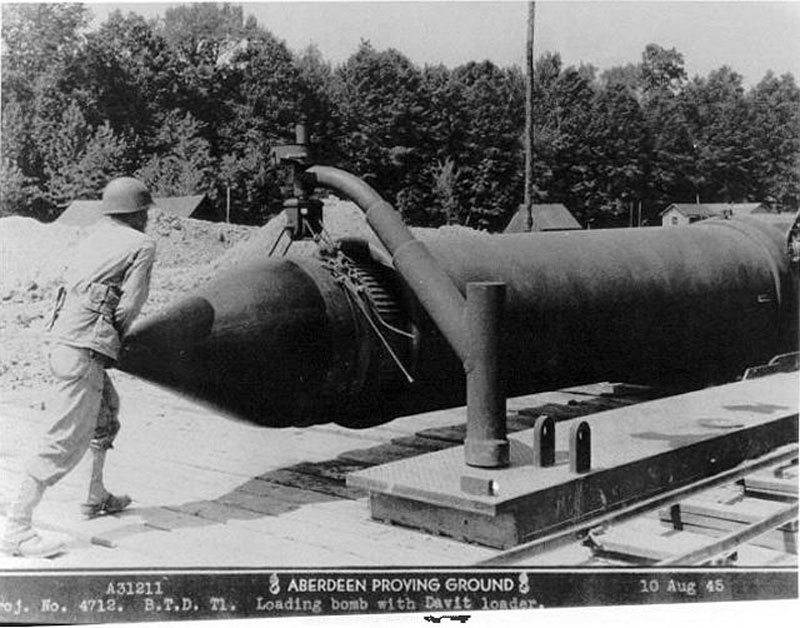
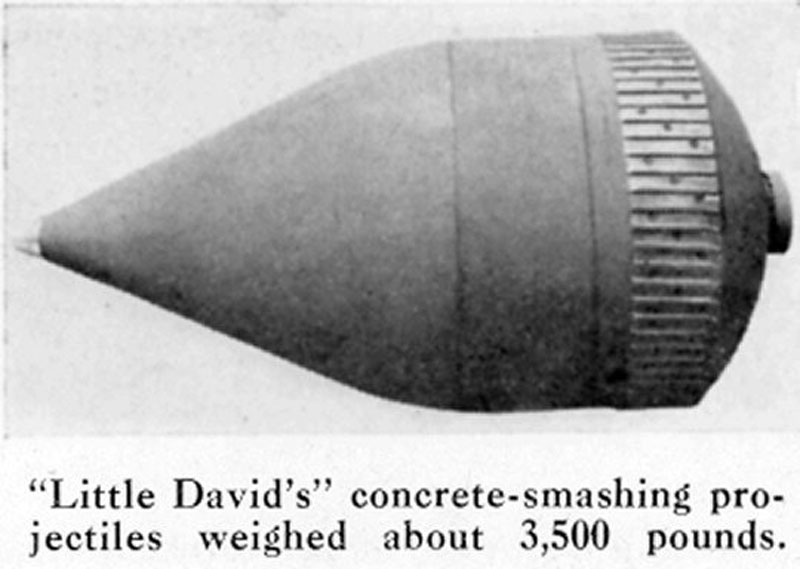
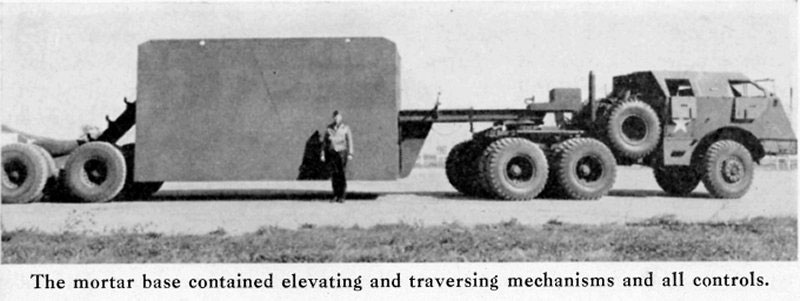
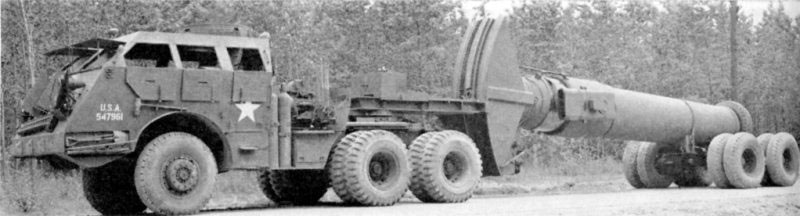
Its potential effectiveness was questionable, however, because of the gun's limited range and accuracy. This mobile mortar was capable of hurling a 3,650-pound projectile a distance of six miles via the giant 22-foot, muzzle-loading rifled mortar tube. Complete with its firing mechanism and other associated parts making up the tube assembly, Little David weighed in at 80,000 pounds. The mortar's metal base half-moon assembly underneath the tube (or barrel) was constructed in a squared huge box that weighed 93,000 pounds. The box would have to be buried underground by its own bulldozer for stability before firing.

Little David would have been transported by two artillery M26A1 tank tractors consisting of a Truck, 12-ton, 6 x 6, Tractor, M26 (Pacific) and a Semi-trailer, 40-ton, M15 (Fruehauf) - the latter also called the 'Dragon Wagon'. The tractors were designated TR-1 by their manufacturers and were powered by the Hall-Scott Type 440 series 240bhp, 6-cylinder gasoline engine. Hall-Scott designed the 440 engine exclusively for the M26A1 and built around 2,100 examples of them. While traveling, the mortar's tube and base assemblies each made up separate tractor loads, while a third tractor would haul the 3,600lb projectiles. A complete Little David unit also included a bulldozer with crane and bucket shovel to dig the emplacement. The huge mortar could be assembled and ready to fire in 12 hours. Comparatively, the largest (820MM) known German artillery weapons were hauled on no fewer than 25 railway cars and required three weeks to be erected into firing position using some 200 crewmen. In that respect, this made Little David more mobile than a railway gun.

One of the last survivors of the Little David gun is on display at the proving grounds in Aberdeen, Maryland, USA.
Text ©2003-2013 www.MilitaryFactory.com • All Rights Reserved • No Reproduction Permitted
MilitaryFactory.com does NOT sell equipment/weaponry. Material presented throughout this website is for historical and entertainment value and should not to be construed as usable for hardware restoration, maintenance or general operation. Please consult manufacturers for such information. Our disclaimer. Email corrections / Comments to MilitaryFactory at Gmail dot com.
Picture of Little David
Pic of the Little David
Image of the Little David
View All Images (6)

Specifications for the
Little David
Heavy Siege Mortar


Country of Origin: United States
Manufacturer: US Army - USA
Initial Year of Service: 1944
Production: 3


Focus Model: Little David
Crew: 7


Overall Length: 27.99ft (8.53m)
Width: 0.00ft (0.00m)
Height: 0.00ft (0.00m)
Weight: 44.8 US Short Tons (40,640kg; 89,596lbs)


Powerplant: None.


Maximum Speed: 0mph (0 km/h)
Maximum Range: 6 miles (10 km)


NBC Protection: None
Nightvision: None


Armament:
1 x 36-inch (914mm) rifled barrel


Ammunition:
Shells of HE - 3,650lbs (1,361kg) each


Variants:
Little David - Base Series Designation


Operators: United States

ALL LAND SYSTEMS CATEGORIES

By Decade:


1910 to 1919
1920 to 1929
1930 to 1939
1940 to 1949
1950 to 1959
1960 to 1969
1970 to 1979
1980 to 1989
1990 to 1999
2000 to 2009
2010 to 2019
VIEW ALL
Compare Tanks


By Type:


4x4 Military Vehicles
6x6 Military Vehicles
8x8 Military Vehicles
Artillery Gun Systems
Anti-Aircraft (AA) Guns
Anti-Aircraft (AA) Vehicles
Anti-Tank (AT) Guns
Anti-Tank (AT) Vehicles
Armored Cars
Armored Personnel Carriers (APC)
Battlefield Robots
Halftrack Vehicles
Heavy Tanks
Infantry Fighting Vehicles (IFV)
Light Tanks
Main Battle Tanks (MBT)
Modern Combat Tanks
Medium Tanks
Military Motorcycles
Multiple Launch Rocket Systems (MLRS)
Reconnaissance Vehicles
Special Purpose Vehicles
Self-Propelled Guns (SPG)
Tank Destroyers
General Purpose / Utility Vehicles


By Nation:


Afghanistan
Britain
China
France
Germany
Iran
Iraq
Israel / Israeli Army
Italy
Libyan Army
North Korea / North Korean Army
Pakistan
Russia
South Korea
Soviet Union
Syrian Army
United States
VIEW ALL

World War 2:


Artillery
Infantry Fighting Vehicles
Tank Destroyers (All)
Tanks (All)
Australian Tanks
British Tanks
Canadian Tanks
Cruiser Tanks (UK)
Czechoslovakian Tanks
French Tanks
German Tanks
German Tank Destroyers
German FlaK Guns
German Reconnaissance Vehicles
Hungarian Tanks
Italian Tanks
Japanese Tanks
Romanian Tanks
Soviet Tanks
Swedish Tanks
US Tanks
VIEW ALL


World War 1:


France WW1 Tanks
Germany WW1 Tanks
Britain WW1 Tanks
US WW1 Tanks
WW1 Artillery
WW1 Tanks (all)
VIEW ALL


Spanish Civil War:

VIEW ALL


Korean War:

Tanks
VIEW ALL


Vietnam War:

VIEW ALL


Cold War:

Cold War Tanks
Cold War American Tanks
Falklands War
Post-WW2 British Tanks
VIEW ALL


Gulf War (1991):

VIEW ALL


Miscellaneous:

Armored Vehicle Chassis Types

Site Disclaimer | Privacy Policy | Site Map | MF Origins


©2013 www.MilitaryFactory.com • Content ©2003-2013 MilitaryFactory.com • All Rights Reserved • Site Contact Email: militaryfactory at gmail dot com. The "Military Factory" name and MilitaryFactory.com logo are registered ® trademarks and protected by all applicable domestic and international intellectual property laws.


Top MF Stuff: 2013 Military Pay Scale | Military Ranks | WW2 Weapons | Sniper Rifles | Kts to Mph | WW1 Aircraft | Automatic Rifles | Aircraft Cockpits | Vietnam War Weapons | Main Battle Tanks | Submachine Guns | Shotguns | French Military Victories


Most photographic images appearing on this site are courtesy of the United States Department of Defense and are approved for public use. Other images acquired through the public domain. Digital art work courtesy of Dan Alex. Business Consulting by Kyle Williams. Material presented throughout this website is for historical and entertainment value and should not to be construed as usable for hardware restoration, maintenance or general operation. Please consult manufacturers for such information.


eXTReMe Tracker