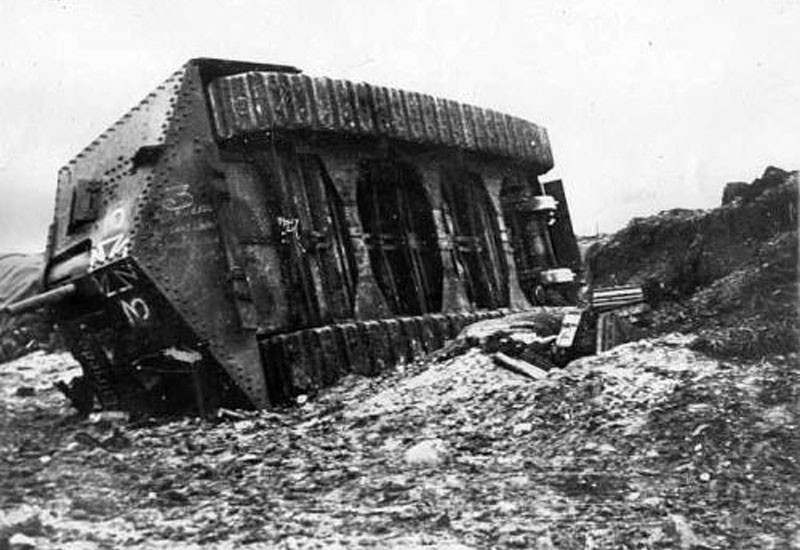
The Sturmpanzerwagen A7V ("Allgemeines Kriegsdepartment, 7. Abteilung, Verkehrswesen") became the first operational German Army tank and appeared in the latter stages of World War 1 (1914-1918). Ironically, it was the Germans who were late in developing viable armored combat vehicles in the war for the British and French made great strides in the field which ultimately aided in breaking through the German defensive lines. Early thought, on the part of the Germans, was given to the prospect of fielding an armored vehicle for the march on Belgium and France but gains made there with standard infantry, cavalry, and artillery negated the use of such vehicles for the time being. It was not until the successes being encountered by Allied tanks that the concept was revisited, resulting in the A7V. Other lesser-known German tank developments became the super-heavy "K-Wagen" and the LK II light tank - though neither of these were operationally available by war's end in November of 1918.
Ultimately, the A7V proved itself a limited endeavor for it was a cumbersome, tactically restricted beast with little to recommend itself when compared to the British heavies in play. It was acquired in just 20 examples by the end of the conflict. It did, however, take part in history's first-ever "tank-versus-tank" duel, this outside of Villers-Bretonneux in April 1918. As with other German armored vehicle designs of the war, Joseph Vollmer's name was tied to the development of the A7V.
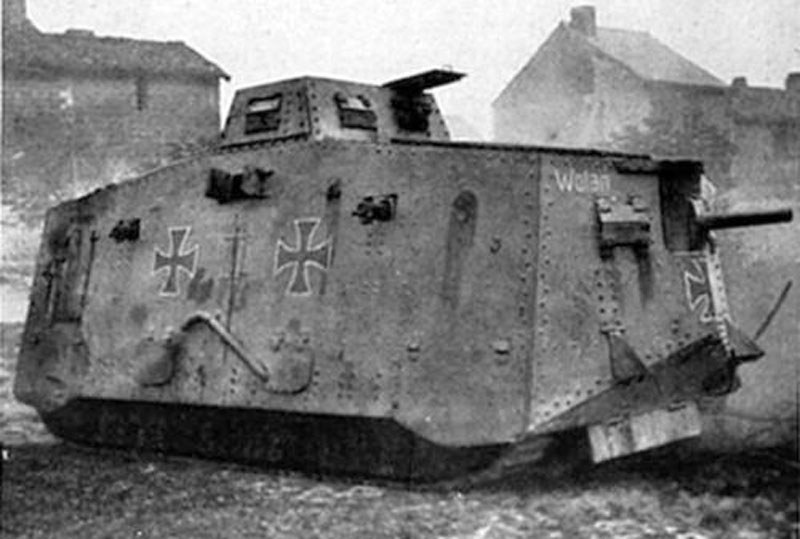
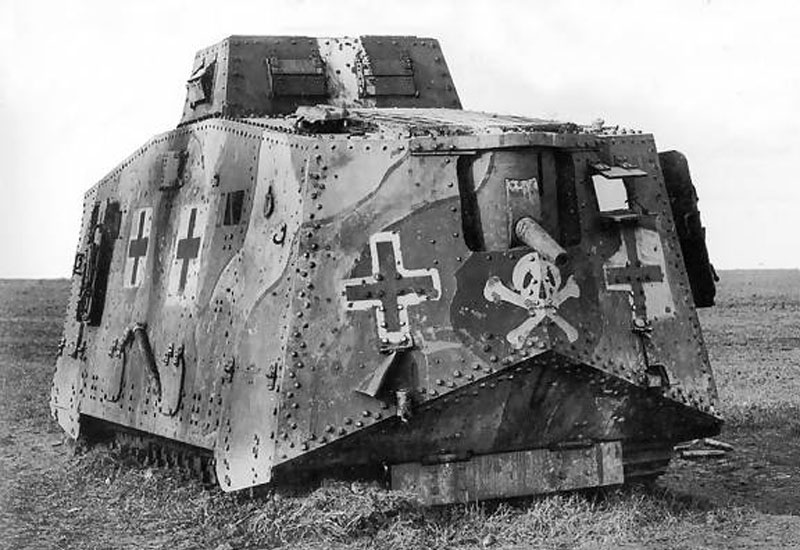
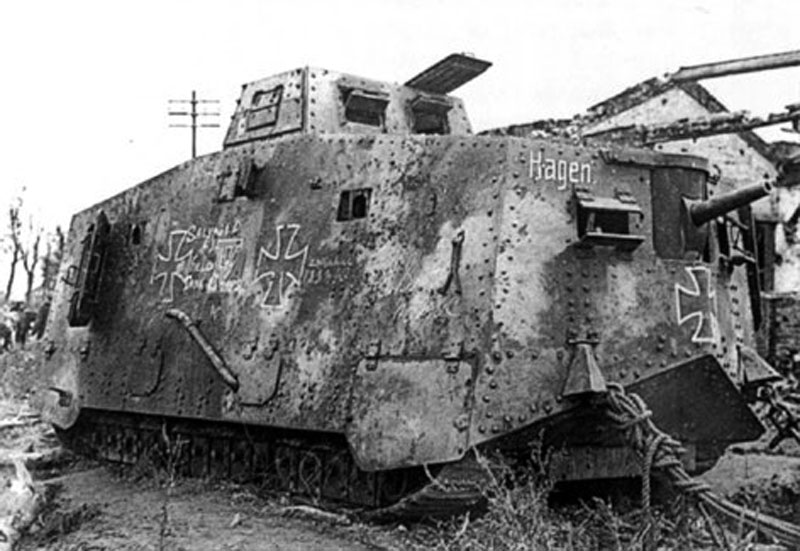
The A7V was born through a boxy, armored hull superstructure fitted atop the modified tracked components of a Holt tractor. The result was a vehicle that appeared to have no true front end - the only telltale sign being its 57mm field gun fitted at the bow. Various captured British, Belgian, and Russian 57mm field guns were uses during production of the twenty vehicles. To this was added 6 x Maxim MG08 machine guns - two at ports along each hull side and a pairing at the rear hull face. The field gun required at least two personnel to operate effectively as did each machine gun. In addition to the driving/steering crew and onboard engineers, the total crew numbered 18 or more. About 30,000 rounds of machine gun ammunition were carried to go along with 500 x 57mm projectiles.
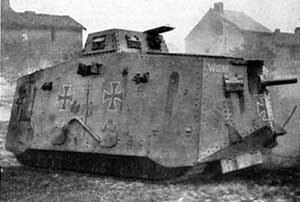
Externally, the A7V mimicked the design approach seen in the period's armored train cars. Its armor plating was near-vertical along all of the available faces and there was a centrally-mounted cupola-type assembly fitted on the roof - this area reserved for the driving compartment. Unlike an armored train car the A7V carried its own powerpack and running gear as well as fuel which did not restrict the vehicle to a railway network. Hinged rectangular doors offered the needed entry/exit for the crew. Armor protection ranged from 30mm at the front facing to 20mm at the rear and 15mm protecting the sides. Combat weight was listed at 36 tons (short).
The vehicle sat atop a rather shallow track system (ground clearance was measured in mere inches) which utilized some fifteen roadwheels to a hull side. Power was through 2 x Daimler-Benz 4-cylinder gasoline engines developing 200 horsepower and mated to Adler gearboxes and differentials while being exhausted through a stack set along the lower hull sides. The suspension system was of vertical springs, retained from the Holt tractor design. All told, the vehicle managed a ponderous 9 miles per hour on roads and 4 miles per hour when attempting cross-country travel. Ranges were limited to 50 miles maximum if the vehicle did not suffer a mechanical breakdown or get bogged down in the terrain.
As with all early tank forms, the Sturmpanzerwagen held a crew compartment that was cramped, smelly, and noisy - very industrial. The engine was installed at center with the main running gear components resting under the rear section of the hull. Two drivers sat in the upper center bridge area operating steering wheel and lever controls. The crew had access to ropes strewn over their heads to help stabilize themselves during rough-terrain travel.
In theory, the idea of a self-propelled, armored bunker bristling with cannon and machine guns seemed sound. In practice, however, the A7V was a flawed design. The vehicle was excessively heavy which made it impractical over uneven and soft terrain and it held an inherently slow speed for traveling to which accompanying infantry simply outpaced it - limiting the A7V's support value during offensives. The shallow and narrow track base made the vehicle unsafe under certain conditions and its powertrain was prone to breakdown - even moreso than seen on British and French designs. Its large size and slow speeds also made for an easy target and near-vertical facings offered little ballistics protection from direct hits. Firing arcs were limited, particularly for the 57mm gun at front. The large crew and inherent operating conditions restricted proper communications. If the A7V held a saving grace, it was in its armor protection scheme which was better than its contemporaries.
The German Army ordered 100 Sturmpanzerwagen A7V tanks by the end of 1917. However, construction was slow and only 20 were completed by the end of the war in November of 1918. The few that were delivered were pressed into action relatively quickly and were involved in some of the fighting leading to the Armistice. The Germans also made heavy use of captured British and French tanks during the war - indeed much of the German armored force was actually made up of captured vehicles and not homegrown designs.
In March of 1918, four A7Vs were paired with five captured British Mark IV tanks and used during the Ludendorff Offensive spanning from March 21st, to July 18th. The operation was intended as a decisive blow against the Allies to head-off the arrival of American forces certain to bolster the Allied ranks. The operation became a tactical German success but inevitably a strategic failure for the advance was not well-maintained due to stressed supply lines. This led to the Allied counter-offensive - the "Hundred Days Offensive" - which removed the German gains and ultimately forced a retreat. The A7Vs and Mark IV tanks were used in the post-artillery barrage period that preceded movement into enemy terrain and fought against the British defenses stationed at St. Quentin.
The recorded first-ever tank-versus-tank duel occurred southwest of Villers-Bretonneaux on April 27th, 1918. The Germans had captured the town and were aiming towards Amiens to enact a breakthrough in the Allied lines. An Allied force managed to take some ground in a night action and three British Mark IV tanks were deployed to hold the ground - though only one was of the cannon-armed (6-pounder) "males", the other two being machine-gun-only-armed "female" tanks. With the threat of encountering an enemy armored vehicle low, this seemed sufficient-enough of a defense for the work ahead.
German A7Vs were eventually sent to counter the Allied gains. Offering just machine gun resistance and lesser armor protection, the two females were both damaged and forced to withdraw. The British male then engaged with its 6-pdr gun and managed several direct hits upon the lead A7V which was knocked out. The remaining two A7Vs then withdrew to mark the end of the fighting, resulting in a rather inconclusive first-look at tank warfare.
A7Vs were further used in anger at the Third Battle of the Aisne (May-June 1918) and at the Second Battle of the Marne (July 1918). Their final actions were on October 11th, 1918 near the northern French town of Iwuy.
The Sturmpanzerwagen could prove a viable gunnery platform under ideal conditions - mainly level ground and when stationary but it was not a highly regarded system - German tanker crews actually preferred to fight from captured British tanks instead. Like the British and early French tanks, it was not an outright success. If A7Vs were not lost to combat, many were scrapped in the post-war drawdown. One example was claimed by the Australians at Villers-Bretonneux and is on display at the Queensland Museum in Brisbane, Australia. All of the twenty completed chassis were given names by the Germans as if battleships - this particular chassis carries the name of "Mephisto".
The Uberlandwagen was an unarmored, open-top supply vehicle form. The A7V/U was a proposed redesign of the A7U with sponson-type all-around track systems. The A7V/U2 was another proposed variant based on the A7V/U though with smaller-sized sponson tracks. The A7V/U3 was to be a machine-gun-armed "female" version.
Power & Performance Those special qualities that separate one land system design from another. Performance specifications presented assume optimal operating conditions for the Sturmpanzerwagen A7V Armored Fighting Vehicle / Tank.
2 x Daimler-Benz gasoline-fueled engines developing 100 horsepower each driving conventional track-and-wheel arrangement. Installed Power
8 mph 13 kph Road Speed
25 miles 40 km Range
Structure The physical qualities of the Sturmpanzerwagen A7V Armored Fighting Vehicle / Tank.
18 (MANNED) Crew
26.2 ft 8 meters O/A Length
10.0 ft 3.06 meters O/A Width
10.8 ft 3.3 meters O/A Height
66,000 lb 29,937 kg | 33.0 tons Weight
Armament & Ammunition Available supported armament, ammunition, and special-mission equipment featured in the design of the Sturmpanzerwagen A7V Armored Fighting Vehicle / Tank.
1 x 57mm main gun.
2 x 7.92mm Maxim MG08 machine guns along left hull side.
2 x 7.92mm Maxim MG08 machine guns along right hull side.
2 x 7.92mm Maxim MG08 machine guns at rear hull facing.
AMMUNITION: 500 x 57mm projectiles.
30,000 x 7.92mm ammunition.
Variants Notable series variants as part of the Sturmpanzerwagen A7V family line.
Sturmpanzerwagen A7V - Base Series Designation
Uberlandwagen - Unarmored, open-top supply vehicle.
A7V/U - Proposed redesign with sponson-type all-around tracks.
A7V/U2 - Proposed model based on the A7V/U, this one having slightly smaller track sponsons.
A7V/U3 - Proposed "female" version of the A7V/U2, having only machine gun armament.
Operators Global customers who have evaluated and/or operated the Sturmpanzerwagen A7V. Nations are displayed by flag, each linked to their respective national land systems listing.
Total Production: 20 Units Contractor(s): State Factories - Germany
The "Military Factory" name and MilitaryFactory.com logo are registered ® U.S. trademarks protected by all applicable domestic and international intellectual property laws. All written content, illustrations, and photography are unique to this website (unless where indicated) and not for reuse/reproduction in any form. Material presented throughout this website is for historical and entertainment value only and should not to be construed as usable for hardware restoration, maintenance, or general operation. We do not sell any of the items showcased on this site. Please direct all other inquiries to militaryfactory AT gmail.com. No A.I. was used in the generation of this content.