Global Firepower     |     Military Industrial Complex     |     Second World War History
spacer
Military Factory Part of the
MF Network Logo
Network
spacer
Home 2010 Military Pay Scale Military Aircraft Small Arms Land Systems Navy Ships Military Education US Ranks WW2 Weapons US Military Medals
 
2010 Military Pay Scale Chart - for Army, Navy, Air Force and Marines Military Factory on Facebook
 
spacer
spacer
  By Decade
   · 1910 to 1919
   · 1920 to 1929
   · 1930 to 1939
   · 1940 to 1949
   · 1950 to 1959
   · 1960 to 1969
   · 1970 to 1979
   · 1980 to 1989
   · 1990 to 1999
   · 2000 and Beyond
   · View All
  By Type
   · 4-Wheeled
   · 6-Wheeled
   · 8-Wheeled
   · Anti-Aircraft
   · Anti-Tank
   · APCs
   · Halftracks
   · Heavy Tanks
   · IFVs
   · Light Tanks
   · Main Battle Tanks
   · Medium Tanks
   · Reconnaissance
   · Special Purpose
   · Self-Propelled Guns
   · Towed Artillery
   · Utility Vehicles
  World War 2
   · Full List
   · Tanks
   · IFVs
   · Tank Destroyers
   · Australia
   · Britain
   · Canada
   · France
   · Germany
   · Italy
   · Japan
   · Soviet Union
   · USA
  World War 1
   · Full List
   · Artillery
   · France
   · Imperial Germany
   · United Kingdom
   · United States
   · Tanks
  Korean War
   · Full List
  Vietnam War
   · Full List

Military Factory on Facebook


Military Factory > Armored Vehicles > MT-13 (M1943)
spacer

MT-13 (M1943)

The M1943 160mm long-range mobile heavy mortar was used in the latter part of World War 2 by the Soviet Army.
By JR Potts, AUS 173d AB  Share
 
More Pictures QuickGraphs Chassis Types CompareX2 Acronyms

The mortar as a weapon is one dating back to about the 12th Century or perhaps even earlier and most always credited to the Chinese. The design concept was simple in nature and based on the shape of the apothecary mortar - a heavy shallow bowl. Mortars were then made in all sizes, large at first then smaller, portable devices for warriors who needed a personal weapon for short-range bombardment. As time went on, more powerful gunpowder and exploding shells were developed along with improved metallurgy for the barrel. Generally speaking, mortars are smaller than artillery weapons but fill a need for "plunging" fire against fixed enemy positions and strong points.

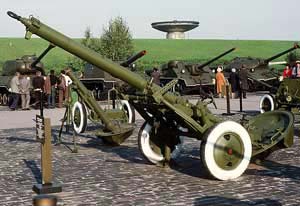
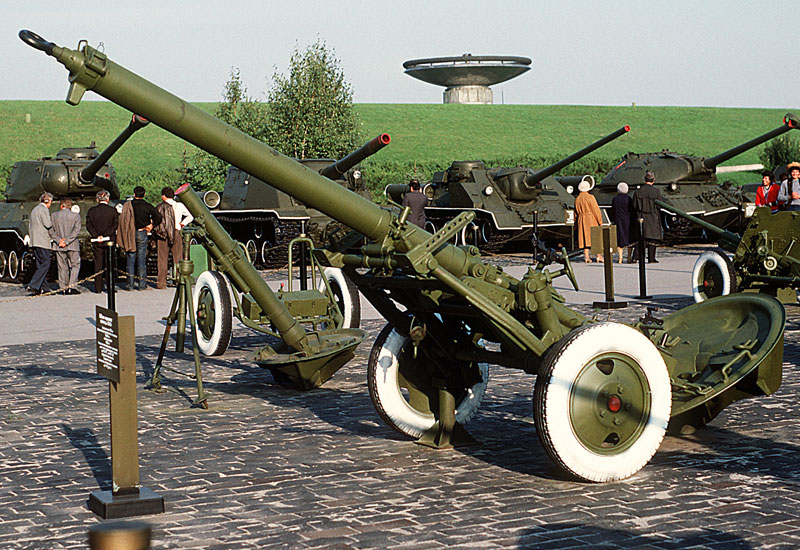
The Soviet Army used many sizes of mortars during the Great Patriotic War and the heaviest was the M1943 (MT-13) firing a 160mm shell. Developed in 1943, a major problem was found while trying to load the weapon it needed the 90lb shell dropped down the 9 ft (3m) firing tube. This herculean effort was found to be non-practical, forcing the weapon to be redesigned. This needed retooling allowed the barrel to be tilted down to a horizontal position for breech loading. The loading system also needed a new heavy duty recoil system to absorb the shock of the firing 160mm shell, an action that forced the base plate far into ground. To counter this force, a large concave thick steel plate was used to spread the downward energy created by the muzzle velocity. The weapon sat on a tripod consisting of the two tow wheels and the base plate making the M1943 one stable firing platform. Loading the weapon required the barrel to be unhinged, allowing it to tilt forward and expose the breach from the base plate. The 90lb shell was then loaded and the breach was closed. The barrel or tube is then cranked to the required mission elevation and is able to be fired at 10 rounds per minute by a trained and rested four man crew. Muzzle velocity was listed at 804 feet per second. Effective range was approximately 5,600 yards.

The Soviet Army assigned the M1943 to its Brigade size units due to its range. Larger artillery with much greater range was assigned to Division size military units. The Brigade was divided into four smaller units called Battalions that had 8 - M1943 mortars assigned to each, making the Brigade's strength 32 M1943's and including its applicable crews and towing vehicles.

The Soviet Army used the M1943 against Germany and effectively with their attack on Berlin in the heavy street-to-street fighting that ensued. After the war, the M1943 was sold to Soviet-allied states and nations including Bulgaria, Czechoslovakia, Poland, Romania and Ukraine plus Syria abroad.

The M1943 was eventually replaced in Soviet post-war service by the M-160 160mm heavy mortar.

History text ©2003-2010 www.MilitaryFactory.com • All Rights Reserved • No Reproduction Without Permission • Corrections / Comments to MilitaryFactory at Gmail dot com

Last Updated: 1/8/2010


  Specifications for the MT-13 (M1943)
Dimensions:
Length: 0.00ft (0.00m)
Width:0.00ft (0.00m)
Height: 0.00ft (0.00m)

Structure:
Accommodation: 5
Weight:0.0US Short Tons (0kg; 0lbs)

Performance:
Speed: 0mph (0km/h)
Range: 0miles (0km)

Systems:
NBC Protection: None
Nightvision: None

Power:
Engine(s): None.

Armament Suite:

1 x 160mm main gun

AMMUNITION:
Dependent on carrier.

Shell: 90lbs
Caliber: 160mm
Type(s): Fragmentation; Smoke; Illumination; Chemical


More Pictures QuickGraphs Chassis Types CompareX2 Acronyms


  Special Armored Vehicles Collections

By Nation:
Afghanistan Tanks
American Tanks
British Tanks
German Tanks
Iran Tanks
Iraq Tanks
Israeli Tanks
Russian Tanks

Miscellaneous:
Cold War Tanks
Modern Tanks


  Recent Armored Vehicle Additions
Thumbnail picture of the T-80 Main Battle Tank
T-80 MBT
Thumbnail picture of the Type 95 Ha-Go light tank
Type 95 Ha-Go
Thumbnail picture of the BRDM-2
BRDM-2

  Contacting MilitaryFactory.com
We can only get better if you tell us how. You can contact MilitaryFactory.com at MilitaryFactory at gmail dot com (replace "at" with "@" and "dot with ".") with any questions, comments or corrections. We also accept related military imagery that you approve for us to use on our website. Keep in mind, however, that due to volume, we may not directly respond to your inquiry. Please add us to your list of non-blocked recipients!


  Armored Vehicle Quick Profile


Image Courtesy of Don S. Montgomery of the United States Department of Defense..

flag of Soviet Union
1943
Designation: MT-13 (M1943)
Classification Type: Long-Range Towed Heavy Mortar
Contractor: Various State Factories - Soviet Union

Country of Origin: Soviet Union
Number Built: 550

Operators: Bulgaria; Czechoslovakia; Poland; Romania; Soviet Union; Syria

  Variants
M1943 - Base Production Series Designation

MT-13 - Alternative designation

  Collections
  • Tanks of World War 2
  • Armor of the Persian Gulf War
  • Towed Artillery Reigns
  • Armor of the Vietnam War
  • Tanks of World War 1
  • Armor of the Korean War
  • World War 2 Tank Destroyers


  Recent Articles:
 
Little MF Logo Another Impressive Luftwaffe "Paper Airplane" - the Me P.1101/92
spacer
Little MF Logo Much Noise But Little Else Came From the Republic XF-84H Thunderscreech
spacer
Little MF Logo Tragic Giant - K-141 Kursk
spacer
Little MF Logo The Mighty Mo - Battleship for Life
spacer
Little MF Logo Upping the Ante - the Iranian HESA Shafaq Advanced Trainer
spacer
Little MF Logo The G3M Nell Left Many Terrified or Dead in Her Wake
spacer
Little MF Logo The Hawker Sea Hawk Quietly Made a Name for Itself


Site Disclaimer | Privacy Policy | Site Map | MF Origins

©2010 www.MilitaryFactory.com • Content ©2003-2010 MilitaryFactory.com • All Rights Reserved • Site Contact Email: militaryfactory at gmail dot com (replace "at" with "@" and "dot" with ".")

eXTReMe Tracker

Top MF Stuff: 2010 Military Pay Scale Chart | Military Ranks | World War 2 Weapons | Sniper Rifles | Conversion Calculators

Most photographic images appearing on this site are courtesy of the United States Department of Defense and are approved for public use. Other images acquired through the public domain. Digital art work courtesy of Dan Alex. Business Consulting by Kyle Williams

Material presented throughout this website is for historical and entertainment value and should not to be construed as usable for hardware restoration, maintenance or general operation. Please consult manufacturers for such information.