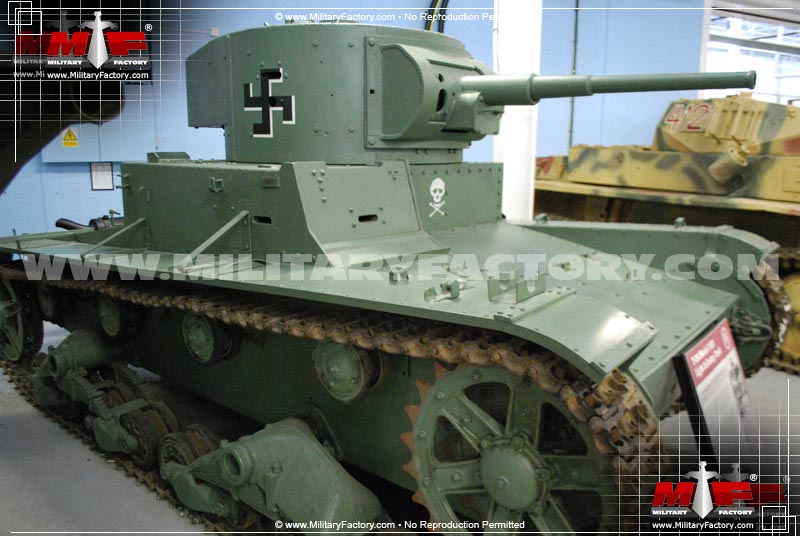
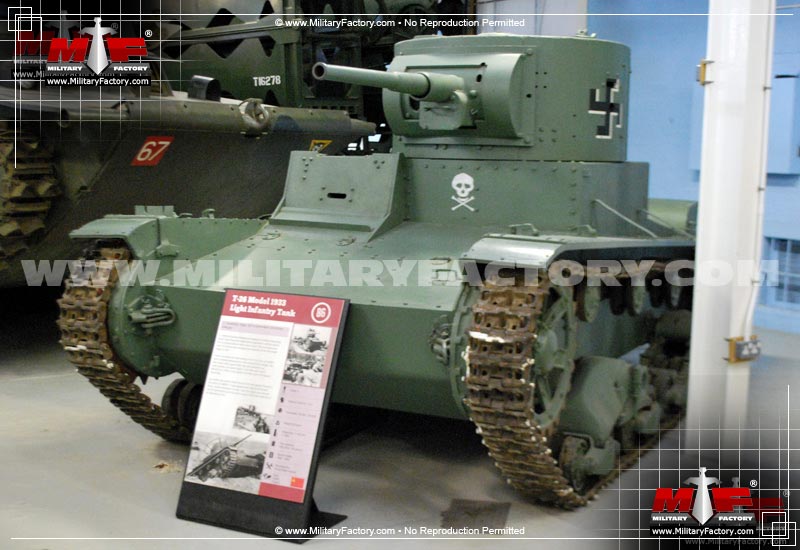
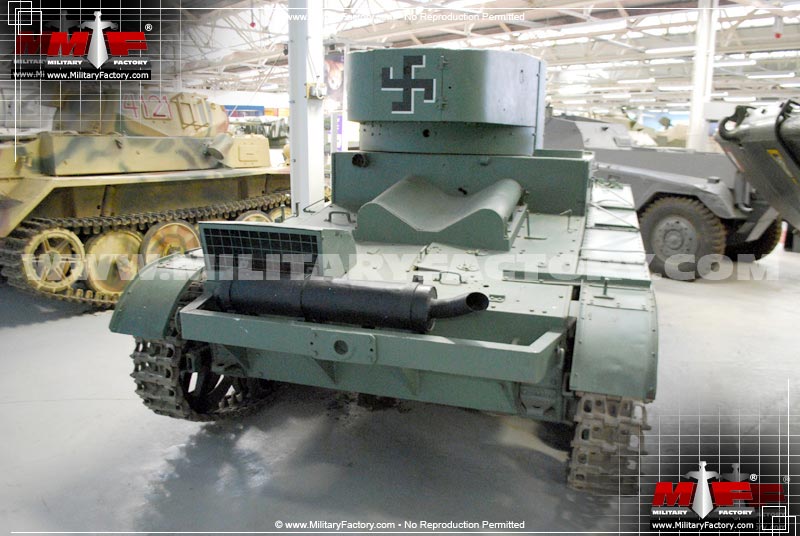
"The T-26 began as a direct copy of the British Vickers 6-ton Type E light tank."
Power & Performance Those special qualities that separate one land system design from another. Performance specifications presented assume optimal operating conditions for the T-26B Infantry Light Tank Tracked Combat Vehicle.
1 x GAZ T-26 8-cylinder gasoline engine developing 91 horsepower. Installed Power
17 mph 28 kph Road Speed
109 miles 175 km Range
Structure The physical qualities of the T-26B Infantry Light Tank Tracked Combat Vehicle.
3 (MANNED) Crew
16.0 ft 4.88 meters O/A Length
11.2 ft 3.41 meters O/A Width
7.9 ft 2.41 meters O/A Height
20,723 lb 9,400 kg | 10.4 tons Weight
Armament & Ammunition Available supported armament, ammunition, and special-mission equipment featured in the design of the T-26 Infantry Light Tank Tracked Combat Vehicle.
1 x 37mm OR 45mm main gun
1 x 7.62mm machine gun
Other Variants:
1 OR 2 x 7.62mm machine gun(s)
1 x Flame Projector in place of main gun(flamethrowing variant)
1 x 12.7mm machine gun
AMMUNITION: 165 x 45mm projectiles
3,654 x 7.62mm ammunition
Variants Notable series variants as part of the T-26 family line.
T-26 - Base Series Designation; based on the British Vickers 6-ton Type E light tank design.
T-26A (T-26 Model 1931) - Initial Production Model Designation.
T-26A-1
T-26A-2 - Fitted with two turrets mounting 1 x 7.62mm machine guns each.
T-26A-3 - Fitted with 1 x 12.7mm machine gun and 1 x 7.62mm machine gun.
T-26A-4 - Fitted with 1 x 27mm cannon and 1 x 7.62mm machine gun.
T-26A-4(U) - Command Vehicle; also T-26A-4V.
T-26A-5 - Fitted with 1 x 37mm main gun and 1 x 7.62mm machine gun.
T-26B (T-26 Model 1933) - Single turret design series.
T-26B-1 - Mounting 1 x 37mm main gun
T-26B-2 - Improved T-26B; all-welded construction; improved turret with gun counterweight added at rear.
T-26B-2(U) - Command Vehicle
T-26S Model 1937 - Fitted with 45mm main gun; may also be known as the T-26C or T-26E.
OT-26 - Flamethrowing Tank based on the T-26A model series.
OT-30 - Flamethrowing Tank based on the T-26B model series.
OT-133 - Flamethrowing Tank; based on the T-26S model series.
ST-26 - Bridging Tank; also IT-26.
AT-1 - Converted T-26 into 76.2mm self-propelled gun role.
As was the norm after World War 1 in all industrialized nations around the globe, Soviet warplanners set about to upgrade their armed forces to meet the demands of the everchanging battlefield. In particular demand was the improvement of the armored corps which were progressively outclassed by their contemporaries. Attempts were made to develop and indigenous design but most came to naught. As such, the British-based Vickers 6-ton Type E series were available in limited numbers stemming from a 1930 purchase from England and were selected for further development.
The British Type E became the T-26 in the Soviet inventory and brought about as a light infantry tank. The initial production version featured twin turrets in a distinct World War 1 style layout, each turret mounting a single 7.62mm anti-infantry machine gun. This version was known as the T-26A1 and were basically carbon copies of the British production models. From there, the previously Vickers design evolved into several variants starting with the base T-26A, all centering on increased crew protection and the mounting of evermore potent weapons. Power was derived from a single GAZ-type T-26 8-cylinder gasoline engine that delivered some 91 horsepower. The system would be crewed by 3 personnel. The T-26A2 followed shortly there after and became the first all-Russian production models armed with Soviet machine guns.
One T-26 model appeared with a 1 x 7.62mm and a 1 x 12.7mm (.50 caliber) machine gun array whilst another mounted an additional 27mm cannon in place of the aforementioned heavy machine gun. A 37mm main gun was fitted to the T-26A-5. The T-26B model series became the definitive T-26 tank as the twin turret design was dropped in favor of a more traditional single turret layout. This single turret was initially fitted with the 37mm main gun of the T-26A-5 but was later upgraded to a more potent 45mm variety.
The pinnacle T-26 design came with the arrival of the T-26S series. This particular series saw a change from riveted construction techniques to welded designing. Not only did this improve the overall protection of the tank turret but it also removed the deadly effect of having rivets blown clean from their holes from inside in the event of a direct hit by the enemy. The T-26 was spawned into other battlefield roles, more notably the addition of bridging tanks (in the ST-26 model), command vehicles (in the T-26A-4V and T-26B-2V models) and flamethrowing derivatives (all tanks beginning with the "OT" designation. An attempt was made with mounting a 76.2mm main gun to the turret which would go on to become the AT-1.
T-26s entered service in 1931 and were in play until 1942, by which time they were wholly obsolete. Captured T-26s in German hands were modified as gun carriers (75mm PaK 97/38 light tank destroyers) while Russian use of their own system was interupted after their factories were overrun. In any case the T-26 was reported to be a stable system without much fanfare. It was adequate for the role but hardly an impressive machine. It did operate in combat conditions from the Spanish Civil War and combat against German, Japanese and Finnish forces alike, earning the Russians some much-needed experience in the realm of tank design and - more importantly - mass production of military systems.
Operators Global customers who have evaluated and/or operated the T-26. Nations are displayed by flag, each linked to their respective national land systems listing.
Total Production: 12,000 Units Contractor(s): Factory No. 174 / Stalingrad Tractor Factory - Soviet Union
[ Afghanistan; Finland; Hungary; Kingdom of Italy; Nazi Germany; Romania; Soviet Union; Spain; Taiwan; Turkey ]
1 / 3
Image copyright www.MilitaryFactory.com; No Reproduction Permitted
2 / 3
Image copyright www.MilitaryFactory.com; No Reproduction Permitted
3 / 3
Image copyright www.MilitaryFactory.com; No Reproduction Permitted
The "Military Factory" name and MilitaryFactory.com logo are registered ® U.S. trademarks protected by all applicable domestic and international intellectual property laws. All written content, illustrations, and photography are unique to this website (unless where indicated) and not for reuse/reproduction in any form. Material presented throughout this website is for historical and entertainment value only and should not to be construed as usable for hardware restoration, maintenance, or general operation. We do not sell any of the items showcased on this site. Please direct all other inquiries to militaryfactory AT gmail.com. No A.I. was used in the generation of this content.