Global Firepower | Military Industrial Complex | Second World War History
Home | Military Pay Scale Chart | Infantry Weapons | Military Aircraft | Vehicles | Navy Ships | Military Education | Military Ranks | WW2 Weapons | French Military Victories
Military Factory Latest from Military Factory
Thumbnail picture of the Arado Ar TEW 16/43-19
Arado TEW 16/43-19
Thumbnail picture of the Winchester Model 1866 Rifle
Winchester Model 1866
Thumbnail picture of the HMAS Brisbane destroyer
HMAS Brisbane
Thumbnail picture of the Henry Model 1860 Rifle
Henry Model 1860
Thumbnail picture of the USNS Henson survey ship
USNS Henson
Thumbnail picture of the FGS Schleswig-Holstein destroyer
Schleswig-Holstein
2010 Military Pay Scale Chart - for Army, Navy, Air Force and Marines
  BY DECADE
    · 1910 to 1919
    · 1920 to 1929
    · 1930 to 1939
    · 1940 to 1949
    · 1950 to 1959
    · 1960 to 1969
    · 1970 to 1979
    · 1980 to 1989
    · 1990 to 1999
    · 2000 and Beyond
    · View All
  BY TYPE
    · 4-Wheeled
    · 6-Wheeled
    · 8-Wheeled
    · Anti-Aircraft
    · Anti-Tank
    · APCs
    · Halftracks
    · Heavy Tanks
    · IFVs
    · Light Tanks
    · Main Battle Tanks
    · Medium Tanks
    · Recon Vehicles
    · Special Purpose
    · SPGs
    · Towed Artillery
    · Utility Vehicles
  WORLD WAR 2
    · Full List
    · Tanks
    · IFVs
    · Tank Destroyers
    · Australia
    · Britain
    · Canada
    · France
    · Germany
    · Italy
    · Japan
    · Soviet Union
    · USA
  WORLD WAR 1
    · Full List
    · Artillery
    · France
    · Imperial Germany
    · United Kingdom
    · United States
    · Tanks
  KOREAN WAR
    · Full List
  VIETNAM WAR
    · Full List

MilitaryFactory > Armored Vehicles > Medium Tank, M4A4 (Sherman VC Firefly)
 
 
More Pictures QuickGraphs Chassis Types CompareX2 Acronyms

Medium Tank, M4A4 (Sherman VC Firefly)

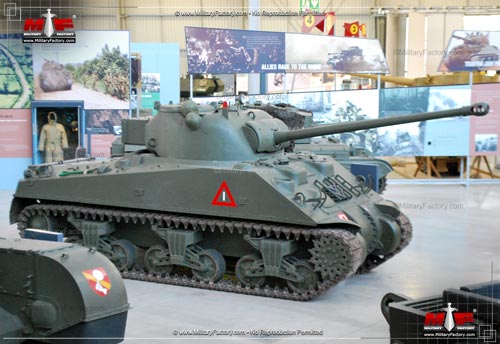
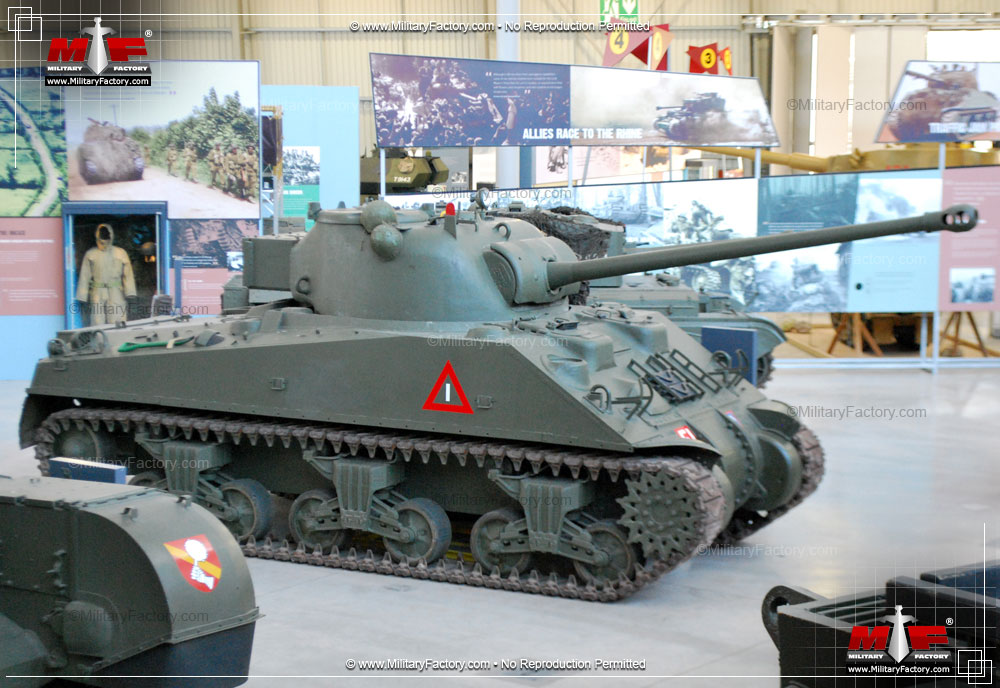
The Sherman Firefly became one of the more important Sherman variants, the first to sport an effective Panzer-killing 76mm main gun.
By Staff Writer

Bookmark and Share

Outwardly, the Sherman Firefly series of tank destroyers looked every bit like their M4 Sherman base counterparts. Closer examination would reveal a British-designed system that was finally capable of dealing with the impressive German Tiger and Panther tanks at distance. The Sherman Firefly would go on to become one of the more important Sherman tank derivatives of World War 2 despite their seemingly limited production numbers.

From the outset, Allied tank crews were at a disadvantage when tangling with the well-armored German tanks, needing numbers and ingenuity to usually overcome their counterparts. This resulted in Allied tank crews zeroing in for a near-point blank hit to the side or rear of the German units. The British and Americans were already looking into an upgunned version of the successful Medium Tank, M4 (or "M4 Sherman"), seeing that the weapon system was readily available in some quantity with a progressive stream of examples coming off the assembly lines at a record pace. Some in the American military offered mating a 90mm main gun to the existing M4 superstructure but others saw to it that the tank-versus-tank engagements should be handled by dedicated tank destroyer elements. Others were worried about the recoil effects and general unbalancing of adding such a weapon to the already heavy Sherman design. Still others gawked at the prospect of having to redesign an entirely new turret system to take on such a weapon.

Going at it alone, the British were un-phased at the prospect. Seeing as how the Germans were able to fit their anti-tank guns into existing Panther tanks beginning in 1943, the British brought up the concept of fitting their 76.2mm anti-tank cannon (also known as the "17-pounder") into a Sherman. The 17-pounder was on par with the German 75mm guns and was already known to be a terrific penetrator of known armor configurations thanks to excellent propellant and a longer barrel. The early model Shermans and their turrets already in the possession of the British Army proved to be the right test bed for such a concept and the "Firefly" was accepted into service immediately. It was quickly issued to each tank group - which normally consisted of five tanks - one would be switched out in favor of a single Firefly.

Three variants of the Firefly were produced and these were noted by the type of Sherman chassis they were utilizing. In British service, the Medium Tank M4 went under the "Sherman" name followed by a roman numeral to distinguish each mark. Therefore, the Sherman I (which was a base M4 Sherman) was used for the new Sherman Firefly as were the Sherman I Hybrid (M4 Composite - named as sch due to the welded and cast hull construction) and the Sherman V (an M4A4 Sherman). In all, some 2,000 Sherman Fireflies would make it into service.

Seeing the fruits of British labor, the Americans now wanted in and put an order for up to 160 Fireflies. British Army shortages (and M4 Sherman chassis shortages in general) along with cultural prejudices within the US Army (it had to be "made in America by Americans" for it to be of value to the US Army) meant that the American order was not fulfilled in the end - though 100 such converted Shermans were in fact in the US Army inventory at war's end - just never utilized on the battlefield.

The Firefly now gave the Allies some punch at distance, with the Firefly able to effectively engage targets some 1,000 yards away. As more impressive munitions became available in the latter months of the war, the destructive power of the Firefly became ever moreso something for Axis tank crews to contend with. So definitive was the arrival of the Sherman Firefly that German anti-tank crews and tanks received explicit orders to engage and eliminate Fireflies as the first priority in any given engagement.

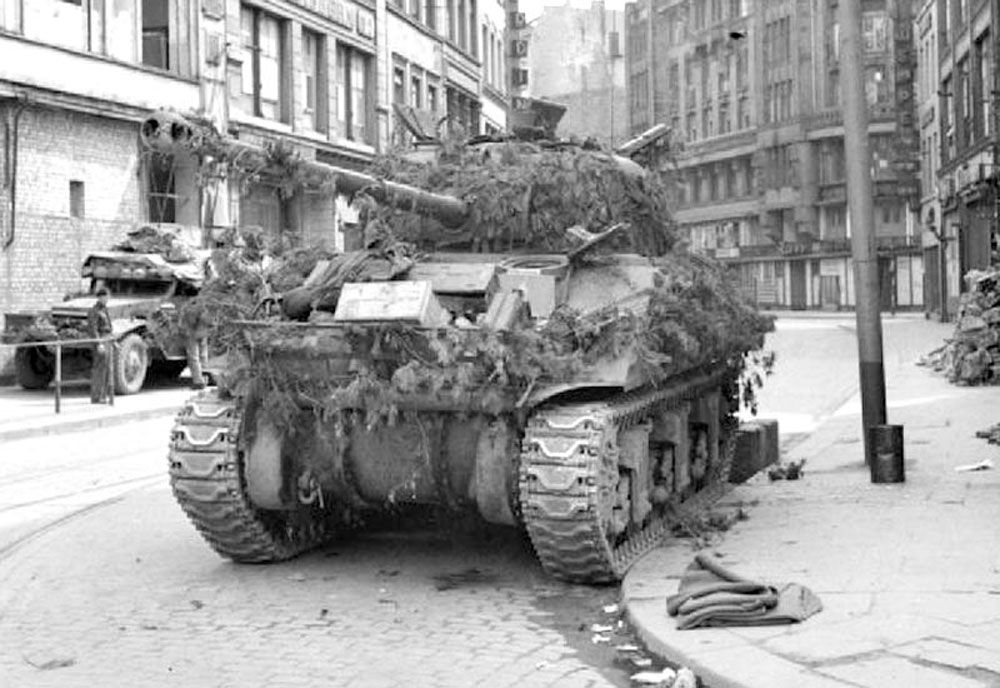
It should be noted that these Sherman conversions to Fireflies basically inherited the "adequate" armor protection of their original designs meaning that no additional armor protection was given to the new Firefly design. As such, Firefly tank crews would still have been wary of their own safety when in the line of enemy fire. Fireflies would appear in the Normandy beach landings of 1944 and were later attached to standard tank battalions onwards, though it was initially intended that Fireflies would form their own tank groups.

History text ©2003-2010 www.MilitaryFactory.com • All Rights Reserved • No Reproduction Without Permission • Corrections / Comments to MilitaryFactory at Gmail dot com

Last Updated: 9/21/2009


  Specifications for the Medium Tank, M4A4 (Sherman VC Firefly)
arrow downDimensions:
Length: 19.32ft (5.89m)
Width:8.60ft (2.62m)
Height: 9.02ft (2.75m)

arrow downStructure:
Accommodation: 5
Weight:33.3US Short Tons (30,164kg; 66,500lbs)

arrow downPerformance:
Speed: 25mph (40.2km/h)
Range: 120miles (193km)

arrow downSystems:
NBC Protection: None
Nightvision: None

arrow downPower:
Engine(s): 1 x Continental 9-cylinder radial delivering 400bhp.

arrow downArmament Suite:

1 x 76.2mm Mk IV L/55 main gun
1 x .30 caliber Browning M1919A4 machine gun

AMMUNITION:
78 x 76.2mm projectiles
5,000 x 7.62mm ammunition


More Pictures QuickGraphs Chassis Types CompareX2 Acronyms

  Special Armored Vehicles Collections

By Nation:
Afghanistan Tanks
American Tanks
British Tanks
Iran Tanks
Iraq Tanks
Israeli Tanks
Russian Tanks

Miscellaneous:
Cold War Tanks
Modern Tanks


  Recent Armored Vehicle Additions
Thumbnail picture of the Rodman 20-inch cannon
Rodman 20-inch
Thumbnail picture of the M-46 field gun
M-46 / M1954
Thumbnail picture of the SA-9 Gaskin air defense system
SA-9 Gaskin

  Contacting MilitaryFactory.com
We can only get better if you tell us how. You can contact MilitaryFactory.com at MilitaryFactory at gmail dot com (replace "at" with "@" and "dot with ".") with any questions, comments or corrections. We also accept related military imagery that you approve for us to use on our website. Keep in mind, however, that due to volume, we may not directly respond to your inquiry. Please add us to your list of non-blocked recipients!

  Armored Vehicle Quick Profile


Image Courtesy of the Public Domain.


flag of United Kingdom
1944
Designation: Medium Tank, M4A4 (Sherman VC Firefly)
Classification Type: Tank Destroyer
Contractor: Not Available

Country of Origin: United Kingdom
Number Built: 2,000

Operators: United Kingdom; United States


  Variants
Medium Tank, M4A4 (Sherman VC Firefly) - British Tank Destroyer derivative based on the M4 Sherman design; fitted with 76.2mm (17-pdr) main gun; three major variants were produced using the Sherman I (M4), Sherman I Hybrid (M4 Composite) and Sherman V (M4A4) chassis.

  Collections
  • Tanks of World War 2
  • Armor of the Persian Gulf War
  • Towed Artillery Reigns
  • Armor of the Vietnam War
  • Tanks of World War 1
  • Armor of the Korean War
  • World War 2 Tank Destroyers


Top MF Stuff: 2010 Military Pay Scale Chart | Military Ranks | World War 2 Weapons | Sniper Rifles | Conversion Calculators


Site Disclaimer | Privacy Policy | Site Map | MF Origins

©2010 www.MilitaryFactory.com • Content ©2003-2010 MilitaryFactory.com • All Rights Reserved • Site Contact Email: militaryfactory at gmail dot com (replace "at" with "@" and "dot" with ".")

eXTReMe Tracker

Most photographic images appearing on this site are courtesy of the United States Department of Defense and are approved for public use. Other images acquired through the public domain. Digital art work courtesy of Dan Alex. Business Consulting by Kyle Williams

Material presented throughout this website is for historical and entertainment value and should not to be construed as usable for hardware restoration, maintenance or general operation. Please consult manufacturers for such information.