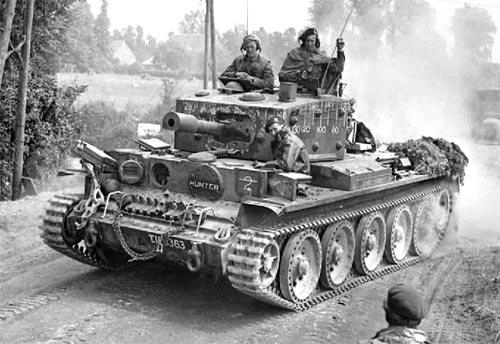
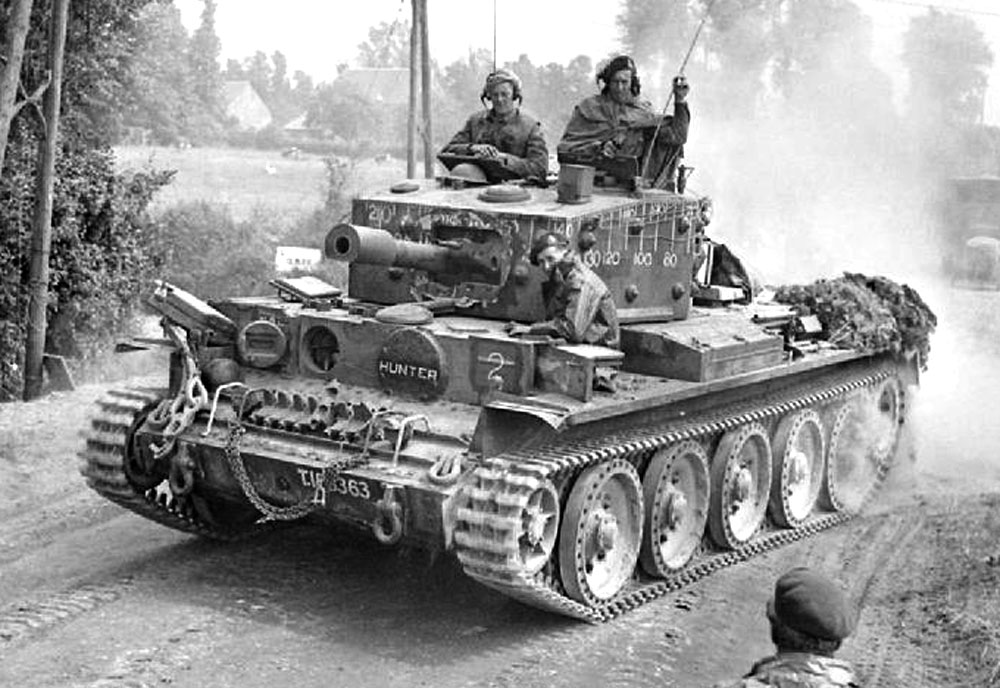
"The Centaur was produced alongside the Cromwell in an effort to find a replacement tank for the aging Crusader series."
Power & Performance Those special qualities that separate one land system design from another. Performance specifications presented assume optimal operating conditions for the Centaur III Cruiser Tank.
1 x Nuffield Liberty Mk V V-12 petrol engine developing 395 horsepower driving a conventional track-and-wheel arrangement. Installed Power
27 mph 43 kph Road Speed
165 miles 265 km Range
Structure The physical qualities of the Centaur III Cruiser Tank.
5 (MANNED) Crew
20.8 ft 6.35 meters O/A Length
9.5 ft 2.89 meters O/A Width
8.1 ft 2.48 meters O/A Height
63,601 lb 28,849 kg | 31.8 tons Weight
Armament & Ammunition Available supported armament, ammunition, and special-mission equipment featured in the design of the Cruiser Tank Mk VIII Centaur (A27L) Cruiser Tank.
1 x 57mm (6-pdr) main gun OR 1 x 95mm main gun.
1 OR 2 x 7.92mm BESA machine gun(s).
AMMUNITION: Not Available.
Variants Notable series variants as part of the Cruiser Tank Mk VIII Centaur (A27L) family line.
Cruiser Tank Mk VIII Centaur (A27L) - Base Series Designation.
Centaur I - 6-pdr main gun; limited to trainer vehicles.
Centaur III - Limited quantity; 75mm main gun.
Centaur IV - Definitive Battlefield Variant; 94mm main gun; 80 examples produced.
Centaur OP - Artillery Observation Vehicle
Centaur Kangaroo - Armored Personnel Carrier
Cantaur ARV - Armored Recovery Vehicle; sans turret.
Centaur Dozer - Dozer-bladed Combat Engineering Vehicle sans turret.
Centaur III/IV AAI - Anti-aircraft platform fitted with 20mm Polsten-type cannons; turret similar to Crusader AA systems.
Centaur III/IV AAII - Anti-aircraft platform fitted with 20mm Polsten-type cannons; turret similar to Crusader AA systems.
The Centaur series of British combat tanks was a product of Leyland Motors and developed alongside the competing Cromwell series of tank and built to the same specifications. The Centaur grew into a very similar design when compared against the Cromwell, though the two would see very different histories develop. The Centaur would prove to be a stop-gap design that would never fulfill its potential, being withdrawn from service by war's end. The system would primarily suffer from an inadequate engine, limiting production and thusly its usage en mass.
With the design of the failed Cruiser Tank Mk VII Cavalier series under its belt, the Leyland Motors company set to bring about a redesigned variant with the designs issues seemingly ironed out. Unfortunately, such was not to be as the Cruiser Centaur system effectively carried over the limiting traits of the previous attempt. Fitting the tank with a Liberty brand engine also did not solidify the design in anyway as the engine was deemed too under-powered and unreliable to the competing Rolls-Royce Meteor types found in the Cromwell.
Even so, the Centaur I appeared from production in June of 1942. These initial systems were held in reserve as trainer tanks while the Centaur III systems came online, these mounting a 75mm main gun and appearing in very limited quantity. The definitive combat Centaur IV followed soon after in equally limited numbers and were fitted with 94mm howitzers. The Centaur IVs would make a contribution to the D-Day landings in June of 1944 and some time afterwards as well.
At its core, the base Centaur III mark sported a 57mm (6-pounder) main gun. Later versions would see this upgraded to a more powerful 95mm howitzer type. Self-defense weaponry came about from one or two BESA-type 7.92mm anti-infantry machine guns. All Centaurs featured crew accommodations for five personnel.
Several variants of the Centaur came aboard after usage of the primary base models were all but spent. These included derivatives based on the similar chassis of the combat versions but were specialized in the form of dozers, observation posts and battlefield engineering vehicles. All combat Centaurs were removed from traditional service and were either re-engined as Cromwells or relegated to secondary roles.
Operators Global customers who have evaluated and/or operated the Cruiser Tank Mk VIII Centaur (A27L). Nations are displayed by flag, each linked to their respective national land systems listing.
Total Production: 3,649 Units Contractor(s): Leyland Motors - UK
[ United Kingdom ]
1 / 1
Image from the Public Domain.
Going Further... The Cruiser Tank Mk VIII Centaur (A27L) Cruiser Tank appears in the following collections:
The "Military Factory" name and MilitaryFactory.com logo are registered ® U.S. trademarks protected by all applicable domestic and international intellectual property laws. All written content, illustrations, and photography are unique to this website (unless where indicated) and not for reuse/reproduction in any form. Material presented throughout this website is for historical and entertainment value only and should not to be construed as usable for hardware restoration, maintenance, or general operation. We do not sell any of the items showcased on this site. Please direct all other inquiries to militaryfactory AT gmail.com. No A.I. was used in the generation of this content.