The Tank Mk V was a further evolution of the British "tank" - then known as "landship" - which began with the original Tank Mk I of 1916. The Mk I was followed by the trainer-minded Tank Mk II which was pressed into combat and the dedicated trainer Tank Mk III models before arrival of the definitive Tank Mk IV combat-centric landship. Such vehicles were critical in breaking the trench warfare stalemates that arose along the Western Front during World War 1 and would become the centerpiece of national armies in the decades following the conflict.
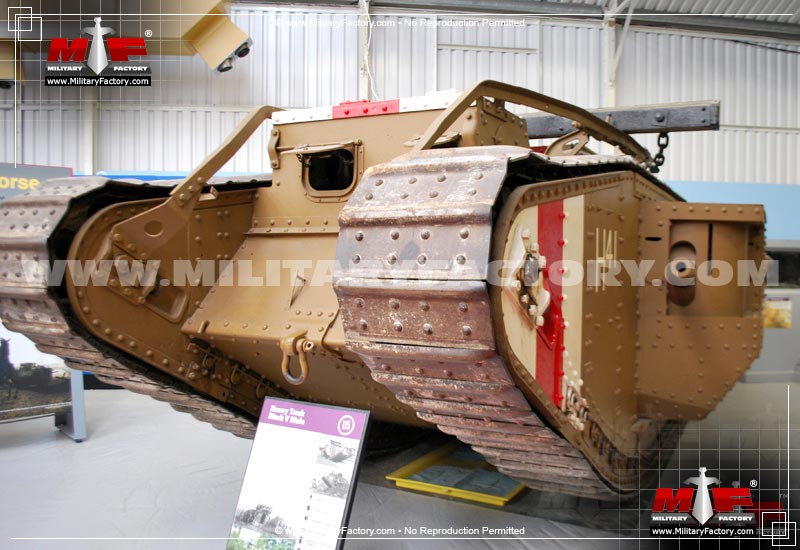
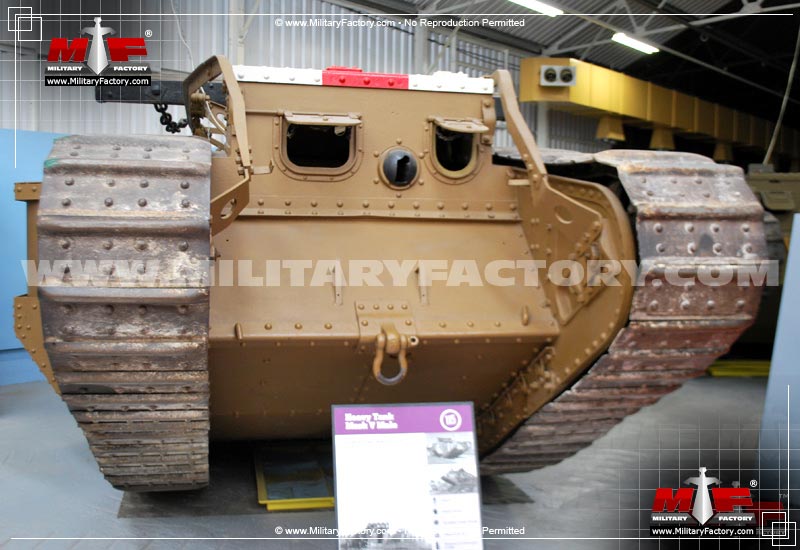
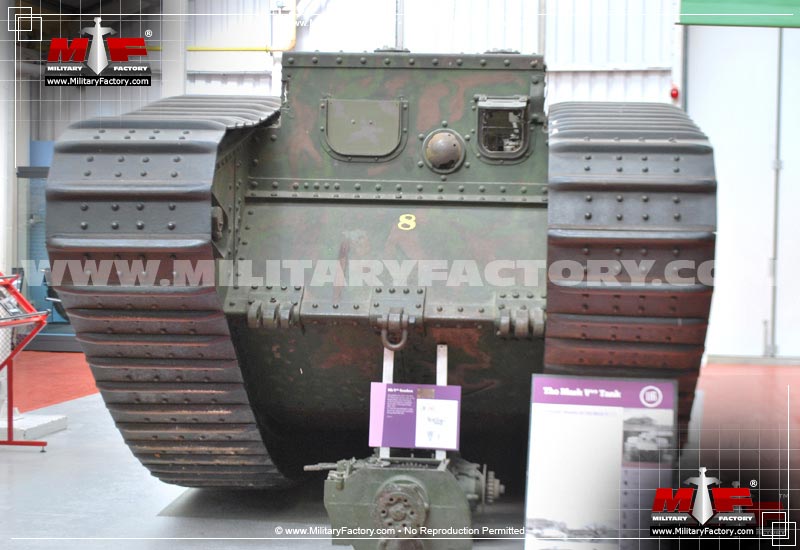
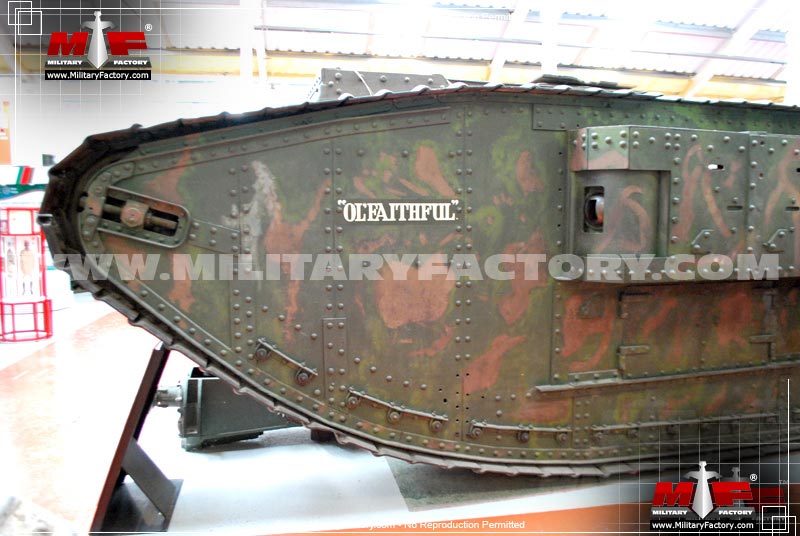
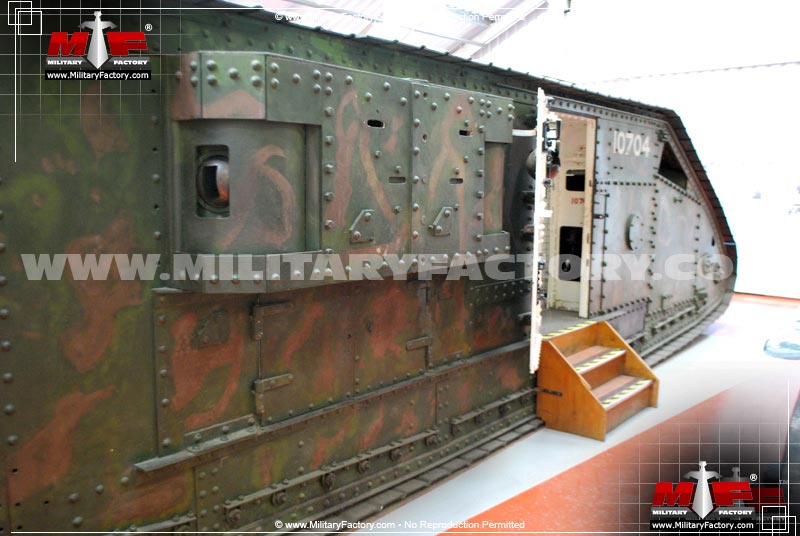
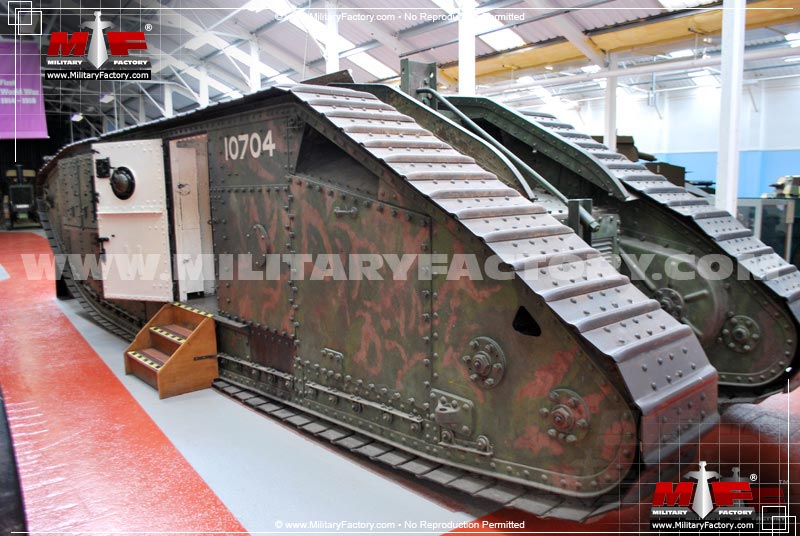
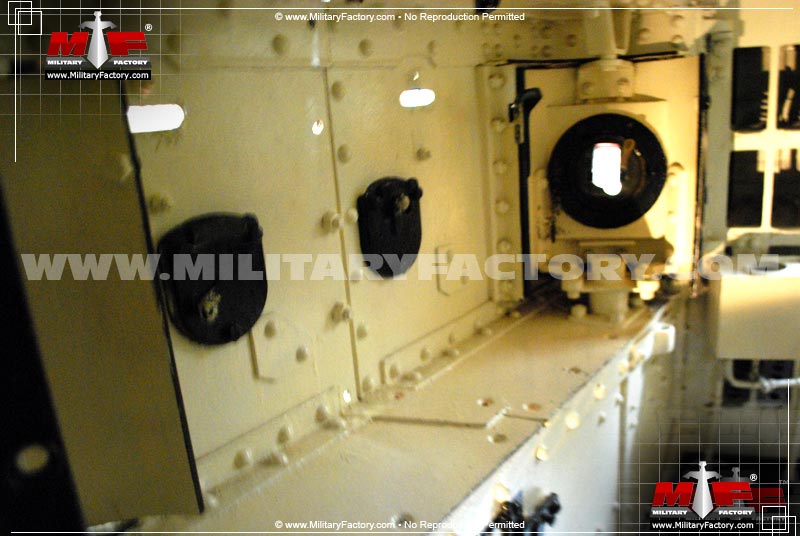
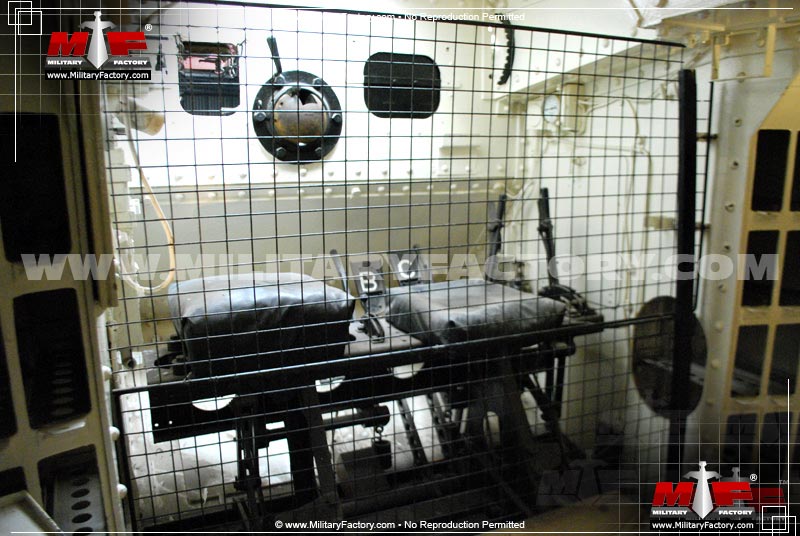
The Tank Mk V incorporated several improvements over previous British landships yet it retained the general rhomboidal shape common to many of these early engineering efforts. The vehicle was crewed by no fewer than eight personnel and main armament was managed through two side sponson assemblies as in earlier marks. Armor protection was 16mm at its thickest (front) with 12mm allocated to the sides. The Tank Mk V was more or less a direct improved form of the preceding Tank Mk IV line of 1917 with an integrated communications system, commander's cupola and drive controls to managed by one person (as opposed to the four required of earlier types). As in the Tank Mk IV series, the Tank Mk V line was also produced in two distinct forms - "Male" and "Female". Male versions carrier cannon armament and machine guns while Female versions were given solely machine guns for the defense of the Males - this in line with armored warfare doctrine of the day.
Manufacture of Tank Mk V systems produced some 400 examples of which 200 were built exclusively as males and 200 as females. As with previous British tanks, there also existed half-male/half-female conversions of these variants that incorporated a cannon-armed sponson on one hull side and a machine gun-only-armed sponson on the other. Manufacture was handled by the Metropolitan Carriage and Wagon company beginning in late-1917. The initial production batch tanks arrived at the frontlines in May of 1918.
With Tank Mk Vs now available in number for 1918, they were put into combat at the Battle of Hamel on July 4th, 1918. Hamel lay in northern German-held France and the battle brought about use of Tank V tanks. A combined force of Australians and Americans attacked German defensive positions with rather modern tactics which helped to ensure an Allied victory. 2,000 Germans were killed and 1,600 taken prisoner against 976 Allied service members killed and 338 wounded. The battle showcased the tank as a centerpiece instrument with extensive support from Australian artillery and British bombers. The battle also served to streamline the usefulness of tanks in modern warfare whereas in previous encounters, commanders were still deciding on the maximum value of the "landship" in the grand scope of the war. Incidentally, the Tank Mk V became the first landship to be made available to American forces in the European theater.
A typical "Male" Tank Mk V was armed with 2 x QF 57mm (6-pounder) main guns held in side sponsons. The side sponson approach (as opposed to use of a more conventional "turret") was selected due to the attack angles needed to engage targets down in a trench (a turret would have had limited downward attack angles). Males were also fielded with up to 4 x 7.7mm (.303) Hotchkiss Mk 1 machine guns. Females were simply armed with 6 x 7.7mm Hotchkiss machine guns and their role was to defend the Male tanks from infantry attack. As such, two females were typically fielded with every one male so all engagement arcs could be covered from enemy attack.
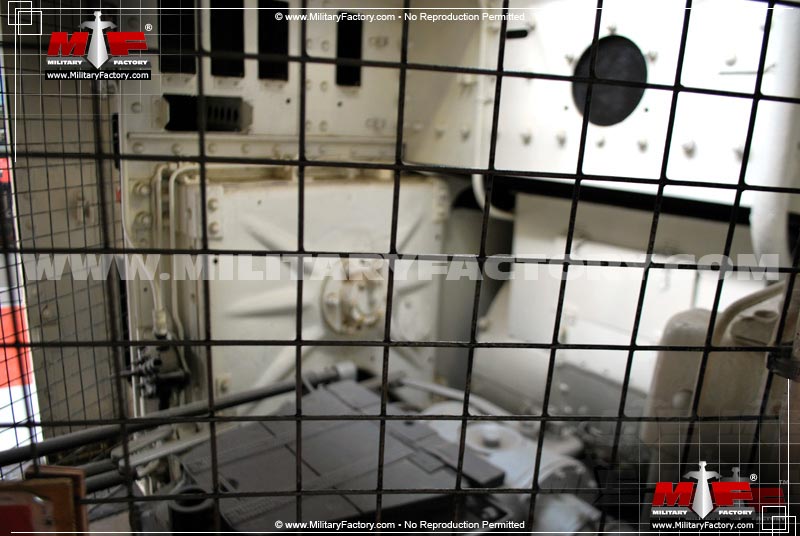
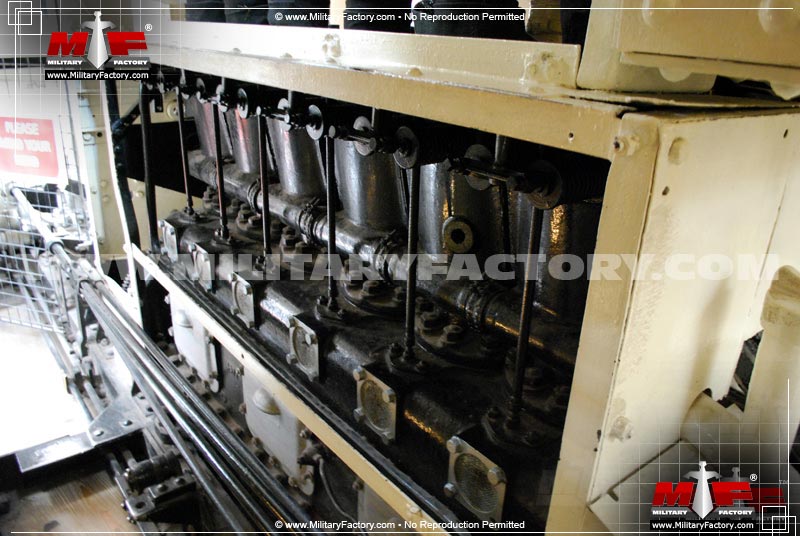
The Tank Mk V was powered by a Ricardo 6-cylinder inline gasoline-fueled engine developing 150 horsepower. This was mated to a five speed transmission featuring 4 forward speeds and 1 reverse. Operational range was 45 miles while maximum speed (on ideal surfaces) was 5 miles per hour. Steering was accomplished through a Wilson epicyclic steering configuration. The powerplant was of particular note for it was the first British tank to feature an engine specifically designed for the role as opposed to a design borrowing from an existing powerplant development - usually resulting in a vastly underpowered engine. Mechanical reliability was always a present menace for these early tank systems and the Mark Vs proved no different - breakdowns were just as common (and dangerous) to Allied tankers as was enemy artillery, the latter proving the most lethal enemy to these first generation tanks in the whole of the war.
Tank Mk Vs were fielded in number during the Battle of Amiens beginning August 8th, 1918. Australian, Canadian, French and American forces scored a victory over the German Empire in this four day encounter that saw major fighting end on the 12th. The Germans lost 30,000 to the Allies 22,200 as 532 Allied tanks took part in the battle which included as many as 1,900 supporting aircraft coupled with traditional heavy artillery. The battle came to be known to the Germans as "The Black Day of the German Army" due to plummeting morale and mass surrenders. The battle also brought an end to the static nature of trench warfare and reinstituted "mobile", or "fluid", warfare back into the fold.
Beyond its service in World War 1, some Tank Mk Vs served alongside "White Army" Russian forces against the Bolsheviks in the scope of the Russian Civil War. The war had begun in the October Revolution of 1917 and carried into October of 1922. Many Tank Mk Vs were subsequently captured in the fighting by Red Army forces and reconstituted. The Allied intervention in the civil war therefore became a failed endeavor - the Bolshevik victory ultimately giving rise to the Soviet Union. The Red Army used Tank Mk Vs to take Tbilisi during its successful invasion of Georgia in 1921. Bolsheviks scored victories in Ukraine, Armenia, Azerbaijan, Kazakhstan and Mongolia as well as in Poland, Finland, Lithuania, Latvia and Estonia.
The Tank Mk V series was eventually produced in three major variants following the basic male/female combat versions detailed above. A lengthened hull variant (designed to help cross wider trench openings) was produced in no fewer than 579 examples (of the 700 initially ordered). These arrived prior to the Armistice of November 1918 though total production was not completed until March of the following year. Many of these saw service well into the 1920s and were designated as Tank Mark V* (note asterisk).
The Tank Mark V** was based on the Tank Mk V* initiative with revised wider tracks to counter the affected track length-to-width ratio that was altered with the hull's lengthening. The engine was uprated to output up to 225 horsepower and relocated further aft in the hull. Of the 700 examples on order before the end of the war, only 25 of this type were ultimately produced - the end of the war cancelled many such procurement orders.
The Tank Mark V*** was a proposed improved form intended for use in 1919 should the war had progressed beyond 1918. The type was evolved into the "Tank Mark X" designation but existed on drawing boards only. It would have emerged as a further improvement on the Mark V utilizing many of its existing automotive components for logistics' sake and borrowed design features of the preceding series. Maneuverability over uneven terrain was a prime focus of this variant.
Power & Performance Those special qualities that separate one land system design from another. Performance specifications presented assume optimal operating conditions for the Tank Mk V (Male) Heavy Tank / Armored Fighting Vehicle (AFV).
1 x Ricardo gasoline-fueled engine developing 150 horsepower. Installed Power
5 mph 7 kph Road Speed
45 miles 72 km Range
Structure The physical qualities of the Tank Mk V (Male) Heavy Tank / Armored Fighting Vehicle (AFV).
8 (MANNED) Crew
26.4 ft 8.05 meters O/A Length
13.5 ft 4.11 meters O/A Width
8.7 ft 2.64 meters O/A Height
57,999 lb 26,308 kg | 29.0 tons Weight
Armament & Ammunition Available supported armament, ammunition, and special-mission equipment featured in the design of the Tank Mk V Heavy Tank / Armored Fighting Vehicle (AFV).
Tank Mk V "Male":
1 x 57mm (6-pounder) gun in left side sponson.
1 x 57mm (6-pounder) gun in right side sponson.
1 x 7.7mm Hotchkiss machine gun in forward hull.
1 x 7.7mm Hotchkiss machine gun in rear hull.
1 x 7.7mm Hotchkiss machine gun in left side sponson.
1 x 7.7mm Hotchkiss machine gun in right side sponson.
Tank Mk V "Female":
6 x 7.7mm Hotchkiss machine guns.
AMMUNITION: 183 x 57mm projectiles.
Variants Notable series variants as part of the Tank Mk V family line.
Tank Mk V (Male) - 2 x 6-pdr guns; 4 x Hotchkiss machine guns; 200 examples produced.
Tank Mk V (Female) - 6 x 7.7mm Hotchkiss machine guns; 200 examples produced.
Tank Mk V (Hermaphrodite) - 1 x gun sponson (from Males) with 1 x machine gun sponson (from Female); conversions of existing vehicles and not new-builds.
Tank Mk V* - Lengthened hull for trench crossing; 579 examples produced (all new-build); 66 added post-war.
Tank Mk V** - Improved Tank Mk V* model with revised tracks; male and female variants developed; 25 examples produced.
Tank Mk V*** - Proposed improved Tank Mk V; never produced; redesignated to Tank Mk X.
Tank Mk X - Redesignated Tank Mk V proposal.
Operators Global customers who have evaluated and/or operated the Tank Mk V. Nations are displayed by flag, each linked to their respective national land systems listing.
Total Production: 1,004 Units Contractor(s): Metropolitan Carriage & Wagon Company - UK
[ Imperial Russia; Soviet Union; United Kingdom; United States ]
1 / 10
Image copyright www.MilitaryFactory.com; No Reproduction Permitted.
2 / 10
Image copyright www.MilitaryFactory.com; No Reproduction Permitted.
3 / 10
Image copyright www.MilitaryFactory.com; No Reproduction Permitted.
4 / 10
Image copyright www.MilitaryFactory.com; No Reproduction Permitted.
5 / 10
Image copyright www.MilitaryFactory.com; No Reproduction Permitted.
6 / 10
Image copyright www.MilitaryFactory.com; No Reproduction Permitted.
7 / 10
Image copyright www.MilitaryFactory.com; No Reproduction Permitted.
8 / 10
Image copyright www.MilitaryFactory.com; No Reproduction Permitted.
9 / 10
Image copyright www.MilitaryFactory.com; No Reproduction Permitted.
10 / 10
Image copyright www.MilitaryFactory.com; No Reproduction Permitted.
The "Military Factory" name and MilitaryFactory.com logo are registered ® U.S. trademarks protected by all applicable domestic and international intellectual property laws. All written content, illustrations, and photography are unique to this website (unless where indicated) and not for reuse/reproduction in any form. Material presented throughout this website is for historical and entertainment value only and should not to be construed as usable for hardware restoration, maintenance, or general operation. We do not sell any of the items showcased on this site. Please direct all other inquiries to militaryfactory AT gmail.com. No A.I. was used in the generation of this content.