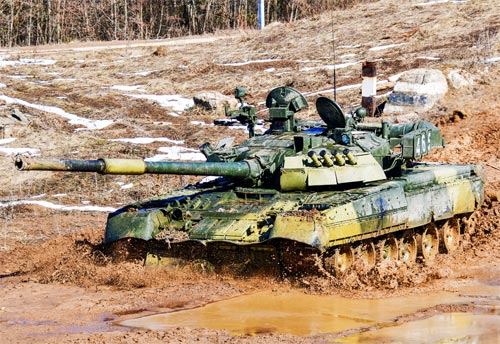
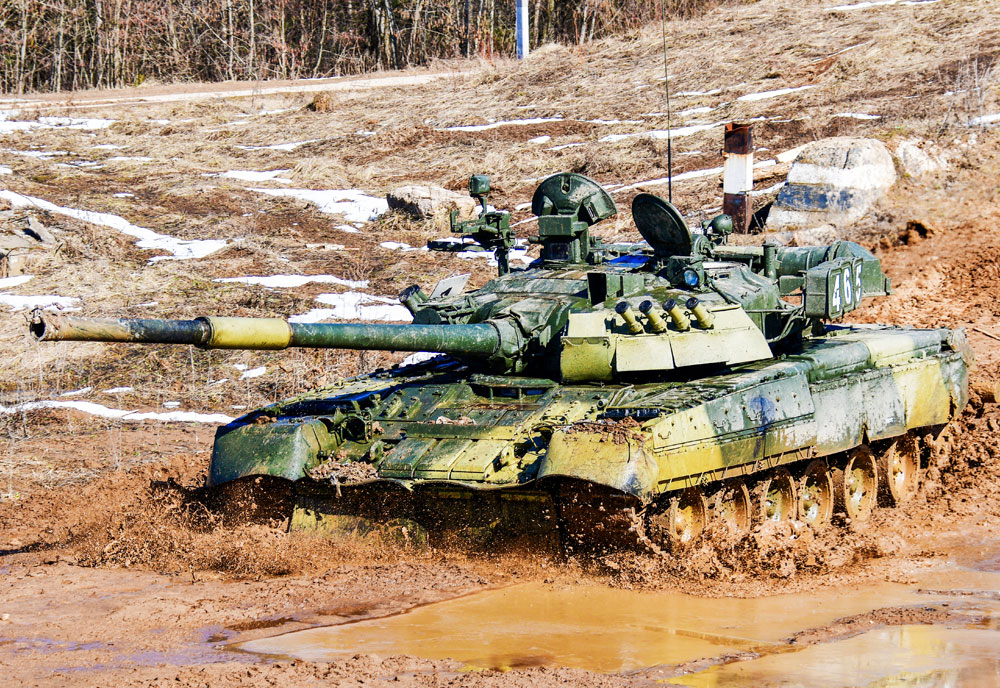
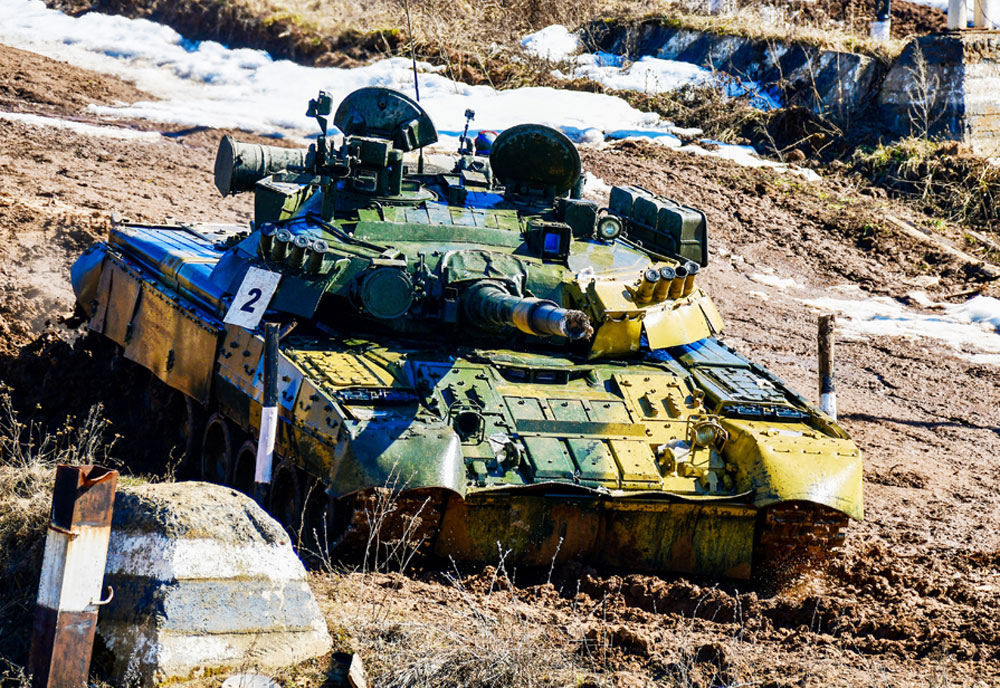
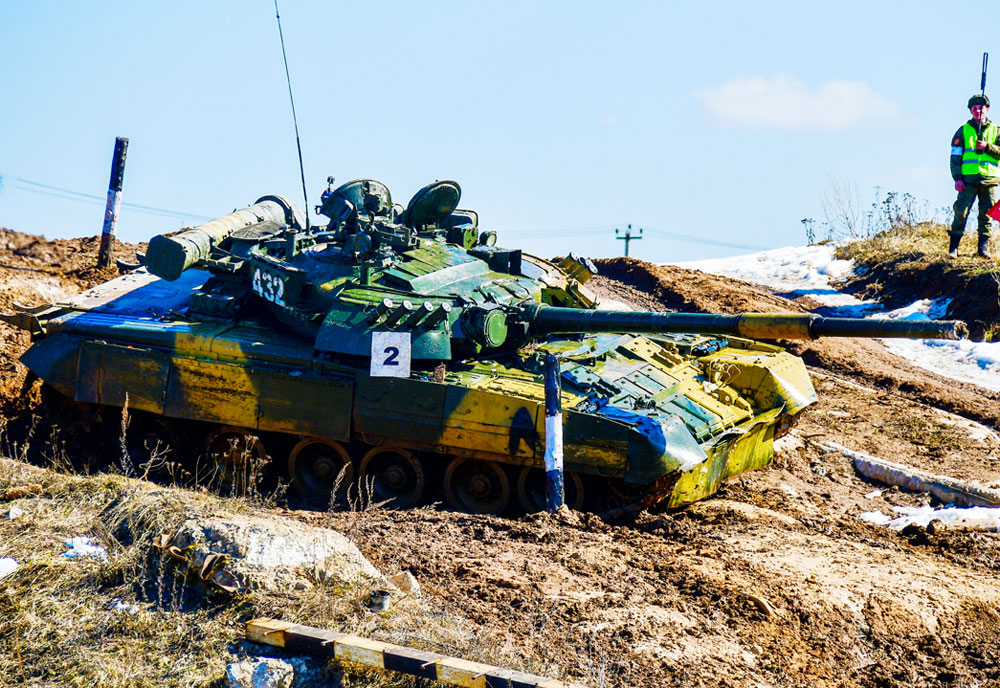
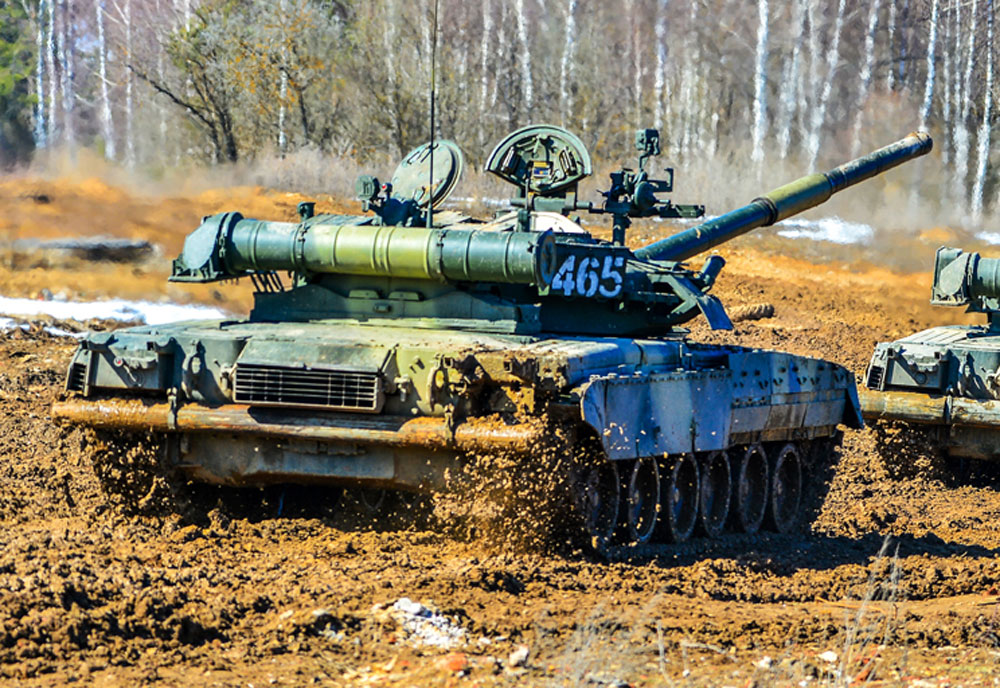
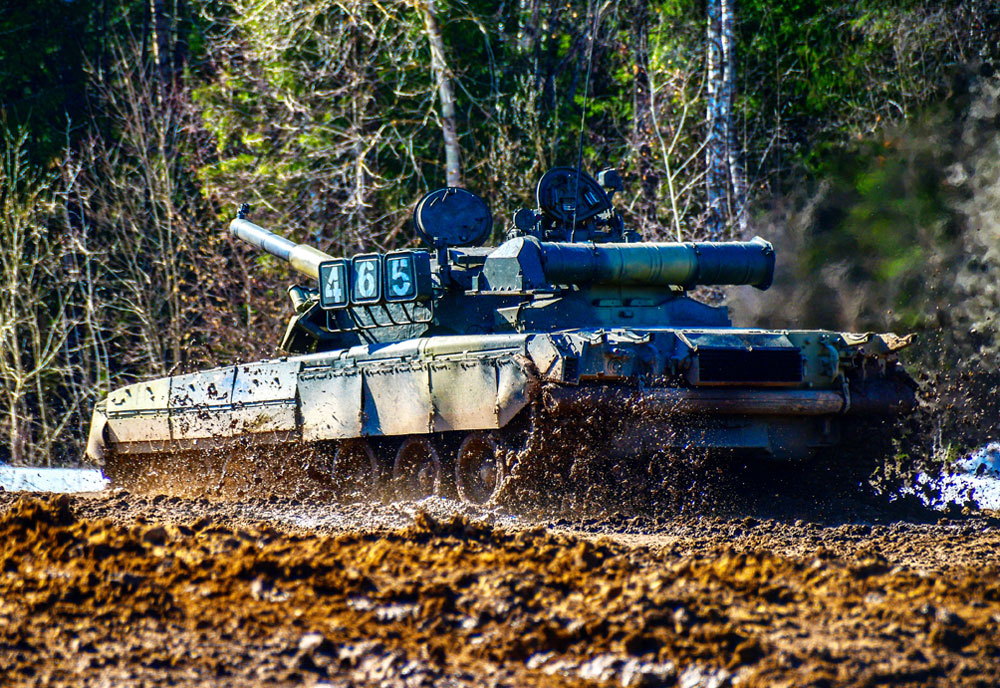
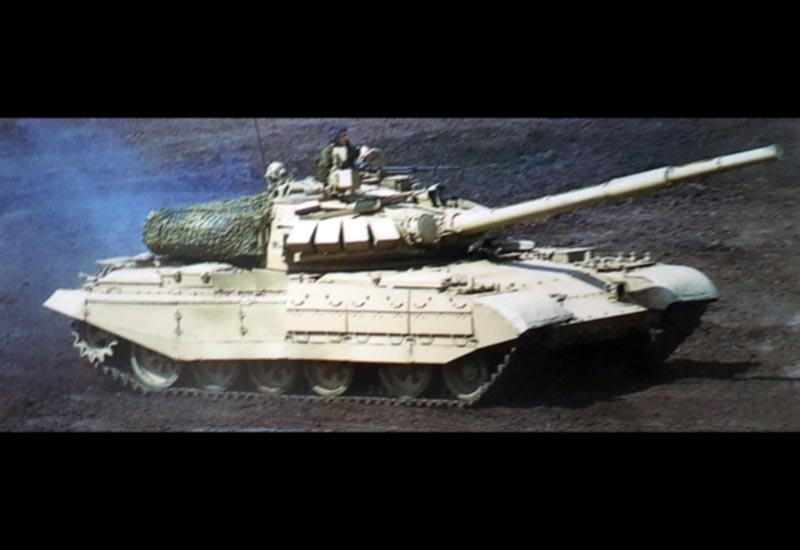
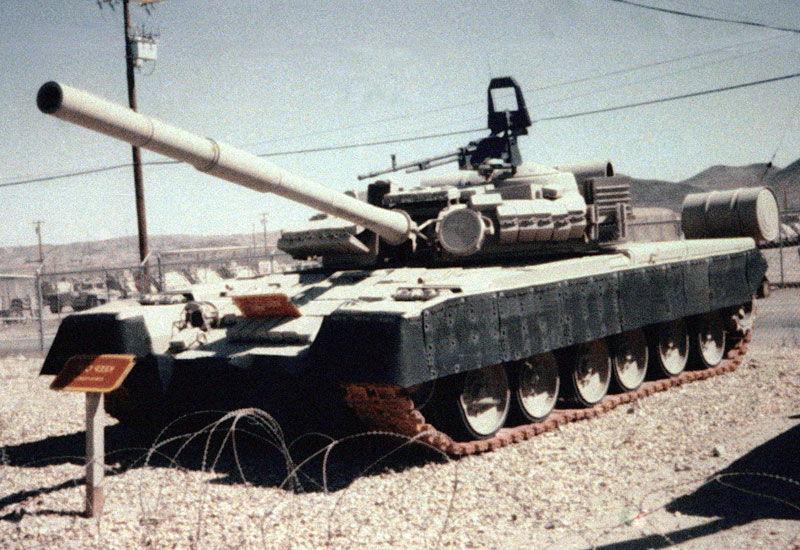
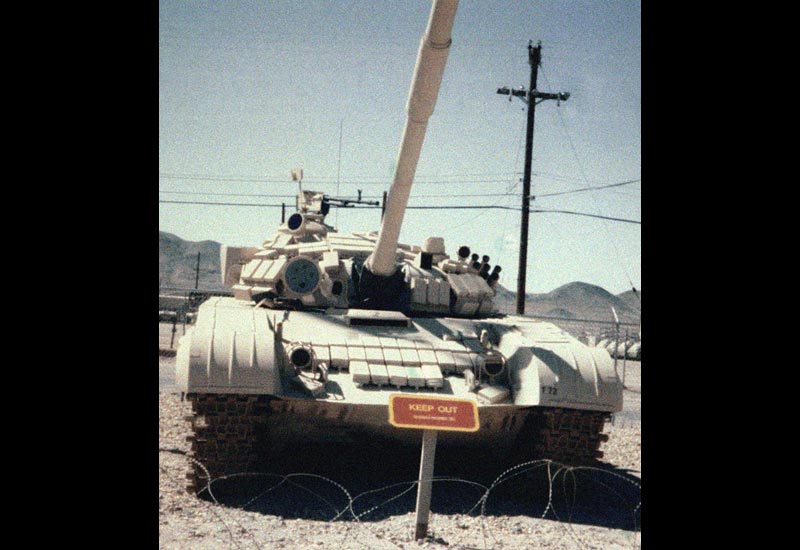
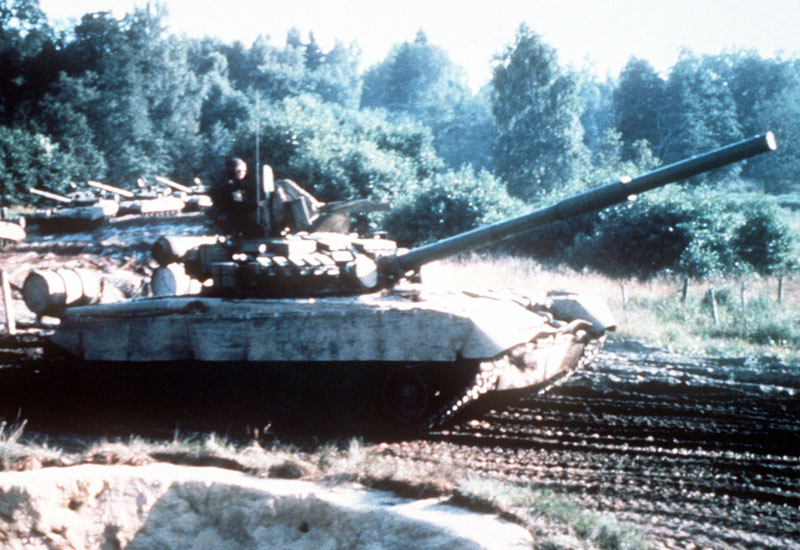
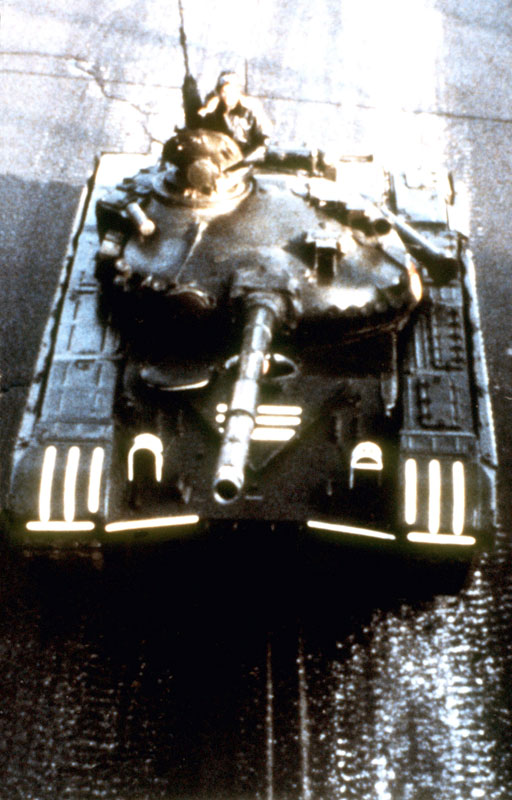
"The Soviet/Russian T-80 Main Battle Tank was a modernized T-64 with improvements borrowed from the successful T-72 series."
Power & Performance Those special qualities that separate one land system design from another. Performance specifications presented assume optimal operating conditions for the T-80 Main Battle Tank.
1 x SG-1000 gas turbine engine developing 1,250 horsepower driving track-and-wheel arrangement. Installed Power
43 mph 70 kph Road Speed
273 miles 440 km Range
Structure The physical qualities of the T-80 Main Battle Tank.
3 (MANNED) Crew
31.7 ft 9.65 meters O/A Length
11.7 ft 3.58 meters O/A Width
7.2 ft 2.2 meters O/A Height
101,413 lb 46,000 kg | 50.7 tons Weight
Armament & Ammunition Available supported armament, ammunition, and special-mission equipment featured in the design of the T-80 (MBT) Main Battle Tank.
1 x 125mm main gun (with AT missile-launching capability).
1 x 12.7mm air defense machine gun.
1 x 7.62mm coaxial machine gun.
2 x 4 smoke grenade dischargers.
AMMUNITION: 36 x 125mm projectiles.
500 x 12.7mm ammunition.
1,250 x 7.62mm ammunition.
8 x Smoke grenades.
5 x AT-8 "Songster" Anti-Tank Guided Miissiles.
Variants Notable series variants as part of the T-80 (MBT) family line.
T-80 - Original production model
T-80B - Base production model for full scale manufacturing.
T-80BK - Command Version
T-80BV - Features additional explosive reactive armor.
T-80BVK - Command Version of T-80BV Variant.
T-80U - Diesel engine; Additional armor protection.
T-80UD - 1,100hp diesel engine.
T-80UK - Command Version of T-80U
T-80UE
T-80UM - Updated fire control system; 1,250hp gas turbine engine.
T-80UM1 - Updated engine; Specialized countermeasures system.
T-80UM2 - Features new cast steel turret.
BREM-80 ARV - Armored Recovery Vehicle
T-84 - Ukrainian T-80 development.
The T-80 of the Russian Army was born in the era of the Soviet Empire during the Cold War. The type was a further evolution of the T-64 line with elements of the successful T-72 added for promising measure. The end result, the first production tank to utilize a gas turbine engine, proved a limited success with numbers never reaching those of its predecessor nor the overtly popular T-72. While still in active service today (2012), the days of the T-80 as a frontline battlefield solution are coming to an end as its available numbers are continually reduced with each passing year. The T-90 (based on the T-72) maintains the primary position in the modern Russian Army, leaving the T-80 as something of an interim solution at best, a measure serving to bridge the gap between the expired Soviet-era T-64 and modern Russian Federation T-90.
In 1963, the Red Army began use of the T-64 Main Battle Tank which formed the spearhead of Soviet armor strength during the critical years of the Cold War. The T-64 incorporated an automatic loader coupled to a 125mm smoothbore main gun capable of firing guided anti-tank missiles. Its arrival certainly forced the West to take notice as it represented the most modern Red Army tank of the time. The T-72 was then developed in short order as a simpler, economical counterpart to the T-64, though it ended up surpassing the T-64 in both numbers and world popularity (some 25,000 T-72 tanks were produced to the 13,000 T-64s). Soviet tank doctrine called for both tank types to serve concurrently and allowed for financial flexibility in the long term. As the T-64 was considered something of a "state secret" in terms of its technology and capabilities, it was not openly exported as the T-72 was.
As such, the T-64 remained the principle high-tech Soviet Main Battle Tank to lead the Red Army onto victory in the event of total war across Europe. In the late 1960s, thought was already being given to a new design built upon the inherent strengths of the T-64. Many developmental tank designs had been in play since the close of World War 2 (1939-1945) for the Soviets and many of these went on to lay the foundation of Soviet tank technologies to come. Such developments began to refine a gas turbine engine that would one day be used in powering an armored vehicle though tank engineers would have to wait for technology to catch up with the desire.
Object 288 was a tank testbed fitted with 2 x GTD-350 series aircraft turbine engines outputting at 690 horsepower. A second design, Object 219 SP1, utilized a single GTD-1000T multi-fuel gas turbine installation and this was able to output at 1,000 horsepower. After extensive testing of various chassis configurations, the Object 219 SP1 was modified into the refined Object 219 SP2 and it was this prototype that formed the basis of the "T-80". Design of the T-80 would span from 1967 until 1975 to which then serial production was ordered and the vehicle entered service in 1976 following the requisite army trials. Production of T-80s would last until 1992 to which 5,404 units would be delivered from LKZ and Omsk Transmash in Russia and Malyshev in the Ukraine. The gas turbine powerplant allowed for greater power over that of traditional diesel-fueled types at the expense of fuel consumption, general reliability and overall cost.
In keeping with Soviet tank design traditions, the T-80 managed a very low profile, exceptional inherent maneuverability and fielded a smoothbore main gun. The use of an autoloader in the turret reduced the traditional operating crew from four to three personnel to be made up of the driver (in the hull) and the commander and gunner (in the turret). The autoloader also allowed for a dimensionally shallower turret design and lighter overall weight. The tank's overall configuration was conventional with the engine at rear, the turret at center and the driver in front. The running gear of the T-80 consisted of six double-tired road wheels to a track side with the drive sprocket at the rear and the track idler at front. The upper track regions were protected over in side skirt armor. General armor protection is steel and composite which can be enhanced through add-on reactive armor blocks. Portions of the T-72's torsion bar suspension system was carried over into the T-80 which allowed for excellent inherent mobility for a vehicle of this weight class.
The T-80's primary armament was the 125mm 2A46-2 smoothbore main gun (same as on the T-72) residing in the front-center portion of the turret. The earlier T-80 marks had internal storage space for up to 36 x 125mm projectiles while newer variants housed up to 45. This could be made up of a mix of munitions to include HE-FRAG(FS), HEAT-FS and APFSDS-T projectiles as well as 9M112 or 9M119 laser-guided anti-tank missiles. Secondary armament was a 7.62mm PKT machine gun in a coaxial position. A 12.7mm NSVT or PKT series heavy machine gun took up the anti-aircraft role at the commander's cupola on the turret roof. The number of smoke grenade dischargers proved variable depending on the production model in question though at least eight were generally fitted (two banks of four launchers to each frontal turret facing.
The base SG-1000 gas turbine engine outputted at 1,000 horsepower. This was coupled to a transmission system featuring five forward and 1 reverse speed which allowed for an inherent operational range of 208 miles to be reached in theory. External tanks mounted along the rear of the hull could extent this to 270 miles under ideal conditions. Maximum road speed was 43 miles per hour while speeds of 30 miles per hour cross-country were attainable though largely based on the operating environment and driving habits.
Initial T-80 production models of 1976 were designation simply as "T-80" and fielded with a standard laser rangefinder but lacked support for Explosive Reactive Armor (ERA) blocks and firing of anti-tank missiles from the main gun. The first major upgrade in the line became the T-80B of 1982 and this version supported firing of anti-tank missiles 9K112 "Kobra" (NATO: AT-8 "Songster") and introduced an all-new stabilized fire control system in a revised turret shell. The T-80B was then revised in 1980 with a newer, more powerful engine outputting at 1,100 horsepower. In 1982, a new main gun was added to the production lines and, in 1985, provisions to support ERA blocks was added (this produced the T-80BVmark). The command tank version of the T-80B was the T-80BK. Also in 1982, the now-standardized T-80A form was introduced with a new turret and an improved fire control system. This was followed by the heavier T-80U which allowed for use of the 9K119 "Refleks" (NATO: AT-11 "Sniper") laser-guided, anti-tank missile fired from the main gun. Additionally, the T-80U was given additional armor protection through the use of "Kontakt-5" ("K5") ERA blocks while its fire control system was again improved. 1990 saw the T-80U gifted with a new engine of 1,250 horsepower output. The T-80UM1 "Bars" ("Snow Leopard") incorporated much improved anti-missile facilities ("Shtora-1" countermeasures). The T-80UM2 has been given a new cast turret design.
The T-80UD "Bereza" of 1987 was a further evolution of the T-80 handled by Ukraine and incorporated an indigenous 6TD series diesel engine as well as a remote-controlled anti-aircraft machine gun station. The latter allowed for firing of the weapon by the crew from within the turret. The Ukrainian T-80UD was then itself evolved to become the "T-84" of 1999, the standard (and present) Ukrainian Army Main Battle Tank as of this writing (2012).
The Soviet T-80 never saw combat through the envisioned large-scale ground war in Europe. The Soviet Union fell in 1991 and its T-80s were used in a failed coup attempt by communist and allied military leaders thereafter. At the time of the Soviet collapse, T-80 strength had reached close to 5,000 units and, in the years following, stocks of these tanks were passed onto successor states such as Ukraine, Kazakhstan and Belarus. Over time, Russian Army T-80 numbers began to dwindle by the hundreds, many being placed in reserve and then headed to storage. While available in numbers at the time, the T-80 was not deployed operationally with the Soviet Army during the Soviet-Aghan War (1979-1989).
The first true notable combat experience concerning T-80 tanks was in the First Chechen War (1994-1996). Russian military budget cuts led to ill-trained Russian tankers fighting across urban environments they were not entirely prepared for. This seemingly played to the strengths of the Chechen guerillas who developed viable defensive and offensive tactics that showcased their prowess in lethal fashion through surprise attacks with anti-tank measures, exacerbating weaknesses in both the T-80 design and modern Russian Army doctrine (the tanks lacked any infantry or armored vehicle support through the operations). Russian Army T-80s in Chechnya proved highly susceptible to anti-tank rocket-propelled grenades and, thusly, forced a program to improve the tank's anti-missile defenses. The attack on the city of Grozny alone cost the Russian Army over 200 tanks lost to action in a single month. Actions in the theater also proved the T-80's inherent range as quite limited (approximately 200 miles without external fuel stores being fitted), making her something of a tactical liability to Russian generals requiring more.
While the T-80 was not allowed to be sold on the export market under Soviet rule, the collapse of the Soviet Empire and, with it, the "old way of doing things", the Russian government opened the T-80 to sale. The vehicle subsequently entered the inventories of Cyprus, Egypt, South Korea, and Yemen while joining existing operators in Armenia, Belarus and Kazakhstan. The Chinese government purchased at least 50 T-80 tanks for trials though they elected not to proceed with large-scale procurement. Similarly, the T-80 failed to secure contracts with Turkey and Greece. Ukrainian-made T-80s found their way to Pakistan while Ukraine also delivered four examples to the United States for evaluation, these joining a single T-80U donated from Britain.
As it stands, the T-80 maintains an active though position in the Russian Army numbering some 1,400 available units with many remaining in key reserve storage facilities - perhaps as many as 3,000 have met this fate. The T-90, a modernization of the T-72 system, is the primary Russian Army Main Battle Tank and numbers 1,670 strong as of 2012. The T-90 incorporates key qualities of the successful T-72 system before it as well as developments refined through operational use of the T-80.
The T-80 chassis has been branched out to fulfill various other battlefield roles including that of engineering, recovery, bridge carrier/layer and mine clearance vehicle.
November 2016 - A new upgrade is available for the T-80BV MBT series. The modernization is intended to bring the T-80BV inline with upgraded T-72B3 tanks. Part of the upgrade includes the PNM Sosna-U gunner's sighting device and broader support for munition types fired from the main gun - including armor-defeating missiles. The onboard laser rangefinder will range out to 7,500 meters. Crew survivability will also be addressed through a dynamic, 3rd-generation protection system.
Operators Global customers who have evaluated and/or operated the T-80 (MBT). Nations are displayed by flag, each linked to their respective national land systems listing.
Total Production: 5,500 Units Contractor(s): LKZ / Omsk Transmash - Russia / Malyshev - Ukraine
The "Military Factory" name and MilitaryFactory.com logo are registered ® U.S. trademarks protected by all applicable domestic and international intellectual property laws. All written content, illustrations, and photography are unique to this website (unless where indicated) and not for reuse/reproduction in any form. Material presented throughout this website is for historical and entertainment value only and should not to be construed as usable for hardware restoration, maintenance, or general operation. We do not sell any of the items showcased on this site. Please direct all other inquiries to militaryfactory AT gmail.com. No A.I. was used in the generation of this content.