No other tank in the British Army inventory was as important as the Matilda II during the early years of World War 2. The German blitzkrieg laid claim to much of Europe and Allied forces barely escaped slaughter at Dunkirk, leaving behind countless small arms, artillery and tanks. The Matilda II came at such a time when there proved little hope in stopping the German war machine. Throughout fighting in the Desert Campaign, the system acquitted herself quite well, leaving behind a reputation as a robust mobile unit worthy of the British tanker. While outmoded towards the middle and end years of the war, the Matilda II no doubt served the Empire well through her many exploits in the field. Amazingly, the Matilda II became the only British tank to have served throughout the whole course of war (beginning with the British and ending with the Australians).
By the time of World War 2, the British Army had adopted tank doctrine centered around lightly-armed, fast "cruiser" tanks complemented by slower-moving, better armored and armed "infantry tanks". The former would be used to exploit weaknesses in the enemy's defense while the latter would serve in the infantry support role. To this end, the British Army laid down a requirement for an new infantry tank to add to its existing inventory in response to the growing threat of war in mainland Europe. The resulting design became the "Infantry Tank Mk I Matilda (A11)" (not to be confused with the "Infantry Tank Mk II Matilda A12").
The (original) Matilda was a two-man tracked vehicle with the primary armament of machine gun fitted to a traversing turret. The type more or less became an interim "stop-gap" design to be built at speed until a more formal development could be achieved. As such, expedients in its design was such that the type was never wholly suitable for modern warfare as dictated for the period. Its heavily armored front - at 60mm thick - was its only saving grace though the type served with some distinction nonetheless. The Matilda (A11) proved pitifully slow on roads (top speed of just 8mph), had unprotected track sides with exposed running gear and utilized machine gun-only armament - overall lacking the qualities of a "true" combat tank even for its time. Additionally, the tank commander was expected to manage virtually all facets of the vehicle: in-the-field by communications with his driver, firing and reload the machine gun (as well as traversing the turret) and managing the radio set that was fitted in the hull, not within easy reach. If anything, the original Matilda was nothing more than a "light support vehicle", more comparable to the light tanks of the time, which justified production at only 139 examples in all.
Even as the Matilda legacy was taking shape, work began on a more purpose-built infantry tank in 1936 under the project designation of "A12". Design work was undertaken at the Royal Arsenal, Woolwich to which a prototype vehicle was constructed at the Vulcan Foundry due to the use of cast steel construction. The construction process required use of heavy industrial foundries which slowed manufacture considerably. The pilot vehicle appeared in 1937 and the design proved sufficient enough to adopt it as the "Infantry Tank Mark II". The tank carried over the "Matilda" name of the A11 though it was an entirely new design all its own. As the two served concurrently, the A11 became the "Matilda I" while the A12 became the "Matilda II". It was only once the Matilda I was retired from frontline service that the Matilda II went on to be known simply as "Matilda" or "Matilda Senior". Like the A11 before it, the A12 was also classified as an "Infantry Tank" in British Army nomenclature and intended for support of infantry-minded actions. The Mk II series entered service in 1938-1939 and established itself as the standard British Army infantry combat tank within time. At the time of the German invasion of Poland, there were only two Matilda IIs completed.
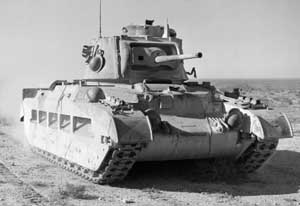
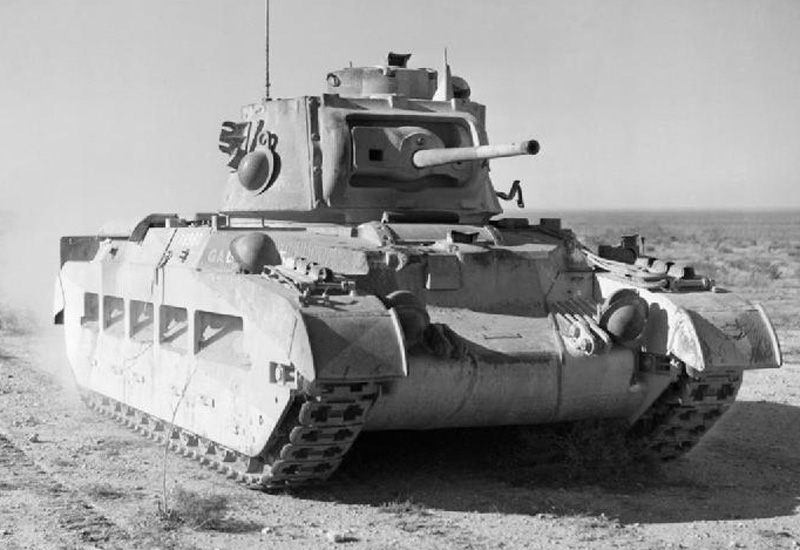
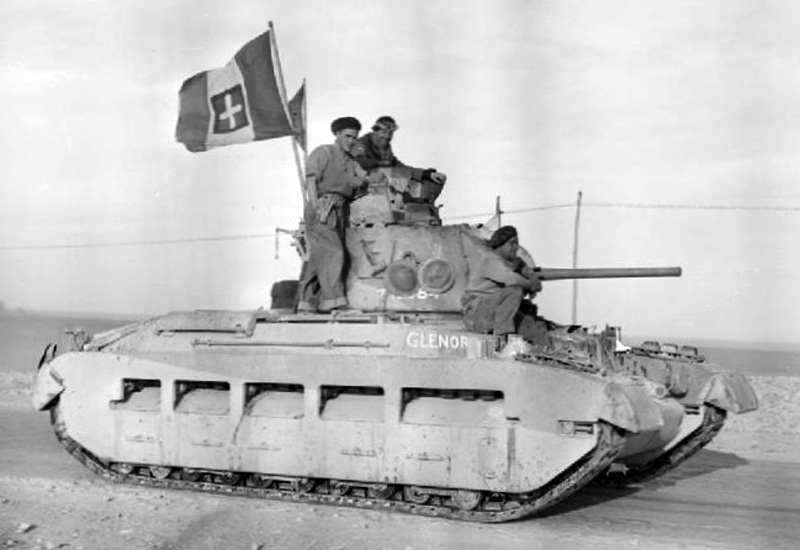
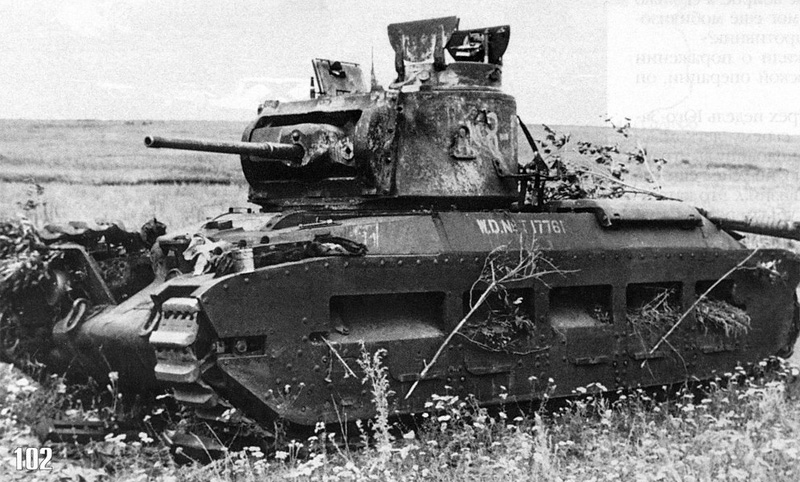
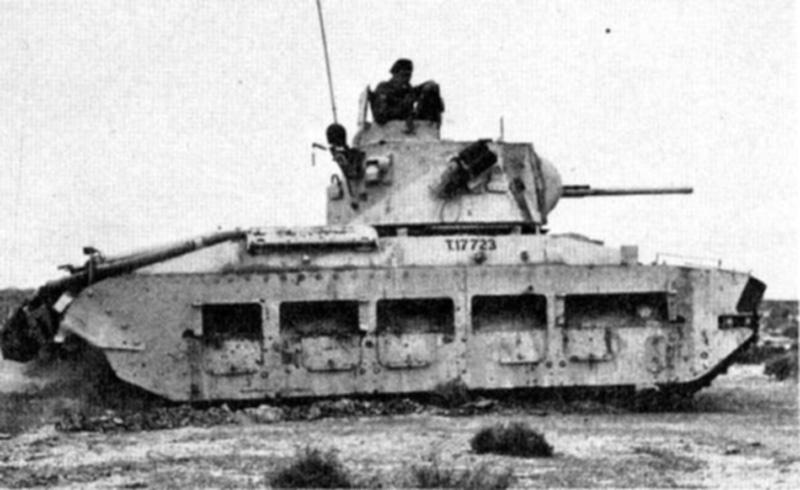
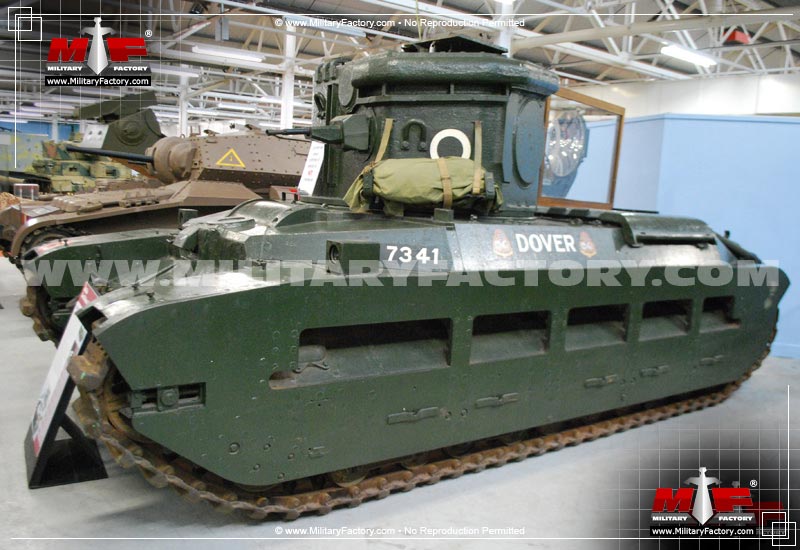
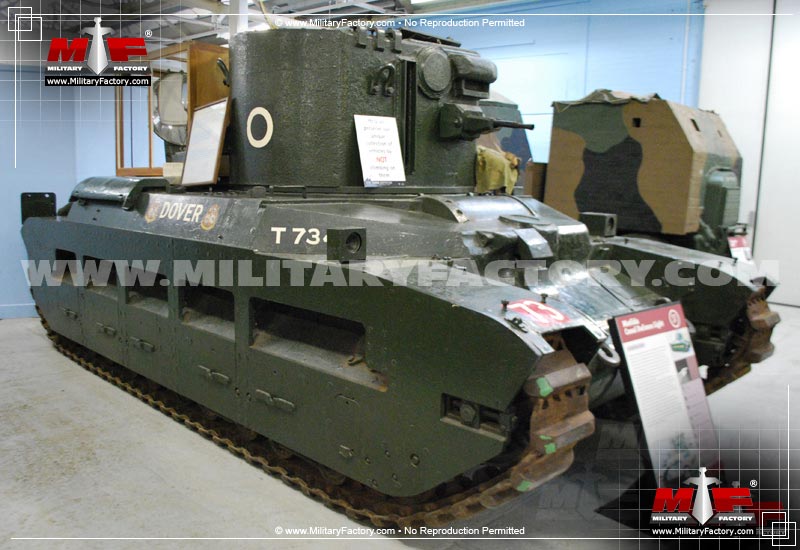
Outwardly the Mk II certainly looked more the part of a "fighting tank" than the Mk I Matilda before it. For starters the vehicle's track running gear was protected along the sides by thick armor skirts fitting five noticeable mud chutes - a characteristic common to World War 1 tanks. The vehicle's arrangement was highly conventional with the driver seated in the hull at front center, the turret atop the fighting compartment (with a crew of three - commander, gunner and loader) and the engine to the rear. There were eleven small road wheels (ten set as pairs) to a track side with coil spring suspension being used to offer cross-country service. There was a short and shallow glacis plate leading up to a short hull superstructure though many panels were vertical in their placement - presenting many opportunities for shot "trap". Atop the superstructure was the turret fitting a 2-pounder L/50 (40mm) main gun. Traversal was a full 360-degrees and a 7.92mm Besa machine gun was added in a coaxial mounting for anti-infantry defense. 93 x 40mm armor-piercing projectiles were carried for the main gun as were 2,925 x 7.92mm ammunition for the machine gun. The Mk II also provided internal space for a four man crew unlike the two required of the Mk I. There was one main hatch atop the turret roof with the other point of entry being the driver's hatch. Overall, the vehicle weighed 25 tons and was protection with a strong armor configuration that was up to 78mm thick in parts.
Power was initially served through a pair of AEC 6-cylinder diesel engines supplying up to combined 94 horsepower. The vehicle could manage a top speed of 16 miles per hour on roads (twice that of the Matilda I) and ranges out to 160 miles. The engine was mated to a Wilson epicyclic pre-selector gearbox which allowed for six speeds through a Rackham clutch installation.
Initially, the Matilda II proved an excellent tank for she was very well protected and gave good service through her 40mm main gun. Only 24 Matilda IIs were available in France during the 1940 invasion but these were enough to cause noticeable headaches among the ranks of the German commanders. The Matilda IIs enjoyed good range with their 2-pounder main guns and could, in turn, absorb greater damage levels than that of competing Panzer light tanks. During the Battle of Arras (alongside 58 of the preceding Matilda I tanks), 16 Matilda IIs decimated German General Erwin Rommel's 7th Panzer Division. The tide turned when it was discovered that the German 88mm anti-aircraft gun proved suitable as a tank destroying weapon with deadly efficiency.
The type went on to see extensive fighting primarily across the North Africa Campaign and managed the light Italian tanks with relative ease (earning the name of "Queen of the Desert"). It was not until the arrival of the Afrika Korps and their 88mm anti-tank guns that the Matilda IIs met their match. Even so, some Matildas were able to withstand several direct hits from these formidable weapons and continue fighting. During Operation Battleaxe in June of 1941, Matilda IIs fared rather poorly in the Axis victory - some 64 units lost to action despite strength in numbers. The British Army counted half of their combat tanks lost in just the first day of fighting through their mildly successful three-pronged assault. On the other hand, over half of the 15th Panzer Division fell to Matildas in fighting at Capuzzo.
The Maltida IIs existence continued as such between these back-and-forth pitched battles. She proved a reliable battlefield implement and was the best British tank of the early war years until replaced by improved, more competent types in time. Ultimately she was herself outmoded on the battlefield by the newer, more powerful enemy types being fielded in addition to improved anti-tank weaponry - as such, her best fighting days fell quickly behind her. Instead of building new Matilda IIs to replaced felled ones, the British Army began introducing the newer "Valentine Infantry Tank" in greater numbers with these beginning service in 1940. Last notable combat actions of Matilda IIs occurred at the 2nd Battle of El Alamein.
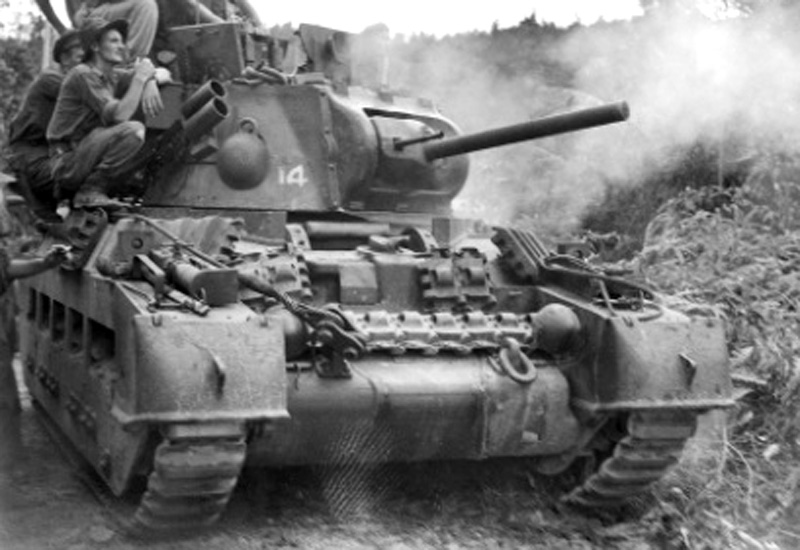
In all, 2,987 Matilda IIs were produced with manufacture spanning from 1937 to 1943. Since production of the cast steel body was complex for the selected British heavy industry - they having experience in building locomotives and not combat vehicles - production levels were always lower than expected. The vehicle managed its way into the inventories of the Australian Army fighting in the Pacific Campaign (the 4th Australian Armored Brigade in New Guinea and Borneo) as well as the Soviet Army through the valuable Lend-Lease initiative. The Soviets received between 1,000 and 3,000 Matilda IIs and these set right to work in the 1941 Winter Offensive. Like other adaptable platforms in existence, the Matilda also served well through her various conversions designed to undertake various battlefield and non-combat roles as required.
Production of Matilda IIs began with the initial Mk II series and these were followed by the Mk II.A which did nothing more than replace the original Vickers-brand coaxial machine gun with that of the Besa. The Mk II.A* noted the installation of the new Leyland diesel engine over the original's AEC brand. The Mk.IV was an improved Matilda II with better engine performance while the Mk.V was given a new transmission system for improved reliability.
Non-combat tank variants went on to include the Matilda II CS (Close Support) mark which was given a QF 3-inch (76mm) howitzer. The Matilda "Scorpion" was a mine flail vehicle while the "Baron" I, II, III and IIIA marks were experimental flail types of similar scope. The Matilda II "CDL" (Canal Defense Light) fitted a powerful searchlight for spearheading night attacks and the Matilda "Black Prince" became a developmental heavy version fitting the British 6-pounder main gun in the turret assembly of the Centaur tank. However this effort was ultimately abandoned due to differences in turret rings.
Australians forces were a bit more "revolutionary" in their Matilda II variant treatments though this was more a case of experience and requirements for the particular fighting environment of the Pacific. Additionally, the Japanese armor threat was relatively light when compared to that of the Germans and Italians in Europe. The Matilda "Frog" was a flame-projecting tank fitted (appropriately) with a flamethrower and useful in clearing out fortifications or swathes of jungle coverage. Another fire projecting form were the "Murray" and "Murray FT" types. Still another Australian Matilda modification became a dedicated engineering vehicle fitting a dozer blade. The Matilda "Hedgehog" was a sort of heavy rocket projector atop a modified Matilda II chassis.
As was common practice within the German Army, captured Matilda IIs were set back into service under new ownership. Some were fitted improved anti-tank guns.
Power & Performance Those special qualities that separate one land system design from another. Performance specifications presented assume optimal operating conditions for the Matilda II Infantry Tank.
2 x AEC 6-cylinder diesel engines developing 94 horsepower OR 2 x Leyland gasoline engines developing 95 horsepower. Installed Power
15 mph 24 kph Road Speed
160 miles 257 km Range
Structure The physical qualities of the Matilda II Infantry Tank.
4 (MANNED) Crew
18.4 ft 5.61 meters O/A Length
8.5 ft 2.59 meters O/A Width
8.2 ft 2.51 meters O/A Height
59,359 lb 26,925 kg | 29.7 tons Weight
Armament & Ammunition Available supported armament, ammunition, and special-mission equipment featured in the design of the Infantry Tank Mk II Matilda (A12) Infantry Tank.
1 x 40mm (2 pdr) main gun.
1 x 7.92mm Vickers / Besa coaxial machine gun.
AMMUNITION: 93 x 40mm projectiles.
2,925 x 7.92mm ammunition.
Variants Notable series variants as part of the Infantry Tank Mk II Matilda (A12) family line.
Mk II - Initial Production Model; fitted with 1 x 40mm main gun and 1 x 7.92mm Vickers coaxial machine gun; 2 x AEC diesel engines.
Mk II.A - Fitted with 1 x 40mm main gun and 1 x 7.92mm BESA coaxial machine gun.
Mk III - Fitted with 2 x Leyland diesel engines.
Mk IV - Improved powerplant
Mk V - Improved transmission system
Matilda II CS - Close Support Model fitting QF 3-inch 76mm howitzer.
Baron I - Experimental Mine Flail
Baron II - Experimental Mine Flail
Baron III - Experimental Mine Flail
Baron IIIA - Experimental Mine Flail
Scorpion I - Operational Mine Flail
Scorpion II - Operational Mine Flail
Matilda II CDL ("Canal Defense Light") - High-powered searchlight fitted to new turret for night operations.
Matilda IV CDL ("Canal Defense Light") - High-powered searchlight fitted to new turret for night operations.
Black Prince - Experimental Matilda II fitting Centaur turret with 6-pounder main gun.
Frog - Australian Army Flame-Projecting Tank; 25 examples converted.
Murray - Australian Army Flame-Projecting Tank
Murray FT - Australian Army Flame-Projecting Tank.
Matilda Dozer - Australian Army bulldozer vehicle
Matilda Hedgehog - Australian Army rocket projecting variant; 6 examples converted.
Operators Global customers who have evaluated and/or operated the Infantry Tank Mk II Matilda (A12). Nations are displayed by flag, each linked to their respective national land systems listing.
Total Production: 2,987 Units Contractor(s): Vulcan Foundry - UK
[ Australia; Soviet Union; United Kingdom ]
1 / 7
Image from the Public Domain.
2 / 7
Image from the Public Domain.
3 / 7
Image from the Public Domain.
4 / 7
Image from the Public Domain.
5 / 7
Image from the Public Domain.
6 / 7
Image copyright www.MilitaryFactory.com; No Reproduction Permitted. Matilda II CDL form pictured.
7 / 7
Image copyright www.MilitaryFactory.com; No Reproduction Permitted. Matilda II CDL form pictured.
The "Military Factory" name and MilitaryFactory.com logo are registered ® U.S. trademarks protected by all applicable domestic and international intellectual property laws. All written content, illustrations, and photography are unique to this website (unless where indicated) and not for reuse/reproduction in any form. Material presented throughout this website is for historical and entertainment value only and should not to be construed as usable for hardware restoration, maintenance, or general operation. We do not sell any of the items showcased on this site. Please direct all other inquiries to militaryfactory AT gmail.com. No A.I. was used in the generation of this content.