The IS-3 (also "Joseph Stalin" or "Iosef Stalin" IS3) heavy tank was a continuation of the successful series of tanks fielded by the Soviet Army in World War 2. The series began with the inception of the IS-1 in 1943, this based on the KV series of similar scope. The IS-1 was then followed into service by the IS-2 first appearing that same year and mounting the lethal 122mm main gun. Convinced that more could be gained from such a system, the Soviets went ahead and developed the mighty IS-3 series.
The IS-3 was essentially a redesign of the IS series as a whole. The turret was given a new, well-rounded look while the glacis plate was more heavily sloped for better ballistics protection. Room for the turret crew was improved as was space for additional projectiles while not losing any of the critical armor protection the series had become famous for. In fact, the IS-3 showcased more armor protection across it turret than previous IS incarnations. Overall armor protection was as good as ever, providing relative safety to both man and machine. The new turret and hull design provided for a lowered silhouette, in effect making her a more difficult target to track from any angle. The powerful 122mm (121.9mm) primary armament was retained for its proven penetration capabilities at range with a skilled crew letting off between 2 and 3 rounds per minute. Projectile choices for the commander were broadened and included at least 10 armor-piercing (AP) rounds along with up to 18 high-explosive (HE) fragmentation rounds giving the IS-3 flexibility when engaging various battlefield targets.
The prototype appeared under the rather bland designation of "Object 703" in October of 1944. Within a short time, the prototype was evaluated and accepted for serial production to commence at Soviet factories equipped for the construction of heavy vehicles. The first examples of completed IS-3s arrived in the Red Army inventory in May of 1945. However, Hitler had already committed suicide at the end of April and the war in Europe was all but over - Berlin had fallen to the Soviet Army and the German war machine was dismantled to become a few remaining pockets still fighting on. The IS-3 was noted for its later appearance in the September 7th victory parade through Berlin proper.
However, while the war in Europe had closed, the Soviets were still continuing their war against the army of Japan in the Far East and it is believed that at least one regiment of the new IS-3 series was deployed in an unknown capacity during August of 1945. The Empire of Japan would, itself, officially capitulate by the end of the month, ending the war in the Pacific.
By the end of the war, the IS-3 proved to be the most advanced tank of its kind anywhere on the battlefield. Production continued through to the middle of 1946 to which some 2,311 individual examples were ultimately completed. The IS-3 went on to stock the inventories of the Red Army and Soviet allies for decades to come during the volatile Cold War years. Its design went on to influence all future Soviet tank endeavors for the next two decades with inquisitive eyes in the West even taking notice.
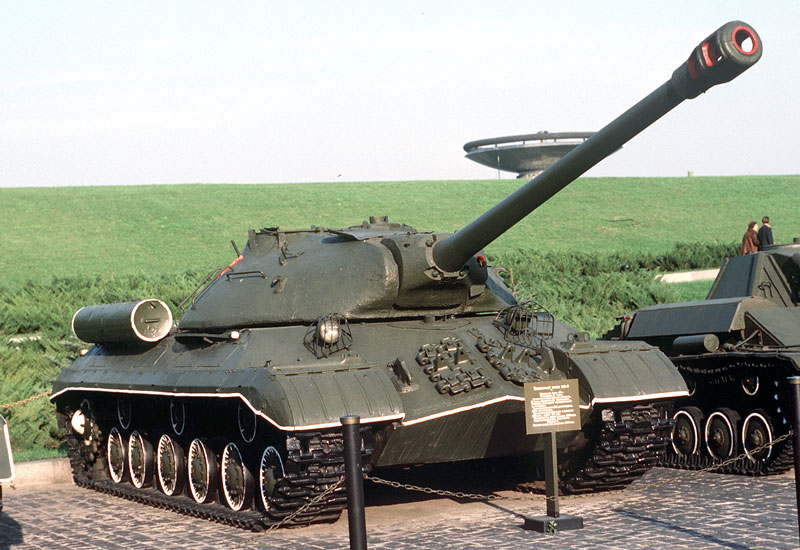
The IS-3 sported a stout, low-set profile, characterized by its curved turret design - appearing as something akin to a frying pan set upside down. The long rifled barrel was capped with a double-baffled muzzle brake. Each track side was fitted with six road wheels with the idler held forward, the drive sprocket aft and three track return rollers. The engine was fitted in a large rear compartment with the turret fitted noticeably forward. The optimal operating crew consisted of four personnel. The IS-3 was armed with the potent 121.9mm D-25T series main gun and afforded approximately 28 rounds of 122mm projectiles. Secondary armament consisted of a 12.7mm anti-aircraft machine gun (250 rounds carried) and one or two 7.62mm anti-infantry machine gun (756 rounds carried). Armor protection ranged from 20mm to 230mm across all facings, essentially over 9 inches at its thickest cover - impressive to say the least. At any rate, attacking the IS-3 from the front could prove a fruitless endeavor. Power for the heavy chassis was served from a V2-IS series engine of 520 horsepower delivering a respectable top speed of 25 miles per hour with a range out to 115 miles. The IS-3 weighed in at 45.77 tons and measured a running length of 32 feet, 4 inches with a relatively low height of just 8 feet.
While a breakthrough design along many fronts, large heavy tanks such as the IS-3 were naturally prone to a few mechanical issues when considering their operational abilities. Foremost was a generally unreliable powerpack - engine and transmission system - which was prone to failure. The haste in which design and production was ushered by Soviet authorities also opened the IS-3 up to some quality control issues regarding defects in the hull. These limitation brought about a phase of upgrades which sought to improve a few key areas by upgrading systems of concern - these included better radio equipment, new road wheels and replacing the original clutch mechanisms. When completed, these improvements drove up the operational weight of the IS-3 by some 4 tons, slightly hampering performance.
The IS-3 served with the Red Army throughout the latter part of the 1940s and into the 1950s. A modernization program was enacted to help keep the IS-3 viable in the ever-changing battlefield that was the Cold War. Eventually, this World War 2-era design was supplanted by more modern thoroughbreds - each owing a little bit of their existence to the mighty IS-3 - while the IS-3 itself fell quietly to the history books. She went on to serve in a few foreign armies before her time was completed and even served as a trainer to new generations of Soviet tankers before heading into storage. Egypt became a notable foreign operator of the type, showcasing the IS-3 on military parades as early as 1956. Several examples were captured by the Israelis during conflict and reconstituted for the IDF. The IDF went as far as upgrading the IS-3s with better engines taken from T54 tanks to help improve performance and modernized the aged system. China received deliveries of IS-3 but only after their participation in the Korean War had drawn to a close.
For the Soviets, the IS-3 was always regarded as "the most powerful tank in the world" and this became a claim that few could dispute.
Power & Performance Those special qualities that separate one land system design from another. Performance specifications presented assume optimal operating conditions for the IS-3 / JS-3 (Josef Stalin) Heavy Tank Tracked Combat Vehicle.
1 x V-2-IS (V-2K) V-12 diesel engine developing 600 horsepower. Installed Power
25 mph 40 kph Road Speed
115 miles 185 km Range
Structure The physical qualities of the IS-3 / JS-3 (Josef Stalin) Heavy Tank Tracked Combat Vehicle.
4 (MANNED) Crew
32.3 ft 9.85 meters O/A Length
10.1 ft 3.09 meters O/A Width
8.0 ft 2.45 meters O/A Height
100,906 lb 45,770 kg | 50.5 tons Weight
Armament & Ammunition Available supported armament, ammunition, and special-mission equipment featured in the design of the IS-3 / JS-3 (Josef Stalin) Heavy Tank Tracked Combat Vehicle.
1 x 122mm (121.9mm) D-25T main gun
1 x 12.7mm anti-aircraft heavy machine gun
1 OR 2 x 7.62mm general purpose machine gun(s)
AMMUNITION: 28 x 122mm projectiles
250 x 12.7mm ammunition
756 x 7.62mm ammunition
Variants Notable series variants as part of the IS-3 / JS-3 (Josef Stalin) family line.
IS-3 - Base production series designation evolving from the IS-2; revised rounded turret armor; heavily-sloped glacis plate; improved armor protection; later upgraded with better road wheels, radio equipment and clutch.
Operators Global customers who have evaluated and/or operated the IS-3 / JS-3 (Josef Stalin). Nations are displayed by flag, each linked to their respective national land systems listing.
Total Production: 2,311 Units Contractor(s): State Factories - Soviet Union
[ China; Egypt; Israel; Soviet Union ]
1 / 1
Front right side view of the IS-3 Joseph Stalin heavy tank on display; color
Going Further... The IS-3 / JS-3 (Josef Stalin) Heavy Tank Tracked Combat Vehicle appears in the following collections:
The "Military Factory" name and MilitaryFactory.com logo are registered ® U.S. trademarks protected by all applicable domestic and international intellectual property laws. All written content, illustrations, and photography are unique to this website (unless where indicated) and not for reuse/reproduction in any form. Material presented throughout this website is for historical and entertainment value only and should not to be construed as usable for hardware restoration, maintenance, or general operation. We do not sell any of the items showcased on this site. Please direct all other inquiries to militaryfactory AT gmail.com. No A.I. was used in the generation of this content.