Military Factory
Military Pay Chart
Global Firepower
Military Industrial Complex
Second World War
Home
Military Pay Scale
Military Ranks
Small Arms
Aircraft
Land Systems
Navy
Education
Military Factory Facebook Logo
flag of United States

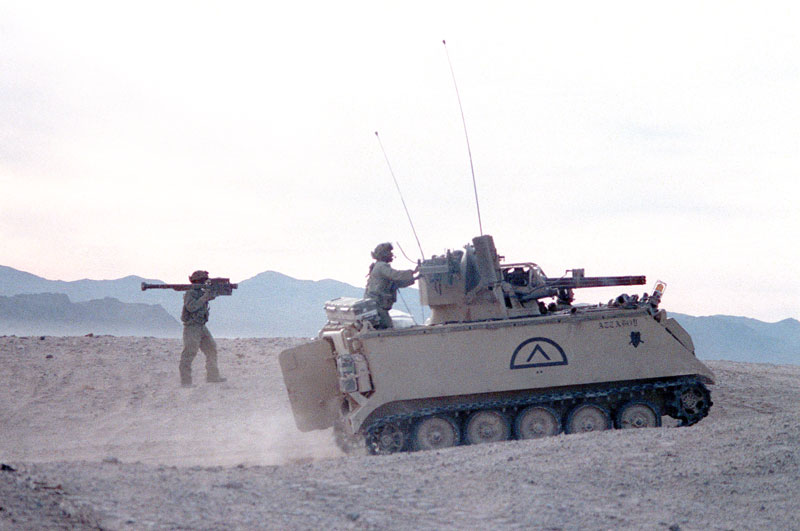
M163 Vulcan Air Defense System (VADS) Self-Propelled Anti-Aircraft Gun (1969)

Authored By Staff Writer | Last Updated: 3/8/2011

The devastating M163 Vulcan is based on the M113 Armored Personnel Carrier fitted with a 20mm M61 Vulcan Gatling cannon.

Find a School Near You
Follow Military Factory on Facebook:
Trending on Military Factory:
Recent Articles:
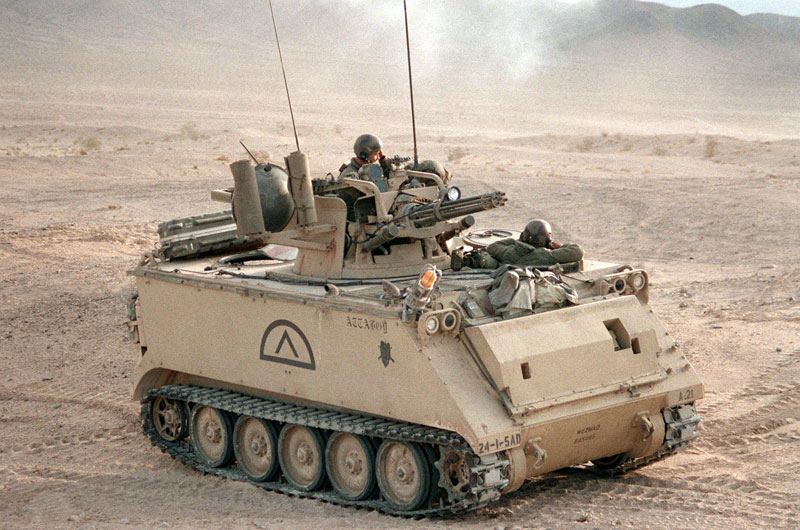
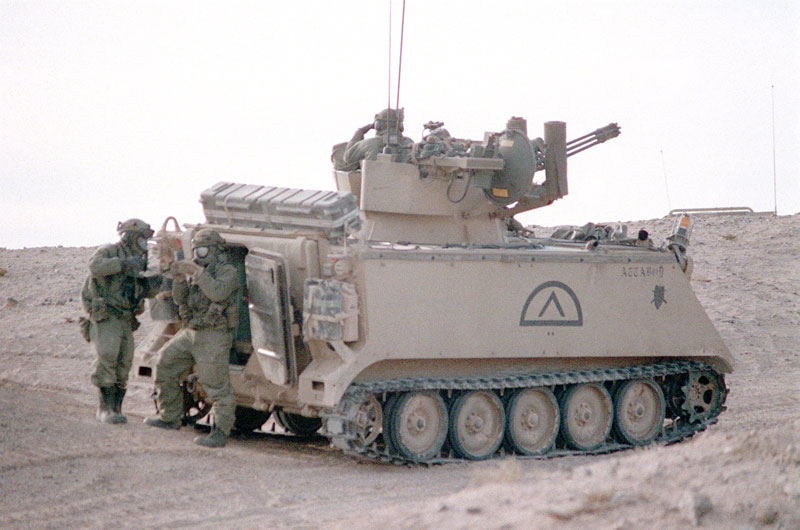
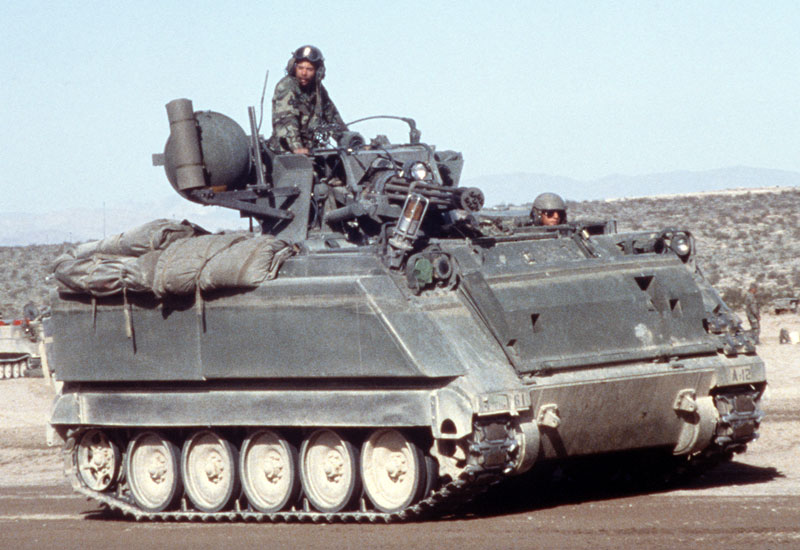
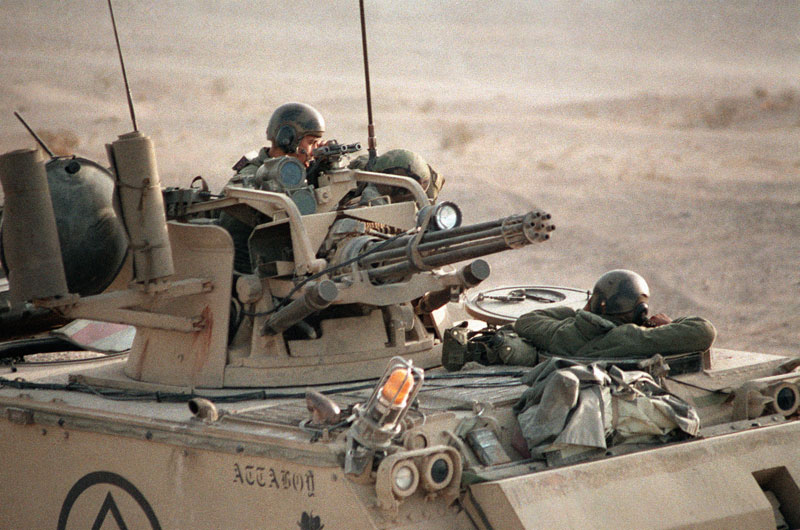
The M163 Vulcan Air Defense System (VADS) mated the firepower of the United States Air Force's standard aerial cannon - the M61 Vulcan - with the proven "go-anywhere" hull of the M113 Armored Personnel Carrier (APC). Its tracked nature ensured that the M163 could reach areas that were generally forbidden to wheeled systems of similar scope and function. Additionally, the firepower inherent in the M61 Vulcan Gatling cannon brought about hearty point defense deterrent against any low-flying enemy aircraft willing to enter its available kill zone. The M163 was formally accepted into US Army service in 1969 and went on to see export to several US-friendly nations during the Cold War.

Development of the M163 coincided with the development of the US Army's other air defense project - the missile-minded MIM-72A/M48 "Chaparral". The Chaparral system was also built atop the tracked M113 chassis and featured a forward-set cab for its operating crew and a positional, four-missile launch system mounting a surface-to-air version of the air-to-air AIM-9 Sidewinder short-ranged missile. The Chaparral served from 1969 to 1998 and nearly 2,000 examples were produced. The M163 Vulcan would be fielded alongside the M48 Chaparral to complete the network by providing a potent short-ranged "one-two" punch utilizing both homing missiles and voluminous fire.

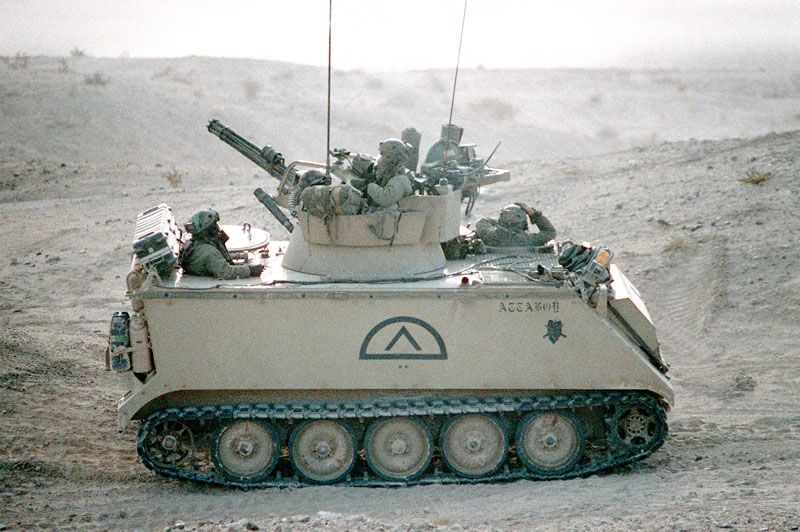
The strong arm of the M163 Vulcan air defense system was its installation of the M61 Vulcan cannon. The rotary cannon was 20mm in caliber and fitted to a powered turret offering 360-degree traverse. Elevation was limited to +80 and -5 and effective range was out to 5 kilometers depending on ammunition type. The cannon could be set to fire at a high rate-of-fire at 3,000 rounds per minute or low at 1,000 rounds per minute in 10, 30, 60 or 100 round bursts. The feed system of linkless in nature. Ammunition variety was key to the success of the M163 and differing types were eventually offered. This included Armored Piercing Incendiary, High-Explosive Incendiary, HEI-T, MPT-SD, SAPHEI and APDS type rounds.

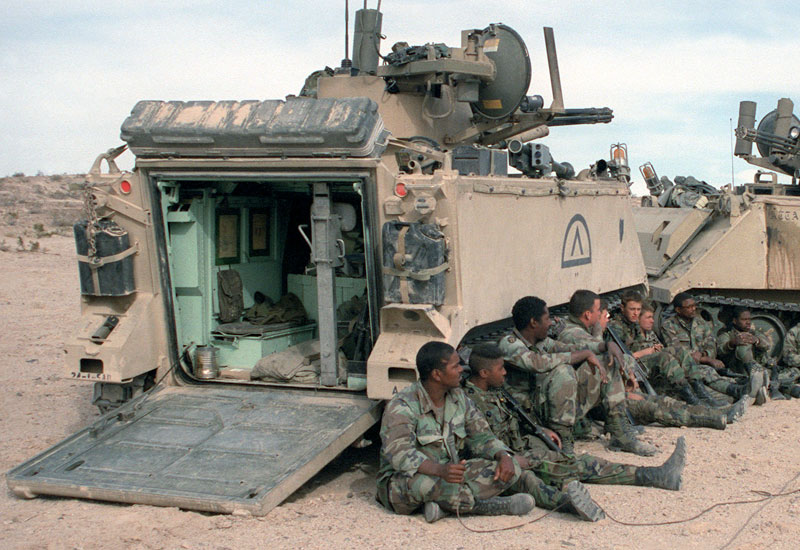
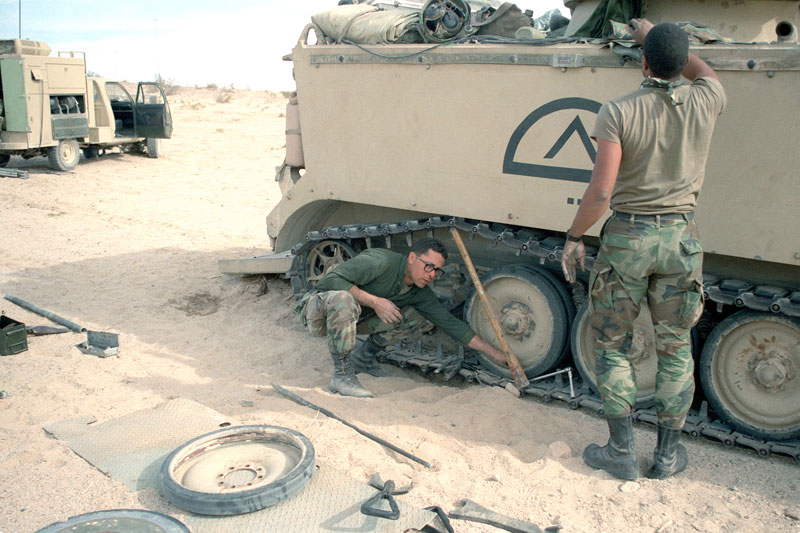
Beyond the installation of the gun, the chassis of the M113 remained largely intact for the M163. The design was characterized by its slab sides, sloped front glacis plate and squared off rear section. The turret was mounted at the middle-center of the hull roof. A pair of tracks straddled the hull sides and featured five rubber-tired road wheels with the drive sprocket at the front hull and the track idler at the rear. A crew of four was the operating ground and included the driver, seated at front left, the commander, gunner and loader. The rear loading ramp from the M113 was also retained. The powerplant, seated in the front hull, is a General Motors 6V53 series 6-cylinder 2-cycle diesel engine developing 212 horsepower @ 2,800rpm.

In 1984, Lockheed Electronics Company introduced a modernization kit known as the PIVADS (Product Improved Vulcan Air Defense System). This kit improved the radar, accuracy of the weapons system and automatic notification systems among other modifications. The ability to fire armor-piercing discarding sabot ammunition was also introduced. The kit was aimed at reducing the gunner's workload overall. While primarily designed for the air defense role, the M163 Vulcan is now used moreso in the ground support role due to her amazing ability to fire off a substantial amount of large-caliber ammunition. Additionally, the range of newer missile defense systems, other more modern close-in weapon systems and the advancing capabilities of enemy aircraft have all contributed to the lesser use of the M163 as a dedicated air defense weapon per se - though the type continues in operational service with a variety of operators as of this writing. Operators beyond the United States Army included/include Albania, Chile, Ecuador, Egypt, Iran, Israel, Jordan, Morocco, Portugal, South Korea, Thailand and Tunisia.

Though the M163 Vulcan formally debuted in 1969, at least six examples were delivered to the Vietnam War (numbered along their sides as "1" through "6") in 1968. These were delivered with non-functioning radar (dummy installations) for the tracking suite was not yet available. As such, the units were used more so for their ground support firepower and were physically aimed against the enemy or target area without (naturally) radar assistance.

The base series designation was known simply as M163. The M163A1 sported changes to the original gun mount to bring it more in line with the changes as featured in the M113A1. The M163A2 was similarly brought up to the M113A2 standard with its revised powertrain. The M163 PIVADS featured the aforementioned accuracy and workload changes/improvements and appeared in 1984. The M167 was nothing more than the gun system of the M163 in a towed-artillery form. These were original hauled by the Gama Goat mover but eventually replaced by the HMMWV ("Humvee"). The "Machbet" was the Israeli variant that also fitted 4 x FIM-92 Stinger short-range, surface-to-air missile systems along with the 20mm M61 Vulcan cannon. Additionally, the Israeli modifications produced a data-sharing system as well as improved target tracking.
Text ©2003-2013 www.MilitaryFactory.com • All Rights Reserved • No Reproduction Permitted
MilitaryFactory.com does NOT sell equipment/weaponry. Material presented throughout this website is for historical and entertainment value and should not to be construed as usable for hardware restoration, maintenance or general operation. Please consult manufacturers for such information. Our disclaimer. Email corrections / Comments to MilitaryFactory at Gmail dot com.
Picture of M163 Vulcan Air Defense System (VADS)
Pic of the M163 Vulcan Air Defense System (VADS)
Image of the M163 Vulcan Air Defense System (VADS)
View All Images (8)

Specifications for the
M163 Vulcan Air Defense System (VADS)
Self-Propelled Anti-Aircraft Gun


Country of Origin: United States
Manufacturer: General Electric Company, USA
Initial Year of Service: 1969
Production: 2,000


Focus Model: M163 Vulcan Air Defense System (VADS)
Crew: 4


Overall Length: 15.94ft (4.86m)
Width: 8.86ft (2.70m)
Height: 9.58ft (2.92m)
Weight: 13.8 US Short Tons (12,493kg; 27,542lbs)


Powerplant: 1 x General Motors 6V53 6-cylinder 2-cycle diesel developing 212hp @ 2,800rpm.


Maximum Speed: 40mph (64 km/h)
Maximum Range: 298 miles (480 km)


NBC Protection: None
Nightvision: Yes - Driver Only


Armament:
1 x 20mm Gattling Gun


Ammunition:
2,100 x 20mm ammunition


Variants:
M163 - Base Series Designation


M163A1 - Gun Mount modification to M113A1 APC standard.

M163A2 - Powertrain upgrade to M113A2 APC standard.

M163 PIVADS - Upraded targeting system; appearing in 1984.

M167 - Towed Turret Variant of M163

"Machbet" - Israeli Variant; fitted with 4 x FIM-92 Stinger short-range missile systems; upgrading tracking suite; data sharing.


Operators: Albania; Chile; Ecuador; Egypt; Iran; Israel; Jordan; Morocco; Portugal; South Korea; Thailand; Tunisia; United States

ALL LAND SYSTEMS CATEGORIES

By Decade:


1910 to 1919
1920 to 1929
1930 to 1939
1940 to 1949
1950 to 1959
1960 to 1969
1970 to 1979
1980 to 1989
1990 to 1999
2000 to 2009
2010 to 2019
VIEW ALL
Compare Tanks


By Type:


4x4 Military Vehicles
6x6 Military Vehicles
8x8 Military Vehicles
Artillery Gun Systems
Anti-Aircraft (AA) Guns
Anti-Aircraft (AA) Vehicles
Anti-Tank (AT) Guns
Anti-Tank (AT) Vehicles
Armored Cars
Armored Personnel Carriers (APC)
Battlefield Robots
Halftrack Vehicles
Heavy Tanks
Infantry Fighting Vehicles (IFV)
Light Tanks
Main Battle Tanks (MBT)
Modern Combat Tanks
Medium Tanks
Military Motorcycles
Multiple Launch Rocket Systems (MLRS)
Reconnaissance Vehicles
Special Purpose Vehicles
Self-Propelled Guns (SPG)
Tank Destroyers
General Purpose / Utility Vehicles


By Nation:


Afghanistan
Britain
China
France
Germany
Iran
Iraq
Israel / Israeli Army
Italy
Libyan Army
North Korea / North Korean Army
Pakistan
Russia
South Korea
Soviet Union
Syrian Army
United States
VIEW ALL

World War 2:


Artillery
Infantry Fighting Vehicles
Tank Destroyers (All)
Tanks (All)
Australian Tanks
British Tanks
Canadian Tanks
Cruiser Tanks (UK)
Czechoslovakian Tanks
French Tanks
German Tanks
German Tank Destroyers
German FlaK Guns
German Reconnaissance Vehicles
Hungarian Tanks
Italian Tanks
Japanese Tanks
Romanian Tanks
Soviet Tanks
Swedish Tanks
US Tanks
VIEW ALL


World War 1:


France WW1 Tanks
Germany WW1 Tanks
Britain WW1 Tanks
US WW1 Tanks
WW1 Artillery
WW1 Tanks (all)
VIEW ALL


Spanish Civil War:

VIEW ALL


Korean War:

Tanks
VIEW ALL


Vietnam War:

VIEW ALL


Cold War:

Cold War Tanks
Cold War American Tanks
Falklands War
Post-WW2 British Tanks
VIEW ALL


Gulf War (1991):

VIEW ALL


Miscellaneous:

Armored Vehicle Chassis Types

Site Disclaimer | Privacy Policy | Site Map | MF Origins


©2013 www.MilitaryFactory.com • Content ©2003-2013 MilitaryFactory.com • All Rights Reserved • Site Contact Email: militaryfactory at gmail dot com. The "Military Factory" name and MilitaryFactory.com logo are registered ® trademarks and protected by all applicable domestic and international intellectual property laws.


Top MF Stuff: 2013 Military Pay Scale | Military Ranks | WW2 Weapons | Sniper Rifles | Kts to Mph | WW1 Aircraft | Automatic Rifles | Aircraft Cockpits | Vietnam War Weapons | Main Battle Tanks | Submachine Guns | Shotguns | French Military Victories


Most photographic images appearing on this site are courtesy of the United States Department of Defense and are approved for public use. Other images acquired through the public domain. Digital art work courtesy of Dan Alex. Business Consulting by Kyle Williams. Material presented throughout this website is for historical and entertainment value and should not to be construed as usable for hardware restoration, maintenance or general operation. Please consult manufacturers for such information.


eXTReMe Tracker