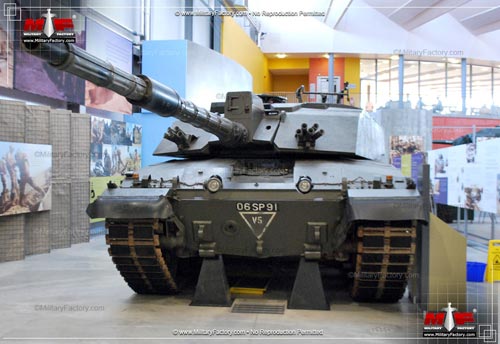
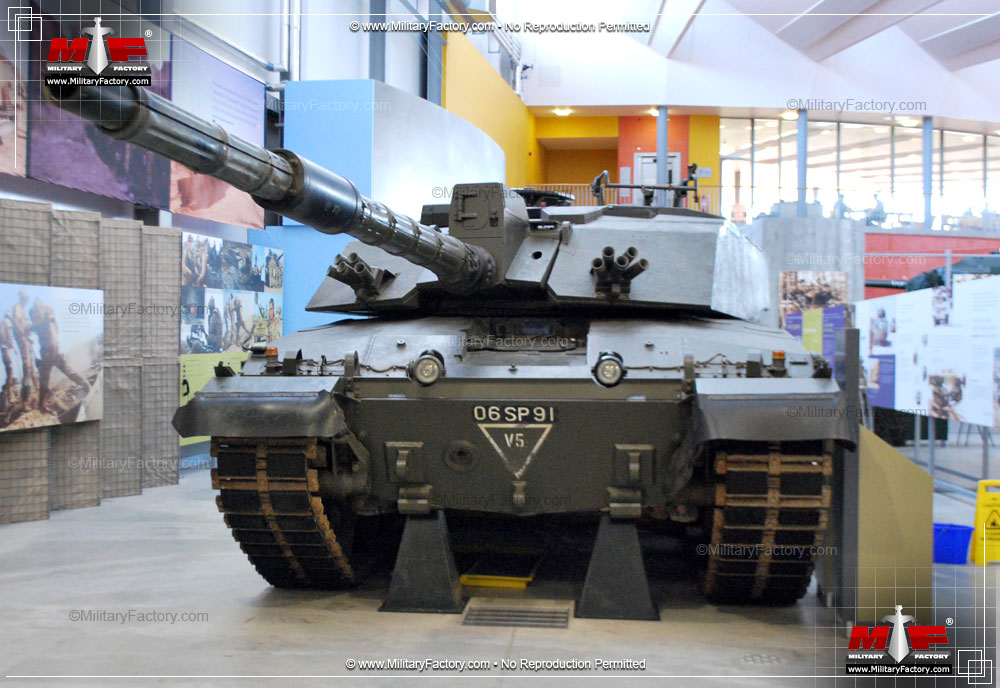
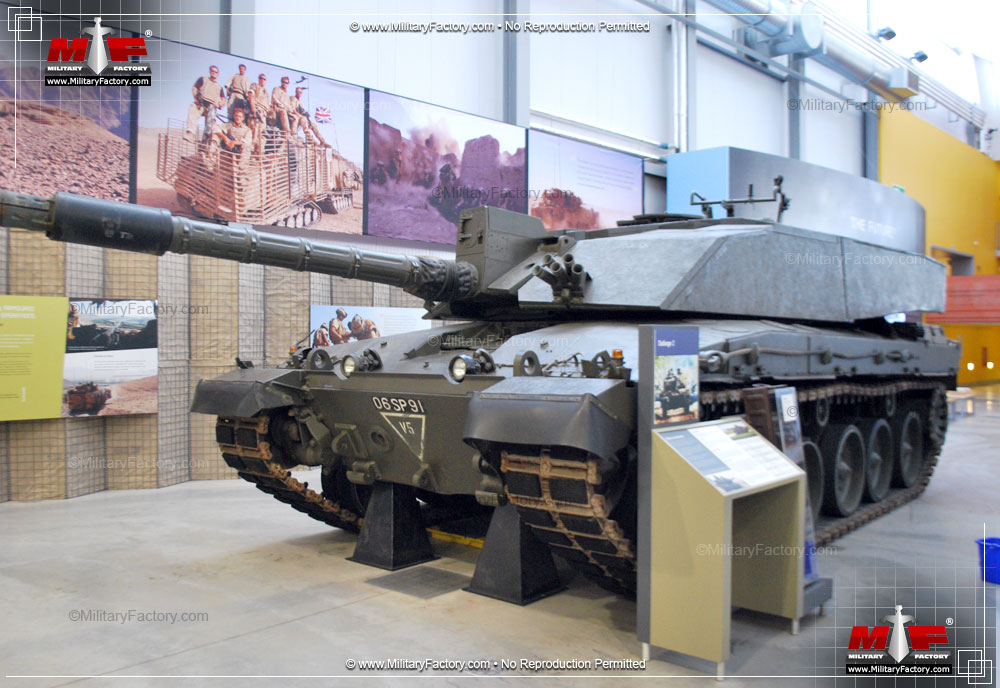
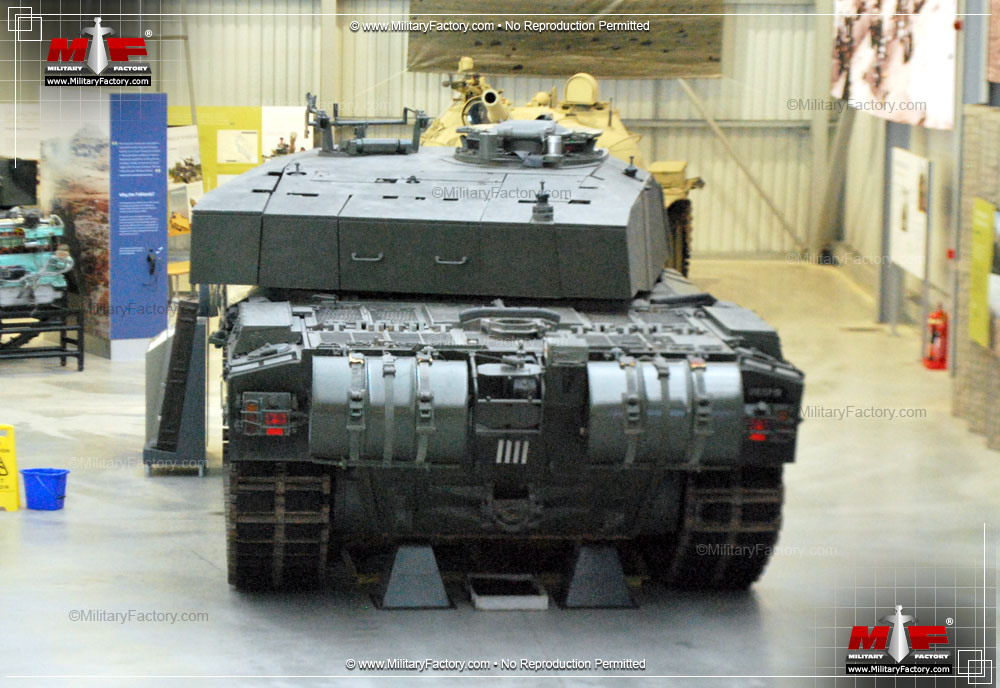
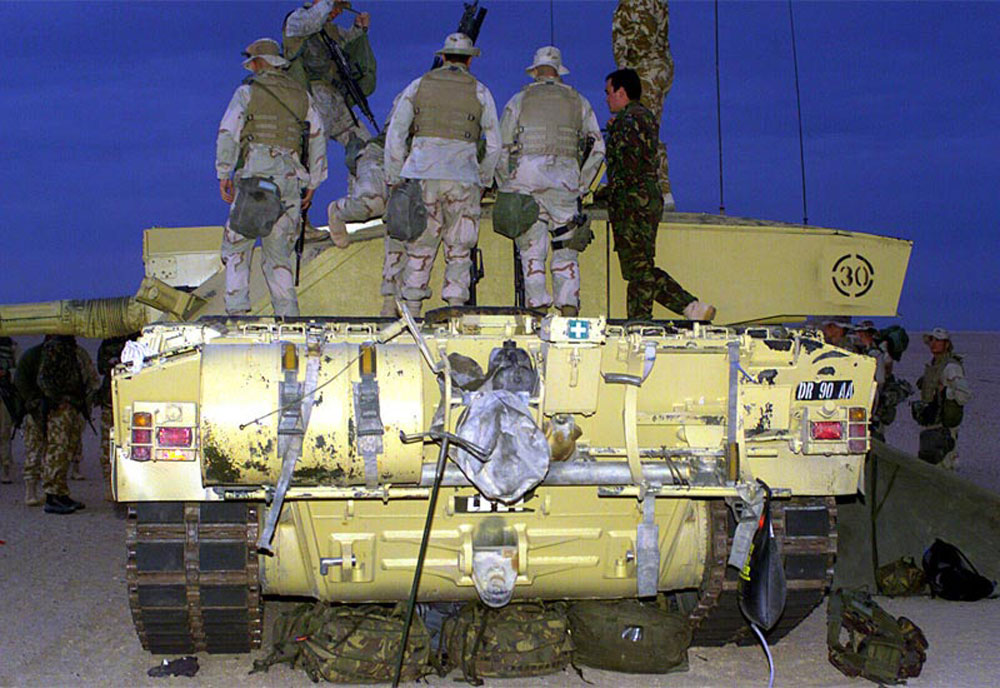
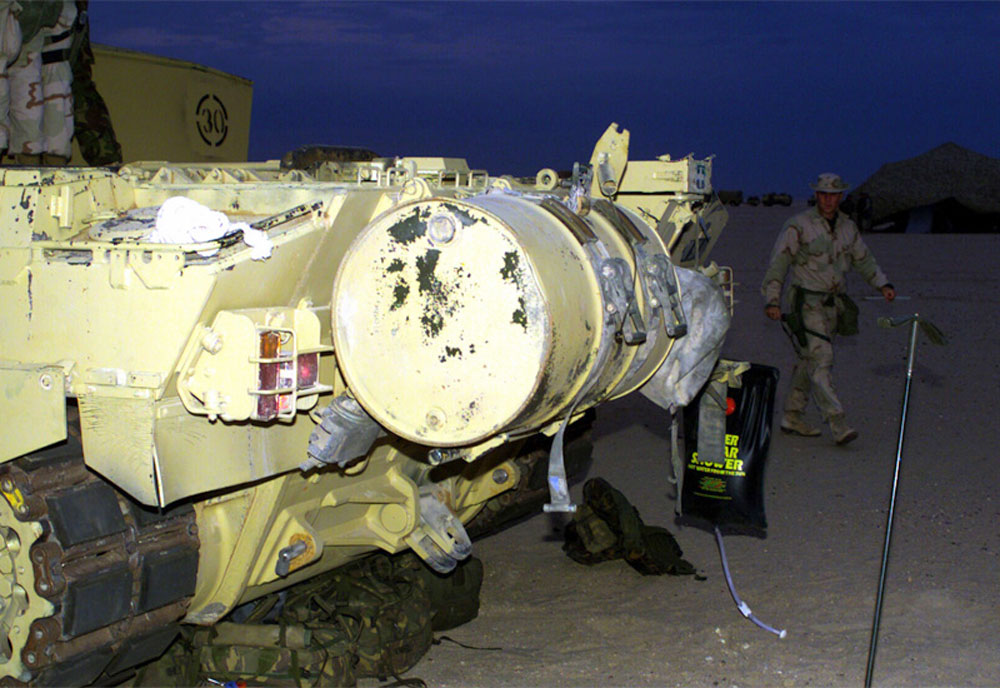
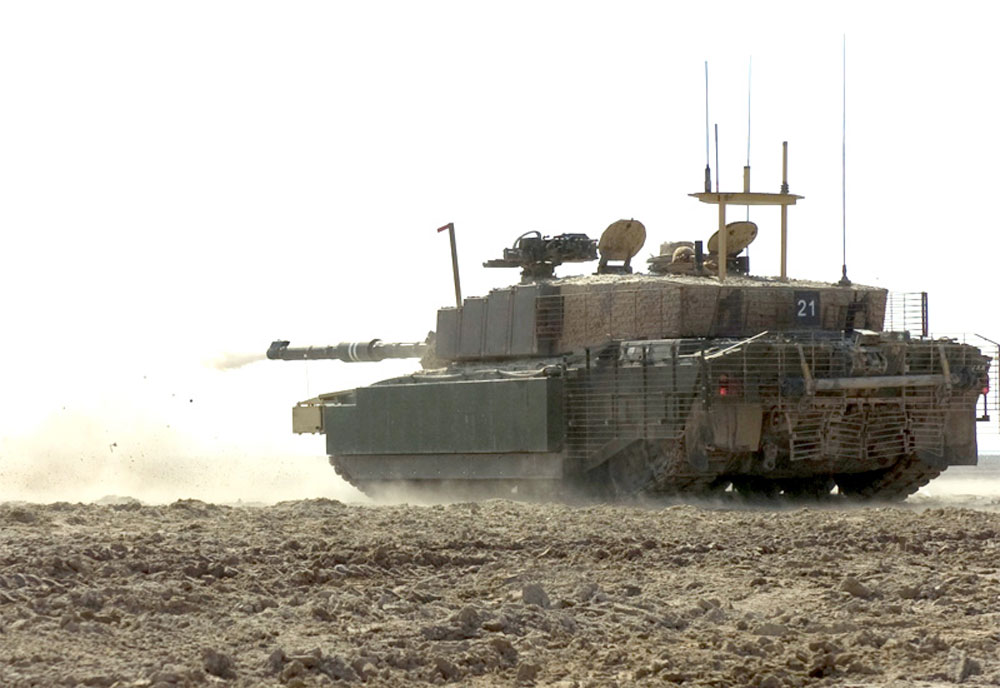
"The lethal Challenger 2 Main Battle Tank system currently forms the backbone of modern British Army tank groups."
Power & Performance Those special qualities that separate one land system design from another. Performance specifications presented assume optimal operating conditions for the Challenger 2 Main Battle Tank (MBT).
1 x Perkins Engines Condor CV12 12-cylinder diesel-fueled engine developing 1,200 horsepower at 2,300rpm driving conventional track-and-wheel arrangement. Installed Power
37 mph 59 kph Road Speed
280 miles 450 km Range
Structure The physical qualities of the Challenger 2 Main Battle Tank (MBT).
4 (MANNED) Crew
37.9 ft 11.55 meters O/A Length
11.5 ft 3.52 meters O/A Width
8.2 ft 2.49 meters O/A Height
137,789 lb 62,500 kg | 68.9 tons Weight
Armament & Ammunition Available supported armament, ammunition, and special-mission equipment featured in the design of the Challenger 2 (FV4034) Main Battle Tank (MBT).
1 x 120mm L30 CHARM main gun (CHallenger main ARMament) in turret front face.
1 x 7.62mm co-axial anti-infantry machine gun in turret front face.
1 x 7.62mm Anti-Aircraft (AA) machine gun on turret roof.
2 x 5 Smoke grenade dischargers on turret frontal sides.
AMMUNITION: 52 x 120mm APFSDS, HESH, or smoke-generating projectiles.
4,000 x 7.62mm ammunition.
10 x Smoke grenades.
Variants Notable series variants as part of the Challenger 2 (FV4034) family line.
Challenger 2 - Base Model Series Designation.
Challenger 2E - Export Model with improved cooling system; 1,500 horsepower engine; since cancelled.
Challenger 2 Trainer - Driver Trainer Vehicle.
Challenger 2 TITAN - Bridgelayer vehicle.
Challenger 2 TROJAN - Battlefield Engineering Vehicle.
Challenger 3 - Model of 2021; Life-EXtension (LEX) program modification standard.
The Challenger 2 Main Battle Tank (MBT) represents the current standard tracked combat vehicle of the British Army. The type represents the pinnacle of British armor development due to its perfect combination of mobility, firepower, and armor protection - key qualities of any modern fighting machine. However, to understand its evolution, one much understand its deep lineage which dates back to the closing years of World War 2 when the British unveiled their Centurion MBT (detailed elsewhere on this site). Developed during the war, this new class of tank arrived too late to see combat actions in the conflict but would go on to become a staple of the Cold War world (1947-1991) and achieve post-war success both locally and through foreign sales - serving in many capacities from 1945 into the 1990s.
For the British Army, their classic Centurion eventually began to show its age (and battlefield limitations) so a new MBT was in order. Work on a new tank turned out to be the equally-excellent Chieftain MBT (detailed elsewhere on this site) of 1966 which introduced the much more powerful 120mm L11A5 series rifled main gun. Later in its life, the Chieftain was upgraded for the better and foreign interest grew, particularly with Iran who procured some 700 examples for their armored corps. A requirement for a new MBT was then developed under the name of "Shir 2" and, while this work was being handled, an improved form of the Chieftain was made available as the "Shir 1" for the interim. However, the Islamic Revolution in Iran in 1979 cancelled the expected orders so the Shir 1 stock was rerouted to Jordan and operated there as the "Khalid". The Shir 2, however, was then selected for further development for the British Army and became the all-modern "Challenger" MBT (detailed elsewhere on this site) after both a British-German MBT initiative and the "MBT-80" tank programs fell through. The Challenger introduced the revolutionary "Chobham" composite armor protection scheme while retaining a powerful 120mm main gun as its primary asset. This tank replaced the Chieftain in British Army service resulting in the latter's retirement in 1995.
The Challenger operated in a front-line capacity from 1983 to the middle of the 1990s and 420 examples were ultimately delivered. It saw action in the 1991 ground war portion of the Gulf War in Iraq with excellent results (a reported 300 enemy armored vehicles destroyed to no losses for itself). However, there was still room for improving the Challenger line (particularly in its slow rate-of-fire and its Fire Control System equipment and software) so modifications commenced in 1980s resulting in what became essentially an all-new combat tank - christened the "Challenger 2" which led the original Challenger line to be renamed as "Challenger 1". The Challenger 2 entered service in June of 1998 with a total of 446 units delivered. Initially intended to complement the Challenger 1 series on the new digital battlefield, it was later officially decided to replace the older stock with the newer breed of tank.
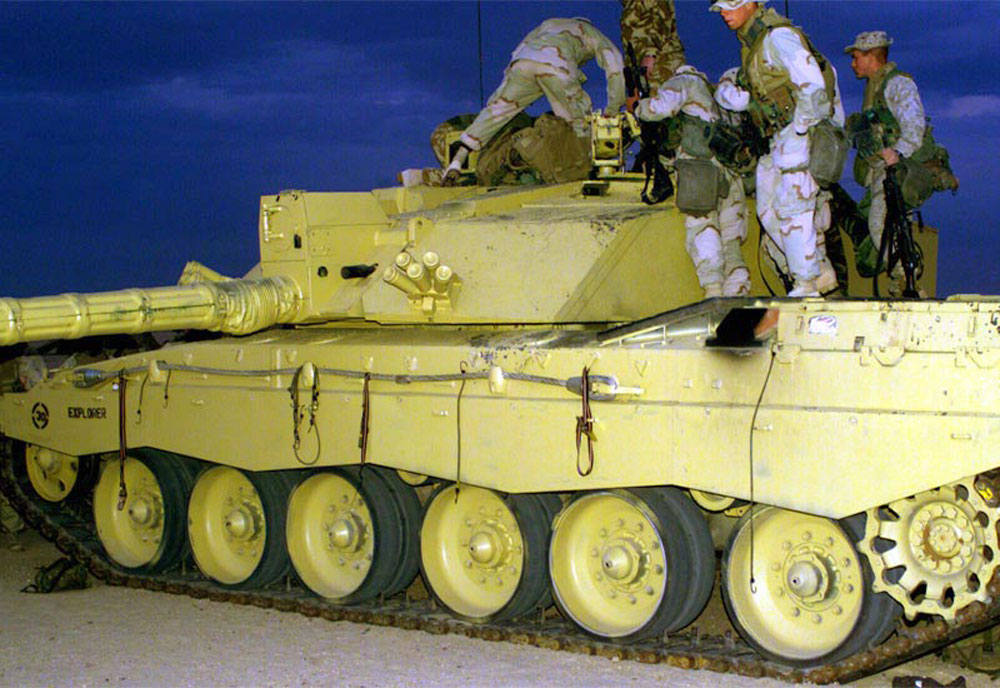
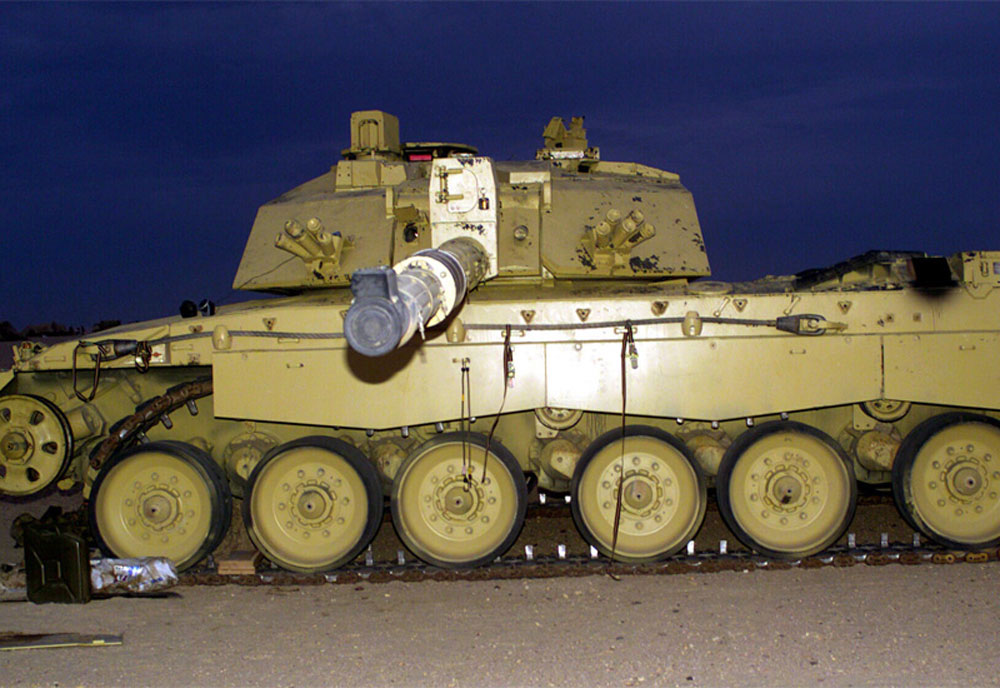
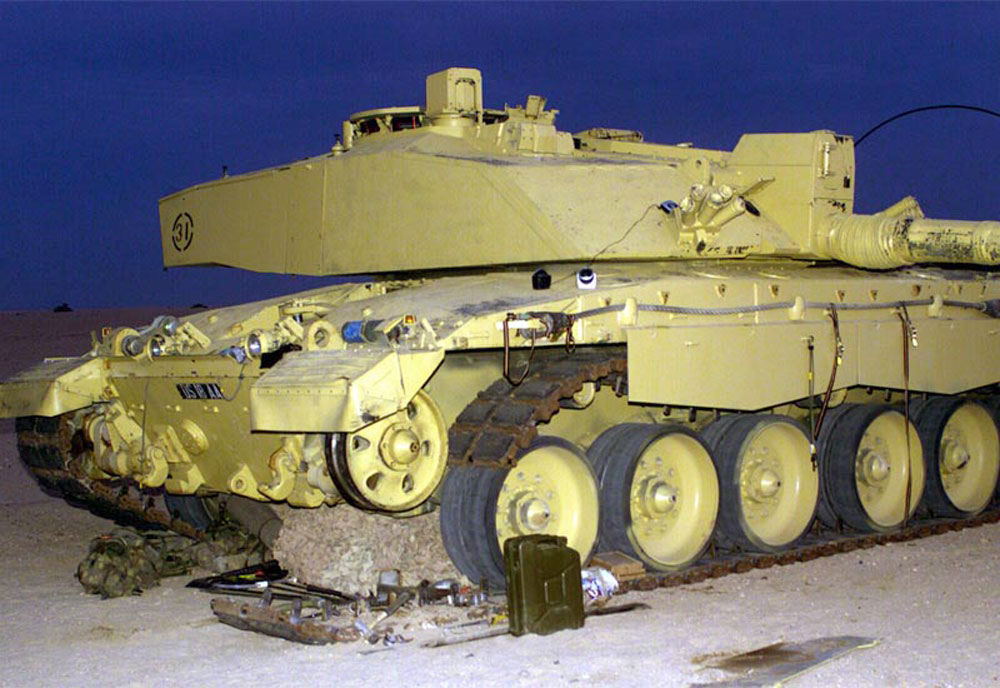
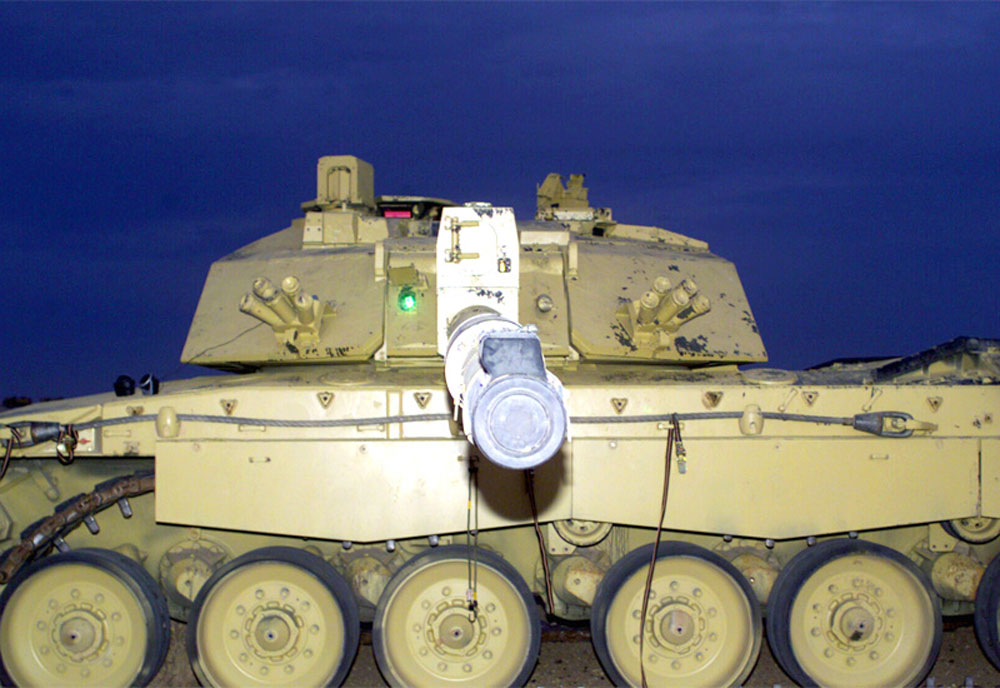
While evolved from the Challenger 1, the Challenger 2 represents a heavily modified version of the earlier tank, and all of this work relates back to the World War 2-era Centurion to some extent. The overall design configuration has remained faithful to the original Challenger with the driver seated front-center, the turret at the center of the hull, and the engine mounted to the rear. The running gear consists of six double-tired road wheels to a track side with the drive sprocket at the rear and the track idler at the front. The glacis plate is well sloped as are the front facings of the turret. The upper regions of the running gear and hull are protected in thin skirt armor. The Challenger 2 maintains a shallow hull and turret which afford it an excellent low profile. The tank is crewed by four personnel with the driver in the hull and the commander, loader and gunner in the turret. The Challenger 2 was given an all-new turret design and retained the use of Chobham armor (though a more evolved form of the original) and the 120mm main gun (rifled). Only the Challenger 1, Challenger 2, and the American M1 Abrams are known users of the highly secretive Chobham armor formula. Explosive Reactive Armor (ERA) blocks can also be added for improved protection though at the cost of weight gains. A Nuclear-Biological-Chemical (NBC) protection system is fitted as standard.
A new, high-pressure 120mm main gun was developed for the Challenger 2 as this was designated as the L30A1. To iron the failings of the original Challenger 1's FCS, a more technologically-sound and advanced digital FCS was integrated into the Challenger 2 series. The main gun is stabilized across both axis to allow for accurized fire-at-range as well for firing on-the-move with equally-deadly results. The Challenger 2 can engage multiple targets at distance with good results from its main gun as both the gunner and commander are given individually-stabilized optical / thermal vision equipment as well as an advanced sighting system. Ergonomics have also been incorporated throughout the interior to provide for a relatively healthy operating environment for the crew of four. As standard, a 7.62mm L94A1 machine gun is fitted in a coaxial mounting alongside the main gun (both of the weapons are operated by the gunner). The commander's cupola retains a 7.62mm L37A2 machine gun for engaging infantry and low-flying aerial threats. There are 52 x 120mm projectiles stored in the hull ofr the main gun and this includes a mix of High-Explosive Squash Head (HESH) and Armor-Piercing Fin-Stabilized Discarding Sabot (APFSDS) rounds. Smoke rounds are also available. 4,200 x 7.62mm rounds of machine gun ammunition are carried as well. The Challenger 2 crew also manages 10 x electrically-operated smoke grenade dischargers fitted as two banks of five at each front side turret panel.
Power for the new Challenger 2 is derived from a single Perkins Engines CV-12 diesel-fueled unit developing 1,200 horsepower. and mated to a David Brown TN54 series epicyclic transmission system offering six forward and two reverse gears. The vehicle is suspended atop a hydropneumatic suspension system (of 2nd Generation Hydrogas development). All told, these inclusions allow for a top road speed of 35 miles-per-hour and an operational range of 280 miles on internal fuel. Jettisonable external fuel drums can further be added at the rear hull line to help extend the vehicle's operational range. Overall weight is a healthy 69 tons.
The Challenger 2 was actually born as a private venture attempt undertaken by Vickers Defence Systems. When the British Army came down with a requirement for a new combat tank, the Vickers design was submitted alongside the American M1 Abrams and German Leopard 2 series as a possible candidate. The Vickers submission was eventually selected for further development and serial production due to circumstances of the time. Though the tank is currently branded under the "BAe Systems Land Systems" name, none of the type were ever produced under the BAe brand label - only modernization programs were enacted by the company. The Challenger 2 shifted original production from "Vickers Defence" to "Alvis Vickers Ltd" before the business was sold to BAe.
Production began through an initial batch of 127 tanks ordered in 1991 and this was then supplemented by an order of 259 more vehicles in 1994. First deliveries came to the British Army in 1994 and the first operational unit became the Royal Scots Dragoon Guards in 1998 - beginning a new era of British tank usage which continues today (2018). Manufacture has spanned across two separate facilities - one at Tyne and Wear and the other at Leeds.
The Challenger 2 has been used operationally in peace-keeping efforts during the Bosnia and Kosovo interventions and went on to see first-combat actions in the 2003 invasion of Iraq where it acquitted itself in excellent fashion - again no battlefield losses were incurred. In several instances, individual Challenger 2s were hit repeatedly by Soviet-era Rocket Propelled Grenades (RPGs) with little to no damage to armor. Protection against Improvised Explosive Devices (IEDs) in the war has also proven a Godsend for tanker crews during subsequent fighting. The Challenger 2 has more than proven a worthy successor to the earlier Challenger 1 line and then some, given the British Army one of the most - if not THE most - powerful Main Battle Tanks in service today. The type is expected to fulfill its frontline role into 2035 with no indications of a successor planned for the near future. Considering the monetary costs of designing, developing and producing main battle tanks in today's world, this is not surprising. Regardless, the Challenger 2 has very few threats on the modern battlefield so the delay in acquiring a new vehicle for the British Army is in many ways acceptable.
Oman is the only foreign operator of the Challenger 2 and this began with a first-order placed in 1993 for 18 vehicles. The fleet was then expanded by a follow-up order for 20 additional Challenger 2s in 1997.
Like other British Army tanks before it, the Challenger 2 chassis is used for various other battlefield armored vehicles modified to suite many roles such as mine rolling, engineering (as the "TROJAN"), the Armored Repair and Recovery Vehicle (ARRV), the TITAN bridge-carrying/bridgelaying tank.
At one point, BAe offered the "Challenger 2E" to interested export buyers and this version incorporated several new additions and improvements while being powered by a EuroPowerPack 1,500 horsepower diesel engine mated to a Renk transmission system. However, there was little interest in the expensive product and the initiative was eventually dropped.
The British Army has taken delivery of 408 total Challenger 2 tanks while Oman operates a fleet of 38.
March 2021 - The British Army has revealed plans to upgrade some 148 in-service Challenger 2 series tanks to a modernized life extension standard known as the "Challenger 3". These are expected to be delivered between 2021 and 2027.
April 2022 - The British MoD announced that it would be sending Challenger 2 MBTs to ally Poland to make up the loss of T-72s destined for Ukraine.
February 2022 - Britain was announced as part of the tank deal to send American Abrams, Challenger 2, and German Leopard 2 MBTs to Ukraine.
Operators Global customers who have evaluated and/or operated the Challenger 2 (FV4034). Nations are displayed by flag, each linked to their respective national land systems listing.
Total Production: 446 Units Contractor(s): Vickers Defence Systems / Alvis Vickers Ltd / BAe Systems Land Systems - UK
[ Oman; Poland; Ukraine (via UK); United Kingdom ]
1 / 10
Image copyright www.MilitaryFactory.com; no reproduction permitted
2 / 10
Image copyright www.MilitaryFactory.com; no reproduction permitted
3 / 10
Image copyright www.MilitaryFactory.com; no reproduction permitted
4 / 10
Image from the United States Department of Defense imagery database.
5 / 10
Image from the United States Department of Defense imagery database.
6 / 10
Image from the United States Department of Defense imagery database.
7 / 10
Image from the United States Department of Defense imagery database.
8 / 10
Image from the United States Department of Defense imagery database.
9 / 10
Image from the United States Department of Defense imagery database.
10 / 10
Image from the United States Department of Defense imagery database.
The "Military Factory" name and MilitaryFactory.com logo are registered ® U.S. trademarks protected by all applicable domestic and international intellectual property laws. All written content, illustrations, and photography are unique to this website (unless where indicated) and not for reuse/reproduction in any form. Material presented throughout this website is for historical and entertainment value only and should not to be construed as usable for hardware restoration, maintenance, or general operation. We do not sell any of the items showcased on this site. Please direct all other inquiries to militaryfactory AT gmail.com. No A.I. was used in the generation of this content.