Military Factory
Military Pay Chart
Global Firepower
Military Industrial Complex
Second World War
Home
Military Pay Scale
Military Ranks
Small Arms
Aircraft
Land Systems
Navy
Education
Military Factory Facebook Logo
flag of Romania

IAR 99 Soim (Hawk) Advanced Trainer / Light Strike (1985)

Authored By Staff Writer | Last Updated: 10/25/2012

The Avioane IAR 99 Soim was a wholly Romanian indigenous advanced trainer/light strike design.

Find a School Near You
Follow Military Factory on Facebook:
Trending on Military Factory:
Recent Articles:
Romania went the indigenous route in developing its advanced jet trainer with light strike capability when producing its IAR 99 series. The aircraft was developed for the Romanian Air Force to replace several aged types from Czechoslovakia with preliminary work beginning in 1975. At the time of its inception, the IAR 99 proved notable as becoming the first wholly-designed and manufactured jet-powered trainer aircraft of Romanian origin, becoming a symbol of national pride. Additionally, it reduced the country's reliance on foreign powers when stocking its military inventory.

Construction of the first prototype began in the early 1980s to which the airframe was made ready for its first flight on December 21st, 1985. Two additional prototypes followed, one to serve as a static test bed. After a period of successful evaluation, the aircraft was formally adopted by the Romanian Air Force as the IAR 99 "Soim" ("Hawk") with serial production upcoming in 1987 by Avioane Craiova. Within two years, the Romanian Air Force boasted over a dozen of the new aircraft type.

By the time of the early 1990s, the geopolitical landscape across Europe and Western Asia had changed considerably owing largely to the fall of the Soviet Empire. This left Romania now independent of its long-time overseer which served to broadened its self-influence considerably. An attempt was then made to market its new advanced trainer to interested foreign parties but these fell to naught as the market for such a fighter was already cornered by other popular breeds and Romanian electronics generally lacked behind its competitors. To rectify the issue, Romanian authorities teamed with the American concern of Honeywell to modify its design resulting in an end-product that failed to net any sales. The IAR 99, in its Honeywell conversion, was also marketed to the US for its Joint Primary Aircraft Training System program as a long-shot choice, the winner becoming the Beechcraft T-6 Texan II.

A modernization program was then enacted and this produced a joint venture between IAR and IAI (Israel Aerospace Industries) to bring more functionality to its IAR 99 aircraft. While avionics were accordingly improved, HOTAS (Hands On Throttle and Stick) was introduced - bringing the Romanian design up to par with modern fighters of the age. Each cockpit was also completed with a pair of multi-function displays for improved capability, doing away with the primitive dials of old. However, as in the previous failed venture prior, this IAR/IAI endeavor eventually stalled and never saw formal completion.

By the mid-1990s, a new modernization initiative for the IAR 99 was put into play to coincide with the arrival of the modernized MiG-21 "LanceR". The MiG-21 was the primary Romanian interceptor of the period and available in quantity by limited by the fact that spare components once supplied from the Soviet Union were not easily accessible. As such, an in-house gesture between Romania and the Israeli concern of Elbit produced the modernized MiG-21s. In turn, this also produced modified IAR 99 airframes for the MiG-21 LanceR trainer role and these came to be known under the designation of "IAR 99C". The upgrade would have included a handful of existing IAR 99 mounts as well as an additional 40 new-built airframes. However, these totals were later curtailed to just a dozen total IAR 99C examples, five from existing airframes.

To date (2012) only 20 IAR 99 aircraft have ever been produced with at least three known to have been lost to accident. The fleet maintains an active status in the Romanian Air Force inventory.

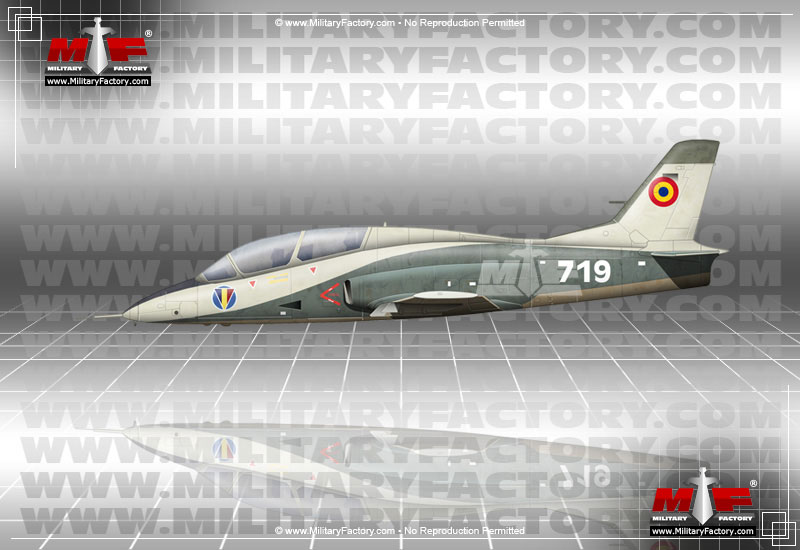
Design-wise, the IAR 99 showcased a sleek, ultra-modern appearance with a well-contoured fuselage housing a single engine configuration and tandem seating cockpit. The short, sloped nosecone allowed for excellent forward and side-to-side visibility while the engine installation was buried deep within the middle-aft portion of the fuselage. The stepped natured of the cockpit allowed the rear pilot to view the action ahead over the seat of the frontal pilot. Wings were low-mounted along the fuselage sides and straight in their general design with clipped tips. The empennage was dominated by a single vertical tail fin held atop the engine exhaust port with applicable horizontal planes fitted at the fin's base (ntably positioned higher than the main wing elements). Small air intakes to aspirate the engine fitting were located near the rear pilot's cockpit position. The undercarriage included a conventional arrangement with a single-wheeled nose gear and single-wheeled main landing gears - all retractable.

Power for the IAR 99 was supplied through a British-originated, French-built Turbomecanica Mk 632-41M turbojet engine (Rolls-Royce "Viper") of 4,000lbs thrust output. Maximum speed was 540 miles per hour with an overall range of 684 miles. Service ceiling was listed at 42,300 feet with a rate-of-climb near 3,450 feet per minute.

While primarily utilized for the advanced jet trainer role, the IAR 99 was also given double-duty as a light strike platform - a dual-role configuration of aircraft popular with many nations today. The aircraft could, therefore, stock external munitions across four underwing hardpoints up to 2,200lbs total. The IAR 99 lacked an internal gun for close-in work but could mount cannon pods as required. Additionally, hardpoints supported conventional drop bombs, rocket pods, air-to-air missiles, air-to-surface missiles and laser guided munitions giving the IAR 99 system a broad tactical reach across most operating environments. The inboard hardpoints were further "plumbed" for accepting external fuel stores which furthered the aircraft's inherent operational range. The aircraft also featured a full electronic warfare and countermeasures suite (complete with chaff/flare dispensers) for self-defense against tracking and homing threats.

In all, the IAR 99 series proved a strong indigenous effort for the nation of Romania, even though the product has failed to net much foreign interest to date.
Text ©2003-2013 www.MilitaryFactory.com • All Rights Reserved • No Reproduction Permitted
MilitaryFactory.com does NOT sell equipment/weaponry. Material presented throughout this website is for historical and entertainment value and should not to be construed as usable for hardware restoration, maintenance or general operation. Please consult manufacturers for such information. Our disclaimer. Email corrections / Comments to MilitaryFactory at Gmail dot com.
Picture of IAR 99 Soim (Hawk)
View All Images (1)

Specifications for the
IAR 99 Soim (Hawk)
Advanced Trainer / Light Strike


Country of Origin: Romania
Manufacturer: Avioane Craiova - Romania
Initial Year of Service: 1985
Production: 22


Focus Model: IAR 99 Soim (Hawk)
Crew: 2


Length: 36.12ft (11.01m)
Width: 32.32ft (9.85m)
Height: 12.80ft (3.90m)
Weight (Empty): 7,055lbs (3,200kg)
Weight (MTOW): 12,258lbs (5,560kg)


Powerplant: 1 x Turbomecanica Mk 632-41M (Rolls-Royce Viper) turbojet engine developing 4,000lbs of thrust.


Maximum Speed: 537mph (865kmh; 467kts)
Maximum Range: 684miles (1,100km)
Service Ceiling: 42,651ft (13,000m; 8.1miles)
Rate-of-Climb: 3,450 feet per minute (1,052m/min)


Hardpoints: 5
Armament Suite:
Variable - up to 3,860lbs of external stores to include air-to-air missiles, air-to-ground missiles, rocket pods, gun pods, cannon pods, conventional drop ordnance and jettisonable fuel tanks.


Variants:
IAR 99 - Base Series Designation


Operators: Romania

ALL AIRCRAFT CATEGORIES

BY DECADE:


1900 to 1909
1910 to 1919
1920 to 1929
1930 to 1939
1940 to 1949
1950 to 1959
1960 to 1969
1970 to 1979
1980 to 1989
1990 to 1999
2000 to 2009
2010 to 2019
2020 to 2029
VIEW ALL
Compare Aircraft


BY TYPE:


Anti-Submarine Warfare (ASW)
Attack Helicopters
Bomber Aircraft
Medium Bombers
Heavy Bombers
Close-Air Support (CAS)
Commercial Aircraft
Dive Bombers
Electronic Warfare Aircraft (EWA)
Experimental / X-Planes
Fighter Aircraft
Floatplane Aircraft
Flying Boat Aircraft
Aerial Refueling Tankers
Helicopters (ALL)
Interceptor Aircraft
Multi-Role Aircraft
Navy Carrier Aircraft
Night Fighters
Reconnaissance / Scout
Search & Rescue (SAR)
Scout Helicopters
Special Purpose
Torpedo Bombers
Trainer Aircraft
Transport Aircraft
Transport Helicopters
Unmanned Aerial Vehicles (UAVs)
Unmanned Combat Air Vehicles (UCAVs)


COLLECTIONS:


4th Generation Fighter Aircraft
5th Generation Fighter Aircraft
US X-Planes
Classic US Warbirds
French Military Helicopters
Grumman "Cats"
Howard Hughes Aircraft
Indian Air Force
Israeli Air Force
Libyan Aircraft
Modern Chinese Aircraft
Modern Chinese Fighters
Modern Military Aircraft
Modern North Korean Aircraft
Modern Trainer Aircraft
Modern US Aircraft
Mikoyan Aircraft
Sukhoi Aircraft
Syrian Aircraft
Top 10 Fighter Aircraft of All Time


AIRCRAFT BY CONFLICT:


Arab-Israeli War (1948)
Cuban Missile Crisis (1959-1962)
Falklands War (1982)
Indo-Pak War (1965, 1971)
Iran-Iraq War (1980-1988)
Lebanon War (1982)
Operation Allied Force (1999)
Operation Desert Storm (1991)
Six Day War (1967)
Spanish Civil War (1936)
Soviet-Afghan War (1979-1989)
Yom Kippur War (1973)


MISCELLANEOUS:


Aircraft Cockpits
Aircraft Manufacturers List
Aircraft Timeline

WORLD WAR 2:


1939 Aircraft
1940 Aircraft
1941 Aircraft
1942 Aircraft
1943 Aircraft
1944 Aircraft
1945 Aircraft
1946 Aircraft
Australian Aircraft
Battle of Britain Aircraft
Bombers
Four-Engine Bombers
British Aircraft
British Bombers
British Transports
Dive Bombers
Canadian Aircraft
Fighters
Chinese Aircraft
French Aircraft
German Aircraft
German Fighters
German Flying Boats
German Jets
Secret Weapons of the Luftwaffe
Italian Aircraft
Imperial Japanese Aircraft
Imperial Japanese Fighters
Mitsubishi Bombers
Navy Aircraft
Pearl Harbor
Polish Aircraft
Romanian Aircraft
US Aircraft
US Bombers
US Navy Aircraft
Soviet Aircraft
Torpedo Bombers
Trainer Aircraft
Transport Aircraft
Tuskegee Airmen Aircraft
W.A.S.P. Aircraft
WW2 Aircraft Ranked by Speed
VIEW ALL


WORLD WAR 1:


1914 Aircraft
1915 Aircraft
1916 Aircraft
1917 Aircraft
1918 Aircraft
Aircraft Timeline
Austro-Hungarian Aircraft
Bomber Aircraft
British Aircraft
Fighters
Flying Boats
French Aircraft
Imperial German Aircraft
Italian Aircraft
Scout Aircraft
Russian Empire Aircraft
US Aircraft
WW1 Aircraft Ranked by Speed
VIEW ALL


KOREAN WAR:


Australian Aircraft
Korean War Aces
Korean War Jets
North Korean Aircraft
US Military Aircraft
VIEW ALL


VIETNAM WAR:


Helicopters
North Vietnam Air Force
US Airpower
VIEW ALL


COLD WAR:


1950s French Aircraft
British V-Bombers
Cold War Bombers
Soviet Aircraft
Soviet Bombers
Soviet Interceptors
Soviet Helicopters
Strategic Air Command
US Aircraft
US Bombers
US Interceptors
VIEW ALL

Site Disclaimer | Privacy Policy | Site Map | MF Origins


©2013 www.MilitaryFactory.com • Content ©2003-2013 MilitaryFactory.com • All Rights Reserved • Site Contact Email: militaryfactory at gmail dot com. The "Military Factory" name and MilitaryFactory.com logo are registered ® trademarks and protected by all applicable domestic and international intellectual property laws.


Top MF Stuff: 2013 Military Pay Scale | Military Ranks | WW2 Weapons | Sniper Rifles | Kts to Mph | WW1 Aircraft | Automatic Rifles | Aircraft Cockpits | Vietnam War Weapons | Main Battle Tanks | Submachine Guns | Shotguns | French Military Victories


Most photographic images appearing on this site are courtesy of the United States Department of Defense and are approved for public use. Other images acquired through the public domain. Digital art work courtesy of Dan Alex. Business Consulting by Kyle Williams. Material presented throughout this website is for historical and entertainment value and should not to be construed as usable for hardware restoration, maintenance or general operation. Please consult manufacturers for such information.


eXTReMe Tracker