Military Factory
Military Pay Chart
Global Firepower
Military Industrial Complex
Second World War
Home
Military Pay Scale
Military Ranks
Small Arms
Aircraft
Land Systems
Navy
Education
Military Factory Facebook Logo
flag of Italy

Alenia Aermacchi S-211 Advanced Trainer / Light Strike (1984)

Authored By Staff Writer | Last Updated: 12/26/2012

The Alenia Aermacchi S-211 advanced trainer was initially conceived of through a private venture endeavor by SIAI-Marchetti of Italy.

Sensing the growing need for light, jet-powered dual-role aircraft, the Italian concern of SIAI-Marchetti proposed a new aircraft through a self-funded, in-house venture designated as the "S.211". The primary target of this program would be its existing operators managing the propeller-driven SF.260 light trainers. Conventional by any regard, the S.211 would allow budget conscious air forces around the world to utilize a modern two-seat training platform that doubled as a light attack aircraft. Such developments were growing in popularity and typified by aircraft types of the period including the Spanish CASA C-101 and the joint French/German Dassault/Dornier Alpha Jet.

Design work on the S.211 began in 1976 to which the project was unveiled publicly in 1977 at the Paris Air Show. Two prototypes were then ordered and the first one went airborne on April 10th, 1981. After a period of trials and evaluations, SIAI-Marchetti was able to net its first procurement order in 1983 through Singapore for ten aircraft. Formal introduction of the type occurred in 1984 with the Singapore Air Force. Production of the aircraft spanned from 1981 into 1994 to which the Philippine Air Force and, later, the Haitian Air Force, joined as operators. In January of 1997, Aermacchi acquired SIAI-Marchetti and production rights to the S.211 was inherited, the designation slightly altered to "S-211". Since the mid-1980s, there have been approximately fifty-eight total S-211 aircraft sold and most were locally assembles under license by the respective customer. Singapore procured 30 units to the Philippines 24. Haiti purchased just 4 examples.

The S.211/S-211 falls into a specially identified group of aircraft that are procured with the primary intention of training up-and-coming pilots on a jet-powered platform while offering strike capabilities as secondary. Such designs generally rely upon a basic airframe with modern equipment and access to basic ordnance options. The crew of two undoubtedly spreads the workload about and the jet-propulsion supplies the needed performance capabilities for the low-level strike role. Many manufactures have supplied trainer/light strike aircraft since the 1960s and this group continues to be an important part of modern world air forces - though the dual-role functionality perhaps proving more important to developing nations or those with restrictive procurement budgets.

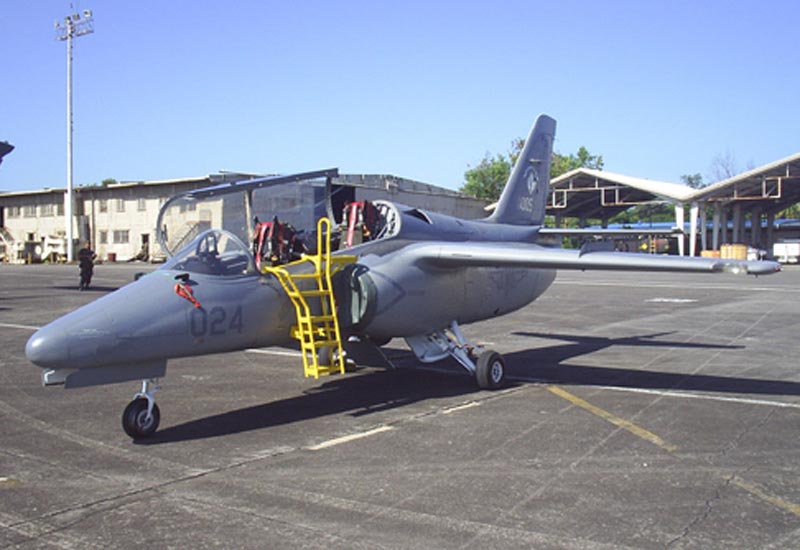
Externally, the S-211/S.211 is a no-frills platform crewed by two personnel sitting in a tandem arrangement under a single-piece canopy (hinged to the right side). Both crew members sit in Martin-Baker ejection seats while the airframe exhibits very smooth and clean contours from the slim, pointed nose cap to the rear tapered empennage. The tail section features a single vertical tail fin and high-mounted tailplanes with the single engine exhaust port located at the base of the tail unit. The main wing assemblies are shoulder-mounted, allowing underwing ordnance the proper ground clearance. There is noticeable sweep along their leading edges only (less noticeable along the trailing edges). Power is served through a single turbofan installation being aspirated through two small intake openings to either side of the cockpit and exhausted through a single port at the rear. The undercarriage is fully-retractable and consists of a pair of single-wheeled main legs and a single-wheeled nose leg. Construction of the S-211 body is primarily of composites, this making up some 60% of the aircraft and providing for a lighter overall end-product.

Power for the S-211 is served through a single Pratt & Whitney JT15D-4C turbofan engine developing 2,500lbs of thrust. This supplies the airframe with a top speed of over 400 miles per hour. Range is listed at 1,000 miles with a service ceiling of 40,000 feet. Rate-of-climb is reported at 4,200 feet per minute.

In the strike role, the S-211 is cleared to carry several basic, externally-mounted munitions across four underwing hardpoints (though ordnance is limited to ground-attack classes). Up to 1,500lbs of stores can be carried aloft. Munition options include machine gun pods, rocket pods and conventional drop bombs. As the S-211 lacks any nose-mounted internal radar facility, it does not support air-to-air missile weaponry. There is also no standard internal cannon in the base design.

At one point, the S-211 became a possible contender for the United State's JPATS program (Joint Primary Aircraft Training System) which sought to procure a single-minded trainer aircraft for both the USAF and USN. The program began in the early 1990s and concluded in 1995 with the Beechcraft T-6 Texan II selected the winner. The Aermacchi S-211 submission was designated as the "S-211A" and was assisted through the proposal process by the American firm of Grumman/Northrop Grumman. Only two S-211A models were produced for the endeavor and these were refurbished and modified examples of a pair of ex-Haitian Air Force systems.

Aermacchi (now Alenia Aermacchi) attempted an S-211 modernization project in 2004 resulting in the new "M-311". As of 2013, the aircraft is still considered developmental and only two prototypes have been completed. The initial prototype recorded its first flight in June of 2005 and Chile signed on with Alenia Aermacchi to locally-produce the aircraft in Chile for interested South American customers. In May of 2008, Alenia Aermacchi joined with powerhouse Boeing to help market the M-311 worldwide. In 2012, the designation of the M-311 was changed to "M-345".

The Philippine Air Force is the sole operator of the S-211 aircraft today (2012) as Singapore and Haiti have both since given up operations with the type. Haitian S-211s numbered only four aircraft though these were eventually sold off to civilian buyers in the United States. As many as 20 ex-military S-221s have been operated by civilian parties in Australia (Singaporean AF S-211s were actually based in Australia due to fewer airspace restrictions). The Philippine Air Force currently manages a stable of just 5 active service S-211s out of its available 25 airframes.
Text ©2003-2013 www.MilitaryFactory.com • All Rights Reserved • No Reproduction Permitted
MilitaryFactory.com does NOT sell equipment/weaponry. Material presented throughout this website is for historical and entertainment value and should not to be construed as usable for hardware restoration, maintenance or general operation. Please consult manufacturers for such information. Our disclaimer. Email corrections / Comments to MilitaryFactory at Gmail dot com.
Picture of Alenia Aermacchi S-211
View All Images (1)

Specifications for the
Alenia Aermacchi S-211
Advanced Trainer / Light Strike


Country of Origin: Italy
Manufacturer: SIAI-Marchetti / Alenia Aermacchi - Italy
Initial Year of Service: 1984
Production: 58


Focus Model: Alenia Aermacchi S-211
Crew: 2


Length: 30.54ft (9.31m)
Width: 27.66ft (8.43m)
Height: 12.47ft (3.80m)
Weight (Empty): 4,079lbs (1,850kg)
Weight (MTOW): 6,063lbs (2,750kg)


Powerplant: 1 x Pratt & Whitney JT15D-4C turbofan engine developing 2,500lbs of thrust.


Maximum Speed: 414mph (667kmh; 360kts)
Maximum Range: 1,038miles (1,670km)
Service Ceiling: 40,026ft (12,200m; 7.6miles)
Rate-of-Climb: 4,200 feet per minute (1,280m/min)


Hardpoints: 4
Armament Suite:
Variable - up to 1,500lbs of external stores underwing to include gun pods, rocket pods and conventional drop ordnance.


Variants:
S-211 - Initial Production Model Designation; 2 x prototypes completed; 58 examples produced under SIAI-Marchetti label.


S-211A - Proposed variant for US JPATS program; 2 examples modified from ex-Haitian AF models.

M-311 - Modernized, uprated variant; since redesignated to M-345; under Alenia-Aermacchi label.

M-345 - Redesignation of M-311 from 2012 onwards.


Operators:
Australia; Haiti; Philippines; Singapore; United States

ALL AIRCRAFT CATEGORIES

BY DECADE:


1900 to 1909
1910 to 1919
1920 to 1929
1930 to 1939
1940 to 1949
1950 to 1959
1960 to 1969
1970 to 1979
1980 to 1989
1990 to 1999
2000 to 2009
2010 to 2019
2020 to 2029
VIEW ALL
Compare Aircraft


BY TYPE:


Anti-Submarine Warfare (ASW)
Attack Helicopters
Bomber Aircraft
Medium Bombers
Heavy Bombers
Close-Air Support (CAS)
Commercial Aircraft
Dive Bombers
Electronic Warfare Aircraft (EWA)
Experimental / X-Planes
Fighter Aircraft
Floatplane Aircraft
Flying Boat Aircraft
Aerial Refueling Tankers
Helicopters (ALL)
Interceptor Aircraft
Multi-Role Aircraft
Navy Carrier Aircraft
Night Fighters
Reconnaissance / Scout
Search & Rescue (SAR)
Scout Helicopters
Special Purpose
Torpedo Bombers
Trainer Aircraft
Transport Aircraft
Transport Helicopters
Unmanned Aerial Vehicles (UAVs)
Unmanned Combat Air Vehicles (UCAVs)


COLLECTIONS:


4th Generation Fighter Aircraft
5th Generation Fighter Aircraft
US X-Planes
Classic US Warbirds
French Military Helicopters
Grumman "Cats"
Howard Hughes Aircraft
Indian Air Force
Israeli Air Force
Libyan Aircraft
Modern Chinese Aircraft
Modern Chinese Fighters
Modern Military Aircraft
Modern North Korean Aircraft
Modern Trainer Aircraft
Modern US Aircraft
Mikoyan Aircraft
Sukhoi Aircraft
Syrian Aircraft
Top 10 Fighter Aircraft of All Time


AIRCRAFT BY CONFLICT:


Arab-Israeli War (1948)
Cuban Missile Crisis (1959-1962)
Falklands War (1982)
Indo-Pak War (1965, 1971)
Iran-Iraq War (1980-1988)
Lebanon War (1982)
Operation Allied Force (1999)
Operation Desert Storm (1991)
Six Day War (1967)
Spanish Civil War (1936)
Soviet-Afghan War (1979-1989)
Yom Kippur War (1973)


MISCELLANEOUS:


Aircraft Cockpits
Aircraft Manufacturers List
Aircraft Production
Aircraft Timeline

WORLD WAR 2:


1939 Aircraft
1940 Aircraft
1941 Aircraft
1942 Aircraft
1943 Aircraft
1944 Aircraft
1945 Aircraft
1946 Aircraft
Australian Aircraft
Battle of Britain Aircraft
Bombers
Four-Engine Bombers
British Aircraft
British Bombers
British Transports
Dive Bombers
Canadian Aircraft
Fighters
Chinese Aircraft
French Aircraft
German Aircraft
German Fighters
German Flying Boats
German Jets
Secret Weapons of the Luftwaffe
Italian Aircraft
Imperial Japanese Aircraft
Imperial Japanese Fighters
Mitsubishi Bombers
Navy Aircraft
Pearl Harbor
Polish Aircraft
Romanian Aircraft
US Aircraft
US Bombers
US Navy Aircraft
Soviet Aircraft
Torpedo Bombers
Trainer Aircraft
Transport Aircraft
Tuskegee Airmen Aircraft
W.A.S.P. Aircraft
WW2 Aircraft Ranked by Speed
VIEW ALL


WORLD WAR 1:


1914 Aircraft
1915 Aircraft
1916 Aircraft
1917 Aircraft
1918 Aircraft
Aircraft Timeline
Austro-Hungarian Aircraft
Bomber Aircraft
British Aircraft
Fighters
Flying Boats
French Aircraft
Imperial German Aircraft
Italian Aircraft
Scout Aircraft
Russian Empire Aircraft
US Aircraft
WW1 Aircraft Ranked by Speed
VIEW ALL


KOREAN WAR:


Australian Aircraft
Korean War Aces
Korean War Jets
North Korean Aircraft
US Military Aircraft
VIEW ALL


VIETNAM WAR:


Helicopters (ALL)
Transport Helicopters
North Vietnam Air Force
US Airpower
VIEW ALL


COLD WAR:


1950s French Aircraft
British V-Bombers
Cold War Bombers
Soviet Aircraft
Soviet Bombers
Soviet Interceptors
Soviet Helicopters
Strategic Air Command
US Aircraft
US Bombers
US Interceptors
VIEW ALL

Site Disclaimer | Privacy Policy | Site Map | MF Origins


©2013 www.MilitaryFactory.com • Content ©2003-2013 MilitaryFactory.com • All Rights Reserved • Site Contact Email: militaryfactory at gmail dot com. The "Military Factory" name and MilitaryFactory.com logo are registered ® trademarks and protected by all applicable domestic and international intellectual property laws.


Top MF Stuff: 2013 Military Pay Scale | Military Ranks | WW2 Weapons | Sniper Rifles | Kts to Mph | WW1 Aircraft | Automatic Rifles | Aircraft Cockpits | Vietnam War Weapons | Main Battle Tanks | Submachine Guns | Shotguns | French Military Victories


Most photographic images appearing on this site are courtesy of the United States Department of Defense and are approved for public use. Other images acquired through the public domain. Digital art work courtesy of Dan Alex. Business Consulting by Kyle Williams. Material presented throughout this website is for historical and entertainment value and should not to be construed as usable for hardware restoration, maintenance or general operation. Please consult manufacturers for such information.


eXTReMe Tracker