For decades the Japanese Ground Self-Defense Force (JGSDF) has made use of the American Hughes OH-6 "Cayuse" light observation helicopter in the reconnaissance role. Better known as the "Loach", the nimble single-engined aircraft served in similar roles with a bevy of nations around the globe. The OH-6 was produced in Japan locally under the Kawasaki brand label as the OH-6J and the follow-up OH-6D. The former was based on the Loach whilst the latter stemmed from the similar Hughes 500D model. Some 387 examples were produced by Kawasaki of which around 100 300 are in active operational service as of this writing (2012).
Thought eventually gave way to design and development of an indigenous light scout helicopter solution in the 1980s and this gave rise to the OH-X helicopter program. As competitions go, the program was responded to by Fuji, Kawasaki and Mitsubishi of which all submitted proposals. Ultimately, Japanese authorities selected the Kawasaki submission as the winner of the OH-X competition in September of 1992, to which it ordered prototypes under the XOH-1 designation. The aircraft has since garnered the nickname of "Ninja". Kawasaki represented the prime contractor of the XOH-1 with subcontractors Fuji ad Mitsubishi in tow (each managing a 20% stake in the project).
First flight of the XOH-1 pilot vehicle was on August 6th, 1996. five more prototypes then followed and these successfully completed initial testing the next year. After successfully completing the required tests, the JSDF formally adopted the XOH-1 as the OH-1 (the designation change coming in late 1996), scheduling serial production to begin in 1998. At the outset, the JGSDF suggested their procurement order maybe several hundred aircraft though this may not be realized amidst current budgetary constraints. As such, deliveries of OH-1s have been slow with less than 50 aircraft completed to date (2012).
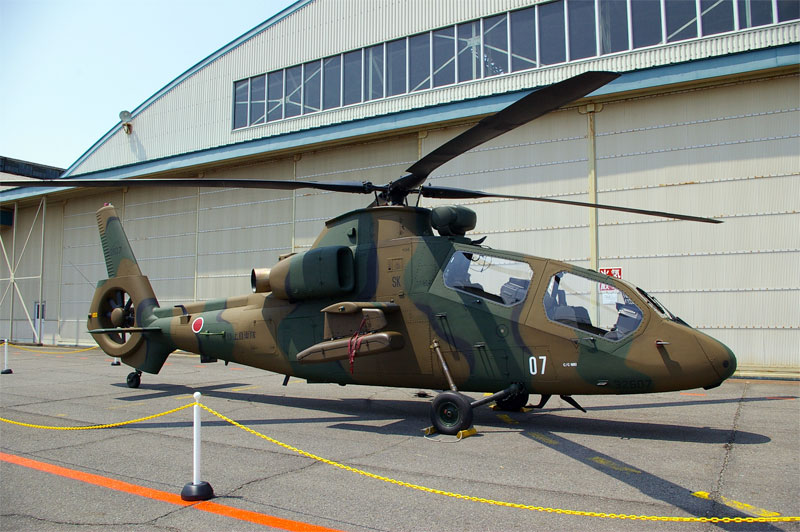
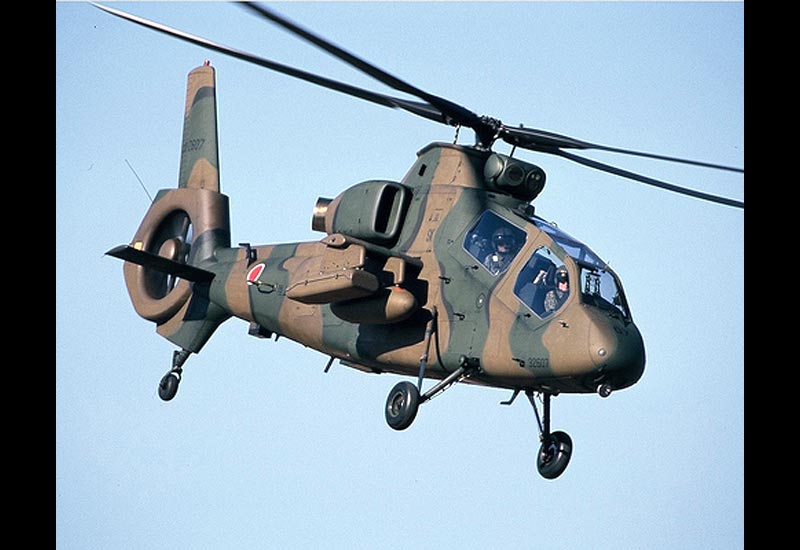
The OH-1 showcases an all-modern appearance and utilizes well-established design concepts found on other military helicopters worldwide. The aircraft is crewed by two specialists seated in tandem with the pilot in the rear elevated cockpit and the weapons officer in the lower front cockpit. The nose assembly is short and well-contoured for good vision for the pilot and efficient aerodynamic qualities. As the pilots are seated in tandem, the fuselage can be made very slim and thusly promote a smaller forward profile. The engines are fitted in nacelles to either side of the fuselage, well aft of the cockpits. The four-bladed main rotor assembly sits low against the top of the fuselage while the tail rotor is shrouded in a Fenestron assembly which helps to reduce its noise output. The empennage is essentially a stem emanating from the main fuselage bulk with horizontal planes set to either side of the tail just ahead of the Fenestron fitting. Atop the tail rotor is the vertical tail fin. Wing stub assemblies are fitted to either side of the fuselage just aft of the pilot's cockpit. These can support four hardpoints for various ordnance layouts or external fuel stores. Armament is variable and can be a mix of missiles, rocket pods, cannon pods and gun pods as needed. The OH-1 does not make use of a chin-mounted turret or optics fairing common to other military helicopter designs. There does exist an optics blister above and behind the pilot's cockpit, just forward of the main rotor mast. The undercarriage is consistent with other military helicopter offerings, presenting two single-wheeled main landing gear legs extending from the forward fuselage sides and a single-wheeled tail unit at the base of the tail rotor assembly. Wire cutters (required in low-level urban flight) are noted ahead of the optical sight mount and under the cockpit floor.
Internally, the OH-1 sports some advanced technology. It relies on nearly 40% of its airframe being built from composites for a lighter overall weight. However, the blades are protected against 20mm shells. The cockpit is all-glass with a LCD monitors and dual HOCAS control systems. The pilot's cockpit is given a HUD (Heads-Up Display) that relays pertinent mission and performance parameters without the operator having to remove his view from the action ahead. In all, the OH-1 supplies the Japanese Army with a modern and capable combat support system which can work in conjunction with its existing fleet of Hughes AH-64DJP Apache and Bell Ah-1 Cobra attack helicopters in the armed scout or support roles.
The Kawasaki OH-1 is being used to succeed Hughes OH-6 light observation units in service with the JGSDF.
March 2019 - The OH-1 Ninja is in the running to satisfy a Japanese Defense requirement for a New Attack Helicopter (NAH).
March 2019 - After a three-year grounding period, which resulted in considerable upgrading plan for the Mitsubishi TSI turboshaft engines, the OH-1 series is being returned to active duty with the JGSDF.
Power & Performance Those special qualities that separate one aircraft design from another. Performance specifications presented assume optimal operating conditions for the Kawasaki OH-1 Ninja Reconnaissance / Observation Helicopter.
2 x Mitsubishi Heavy Industries (MHI) TS1-M-10 turboshaft engines developing 890 horsepower each driving a four-blade main rotor and fenestron shrouded tail rotor. Propulsion
173 mph 278 kph | 150 kts Max Speed
16,076 ft 4,900 m | 3 miles Service Ceiling
336 miles 540 km | 292 nm Operational Range
Structure The nose-to-tail, wingtip-to-wingtip physical qualities of the Kawasaki OH-1 Ninja Reconnaissance / Observation Helicopter.
2 (MANNED) Crew
39.4 ft 12.00 m O/A Length
38.1 ft (11.60 m) O/A Width
12.5 ft (3.80 m) O/A Height
5,401 lb (2,450 kg) Empty Weight
8,818 lb (4,000 kg) MTOW
Armament Available supported armament and special-mission equipment featured in the design of the Kawasaki OH-1 Ninja Reconnaissance / Observation Helicopter .
Variable - dependent upon mission type. Includes a mix of air-to-surface missiles, rocket pods, gun pods, and cannon pods as required.
Variants Notable series variants as part of the Kawasaki OH-1 Ninja family line.
XOH-1 - Prototype Designation; six examples produced.
OH-1 - Base Series Designation.
AH-2 - Proposed dedicated attack helicopter variant based in the OH-1; not furthered.
Operators Global customers who have evaluated and/or operated the Kawasaki OH-1 Ninja. Nations are displayed by flag, each linked to their respective national aircraft listing.
Total Production: 40 Units Contractor(s): Kawasaki - Japan
[ Japan ]
1 / 2
Image courtesy pf Wikipedia user los688 via Wikipedia; released to the public domain
The "Military Factory" name and MilitaryFactory.com logo are registered ® U.S. trademarks protected by all applicable domestic and international intellectual property laws. All written content, illustrations, and photography are unique to this website (unless where indicated) and not for reuse/reproduction in any form. Material presented throughout this website is for historical and entertainment value only and should not to be construed as usable for hardware restoration, maintenance, or general operation. We do not sell any of the items showcased on this site. Please direct all other inquiries to militaryfactory AT gmail.com. No A.I. was used in the generation of this content.