Military Factory
Military Pay Chart
Global Firepower
Military Industrial Complex
Second World War
Home
Military Pay Scale
Military Ranks
Small Arms
Aircraft
Land Systems
Navy
Education
Military Factory Facebook Logo
flag of Russia

Yakovlev Yak-130 (Mitten) Advanced Trainer / Light Strike (2010)

Authored By Staff Writer | Last Updated: 4/25/2013

Despite entering service with the Russian Air Force in 2009, overall quantitative deliveries of the Yak-130 have been slow.

Advanced jet-powered trainers with secondary strike roles are becoming an ever more growing presence on the modern battlefield due to their initial procurement costs (this usually in some great number), long-term maintenance costs and inherent dual-role functionality. Such aircraft allow a potential operator the ability to train all-new generations of airmen while maintaining a limited attack capability in their fleet of lightweight systems - making them highly appealing to budget-concious interested parties. The Yak-130 (NATO: "Mitten") is Yakovlev's entry into the crowded field, bringing with it a strong company lineage dating back to 1934 and modern-minded modular capabilities that have primarily garnered it the interest of the Russian Air Force to date. Irkut Corporation handles manufacture of the Yak-130 though an export-minded derivative for Western clients is also being developed as the M-346 "Master" under the Alenia Aermacchi brand label of Italy.

One of the key qualities of aircraft systems like the relatively new Yak-130 is the ability to recreate the operating environment and handling of modern fighting jets. For the Russian Air Force, this also includes mimicking the qualities of their upcoming Sukhoi T-50 PAK FA 5th Generation high-performance stealth fighter as well as current 4th Generation mounts already in inventory. The PAK FA stealth fighter is a direct competitor to the American F-22 Raptor and only one of a now-growing number of such aircraft in the world. Similarly, the Chinese are working on their Chengdu J-20 twin engine initiative.

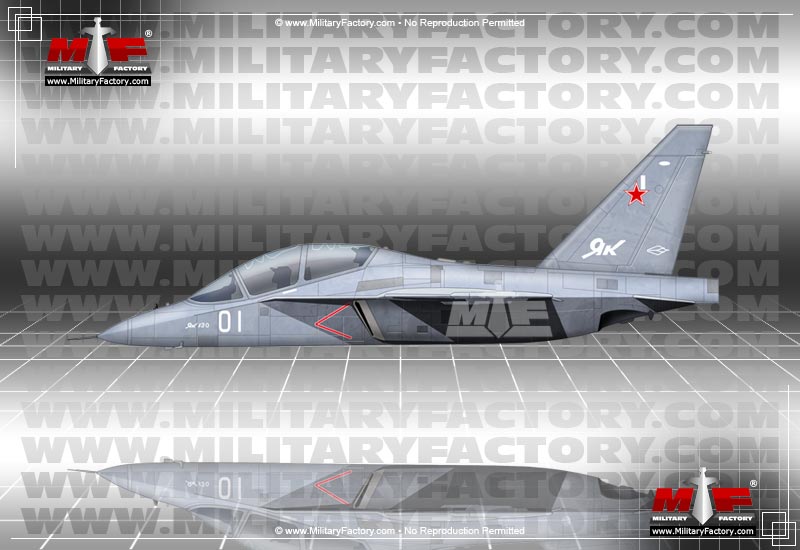
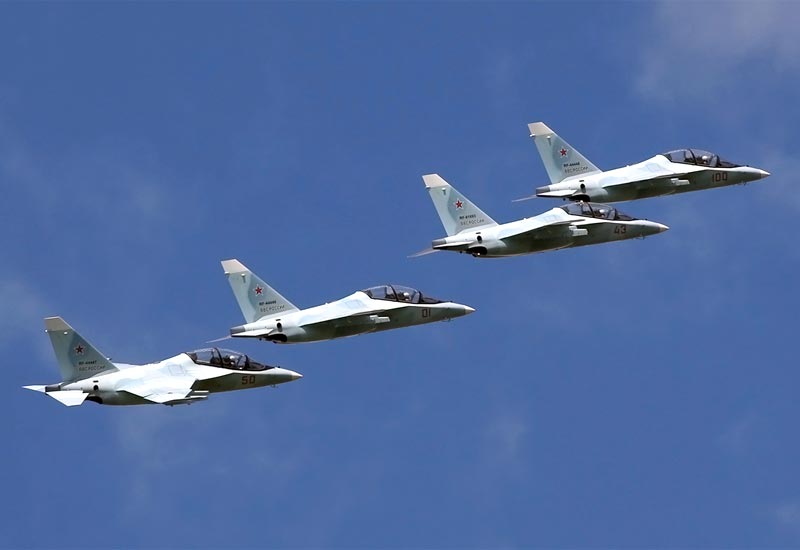
Design of the Yak-130 is highly conventional for aircraft of this class yet wholly modern. The fuselage is well-contoured for the high-performance role, featuring a pointed beak-like nose cone assembly, forward-set cockpit and dual-engine layout. In two-seat versions of the aircraft, the pilots sit in tandem with the student (primary) pilot in the front cockpit and the instructor (secondary) pilot in the rear cockpit. Both benefit from the aircraft's use of a large unobstructed canopy which rewards with excellent vision to all regions of the aircraft save for the slightly blocked rear view due to the fuselage's spine. The wings stem from extended forward root edges along each cockpit side and are lightly-swept along the leading edges and straight along their trailing edges, both assemblies able to support up to 3,000 kilograms of external ordnance with the two innermost hardpoints being plumbed for fuel jettisonable fuel stores. The Yak-130 makes use of a pair of conventional horizontal tailplanes and a single vertical tail fin, the latter emanating from above and between the two exhaust ports. The dual-engine layout is aspirated by a pair of well-recessed, oblong air intakes fitted to either side (and aft) of the rear-most cockpit area. The undercarriage is fully retractable in the usual sense and consists of two single-wheeled main landing gear legs and a single-wheeled nose landing gear leg. As detailed below, the Yak-130 comes in a twin-seat form and a single-seat form, the latter for more dedicated roles.

The Yak-130 is powered by a pair of Progress AI-222-25 series turbofans with each installation rated up to 5,500lbs of thrust. These supply the airframe with a listed top speed of 644 miles per hour (cruise speed is in the general vicinity of 550 miles per hour) while the aircraft's internal fuel allows for an operational range of 1,600 miles. Its pressurized cabin and high-thrust engines allows operations up to 42,600 feet. Rate-of-climb is a reported 10,000 feet-per-minute.

While inherently a two-seat advanced jet trainer first, the Yak-130 retains a somewhat limited - albeit still potent - capability to launch self-supported strikes against both ground and air target thanks to its multirole nature. The two-seat approach ultimately divides mission loads between the two pilots in the attack role while also bringing along a "second pair of eyes" beyond that of just the single pilot (as well as any onboard sensor equipment being fitted). Light strikes serve such a lightweight airframe well as the multi-faceted wings can take on mixed ordnance loads that include air-to-air missiles, air-to-ground missiles, anti-radar missiles, laser-guided munitions, conventional drop bombs, gun pods and rocket pods as well as additional fuel stores (this across nine external hard points, three under each wing). A modern approach to design ensures quick turn-around times between sorties and compatibility with the latest in Russian military hardware. Beyond its light strike role, the Yak-130 can also be outfitted with various sensor and surveillance equipment to undertake general reconnaissance as needed. Such flexibility is at the heart of advanced trainer/light strike mounts like the Yak-130 and copied across like-type aircraft all over the world.

First flight of the Yak-130 was recorded on April 26th, 1996 and, after several years of extended testing, evaluation and finalization, the Yak-130 was formally introduced into service with the Russian Air Force in February of 2010 at the cost of $15 million per unit. To date, 27 aircraft have been delivered with 11 having since entered service with the Russian Air Force in July of 2009. Russia maintains a standing order of several dozen aircraft and is expected to procure several hundred before the end. It is noteworthy that one Yak-130 was already lost to accident in May of 2010 though both pilots were able to eject safely. Beyond its service with the Russian Air Force, the Yak-130 has piqued the interest of the air forces of Algeria, Vietnam and Syria with as many as a dozen more or so "potential" customers possibly upcoming (according to manufacturer Irkut). To date (2012), Algeria manages 16 of the type while Vietnam has put on order 8 examples. Syria stands to become the largest foreign operator of the aircraft (and is a long standing Soviet/Russian customer) and has settled on an order for 36 aircraft. However, current civil upheaval across the country now brings in doubt as to their actual deliverable status. Similarly, an order for six Yak-130 aircraft to Libya has been stalled when internal political events disrupted government functions in 2011. The purchase is in queue for formal review along with several other standing military orders by the transition government.

At any rate, the Yak-130 will come about at a time when many-an-air force will seek to update outgoing, outmoded aircraft of the same classification. For Uruguay this potentially means replacing their decades-old fleet of Cessna A-37 "Dragonfly" straight-wing, dual-role aircraft while, for the United States Air Force, this means formal retirement of their long-running Northrop T-38 Talon jet-powered trainers. The USAF was at one time mentioned as a potential customer for the Yak-130 derivative - the in-development Alenia Aermacchi M-346 "Master" - for its USAF T-X competition. While a long-shot to have made any progress in the upcoming competition, it has since been ruled out by Irkut. The deal would have been potentially massive, with 350 initial T-38 Talons being replaced and the final numbers could have reached 1,000 units in time. As it stands, the Yak-130/M-346 will not be in competition to become the USAF's next primary jet trainer - other potential candidates include the Lockheed/KAI T-50 "Golden Eagle" and the British BAe "Hawk" and Boeing is also said to be in the running with an all-new design. Saab is another mentioned party though while becoming a long shot to compete, their entry a possible Gripen-based design.

There are four major versions within the Yak-130 family and this includes the basic trainer which is identified simply as the "Yak-130". The Yak-130 represents the basic twin-seat advanced trainer with secondary strike facilities. The Yak-131 is a more defined strike platform sans the second (instructor's) cockpit position to allow for more internal volume (fuel, avionics). The Yak-133 is a dedicated single-seat reconnaissance mount. The Yak-135 is the most interesting version of all, featuring seating for four persons in the VIP transport role.
Text ©2003-2013 www.MilitaryFactory.com • All Rights Reserved • No Reproduction Permitted
MilitaryFactory.com does NOT sell equipment/weaponry. Material presented throughout this website is for historical and entertainment value and should not to be construed as usable for hardware restoration, maintenance or general operation. Please consult manufacturers for such information. Our disclaimer. Email corrections / Comments to MilitaryFactory at Gmail dot com.
Picture of Yakovlev Yak-130 (Mitten)
View All Images (1)

Specifications for the
Yakovlev Yak-130 (Mitten)
Advanced Trainer / Light Strike


Country of Origin: Russia
Manufacturer: Yakovlev / Irkut Corporation - Russia
Initial Year of Service: 2010
Production: 170


Focus Model: Yakovlev Yak-130 (Mitten)
Crew: 2


Length: 37.73ft (11.5m)
Width: 31.82ft (9.70m)
Height: 15.62ft (4.76m)
Weight (Empty): 10,141lbs (4,600kg)
Weight (MTOW): 22,708lbs (10,300kg)


Powerplant: 2 x Progress AI-222-25 turbofan engines developing 5,500lbs thrust each.


Maximum Speed: 652mph (1,050kmh; 567kts)
Maximum Range: 1,578miles (2,540km)
Service Ceiling: 41,010ft (12,500m; 7.8miles)
Rate-of-Climb: 10,000 feet per minute (3,048m/min)


Hardpoints: 9
Armament Suite:
Mixed ordnance capability of air-to-air/air-to-ground missiles, guided munitions, rocket pods, gun pods, conventional drop ordnance and jettisonable fuel tanks.


Variants:
Yak-130 - Base Trainer Variant; dual inline seating for dual-control student/trainer functionality.


Yak-131 - Single-Seat Light Strike Variant

Yak-133 - Dedicated Reconnaissance Platform

Yak-135 - Four-seat VIP transport variant


Operators:
Algeria; Bangladesh; Belarus; Mongolia; Russia; Syria; Vietnam

ALL AIRCRAFT CATEGORIES

BY DECADE:


1900 to 1909
1910 to 1919
1920 to 1929
1930 to 1939
1940 to 1949
1950 to 1959
1960 to 1969
1970 to 1979
1980 to 1989
1990 to 1999
2000 to 2009
2010 to 2019
2020 to 2029
VIEW ALL
Compare Aircraft


BY TYPE:


Anti-Submarine Warfare (ASW)
Attack Helicopters
Bomber Aircraft
Medium Bombers
Heavy Bombers
Close-Air Support (CAS)
Commercial Aircraft
Dive Bombers
Electronic Warfare Aircraft (EWA)
Experimental / X-Planes
Fighter Aircraft
Floatplane Aircraft
Flying Boat Aircraft
Aerial Refueling Tankers
Helicopters (ALL)
Interceptor Aircraft
Multi-Role Aircraft
Navy Carrier Aircraft
Night Fighters
Reconnaissance / Scout
Search & Rescue (SAR)
Scout Helicopters
Special Purpose
Torpedo Bombers
Trainer Aircraft
Transport Aircraft
Transport Helicopters
Unmanned Aerial Vehicles (UAVs)
Unmanned Combat Air Vehicles (UCAVs)


COLLECTIONS:


4th Generation Fighter Aircraft
5th Generation Fighter Aircraft
US X-Planes
Classic US Warbirds
French Military Helicopters
Grumman "Cats"
Howard Hughes Aircraft
Indian Air Force
Israeli Air Force
Libyan Aircraft
Modern Chinese Aircraft
Modern Chinese Fighters
Modern Military Aircraft
Modern North Korean Aircraft
Modern Trainer Aircraft
Modern US Aircraft
Mikoyan Aircraft
Sukhoi Aircraft
Syrian Aircraft
Top 10 Fighter Aircraft of All Time


AIRCRAFT BY CONFLICT:


Arab-Israeli War (1948)
Cuban Missile Crisis (1959-1962)
Falklands War (1982)
Indo-Pak War (1965, 1971)
Iran-Iraq War (1980-1988)
Lebanon War (1982)
Operation Allied Force (1999)
Operation Desert Storm (1991)
Six Day War (1967)
Spanish Civil War (1936)
Soviet-Afghan War (1979-1989)
Yom Kippur War (1973)


MISCELLANEOUS:


Aircraft Cockpits
Aircraft Manufacturers List
Aircraft Production
Aircraft Timeline

WORLD WAR 2:


1939 Aircraft
1940 Aircraft
1941 Aircraft
1942 Aircraft
1943 Aircraft
1944 Aircraft
1945 Aircraft
1946 Aircraft
Australian Aircraft
Battle of Britain Aircraft
Bombers
Four-Engine Bombers
British Aircraft
British Bombers
British Transports
Dive Bombers
Canadian Aircraft
Fighters
Chinese Aircraft
French Aircraft
German Aircraft
German Fighters
German Flying Boats
German Jets
Secret Weapons of the Luftwaffe
Italian Aircraft
Imperial Japanese Aircraft
Imperial Japanese Fighters
Mitsubishi Bombers
Navy Aircraft
Pearl Harbor
Polish Aircraft
Romanian Aircraft
US Aircraft
US Bombers
US Navy Aircraft
Soviet Aircraft
Torpedo Bombers
Trainer Aircraft
Transport Aircraft
Tuskegee Airmen Aircraft
W.A.S.P. Aircraft
WW2 Aircraft Ranked by Speed
VIEW ALL


WORLD WAR 1:


1914 Aircraft
1915 Aircraft
1916 Aircraft
1917 Aircraft
1918 Aircraft
Aircraft Timeline
Austro-Hungarian Aircraft
Bomber Aircraft
British Aircraft
Fighters
Flying Boats
French Aircraft
Imperial German Aircraft
Italian Aircraft
Scout Aircraft
Russian Empire Aircraft
US Aircraft
WW1 Aircraft Ranked by Speed
VIEW ALL


KOREAN WAR:


Australian Aircraft
Korean War Aces
Korean War Jets
North Korean Aircraft
US Military Aircraft
VIEW ALL


VIETNAM WAR:


Helicopters (ALL)
Transport Helicopters
North Vietnam Air Force
US Airpower
VIEW ALL


COLD WAR:


1950s French Aircraft
British V-Bombers
Cold War Bombers
Soviet Aircraft
Soviet Bombers
Soviet Interceptors
Soviet Helicopters
Strategic Air Command
US Aircraft
US Bombers
US Interceptors
VIEW ALL

Site Disclaimer | Privacy Policy | Site Map | MF Origins


©2013 www.MilitaryFactory.com • Content ©2003-2013 MilitaryFactory.com • All Rights Reserved • Site Contact Email: militaryfactory at gmail dot com. The "Military Factory" name and MilitaryFactory.com logo are registered ® trademarks and protected by all applicable domestic and international intellectual property laws.


Top MF Stuff: 2013 Military Pay Scale | Military Ranks | WW2 Weapons | Sniper Rifles | Kts to Mph | WW1 Aircraft | Automatic Rifles | Aircraft Cockpits | Vietnam War Weapons | Main Battle Tanks | Submachine Guns | Shotguns | French Military Victories


Most photographic images appearing on this site are courtesy of the United States Department of Defense and are approved for public use. Other images acquired through the public domain. Digital art work courtesy of Dan Alex. Business Consulting by Kyle Williams. Material presented throughout this website is for historical and entertainment value and should not to be construed as usable for hardware restoration, maintenance or general operation. Please consult manufacturers for such information.


eXTReMe Tracker