Military Factory
Military Pay Chart
Global Firepower
Military Industrial Complex
Second World War
Home
Military Pay Scale
Military Ranks
Small Arms
Aircraft
Land Systems
Navy
Education
Military Factory Facebook Logo
flag of Nazi Germany

Focke-Wulf Fw 191 Medium Bomber (1942)

Authored By Staff Writer | Last Updated: 1/31/2013

Three Focke-Wulf Fw 191 bomber prototypes were completed before the program was cancelled in full.

Find a School Near You
Follow Military Factory on Facebook:
Trending on Military Factory:
Recent Articles:
Little MF Logo
Little MF Logo
Little MF Logo
Little MF Logo
Little MF Logo
Little MF Logo
Little MF Logo
Little MF Logo
Little MF Logo
Little MF Logo
The Fw 191 was the Focke-Wulf submission to the German Air Ministry's "Bomber B" program of 1939. Authorities were sold on the concept of high-speed bombers ("schnellbombers") and envisioned fleets of these medium-class, multi-engined aircraft reaching targets all across England from German-held bases across the Channel and able to outrun and trailing adversary. The Fw 191 was certainly a sound design though issues with the required technology (many of its facilities were to be electrically-driven) and engines delayed the project before it was finally doomed altogether along with the Bomber B initiative itself. Only three prototypes were ever completed.

Several major German concerns were in play for the Bomber B requirement and these represented by Arado, Dornier, Junkers and Focke-Wulf. The Arado concept was dropped from contention while slow work was committed to the Dornier submission. Only the Junkers and Focke-Wulf proposals were seriously furthered. The German requirement called for a few specifics such as a pressurized cabin for the flight crew, remote-controlled armament, all-new engine designs (to be provided by either Junkers or Daimler-Benz), a top speed of 600 kmh, excellent endurance over land and water and an internal/external ordnance load of up to 8,800lbs. Focke-Wulf, largely remembered for their excellent Fw 190 single-seat, single-engine fighter of World War 2, proposed their Fw 191 - a twin-engined, multi-crew offering incorporating the many concepts the German Air Ministry sought.

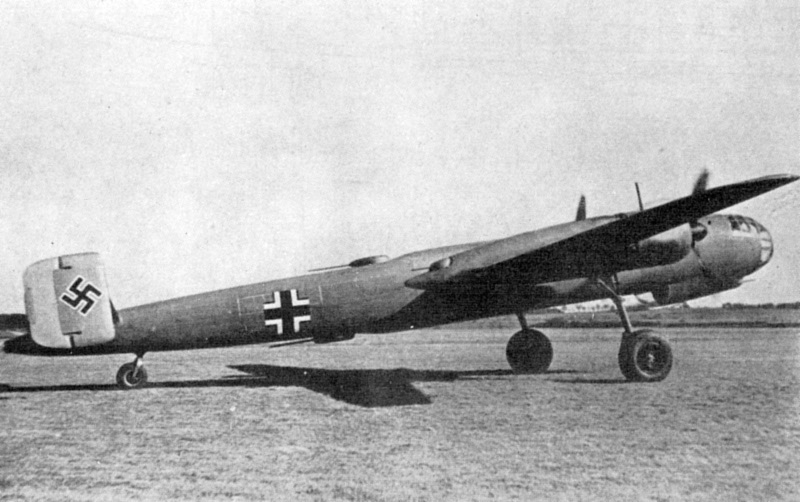
Externally, the Fw 191 fielded a pencil-like, well-streamlined fuselage with its cockpit integrated into the airflow as seen in the German Heinkel He 111 medium bomber (and later in the American Boeing B-29 Superfortress). This allowed for an all-glazed nose section with no cockpit "stepping" to break up the design. Since the crew was amassed in the forward portion of the aircraft, this non-stepped cockpit approach made crew communication excellent and visibility out of the cockpit relatively good. The fuselage tapered at the rear and this was capped by twin outboard vertical tail fins. Wings were fitted at the center of the design and high-mounted for good ground clearance. Engines were fitted into streamlined nacelles along each wing leading edge, the nacelles running past the trailing edges. The undercarriage was wholly retractable to, again, maintain strong airflow about the aircraft. The configuration included two single-wheeled main legs and a single-wheeled tail leg. An internal bomb bay was situated at the center of the airframe while hardpoints inboard of each engine nacelle were considered. As defensive armament was intended to be largely remotely-controlled from within the fuselage, there was a dorsal and ventral turret as well as rear-facing guns at the aft section of each engine nacelle. A tail turret was imagined at the extreme rear of the airframe between the twin vertical fins to counter any pursuing threats. A chin-mounted turreted cannon was also optional and this woudl protect the vulnerable front from head-on attacks by the enemy. Armament would consist of a collection of 7.92mm MG 81 machine guns (2 x chin, 1 x each engine nacelle), 13mm MG 131 machine guns (2 x dorsal turret, 2 x ventral turret) and MG 151/20 cannons (1 x dorsal turret, 1 x ventral turret).

The Fw 191 airframe itself was a strong applicant for the Bomber B program exhibiting speed through its basic appearance. However, the required heavy use of electrics required equally heavy reliance on generators and motors. This not only added weight to the growing design but also made for a more complex engineering end-product. The design was eventually evolved through simplification processes that went on to include conventional manned gun positions (the nacelle guns were dropped altogether) and proven hydraulic and mechanical features began replacing the intended electronically-powered facilities. Despite a more lightened design, the aircraft still suffered from being underpowered - the Junkers Jumo 222 series engines not proving up to the task (the Daimler-Benz offering eventually went abandoned). These program limitations eventually netted just the three Fw 191 prototypes recognized simply as "V1", "V2" and "V6". Additional prototypes intended to solve several key issues were also envisioned though none of these came to pass. By this time in the war, the German situation had changed for the worse and commitments were given to other, more defensive-minded programs. With the end of the Bomber B program, the Fw 191 fell to the pages of military aviation obscurity - joining a plethora of other promising German designs of World War 2.

Performance estimates for the Fw 191 (prototype V6) included a top speed of 620 kmh with a range of 2,240 miles - both within the scope of the Bomber B requirements. The airframe would have featured a service ceiling of approximately 31,800 feet to which a pressurized cabin would have assisted the crew though a later project rewrite eventually dismissed the complicated pressurization equipment altogether. The Fw 191 was to field 9,240lbs of internal and external ordnance including conventional drop bombs and possibly torpedoes - the later for the maritime strike role over water.
Text ©2003-2013 www.MilitaryFactory.com • All Rights Reserved • No Reproduction Permitted
MilitaryFactory.com does NOT sell equipment/weaponry. Material presented throughout this website is for historical and entertainment value and should not to be construed as usable for hardware restoration, maintenance or general operation. Please consult manufacturers for such information. Our disclaimer. Email corrections / Comments to MilitaryFactory at Gmail dot com.
Picture of Focke-Wulf Fw 191
View All Images (1)

Specifications for the
Focke-Wulf Fw 191
Medium Bomber


Country of Origin: Nazi Germany
Manufacturer: Focke-Wulf - Nazi Germany
Initial Year of Service: 1942
Production: 3


Focus Model: Focke-Wulf Fw 191
Crew: 3


Length: 60.53ft (18.45m)
Width: 82.02ft (25.00m)
Height: 15.75ft (4.80m)
Weight (Empty): 26,455lbs (12,000kg)
Weight (MTOW): 42,990lbs (19,500kg)


Powerplant: 2 x Junkers Jumo 222 liquid-cooled inline piston engines developing 2,000 horsepower each.


Maximum Speed: 385mph (620kmh; 335kts)
Maximum Range: 2,237miles (3,600km)
Service Ceiling: 31,824ft (9,700m; 6.0miles)
Rate-of-Climb: 1,200 feet per minute (366m/min)


Hardpoints: 2
Armament Suite:
STANDARD:
2 x 7.92mm MG 81 machine guns in chin turret
2 x 7.92mm MG 81 machine guns in remote-controlled rear nacelle turrets.
1 x 20mm MG 151/20 cannon and 2 x 13mm MG 131 machine guns in dorsal turret.
1 x 20mm MG 151/20 cannon and 2 x 13mm MG 131 machine guns in ventral turret.

OPTIONAL:
2 x torpedoes
Up to 9,240lbs of internal stores.


Variants:
Fw 191 - Base Series Designation


Fw 191 V1 - Initial prototype; BMW 801A engines of 1,540 horsepower.

Fw 191 V2 - Second prototype

Fw 191 V3 - Proposed prototype

Fw 191 V4 - Proposed prototype

Fw 191 V5 - Proposed prototype

Fw 191 V6 - Final revised prototype; Junkers Jumo 222 engines of 2,170 horsepower.

Fw 191 V7 - Abandoned prototype

Fw 191 V8 - Abandoned prototype

Fw 191 V9 - Abandoned prototype

Fw 191 V10 - Abandoned prototype

Fw 191 V11 - Abandoned prototype

Fw 191 V12 - Abandoned prototype

Fw 191 V13 - Proposed prototype with Daimler Benz DB 606/610 coupled engines.

Fw 191A - Proposed initial production designation

Fw 191B - Revised Fw 191 production designation


Operators:
Nazi Germany

ALL AIRCRAFT CATEGORIES

BY DECADE:


1900 to 1909
1910 to 1919
1920 to 1929
1930 to 1939
1940 to 1949
1950 to 1959
1960 to 1969
1970 to 1979
1980 to 1989
1990 to 1999
2000 to 2009
2010 to 2019
2020 to 2029
VIEW ALL
Compare Aircraft


BY TYPE:


Anti-Submarine Warfare (ASW)
Attack Helicopters
Bomber Aircraft
Medium Bombers
Heavy Bombers
Close-Air Support (CAS)
Commercial Aircraft
Dive Bombers
Electronic Warfare Aircraft (EWA)
Experimental / X-Planes
Fighter Aircraft
Floatplane Aircraft
Flying Boat Aircraft
Aerial Refueling Tankers
Helicopters (ALL)
Interceptor Aircraft
Multi-Role Aircraft
Navy Carrier Aircraft
Night Fighters
Reconnaissance / Scout
Search & Rescue (SAR)
Scout Helicopters
Special Purpose
Torpedo Bombers
Trainer Aircraft
Transport Aircraft
Transport Helicopters
Unmanned Aerial Vehicles (UAVs)
Unmanned Combat Air Vehicles (UCAVs)


COLLECTIONS:


4th Generation Fighter Aircraft
5th Generation Fighter Aircraft
US X-Planes
Classic US Warbirds
French Military Helicopters
Grumman "Cats"
Howard Hughes Aircraft
Indian Air Force
Israeli Air Force
Libyan Aircraft
Modern Chinese Aircraft
Modern Chinese Fighters
Modern Military Aircraft
Modern North Korean Aircraft
Modern Trainer Aircraft
Modern US Aircraft
Mikoyan Aircraft
Sukhoi Aircraft
Syrian Aircraft
Top 10 Fighter Aircraft of All Time


AIRCRAFT BY CONFLICT:


Arab-Israeli War (1948)
Cuban Missile Crisis (1959-1962)
Falklands War (1982)
Indo-Pak War (1965, 1971)
Iran-Iraq War (1980-1988)
Lebanon War (1982)
Operation Allied Force (1999)
Operation Desert Storm (1991)
Six Day War (1967)
Spanish Civil War (1936)
Soviet-Afghan War (1979-1989)
Yom Kippur War (1973)


MISCELLANEOUS:


Aircraft Cockpits
Aircraft Manufacturers List
Aircraft Production
Aircraft Timeline

WORLD WAR 2:


1939 Aircraft
1940 Aircraft
1941 Aircraft
1942 Aircraft
1943 Aircraft
1944 Aircraft
1945 Aircraft
1946 Aircraft
Australian Aircraft
Battle of Britain Aircraft
Bombers
Four-Engine Bombers
British Aircraft
British Bombers
British Transports
Dive Bombers
Canadian Aircraft
Fighters
Chinese Aircraft
French Aircraft
German Aircraft
German Fighters
German Flying Boats
German Jets
Secret Weapons of the Luftwaffe
Italian Aircraft
Imperial Japanese Aircraft
Imperial Japanese Fighters
Mitsubishi Bombers
Navy Aircraft
Pearl Harbor
Polish Aircraft
Romanian Aircraft
US Aircraft
US Bombers
US Navy Aircraft
Soviet Aircraft
Torpedo Bombers
Trainer Aircraft
Transport Aircraft
Tuskegee Airmen Aircraft
W.A.S.P. Aircraft
WW2 Aircraft Ranked by Speed
VIEW ALL


WORLD WAR 1:


1914 Aircraft
1915 Aircraft
1916 Aircraft
1917 Aircraft
1918 Aircraft
Aircraft Timeline
Austro-Hungarian Aircraft
Bomber Aircraft
British Aircraft
Fighters
Flying Boats
French Aircraft
Imperial German Aircraft
Italian Aircraft
Scout Aircraft
Russian Empire Aircraft
US Aircraft
WW1 Aircraft Ranked by Speed
VIEW ALL


KOREAN WAR:


Australian Aircraft
Korean War Aces
Korean War Jets
North Korean Aircraft
US Military Aircraft
VIEW ALL


VIETNAM WAR:


Helicopters (ALL)
Transport Helicopters
North Vietnam Air Force
US Airpower
VIEW ALL


COLD WAR:


1950s French Aircraft
British V-Bombers
Cold War Bombers
Soviet Aircraft
Soviet Bombers
Soviet Interceptors
Soviet Helicopters
Strategic Air Command
US Aircraft
US Bombers
US Interceptors
VIEW ALL

Site Disclaimer | Privacy Policy | Site Map | MF Origins


©2013 www.MilitaryFactory.com • Content ©2003-2013 MilitaryFactory.com • All Rights Reserved • Site Contact Email: militaryfactory at gmail dot com. The "Military Factory" name and MilitaryFactory.com logo are registered ® trademarks and protected by all applicable domestic and international intellectual property laws.


Top MF Stuff: 2013 Military Pay Scale | Military Ranks | WW2 Weapons | Sniper Rifles | Kts to Mph | WW1 Aircraft | Automatic Rifles | Aircraft Cockpits | Vietnam War Weapons | Main Battle Tanks | Submachine Guns | Shotguns | French Military Victories


Most photographic images appearing on this site are courtesy of the United States Department of Defense and are approved for public use. Other images acquired through the public domain. Digital art work courtesy of Dan Alex. Business Consulting by Kyle Williams. Material presented throughout this website is for historical and entertainment value and should not to be construed as usable for hardware restoration, maintenance or general operation. Please consult manufacturers for such information.


eXTReMe Tracker