Military Factory
Military Pay Chart
Global Firepower
Military Industrial Complex
Second World War
Home
Military Pay Scale
Military Ranks
Small Arms
Aircraft
Land Systems
Navy
Education
Military Factory Facebook Logo
flag of United Kingdom

Avro Lincoln Long-Range Heavy Bomber (1945)

Authored By Captain Jack | Last Updated: 2/14/2013

The Avro Lincoln series of British four-engined heavy bombers arrived too late to see action in World War 2.

Find a School Near You
Follow Military Factory on Facebook:
Trending on Military Factory:
Recent Articles:
The Avro Lincoln became a late-World War 2, four-engined heavy bomber developed form the hugely successful Avro Lancaster series. The Lancaster headed the British Royal Air Force's (RAF) night-bombing campaign against the Axis which, coupled with the daytime campaign of the Americans, allowed for the disruption of German war-making capabilities. The Avro Lincoln itself initially emerged as the Lancaster B.Mk IV and the B.Mk V though both were redesignated as the Lincoln B.Mk I and B.Mk II respectively when the Lancaster design was considerably modified to merit the change. The Lincoln was born from Air Ministry Specification B.14/43 which originally called for a twin-engined medium-class bomber for operations in the Far East which promised to extend into 1946.

The Lancaster design was given an increased high-aspect ratio wingspan along with an elongated fuselage assembly and a new nose to produce the Lancaster B.Mk IV. The nose accommodated a Boulton Paul powered turret fitting 2 x .50 caliber Browning heavy machine guns. Initial models were fitted with 4 x two-stage Rolls-Royce Merlin 85 series inline engines of 1,750 horsepower each housed in underslung nacelles, two engines to a wing. The B.Mk IV then became the start of the new Lincoln series of heavy bombers as the Lincoln B.Mk I. Following another increase in wingspan and a further lengthening of the fuselage, the Lincoln B.Mk II model was born and these were powered by 4 x Rolls-Royce Merlin 66, 68A or 300 inline engines throughout their service lives.

First flight of a Lincoln prototype occurred on June 9th, 1944, now designed to Air Ministry Specification 14/43. Three prototypes would eventually be built under the company designation of Type 694. The aircraft showcased an increased operational range as well as an improved operational service ceiling which allowed it to operate further from friendly bases and farther from enemy ground attack installations. The Lincoln was quickly adopted by the RAF and production lines set up at three Avro facilities in Chadderton, Cheshire and Woodford. To help with wartime demand for such aircraft, Armstrong Whitworth and Vickers Metropolitan both were eventually awarded with additional manufacture of the Avro product. The Royal Australian Air Force (RAAF) was eventually granted local license production of the Lincoln I to which it knew as the Lincoln B.Mk 30 and modified with Rolls-Royce Merlin 85 engines. However, these did not appear until after the war.

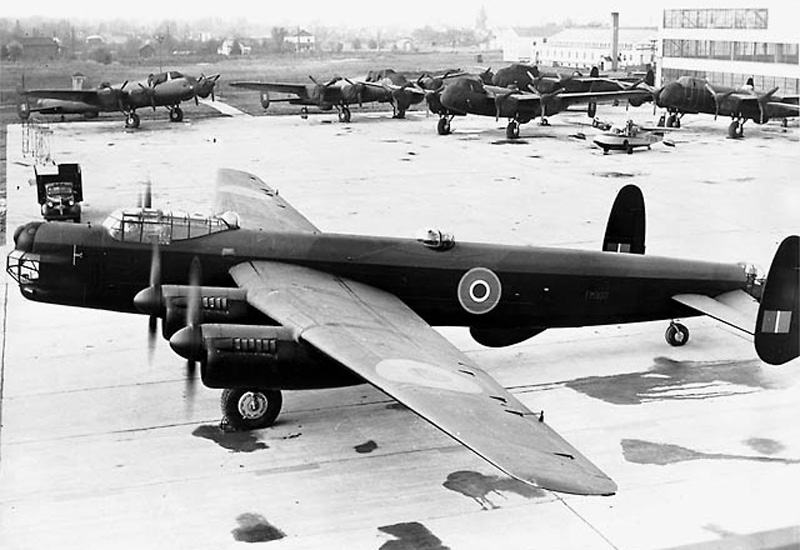
Outwardly, the Lincoln looked very much as an enlarged Lancaster. The design centered along the boxy squared-off tapered fuselage form to which high-mounted wings and a split-vertical tail fin was added. Each wing managed a pair of engines in streamlined nacelles and within easy view of the crew. The cockpit consisted of a heavily glazed covering with the crew set slightly aft of the nose. The nose was also windowed and sported the typical Avro bulb-like shape. The undercarriage was made up of two main landing gear legs, each mounting a large donut-style wheel, while the tail was supported by a single-wheeled leg. This gave the Lincoln a pronounced "nose-up" appearance when at rest. The internal bomb bay took over a large internal portion of the fuselage, the doors running from under the flightdeck to amidships. The standard operating crew involved seven personnel made up of two pilots, the navigator, radio operator, bombardier/nose gunner, a dorsal gunner and a tail gunner.

The Lincoln was defensed through a network of machine gun fittings. This included a nose turret with 2 x 0.50 caliber machine guns, a tail turret with 2 x 0.50 caliber machine guns and a dorsal turret with either 2 x 0.50 caliber machine guns or 2 x 20mm Hispano cannons. The internal bomb load capacity of the original B.Mk I was approximately 14,000lbs under general conditions.

Similarly, RAF Lincolns missed out on combat service in World War 2 altogether. The first Lincoln bomber arrived to No. 57 Squadron of East Kirby in 1945 and they were joined in August by No. 75 (New Zealand) Squadron RAF. The Empire of Japan capitulated in August of 1945 and the formal surrender occurred in early September, bringing an end to hostilities in the Asia-Pacific Theater for the interim. However, a great threat loomed in the Soviet Union which ushered in its communist government wherever it could. As such, the RAF continued accepting deliveries of the Lincoln which now formed a critical long-range bombing arm during the tumultuous Cold War years to follow. Some 32 RAF squadrons would eventually field some form of the Lincoln with many primarily acting as a deterrent to Soviet actions across Europe. Some were also converted to aerial tankers for inflight refueling. The RAF fielded their Lincolns in anger against pro-communist forces over Kenya (against Mau Mau rebels during the Kenyan Emergency, 1952-1960) and over Malaya (during the Malayan Emergency, 1948-1960). RAF Lincolns were lastly used as reconnaissance platforms during the Aden Emergency (1963-1967).

Australian Lincoln bombers formed with No. 82 Wing RAAF out of Amberley and, by mid-March of 1949, four squadrons constituted the type (a total of seven eventually operated Lincolns). Australian Lincolns were produced locally and operated alongside their British counterparts over Malaya before their ultimate retirement in 1961. Beyond the basic B.Mk 30 long-range bomber form, the RAAF also utilized the B.Mk 30A heavy bomber variant which incorporated a lengthened nose and Rolls-Royce Merlin 102 series engines. The B.Mk 31 became a dedicated maritime patrol and anti-submarine warfare (ASW) platform.

The Royal Canadian Air Force operated just three Avro Lincolns from 1946 into 1948. The end of World War 2 curtailed any need for procurement of an expensive heavy bomber. Local production (by Victor Aircraft) netted just one aircraft.

The Avro Lincoln was purchased in number by the Argentine Air Force beginning in 1947 and these functioned up until 1965. These Lincolns proved useful in their given heavy bomber role and were used as such against rebel counter-government forces in the September 1951 coup attempt. In the 1955 revolution, the bomber was fielded by both government and rebel forces. The last frontline Lincoln in Argentine service was officially removed in 1967.

Beyond the dedicated Lincoln B.Mk I/B.Mk 30 and B.Mk II long-range heavy bomber forms, the series saw a few notable variants trialed or produced: the Lincoln III was a proposed maritime reconnaissance platform also intended for anti-submarine warfare (ASW) which, modified extensively as the Lincoln ASR.Mk 3 , became the Avro Shackleton instead . The Lincoln B.Mk IV was the Lincoln B.Mk II bomber upgraded with Rolls-Royce Merlin 85 engines. The Avro 695 "Lincolnian" was a dedicated transport variant of the Lincoln bomber, its ordnance-carrying capabilities dropped in favor of more internal space for cargo.

In all, production of Avro Lincolns reached 604 examples. A.V. Roe handled 168 of the total while Vickers added another 80. However, Armstrong Whitworth (Coventry) was responsible for a bulk of production which totaled 281 examples. 73 examples came from Australian facilities. The long-running Cold War reach of Lincolns ensured their place in military aviation history. All were given up by the RAF due to age and were eventually superseded by the new generation of large, jet-powered heavy bombers no en vogue across many militaries of the world. For other operators, the type was simply dropped from service without replacement.
Text ©2003-2013 www.MilitaryFactory.com • All Rights Reserved • No Reproduction Permitted
MilitaryFactory.com does NOT sell equipment/weaponry. Material presented throughout this website is for historical and entertainment value and should not to be construed as usable for hardware restoration, maintenance or general operation. Please consult manufacturers for such information. Our disclaimer. Email corrections / Comments to MilitaryFactory at Gmail dot com.
Picture of Avro Lincoln
View All Images (1)

Specifications for the
Avro Lincoln
Long-Range Heavy Bomber


Country of Origin: United Kingdom
Manufacturer: Avro - A.V. Roe; Metropolitan-Vickers; Armstrong Whitworth - UK
Initial Year of Service: 1945
Production: 604


Focus Model: Avro Lincoln B.Mk I
Crew: 7


Length: 78.28ft (23.86m)
Width: 120.01ft (36.58m)
Height: 17.29ft (5.27m)
Weight (Empty): 43,400lbs (19,686kg)
Weight (MTOW): 82,173lbs (37,273kg)


Powerplant: 4 x Rolls-Royce Merlin 85 V inline piston engines developing 1,750 horsepower each.


Maximum Speed: 295mph (475kmh; 256kts)
Maximum Range: 2,933miles (4,720km)
Service Ceiling: 30,495ft (9,295m; 5.8miles)
Rate-of-Climb: 800 feet per minute (244m/min)


Hardpoints: 0
Armament Suite:
STANDARD:
2 x 0.50 caliber Browning heavy machine guns in nose turret.
2 x 0.50 caliber Browning heavy machine guns in tail turret.
2 x 2 x 0.50 caliber Browning heavy machine guns OR 20mm Hispano cannons in dorsal turret.


OPTIONAL:
Up to 14,000lbs of internal stores.


Variants:
Type 694 - Original Avro company model designation


Lincoln I - Initial Lincoln bomber production model based on the Lancaster B.Mk IV development; powered by 4 x Rolls-Royce Merlin 85 engines of 1,750 horsepower each.

Lincoln II - Second bomber variant; powered by 4 x Rolls-Royce Merlin 66, 68A or 300 engines.

Lincoln III - Proposed maritime reconnaissance platform with anti-submarine warfare (ASW) capabilities); to become the Avro Shackleton.

Lincoln IV - Lincoln Mk II bombers fitted with Rolls-Royce Merlin 85 engines.

Lincoln Mk 15 (B Mk XV) - Single Canadian production example.

Lincoln Mk 30 - Australian bomber local production designation.

Lincoln Mk 30A - Australian bomber local production designation; lengthened nose section; Rolls-Royce Merlin 102 engines.

Lincoln Mk 31 - Dedicated Australian maritime patrol and anti-submarine warfare variant.

Avro 695 Lincolnian - Dedicated transport variant of the Lincoln bomber.

Lincoln ASR.Mk III - Proposed maritime patrol/ASW aircraft; to become the Avro Shackleton.


Operators: Argentina; Australia; Canada; United Kingdom

ALL AIRCRAFT CATEGORIES

BY DECADE:


1900 to 1909
1910 to 1919
1920 to 1929
1930 to 1939
1940 to 1949
1950 to 1959
1960 to 1969
1970 to 1979
1980 to 1989
1990 to 1999
2000 to 2009
2010 to 2019
2020 to 2029
VIEW ALL
Compare Aircraft


BY TYPE:


Anti-Submarine Warfare (ASW)
Attack Helicopters
Bomber Aircraft
Medium Bombers
Heavy Bombers
Close-Air Support (CAS)
Commercial Aircraft
Dive Bombers
Electronic Warfare Aircraft (EWA)
Experimental / X-Planes
Fighter Aircraft
Floatplane Aircraft
Flying Boat Aircraft
Aerial Refueling Tankers
Helicopters (ALL)
Interceptor Aircraft
Multi-Role Aircraft
Navy Carrier Aircraft
Night Fighters
Reconnaissance / Scout
Search & Rescue (SAR)
Scout Helicopters
Special Purpose
Torpedo Bombers
Trainer Aircraft
Transport Aircraft
Transport Helicopters
Unmanned Aerial Vehicles (UAVs)
Unmanned Combat Air Vehicles (UCAVs)


COLLECTIONS:


4th Generation Fighter Aircraft
5th Generation Fighter Aircraft
US X-Planes
Classic US Warbirds
French Military Helicopters
Grumman "Cats"
Howard Hughes Aircraft
Indian Air Force
Israeli Air Force
Libyan Aircraft
Modern Chinese Aircraft
Modern Chinese Fighters
Modern Military Aircraft
Modern North Korean Aircraft
Modern Trainer Aircraft
Modern US Aircraft
Mikoyan Aircraft
Sukhoi Aircraft
Syrian Aircraft
Top 10 Fighter Aircraft of All Time


AIRCRAFT BY CONFLICT:


Arab-Israeli War (1948)
Cuban Missile Crisis (1959-1962)
Falklands War (1982)
Indo-Pak War (1965, 1971)
Iran-Iraq War (1980-1988)
Lebanon War (1982)
Operation Allied Force (1999)
Operation Desert Storm (1991)
Six Day War (1967)
Spanish Civil War (1936)
Soviet-Afghan War (1979-1989)
Yom Kippur War (1973)


MISCELLANEOUS:


Aircraft Cockpits
Aircraft Manufacturers List
Aircraft Timeline

WORLD WAR 2:


1939 Aircraft
1940 Aircraft
1941 Aircraft
1942 Aircraft
1943 Aircraft
1944 Aircraft
1945 Aircraft
1946 Aircraft
Australian Aircraft
Battle of Britain Aircraft
Bombers
Four-Engine Bombers
British Aircraft
British Bombers
British Transports
Dive Bombers
Canadian Aircraft
Fighters
Chinese Aircraft
French Aircraft
German Aircraft
German Fighters
German Flying Boats
German Jets
Secret Weapons of the Luftwaffe
Italian Aircraft
Imperial Japanese Aircraft
Imperial Japanese Fighters
Mitsubishi Bombers
Navy Aircraft
Pearl Harbor
Polish Aircraft
Romanian Aircraft
US Aircraft
US Bombers
US Navy Aircraft
Soviet Aircraft
Torpedo Bombers
Trainer Aircraft
Transport Aircraft
Tuskegee Airmen Aircraft
W.A.S.P. Aircraft
WW2 Aircraft Ranked by Speed
VIEW ALL


WORLD WAR 1:


1914 Aircraft
1915 Aircraft
1916 Aircraft
1917 Aircraft
1918 Aircraft
Aircraft Timeline
Austro-Hungarian Aircraft
Bomber Aircraft
British Aircraft
Fighters
Flying Boats
French Aircraft
Imperial German Aircraft
Italian Aircraft
Scout Aircraft
Russian Empire Aircraft
US Aircraft
WW1 Aircraft Ranked by Speed
VIEW ALL


KOREAN WAR:


Australian Aircraft
Korean War Aces
Korean War Jets
North Korean Aircraft
US Military Aircraft
VIEW ALL


VIETNAM WAR:


Helicopters
North Vietnam Air Force
US Airpower
VIEW ALL


COLD WAR:


1950s French Aircraft
British V-Bombers
Cold War Bombers
Soviet Aircraft
Soviet Bombers
Soviet Interceptors
Soviet Helicopters
Strategic Air Command
US Aircraft
US Bombers
US Interceptors
VIEW ALL

Site Disclaimer | Privacy Policy | Site Map | MF Origins


©2013 www.MilitaryFactory.com • Content ©2003-2013 MilitaryFactory.com • All Rights Reserved • Site Contact Email: militaryfactory at gmail dot com. The "Military Factory" name and MilitaryFactory.com logo are registered ® trademarks and protected by all applicable domestic and international intellectual property laws.


Top MF Stuff: 2013 Military Pay Scale | Military Ranks | WW2 Weapons | Sniper Rifles | Kts to Mph | WW1 Aircraft | Automatic Rifles | Aircraft Cockpits | Vietnam War Weapons | Main Battle Tanks | Submachine Guns | Shotguns | French Military Victories


Most photographic images appearing on this site are courtesy of the United States Department of Defense and are approved for public use. Other images acquired through the public domain. Digital art work courtesy of Dan Alex. Business Consulting by Kyle Williams. Material presented throughout this website is for historical and entertainment value and should not to be construed as usable for hardware restoration, maintenance or general operation. Please consult manufacturers for such information.


eXTReMe Tracker