Military Factory
Military Pay Chart
Global Firepower
Military Industrial Complex
Second World War
Home
Military Pay Scale
Military Ranks
Small Arms
Aircraft
Land Systems
Navy
Education
Military Factory Facebook Logo
flag of Imperial Japan

Kawasaki Ki-64 (Rob) Experimental Heavy Fighter (1943)

Authored By Staff Writer | Last Updated: 5/11/2013

First flight of the Kawasaki Ki-64 heavy fighter was undertaken in December of 1943 though the program was ultimately given up for good the following year with only one completed example.

Find a School Near You
Follow Military Factory on Facebook:
Trending on Military Factory:
Recent Articles:
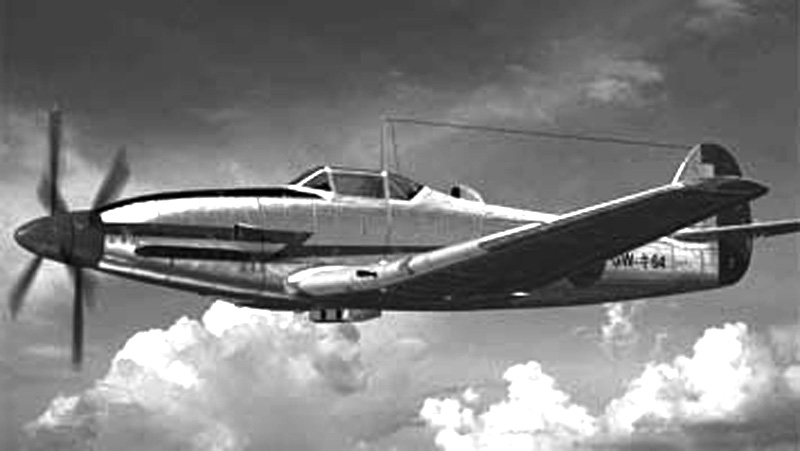
During the height of World War 2 (1939-1945), all major participants undertook various programs to further evolve existing weapons platforms. For the Japanese concern of Kawasaki, a 1943 initiative produced the experimental "Ki-64" single-seat, piston-driven fighter. The type managed to be constructed through only a single prototype offering and the program, as a whole, was abandoned shortly after a test flight ended in a forced landing due to fire. First flight of the Ki-64 was recorded sometime in December of 1943 and the aircraft was codenamed "Rob" by the Allies.

For all intents and purposes, the Ki-64 was of a conventional fighter aircraft design with a unique internal arrangement intended to promote excellent top-line speeds and performance essential to countering developments by the Americans in the Pacific. One of the most notable qualities of the design was its coupling of two Kawasaki Ha-40 Army Type 2 liquid-cooled, inline piston engines which, when mated, was recognized under the designation of "Ha-201". It is noteworthy that the Ha-40 was nothing more than a localized production copy of the excellent German-originated Daimler-Benz DB 601Aa series inline engine powering the equally-excellent Messerschmitt Bf 109 fighter - manufacturing licenses granted to both Kawasaki and Aichi Japanese concerns. The powerplant provided the Kawasaki airframe with an output of some 2,350 horsepower allowing for top speeds of nearly 430 miles per hour and an operating ceiling near 40,000 feet. Range was out to 620 miles with a rate-of-climb of approximately 3,000 feet per minute. The airframe exhibited an empty weight of 9,000lbs and a gross weight of 11,200lbs. Kawasaki classified their Ki-64 as a "heavy" fighter as a result. The Ha-40 was later redesignated to "Ha-60" following the 1944 restructured designation system.

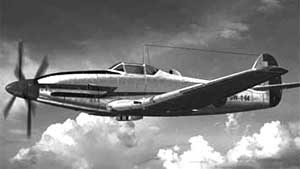
Outwardly, the Ki-64 showcased a basic fighter form including straight, low-mounted wing apendages, a streamlined airframe and single, curved vertical tail fin. The undercarriage was wholly retractable of the "tail dragger" variety. The pilot sat ahead of amidships under a lightly-framed canopy with adequate views of the action. Due to the limited internal volume of the airframe (of slim design profile), one of the Ha-40 engines was fitted ahead of the cockpit in the usual way with the second engine added to a compartment just aft of the cockpit. The rear engine was connected to the forward system via a drive shaft running under the cockpit floor (similar to the American Bell P-39 Airacobra fighter). This allowed full output from both engines to be featured or the ability to fly on a single unit if need be. To the engine pairing was added 2 x three-bladed propeller systems arranged in a contra-rotating fashion, designed to take full advantage of performance output at speed. It is noteworthy that engine output was not combined to both propellers. Instead, the rear engine drove the frontal propeller assembly independently of the front engine driving the rear-set propeller. The forward propeller was of a variable pitch design while the rearward propeller was fixed pitch.

As a fighter intended to tackle enemy fighters in turn as well as Allied bombers pummeling Japanese territorial and mainland installations, Kawasaki considered their Ki-64 with a battery of 4 x 20mm Ho-5 series cannons or 2 x 20mm Ho-5 cannons supplemented by 2 x 12.7mm Ho-103 series heavy machine guns. In either case, this armament array would have been formidable in combat.

Testing of the Ki-64 continued into 1944. During its fifth flight, the rear engine installation erupted into fire which immediately sent the pilot into landing the aircraft. While the landing proved successful without loss of life, the impact of the crash damaged the test frame considerably. This proved an insurmountable setback for the program to which the Ki-64 was dropped from further development, leaving it to the pages of military aviation history.

Like many other programs begun prior to the end of the war in 1945 (be they aircraft or tank), the Ki-64 airframe was eventually captured and overtaken by the advancing Allies. Its design was then handed over to American engineers for study before being discarded to the scrapheap. Thus ended the short-lived reign of the Ki-64 heavy fighter.
Text ©2003-2013 www.MilitaryFactory.com • All Rights Reserved • No Reproduction Permitted
MilitaryFactory.com does NOT sell equipment/weaponry. Material presented throughout this website is for historical and entertainment value and should not to be construed as usable for hardware restoration, maintenance or general operation. Please consult manufacturers for such information. Our disclaimer. Email corrections / Comments to MilitaryFactory at Gmail dot com.
Picture of Kawasaki Ki-64 (Rob)
View All Images (1)

Specifications for the
Kawasaki Ki-64 (Rob)
Experimental Heavy Fighter


Country of Origin: Imperial Japan
Manufacturer: Kawasaki - Imperial Japan
Initial Year of Service: 1943
Production: 1


Focus Model: Kawasaki Ki-64 (Rob)
Crew: 1


Length: 36.09ft (11m)
Width: 44.29ft (13.50m)
Height: 13.94ft (4.25m)
Weight (Empty): 8,929lbs (4,050kg)
Weight (MTOW): 11,244lbs (5,100kg)


Powerplant: 1 x Kawasaki Ha-201 (2 x Ha-40 (Daimler-Benz DB 601Aa inline)) V12 liquid-cooled, inline piston engine developing 2,350 horsepower.


Maximum Speed: 429mph (690kmh; 373kts)
Maximum Range: 621miles (1,000km)
Service Ceiling: 39,370ft (12,000m; 7.5miles)
Rate-of-Climb: 2,900 feet per minute (884m/min)


Hardpoints: 0
Armament Suite:
PROPOSED:
4 x 20mm Ho-5 cannons OR 2 x Ho-5 cannons and 2 x 12.7mm Ho-103 heavy machine guns.


Variants:
Ki-64 - Base Series Designation


Operators: Imperial Japan

ALL AIRCRAFT CATEGORIES

BY DECADE:


1900 to 1909
1910 to 1919
1920 to 1929
1930 to 1939
1940 to 1949
1950 to 1959
1960 to 1969
1970 to 1979
1980 to 1989
1990 to 1999
2000 to 2009
2010 to 2019
2020 to 2029
VIEW ALL
Compare Aircraft


BY TYPE:


Anti-Submarine Warfare (ASW)
Attack Helicopters
Bomber Aircraft
Medium Bombers
Heavy Bombers
Close-Air Support (CAS)
Commercial Aircraft
Dive Bombers
Electronic Warfare Aircraft (EWA)
Experimental / X-Planes
Fighter Aircraft
Floatplane Aircraft
Flying Boat Aircraft
Aerial Refueling Tankers
Helicopters (ALL)
Interceptor Aircraft
Multi-Role Aircraft
Navy Carrier Aircraft
Night Fighters
Reconnaissance / Scout
Search & Rescue (SAR)
Scout Helicopters
Special Purpose
Torpedo Bombers
Trainer Aircraft
Transport Aircraft
Transport Helicopters
Unmanned Aerial Vehicles (UAVs)
Unmanned Combat Air Vehicles (UCAVs)


COLLECTIONS:


4th Generation Fighter Aircraft
5th Generation Fighter Aircraft
US X-Planes
Classic US Warbirds
French Military Helicopters
Grumman "Cats"
Howard Hughes Aircraft
Indian Air Force
Israeli Air Force
Libyan Aircraft
Modern Chinese Aircraft
Modern Chinese Fighters
Modern Military Aircraft
Modern North Korean Aircraft
Modern Trainer Aircraft
Modern US Aircraft
Mikoyan Aircraft
Sukhoi Aircraft
Syrian Aircraft
Top 10 Fighter Aircraft of All Time


AIRCRAFT BY CONFLICT:


Arab-Israeli War (1948)
Cuban Missile Crisis (1959-1962)
Falklands War (1982)
Indo-Pak War (1965, 1971)
Iran-Iraq War (1980-1988)
Lebanon War (1982)
Operation Allied Force (1999)
Operation Desert Storm (1991)
Six Day War (1967)
Spanish Civil War (1936)
Soviet-Afghan War (1979-1989)
Yom Kippur War (1973)


MISCELLANEOUS:


Aircraft Cockpits
Aircraft Manufacturers List
Aircraft Timeline

WORLD WAR 2:


1939 Aircraft
1940 Aircraft
1941 Aircraft
1942 Aircraft
1943 Aircraft
1944 Aircraft
1945 Aircraft
1946 Aircraft
Australian Aircraft
Battle of Britain Aircraft
Bombers
Four-Engine Bombers
British Aircraft
British Bombers
British Transports
Dive Bombers
Canadian Aircraft
Fighters
Chinese Aircraft
French Aircraft
German Aircraft
German Fighters
German Flying Boats
German Jets
Secret Weapons of the Luftwaffe
Italian Aircraft
Imperial Japanese Aircraft
Imperial Japanese Fighters
Mitsubishi Bombers
Navy Aircraft
Pearl Harbor
Polish Aircraft
Romanian Aircraft
US Aircraft
US Bombers
US Navy Aircraft
Soviet Aircraft
Torpedo Bombers
Trainer Aircraft
Transport Aircraft
Tuskegee Airmen Aircraft
W.A.S.P. Aircraft
WW2 Aircraft Ranked by Speed
VIEW ALL


WORLD WAR 1:


1914 Aircraft
1915 Aircraft
1916 Aircraft
1917 Aircraft
1918 Aircraft
Aircraft Timeline
Austro-Hungarian Aircraft
Bomber Aircraft
British Aircraft
Fighters
Flying Boats
French Aircraft
Imperial German Aircraft
Italian Aircraft
Scout Aircraft
Russian Empire Aircraft
US Aircraft
WW1 Aircraft Ranked by Speed
VIEW ALL


KOREAN WAR:


Australian Aircraft
Korean War Aces
Korean War Jets
North Korean Aircraft
US Military Aircraft
VIEW ALL


VIETNAM WAR:


Helicopters
North Vietnam Air Force
US Airpower
VIEW ALL


COLD WAR:


1950s French Aircraft
British V-Bombers
Cold War Bombers
Soviet Aircraft
Soviet Bombers
Soviet Interceptors
Soviet Helicopters
Strategic Air Command
US Aircraft
US Bombers
US Interceptors
VIEW ALL

Site Disclaimer | Privacy Policy | Site Map | MF Origins


©2013 www.MilitaryFactory.com • Content ©2003-2013 MilitaryFactory.com • All Rights Reserved • Site Contact Email: militaryfactory at gmail dot com. The "Military Factory" name and MilitaryFactory.com logo are registered ® trademarks and protected by all applicable domestic and international intellectual property laws.


Top MF Stuff: 2013 Military Pay Scale | Military Ranks | WW2 Weapons | Sniper Rifles | Kts to Mph | WW1 Aircraft | Automatic Rifles | Aircraft Cockpits | Vietnam War Weapons | Main Battle Tanks | Submachine Guns | Shotguns | French Military Victories


Most photographic images appearing on this site are courtesy of the United States Department of Defense and are approved for public use. Other images acquired through the public domain. Digital art work courtesy of Dan Alex. Business Consulting by Kyle Williams. Material presented throughout this website is for historical and entertainment value and should not to be construed as usable for hardware restoration, maintenance or general operation. Please consult manufacturers for such information.


eXTReMe Tracker