Military Factory
Military Pay Chart
Global Firepower
Military Industrial Complex
Second World War
Home
Military Pay Scale
Military Ranks
Small Arms
Aircraft
Land Systems
Navy
Education
Military Factory Facebook Logo
flag of Nazi Germany

Messerschmitt Me 309 Fighter (1942)

Authored By Staff Writer | Last Updated: 4/19/2013

The Messerschmitt Me 309 was intended as a direct successor to the famous Messerschmitt Bf 109 fighter series.

Find a School Near You
Follow Military Factory on Facebook:
Trending on Military Factory:
Recent Articles:
The Messerschmitt Me 309 was one of two fighters (joining the later Me 209-II) developed by the German concern during World War 2 as a successor to the storied Messerschmitt Bf 109. The Bf 109 was introduced to Luftwaffe forces in 1937 and formed the spearhead of all German air actions throughout the war into 1945, being produced in the tens of thousands. The aircraft - a modern single-engined, single-seat monoplane fighter - was then joined by the equally excellent Focke-Wulf Fw 190 of 1941. Together, these two fighters gave German air corps a distinct edge in almost any air battle until matched pound-for-pound by the likes of newer and decidedly evolved Allied offerings.

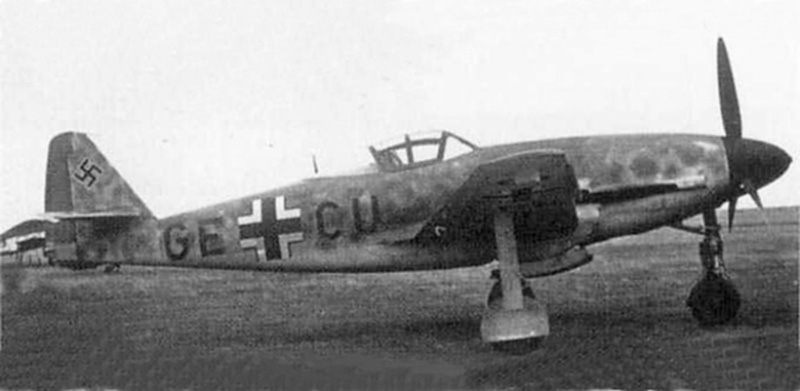
While the German Air Ministry was already satisfied with their Bf 109, Messerschmitt engineers forged ahead with an in-house venture to provide a much-improved form of their aircraft - the new design under the designation of "Me 309". The aircraft would exhibit well-streamlined fuselage containing the engine in a forward compartment, the cockpit at center and a tapered rear with conventional single-rudder arrangement sporting a pair of horizontal planes. Wings were low-mounted, straight with curved tips and set just ahead of amidships. The canopy housed a single pilot under a heavily-framed assembly with adequate views about the aircraft (consistent with the period). The canopy was hinged to open over the right side, entry via the left. No raised fuselage spin meant that a panel of window could added aft of the pilot with good views to the rear. The powerplant of choice became the Daimler-Benx DB 603G series 12-cylinder liquid-cooled inline piston engine of 1,726 horsepower driving a three-bladed propeller assembly. Armament of 2 x 15mm MG 151 cannon and 2 x 13mm MG 131 machine guns would be concentrated in the leading edge of the wing roots. A scoop featured under the fuselage gave the aircraft a distinct, "deep" appearance akin to the North American P-51 Mustang. To contend with high-altitude work, engineers designed the Me309 with a pressurized cockpit from the outset.

One of the more distinct features of the Me 309 aircraft was its use of a tricycle landing gear arrangement at a time when the accepted norm proved to be "tail-dragger" types (the Bell P-39 Airacobra and Lockheed P-38 Lightning were two notable wartime fighters to feature a tricycle arrangement). The undercarriage consisted of two single-wheeled landing gear legs and a single-wheeled nose leg. The main legs retracted inwards towards centerline under each wing while the nose leg utilized a more complicated 90-degree turning retraction scheme.

To keep costs in check, the Me 309 had her more specialized systems trialed on existing Messerschmitt airframes to prove viability. Eventually, these key systems were pressed into her all-new fuselage design and a prototype airframe was completed in early 1942. However, persistent mechanical issues with the complex nose landing gear leg delayed the Me 309's maiden flight until July 18th, 1942. Testing proved the aircraft sound in handling though its overall performance was only marginally better, and this under light testing loads, when compared to the standard frontline Bf 109G models of the time.

With lackluster government support on the program, the Me 309 moved slowly and ultimately languished under the stresses of wartime (resources and talent redirected to priority requirements). With the Bf 109 and Fw 190 series more than enough for the German Air Ministry to focus their fighter groups on, the Me 309 never proved a serious competitor as a replacement option. As such, the program resulted in just four completed prototypes before cancellation.

The Me 209-II proposal of 1943, borrowing more of the existing Bf 109 as a cost-effective gesture, joined the Me 309 by falling to the pages of history with only four prototypes of its own completed before cancellation. Once again, the prototype's performance proved no better than the aircraft it was intended to replace.
Text ©2003-2013 www.MilitaryFactory.com • All Rights Reserved • No Reproduction Permitted
MilitaryFactory.com does NOT sell equipment/weaponry. Material presented throughout this website is for historical and entertainment value and should not to be construed as usable for hardware restoration, maintenance or general operation. Please consult manufacturers for such information. Our disclaimer. Email corrections / Comments to MilitaryFactory at Gmail dot com.
Picture of Messerschmitt Me 309
View All Images (1)

Specifications for the
Messerschmitt Me 309
Fighter


Country of Origin: Nazi Germany
Manufacturer: Messerschmitt - Nazi Germany
Initial Year of Service: 1942
Production: 4


Focus Model: Messerschmitt Me 309
Crew: 1


Length: 31.04ft (9.46m)
Width: 36.09ft (11.00m)
Height: 12.80ft (3.90m)
Weight (Empty): 7,716lbs (3,500kg)
Weight (MTOW): 9,370lbs (4,250kg)


Powerplant: 1 x Daimler-Benz DB 603G inverted V12 liquid-cooled inline piston engine developing 1,726 horsepower.


Maximum Speed: 455mph (733kmh; 396kts)
Maximum Range: 684miles (1,100km)
Service Ceiling: 39,370ft (12,000m; 7.5miles)
Rate-of-Climb: 0 feet per minute (0m/min)


Hardpoints: 0
Armament Suite:
STANDARD:
2 x 14mm MG 151 cannons in wings
2 x 13mm MG 131 heavy machine guns in wings


Variants:
Me 309 - Base Series Designation


Operators: Nazi Germany

ALL AIRCRAFT CATEGORIES

BY DECADE:


1900 to 1909
1910 to 1919
1920 to 1929
1930 to 1939
1940 to 1949
1950 to 1959
1960 to 1969
1970 to 1979
1980 to 1989
1990 to 1999
2000 to 2009
2010 to 2019
2020 to 2029
VIEW ALL
Compare Aircraft


BY TYPE:


Anti-Submarine Warfare (ASW)
Attack Helicopters
Bomber Aircraft
Medium Bombers
Heavy Bombers
Close-Air Support (CAS)
Commercial Aircraft
Dive Bombers
Electronic Warfare Aircraft (EWA)
Experimental / X-Planes
Fighter Aircraft
Floatplane Aircraft
Flying Boat Aircraft
Aerial Refueling Tankers
Helicopters (ALL)
Interceptor Aircraft
Multi-Role Aircraft
Navy Carrier Aircraft
Night Fighters
Reconnaissance / Scout
Search & Rescue (SAR)
Scout Helicopters
Special Purpose
Torpedo Bombers
Trainer Aircraft
Transport Aircraft
Transport Helicopters
Unmanned Aerial Vehicles (UAVs)
Unmanned Combat Air Vehicles (UCAVs)


COLLECTIONS:


4th Generation Fighter Aircraft
5th Generation Fighter Aircraft
US X-Planes
Classic US Warbirds
French Military Helicopters
Grumman "Cats"
Howard Hughes Aircraft
Indian Air Force
Israeli Air Force
Libyan Aircraft
Modern Chinese Aircraft
Modern Chinese Fighters
Modern Military Aircraft
Modern North Korean Aircraft
Modern Trainer Aircraft
Modern US Aircraft
Mikoyan Aircraft
Sukhoi Aircraft
Syrian Aircraft
Top 10 Fighter Aircraft of All Time


AIRCRAFT BY CONFLICT:


Arab-Israeli War (1948)
Cuban Missile Crisis (1959-1962)
Falklands War (1982)
Indo-Pak War (1965, 1971)
Iran-Iraq War (1980-1988)
Lebanon War (1982)
Operation Allied Force (1999)
Operation Desert Storm (1991)
Six Day War (1967)
Spanish Civil War (1936)
Soviet-Afghan War (1979-1989)
Yom Kippur War (1973)


MISCELLANEOUS:


Aircraft Cockpits
Aircraft Manufacturers List
Aircraft Timeline

WORLD WAR 2:


1939 Aircraft
1940 Aircraft
1941 Aircraft
1942 Aircraft
1943 Aircraft
1944 Aircraft
1945 Aircraft
1946 Aircraft
Australian Aircraft
Battle of Britain Aircraft
Bombers
Four-Engine Bombers
British Aircraft
British Bombers
British Transports
Dive Bombers
Canadian Aircraft
Fighters
Chinese Aircraft
French Aircraft
German Aircraft
German Fighters
German Flying Boats
German Jets
Secret Weapons of the Luftwaffe
Italian Aircraft
Imperial Japanese Aircraft
Imperial Japanese Fighters
Mitsubishi Bombers
Navy Aircraft
Pearl Harbor
Polish Aircraft
Romanian Aircraft
US Aircraft
US Bombers
US Navy Aircraft
Soviet Aircraft
Torpedo Bombers
Transport Aircraft
Tuskegee Airmen Aircraft
W.A.S.P. Aircraft
WW2 Aircraft Ranked by Speed
VIEW ALL


WORLD WAR 1:


1914 Aircraft
1915 Aircraft
1916 Aircraft
1917 Aircraft
1918 Aircraft
Aircraft Timeline
Austro-Hungarian Aircraft
Bomber Aircraft
British Aircraft
Fighters
Flying Boats
French Aircraft
Imperial German Aircraft
Italian Aircraft
Scout Aircraft
Russian Empire Aircraft
US Aircraft
WW1 Aircraft Ranked by Speed
VIEW ALL


KOREAN WAR:


Australian Aircraft
Korean War Aces
Korean War Jets
North Korean Aircraft
US Military Aircraft
VIEW ALL


VIETNAM WAR:


Helicopters
North Vietnam Air Force
US Airpower
VIEW ALL


COLD WAR:


1950s French Aircraft
British V-Bombers
Cold War Bombers
Soviet Aircraft
Soviet Bombers
Soviet Interceptors
Soviet Helicopters
Strategic Air Command
US Aircraft
US Bombers
US Interceptors
VIEW ALL

Site Disclaimer | Privacy Policy | Site Map | MF Origins


©2013 www.MilitaryFactory.com • Content ©2003-2013 MilitaryFactory.com • All Rights Reserved • Site Contact Email: militaryfactory at gmail dot com. The "Military Factory" name and MilitaryFactory.com logo are registered ® trademarks and protected by all applicable domestic and international intellectual property laws.


Top MF Stuff: 2013 Military Pay Scale | Military Ranks | WW2 Weapons | Sniper Rifles | Kts to Mph | WW1 Aircraft | Automatic Rifles | Aircraft Cockpits | Vietnam War Weapons | Main Battle Tanks | Submachine Guns | Shotguns | French Military Victories


Most photographic images appearing on this site are courtesy of the United States Department of Defense and are approved for public use. Other images acquired through the public domain. Digital art work courtesy of Dan Alex. Business Consulting by Kyle Williams. Material presented throughout this website is for historical and entertainment value and should not to be construed as usable for hardware restoration, maintenance or general operation. Please consult manufacturers for such information.


eXTReMe Tracker