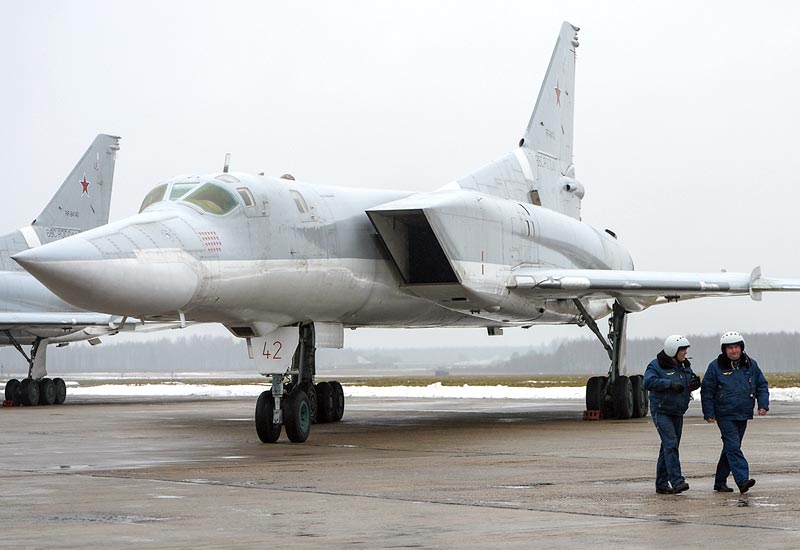
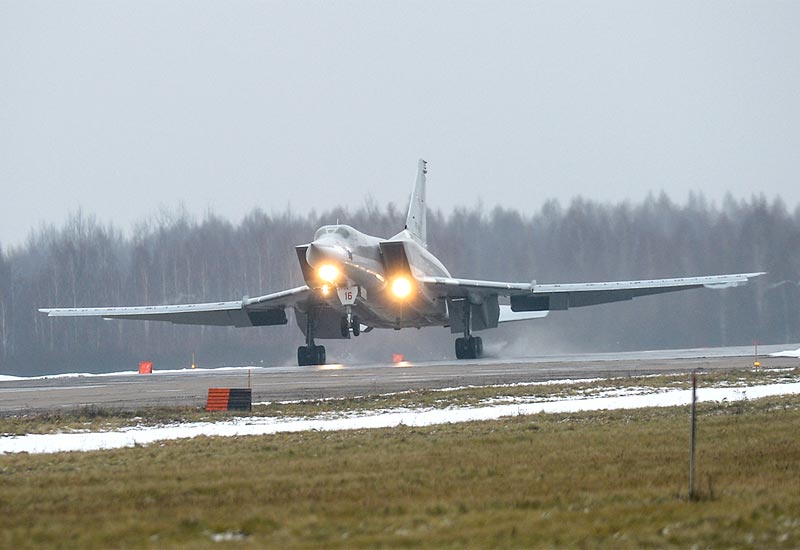
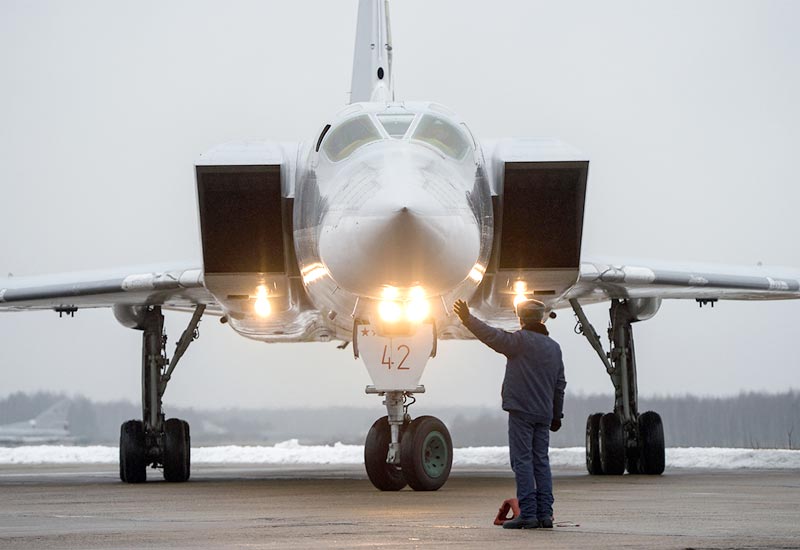
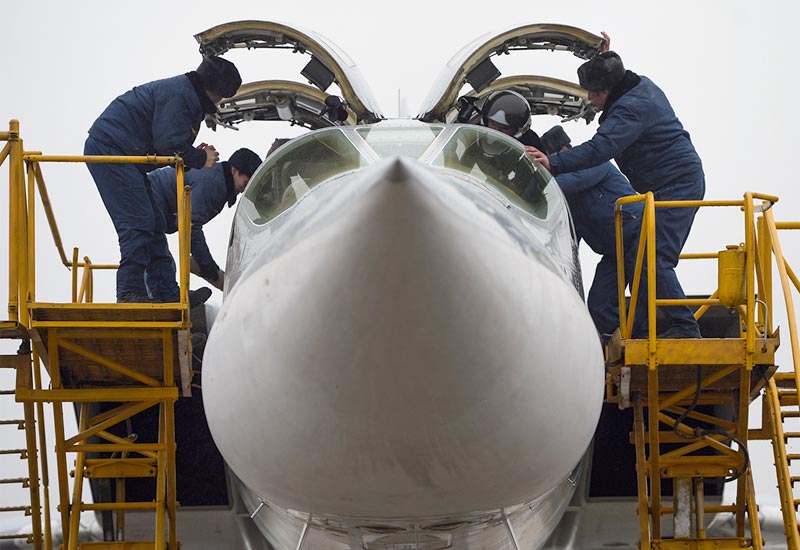
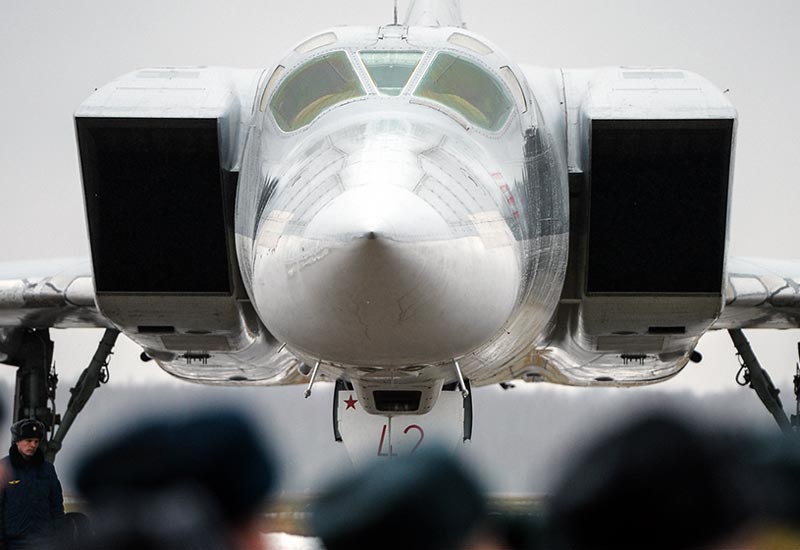
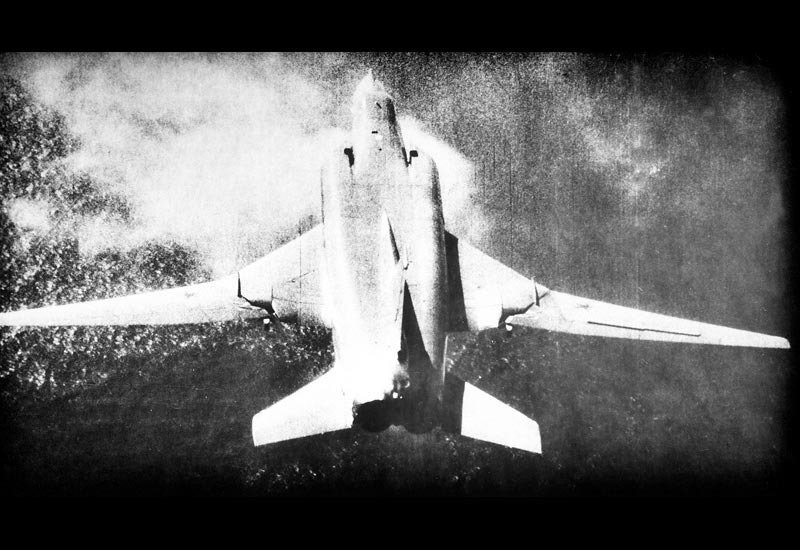
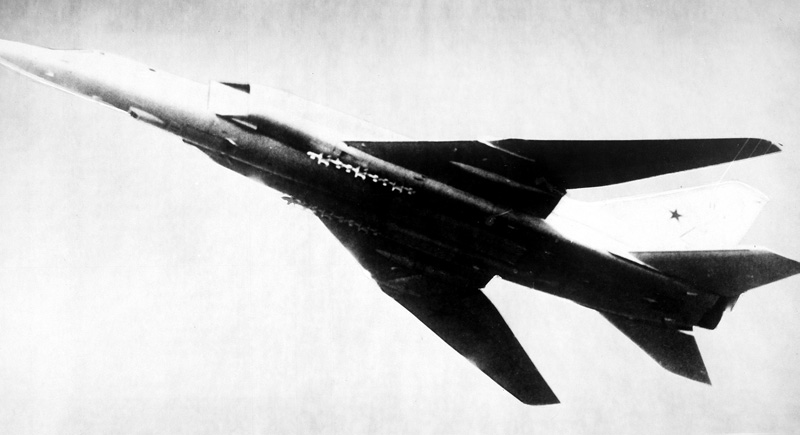
The Tupolev Tu22M "Backfire" was/is a dedicated strategic bombing and maritime strike platform primarily serving Soviet interests (both during the Cold War and even today). The Tu-22M represented a further evolution of the original Tu-22 "Blinder" which failed to impress along many lines. However, the Tu-22M incorporated enough major changes that it could be considered an "all-new" bomber aircraft and brought about improved use of missile armament and supersonic flight as well as introducing variable geometry wings.
While the original supersonic Tupolev Tu-22 "Blinder" medium bomber failed to live to its expectations in replacing the aging Tu-16 "Badger" series, work inevitably began on a "variable-geometry" of the same aircraft. Variable geometry wings were being researched as early as the 1930s and it was the Germans who made good progress on the subject in World War 2. The technology was furthered during the Cold War with the (arguably) best example of this type of aircraft being the American Grumman F-14 Tomcat carrier-based interceptor. Other aircraft to incorporate this technology ultimately included the Rockwell B-1 "Lancer", the General Dynamics F-111 "Aardvark", the MiG-23/MiG-27 "Flogger", the Panavia "Tornado" and the Tupolev Tu-160 "Blackjack". The evolution planned for the Tu-22 was nothing new to Soviet avionics for the Sukhoi Su-7 "Fitter" began life as a fixed-wing fighter aircraft onto to become the swing-wing Su-17/Su-20/Su-22 family of fighter bombers a short time later.
What the original Tu-22 design lacked was inherently poor handling. She proved technologically complex and require high maintenance levels with poor turn-around times. She was a complex beast and, to add insult to injury, proved limited in a performance sense - the Tu-22 actually failed to improve upon the qualities of the subsonic Tu-16 in many respects, essentially labeling itself a disappointment overall. Production of the type totaled just 311 aircraft. The implementation of variable geometry wings would allow the "new" aircraft the ability to adjust its wing planform inflight, in direct response to changing speeds and airflow, providing stability at low and high speeds. The Tupolev concern toyed with the idea of fitting their Tu-22 with swing-wings as early as 1962 and design work on such an airframe began as early as 1962. Ultimately, the firm produced the "Samolyot 145" prototype to test the idea in a practical sense and a formal prototype then emerged as the "Tu-22M0" which took to the air for the first time on August 30th, 1968. After a short evaluation period, the "Tu-22M" was formally adopted for service in the Soviet Air Force. When NATO observers identified the plane as unique (this in September of 1969), it was assigned the incorrect designation of "Tu-26" with the codename of "Backfire", Western observers believing that the Tu-22M was, in fact, an all-new aircraft in the traditional sense. The initial production mark (Tu-22M1) therefore became the "Backfire-A".
The Tu-22M pre-production form was limited to just nine examples while the early Tu-22M1 was produced in another nine examples in 1971. The first truly "definitive" production form therefore became the Tu-22M2 ("Backfire-B") with its NK-22 series turbofan engines. The upcoming Tu-22M3 was given improved NK-25 turbofans and was known under the NATO codename of "Backfire-C" which went online in 1983 (first flying in 1976). A new nav/attack radar was introduced as were other refinements. A rotary missile launcher was installed in the bomb bay and overall performance specifications were improved to an extent. All Tu-22M-capable Tu-22M production models were then upgraded to the more modern Tu-22ME standard. The Tu-22M3 itself was upgraded to the Tu-22M3M mark with new avionics and provision for guided munitions dispensing. Tu-22M2 versions fitted with NK-23 engines were known as Tu-22M2Ye.
The Tu-22M3(R)/Tu-22MR was an ELectronic INTelligence (ELINT) model with specialized equipment for the role. These were born of existing T-22M3 airframes. The Tu-22MP was similar in scope though intended as electronic warfare aircraft (EWA). In all some 497 Tu-22M aircraft were ultimately completed. The type still maintains a presence within the inventory of the Soviet Air Force and Navy. Other operators (though former) went on to include Belarus, India and Ukraine. Though never formally offered up for export to potential customers, the Ukraine inherited the aircraft after the dissolving of the Soviet Empire. India leased their Tu-22Ms from Russia for a short time. Any foreign use has since been discontinued. Ukrainian mounts were scrapped.
Despite its origins in the Tu-22, the Tu-22M included several major design changes that quickly differentiated the type from the former. The outwardly-placed engine nacelles at the base of the vertical tail fin of the Tu-22 were now relocated to a more conventional internal mounting deep within the fuselage. Its positioning there required use of split air intakes - fitted to either side of the fuselage - with applicable duct work to aspirate the new turbofans. Each rectangular intake was managed by variable splitter plates. This alone changed the outward design appearance of the Tu-22 substantially and led Western observers to believe it was an all-new aircraft series. The swept-back wings of the original Tu-22 now gave way to a swept-back pair of variable-geometry assemblies which further differentiated the Tu-22M from the Tu-22. A new undercarriage was also developed to content with the revised airframe. Unlike the T-22, the Tu-22M brought about a copilot to help manage inflight systems, taking some of the stresses away from the principle pilot at the controls. The navigator and weapons officer were retained.
Key to the development of the Tu-22M was the installation of 2 x Kuznetsov NK-25 series turbofan engines, each delivering 55,100lbs of thrust each. In comparison, the original Tu-22 fitted a pair of Dobrynin RD-7M-2 turbojets which supplied up to 36,376lbs of thrust with thirsty afterburners engaged. The Tu-22M therefore managed a top speed of 1,240 miles per hour (Mach 1.88) with a service ceiling of 43,600 feet. Its combat radius was 1,500 miles though this could be further managed through subsonic/supersonic flight as needed.
Armament for the Tu-22M included use of underwing and underfuselage hardpoints as well as the internal weapons bay. The internal weapons also featured a rotary missile launcher. The total ordnance-hauling capacity for the Tu-22M was 52,900lbs and this could include missiles (homing, cruise or anti-ship) or conventional drop bombs. For standard self-defense, the Tu-22M was provided a 1 x 23mm GSh-23 series cannon in a remote-controlled turret at the tail.
To date (2012), the Russian inventory lists some 150 Tu-22Ms in operational service (or service capable) with an additional 90 or so in mothballs.
August 2018 - United Aircraft (UAC) has unveiled an all-modernized version of the Tu-22M in the Tu-22M3M variant. The aircraft has had various critical systems upgrade for new battlefield requirements including avionics, weapons controls, navigation, communications, and Electronic Warfare (EW). Ground and flight trials by the company are underway after which the aircraft will be passed on to the Russian Air Force for formal testing. At least 67 Tu-22M model aircraft remain in operational service with the Russian Air Force.
January 2019 - It was reported that a Tu-22M3 production model had crashed during a landing action in the northwestern region of Murmansk, Russia. Two of the crew members perished with two surviving. The cause of the crash was under investigation.
March 2020 - The modernized Tu-22M3M variant has successfully completed its first flight. This took place on March 20th, 2020.
Power & Performance Those special qualities that separate one aircraft design from another. Performance specifications presented assume optimal operating conditions for the Tupolev Tu-22M Swing-Wing Supersonic Strategic / Maritime Bomber.
2 x Kuznetsov NK-25 turbofan engines developing 55,100lb of thrust each. Propulsion
1,243 mph 2,000 kph | 1,080 kts Max Speed
43,635 ft 13,300 m | 8 miles Service Ceiling
1,498 miles 2,410 km | 1,301 nm Operational Range
Structure The nose-to-tail, wingtip-to-wingtip physical qualities of the Tupolev Tu-22M Swing-Wing Supersonic Strategic / Maritime Bomber.
4 (MANNED) Crew
139.1 ft 42.40 m O/A Length
112.5 ft (34.28 m) O/A Width
36.3 ft (11.05 m) O/A Height
119,050 lb (54,000 kg) Empty Weight
273,373 lb (124,000 kg) MTOW
Armament Available supported armament and special-mission equipment featured in the design of the Tupolev Tu-22M (Backfire) Swing-Wing Supersonic Strategic / Maritime Bomber .
STANDARD:
1 x 23mm GSh-23 remote-controlled cannon in tail turret.
Up to 53,000lb of internal and external stores (underwing and underfuselage) including air-to-surface missiles, anti-ship missiles, conventional drop bombs, laser-guided bombs, and cruise missiles.
Variants Notable series variants as part of the Tupolev Tu-22M (Backfire) family line.
Tu-22M ("Backfire") - Base Series Designation.
Tu-22M0 - Preproduction Models; 9 examples.
Tu-22M1 - Initial low-rate production models; 9 examples.
Tu-22M2 - Definitive production form appearing in 1972; NK-22 series turbofan engines (later forms with NK-23 series engines); redesigned fuselage; lengthened wing assemblies.
Tu-22M2Ye - Tu-22M2 production models fitted with NK-23 series turbofan engines.
Tu-22M3 - Improved Tu-22M appearing in 1983; fitted with NK-25 series turbofan engines; updated nav-attack suite; rotary missile launcher in bomb bay.
Tu-22M3(R)/Tu-22MR - ELINT variant.
Tu-22MP - EWA variant.
Tu-22ME - Updated avionics; no large-scale production/conversion since forthcoming.
Tu-22M3M - Modernized Tu-22M3s with upgraded avionics; support for guided munitions; modifications by United Aircraft (UAC).
Operators Global customers who have evaluated and/or operated the Tupolev Tu-22M (Backfire). Nations are displayed by flag, each linked to their respective national aircraft listing.
Total Production: 497 Units Contractor(s): United Aircraft (UAC) - Russia / Tupolev OKB - Soviet Union
The "Military Factory" name and MilitaryFactory.com logo are registered ® U.S. trademarks protected by all applicable domestic and international intellectual property laws. All written content, illustrations, and photography are unique to this website (unless where indicated) and not for reuse/reproduction in any form. Material presented throughout this website is for historical and entertainment value only and should not to be construed as usable for hardware restoration, maintenance, or general operation. We do not sell any of the items showcased on this site. Please direct all other inquiries to militaryfactory AT gmail.com. No A.I. was used in the generation of this content.