Military Factory
Military Pay Chart
Global Firepower
Military Industrial Complex
Second World War
Home
Military Pay Scale
Military Ranks
Small Arms
Aircraft
Land Systems
Navy
Education
Military Factory Facebook Logo
flag of Nazi Germany

Gotha Go P.60C All-Weather / Nightfighter (1945)

Authored By Staff Writer | Last Updated: 5/14/2013

The Gotha Project 60C jet-powered nightfighter was conceived of in the final months of World War 2.

The Gotha Project 60C nightfighter was another late-war "paper airplane" design attempt intended to defend the Reich from the masses of enemy bombers attacking Germany with impunity in the waning months of World War 2. Like other similar late-war developments of the time, the aircraft was to be powered by turbine jets as well as rocket propulsion for exceptional performance at altitude and it would have been rushed into production should the war have been extended several more months. However, Project 60C never materialized beyond the design stage though many believe that the type would have received the "green light" should the war proceeded beyond the summer of 1945. With that said, no operational examples of the Project 60C were ever produced leaving the aircraft to the pages of military aviation history and nothing more.

By the spring of 1945, the war for Germany was turning into a noticeably losing effort. The daily and nightly Allied bombing campaigns were certainly taking a toll on all sorts of German war-making capabilities and the defense of Germany itself was now the primary concern - the Allies were closing in from the West and East now. As such, the German Air Ministry enacted what would become many last-ditch efforts to try to capitalize on the newfound technologies of rocket and jet propulsion in building a new generation of fighters and bombers. To help counter the Allied bomber scourge raking German infrastructure and factories, the Air Ministry sent forth a new requirement on February 27th, 1945 centering on the development of a specialized jet-powered, all-weather nightfighter. The aircraft would utilize two turbines for high-speed, high-level performance, cannon armament to contend with the large-target bombers and sport a radar facility for tracking and engaging targets in the dark of night or in adverse weather conditions. Top speed would have to be no less than 900kmh (approximately 559mph).

German aviation firms were quick to respond, knowing the potentially lucrative defense contracts that could follow. Five concerns submitted their designs and these included works from well-established firms - Arado, Blohm & Voss, Dornier, Focke-Wulf and Gothaer Waggonfabrik AG (or simply "Gotha"). A total of seven designs were actually submitted with Arado and Focke-Wulf each delivering two to further their chances at fulfilling the requirement. The Air Ministry was impressed with the estimated performance specifications of the Gotha submission (known as Projekt 60C) for they either met or vastly exceeded the required numbers. It was estimated that the Project 60C design could hit 974kmh (606mph) out to distances of 2,700 miles with a rate-of-climb nearing 3,500 feet per minute. The latter figure was of particular note considering the quick-reaction nature required of intercepting aircraft.

In essence, the Gotha design was a further evolution of their previous "Project 60B". However, the Project 60C was an enlarged and lengthened version of that preceding design and featured a crew of two or three seated conventionally. The Project 60B was dimensionally smaller and forced its pilot to lie prone - a rather unconventional way to fly an aircraft especially over long periods of time. The Project 60C was to be powered by a combination of turbine jet engines and a rocket booster. This pairing would enable the aircraft to reach exceptional speeds and altitudes in a short amount of time. Jet propulsion would be provided through 2 x Heinkel-Hirth HeS 011 series turbine engines developing 2,866lbs of thrust each. Added power would be supplied by 1 x Walter HWK solid-fueled booster rocket managing an output of 4,400lbs thrust. The booster rocket would be used during the initial take-off action and assist the aircraft in achieving altitude within minutes. The engines would be paired in an "over-under" fashion at the rear of the fuselage and held externally for ease of maintenance and replacement by ground personnel.

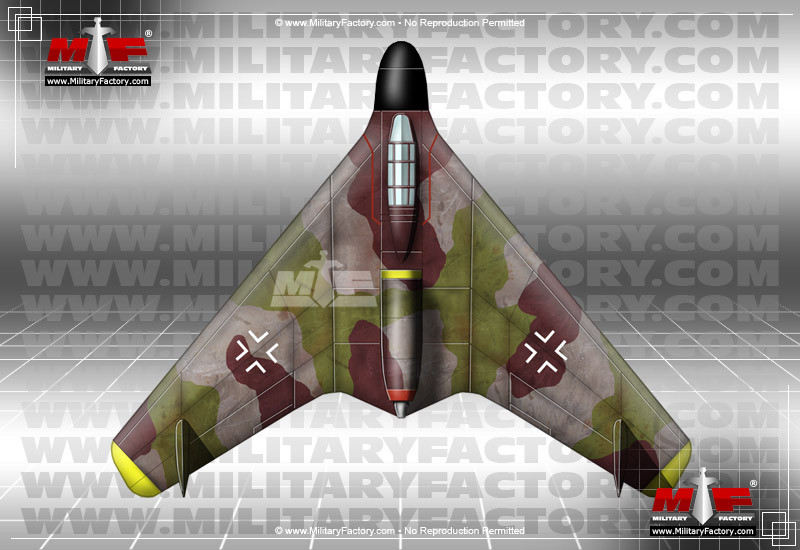
The overall aircraft design was to be more akin to a delta-shaped "flying wing" with only small vertical tail fins fitted near the wingtip trailing edges (for stability) for the wing elements and fuselage were well integrated into one another - as almost a single complete piece. The cockpit would be set forward in the design (just ahead of amidships) and consist of a lightly framed canopy. The undercarriage was to be tricycle in its arrangement with two single-wheeled main legs and a single-wheeled nose leg. The nose leg was ahead and under the cockpit floor while the main legs were set along the fuselage undersides - all three fully retractable. Radar would be housed in the nose cone assembly which forced the cockpit rearwards. The aircraft's wingspan measured at just over 44 feet. Aircraft weight estimates included 18,500lbs when empty and 25,100lbs when fully laden with fuel and ammunition stores.

Proposed armament for the Project 60C was to be a battery of cannon installations. This included 4 x MK 108 series autocannons in fixed, forward-firing mounts for engaging targets ahead of the aircraft. However, one of the more interesting additions would have been the 3 x MK 108 series cannons mounted to fire obliquely upwards. What this did was allow the crew to bring their aircraft underneath the lesser-protected portions of enemy bombers and engage nearly at will. Cannons had proven to the Germans of great value, particularly when trying to bring down large bomber aircraft that could absorb a great deal of punishment (when compared to machine gun-only arrangements).

While the Project 60C was the intriguing selection to win the Air Ministry contract, there were those within the ranks that saw fit to question the viability of certain design elements inherent in the Gotha submission. This included the rather unconventional placement of the engines at a time when it made sense to fit engines within the fuselage proper and, thusly, keep an aerodynamic shape in check. The argument centered around the airflow passing over the fuselage front and wing leading edges into a rear-set, externally-mounted engine fitting - therefore degrading the power of said engine. Gotha chief engineer Dr. Rudolf Gothert successfully argued the merits of his approach, citing improved performance at high speeds.

Despite the work already underway, the war for Germany had come to a close in May of 1945. Hitler was dead via suicide and the Germans were either surrendering in droves or fighting to the last. The Soviets had captured the heart of Berlin and the war in Europe formally ended. With the end of the war so too ended the hope of many designs still on the drawing boards of various German aviation firms. As such, the Project 60C only ever existed on paper and no known mockups or prototypes were ever built. While no clear winner of the Air Ministry proposal was ever declared, many observers suggest that the Gotha Project 60C held the most advantage and was a clear favorite to win the competition.

Beyond the nightfighting version of the Project 60C, Gotha engineers also drew up plans for a dayfighter version sans the radar facility. In this design, the nose was reworked to a more aerodynamically efficient "dart-like" hollow assembly (due to the lack of radar) and the crew would have been reduced to one or two personnel. Beyond that, the basic design layout would have remained largely the same.
Text ©2003-2013 www.MilitaryFactory.com • All Rights Reserved • No Reproduction Permitted
MilitaryFactory.com does NOT sell equipment/weaponry. Material presented throughout this website is for historical and entertainment value and should not to be construed as usable for hardware restoration, maintenance or general operation. Please consult manufacturers for such information. Our disclaimer. Email corrections / Comments to MilitaryFactory at Gmail dot com.
Picture of Gotha Go P.60C
View All Images (1)

Specifications for the
Gotha Go P.60C
All-Weather / Nightfighter


Country of Origin: Nazi Germany
Manufacturer: Gothaer Waggonfabrik AG - Nazi Germany
Initial Year of Service: 1945
Production: Not Available


Focus Model: Gotha Go P.60C
Crew: 1, 2 or 3


Length: 35.76ft (10.9m)
Width: 44.29ft (13.50m)
Height: 0.00ft (0.00m)
Weight (Empty): 18,519lbs (8,400kg)
Weight (MTOW): 25,133lbs (11,400kg)


Powerplant: 2 x Heinkel-Hirth HeS 011 turbine engines developing 2,866lbs of thrust each; 1 x Walter HWK solid-fuel rocket providing up to 4,400lbs of thrust.


Maximum Speed: 605mph (974kmh; 526kts)
Maximum Range: 1,030miles (1,658km)
Service Ceiling: 47,244ft (14,400m; 8.9miles)
Rate-of-Climb: 3,480 feet per minute (1,061m/min)


Hardpoints: 0
Armament Suite:
PROPOSED:
4 x 30mm MK 108 fixed, forward-firing cannons
3 x 30mm MK 108 fixed oblique-angled cannons


Variants:
Project 60C (Nightfighter) - Base Series Designation; crew of three.


Project 60C (Dayfighter) - Proposed day-fighting variant sans radar installationl revised nose assembly and crew of two.


Operators:
Nazi Germany

ALL AIRCRAFT CATEGORIES

BY DECADE:


1900 to 1909
1910 to 1919
1920 to 1929
1930 to 1939
1940 to 1949
1950 to 1959
1960 to 1969
1970 to 1979
1980 to 1989
1990 to 1999
2000 to 2009
2010 to 2019
2020 to 2029
VIEW ALL
Compare Aircraft


BY TYPE:


Anti-Submarine Warfare (ASW)
Attack Helicopters
Bomber Aircraft
Medium Bombers
Heavy Bombers
Close-Air Support (CAS)
Commercial Aircraft
Dive Bombers
Electronic Warfare Aircraft (EWA)
Experimental / X-Planes
Fighter Aircraft
Floatplane Aircraft
Flying Boat Aircraft
Aerial Refueling Tankers
Helicopters (ALL)
Interceptor Aircraft
Multi-Role Aircraft
Navy Carrier Aircraft
Night Fighters
Reconnaissance / Scout
Search & Rescue (SAR)
Scout Helicopters
Special Purpose
Torpedo Bombers
Trainer Aircraft
Transport Aircraft
Transport Helicopters
Unmanned Aerial Vehicles (UAVs)
Unmanned Combat Air Vehicles (UCAVs)


COLLECTIONS:


4th Generation Fighter Aircraft
5th Generation Fighter Aircraft
US X-Planes
Classic US Warbirds
French Military Helicopters
Grumman "Cats"
Howard Hughes Aircraft
Indian Air Force
Israeli Air Force
Libyan Aircraft
Modern Chinese Aircraft
Modern Chinese Fighters
Modern Military Aircraft
Modern North Korean Aircraft
Modern Trainer Aircraft
Modern US Aircraft
Mikoyan Aircraft
Sukhoi Aircraft
Syrian Aircraft
Top 10 Fighter Aircraft of All Time


AIRCRAFT BY CONFLICT:


Arab-Israeli War (1948)
Cuban Missile Crisis (1959-1962)
Falklands War (1982)
Indo-Pak War (1965, 1971)
Iran-Iraq War (1980-1988)
Lebanon War (1982)
Operation Allied Force (1999)
Operation Desert Storm (1991)
Six Day War (1967)
Spanish Civil War (1936)
Soviet-Afghan War (1979-1989)
Yom Kippur War (1973)


MISCELLANEOUS:


Aircraft Cockpits
Aircraft Manufacturers List
Aircraft Production
Aircraft Timeline

WORLD WAR 2:


1939 Aircraft
1940 Aircraft
1941 Aircraft
1942 Aircraft
1943 Aircraft
1944 Aircraft
1945 Aircraft
1946 Aircraft
Australian Aircraft
Battle of Britain Aircraft
Bombers
Four-Engine Bombers
British Aircraft
British Bombers
British Transports
Dive Bombers
Canadian Aircraft
Fighters
Chinese Aircraft
French Aircraft
German Aircraft
German Fighters
German Flying Boats
German Jets
Secret Weapons of the Luftwaffe
Italian Aircraft
Imperial Japanese Aircraft
Imperial Japanese Fighters
Mitsubishi Bombers
Navy Aircraft
Pearl Harbor
Polish Aircraft
Romanian Aircraft
US Aircraft
US Bombers
US Navy Aircraft
Soviet Aircraft
Torpedo Bombers
Trainer Aircraft
Transport Aircraft
Tuskegee Airmen Aircraft
W.A.S.P. Aircraft
WW2 Aircraft Ranked by Speed
VIEW ALL


WORLD WAR 1:


1914 Aircraft
1915 Aircraft
1916 Aircraft
1917 Aircraft
1918 Aircraft
Aircraft Timeline
Austro-Hungarian Aircraft
Bomber Aircraft
British Aircraft
Fighters
Flying Boats
French Aircraft
Imperial German Aircraft
Italian Aircraft
Scout Aircraft
Russian Empire Aircraft
US Aircraft
WW1 Aircraft Ranked by Speed
VIEW ALL


KOREAN WAR:


Australian Aircraft
Korean War Aces
Korean War Jets
North Korean Aircraft
US Military Aircraft
VIEW ALL


VIETNAM WAR:


Helicopters (ALL)
Transport Helicopters
North Vietnam Air Force
US Airpower
VIEW ALL


COLD WAR:


1950s French Aircraft
British V-Bombers
Cold War Bombers
Soviet Aircraft
Soviet Bombers
Soviet Interceptors
Soviet Helicopters
Strategic Air Command
US Aircraft
US Bombers
US Interceptors
VIEW ALL

Site Disclaimer | Privacy Policy | Site Map | MF Origins


©2013 www.MilitaryFactory.com • Content ©2003-2013 MilitaryFactory.com • All Rights Reserved • Site Contact Email: militaryfactory at gmail dot com. The "Military Factory" name and MilitaryFactory.com logo are registered ® trademarks and protected by all applicable domestic and international intellectual property laws.


Top MF Stuff: 2013 Military Pay Scale | Military Ranks | WW2 Weapons | Sniper Rifles | Kts to Mph | WW1 Aircraft | Automatic Rifles | Aircraft Cockpits | Vietnam War Weapons | Main Battle Tanks | Submachine Guns | Shotguns | French Military Victories


Most photographic images appearing on this site are courtesy of the United States Department of Defense and are approved for public use. Other images acquired through the public domain. Digital art work courtesy of Dan Alex. Business Consulting by Kyle Williams. Material presented throughout this website is for historical and entertainment value and should not to be construed as usable for hardware restoration, maintenance or general operation. Please consult manufacturers for such information.


eXTReMe Tracker