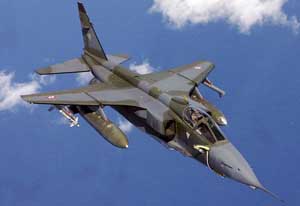
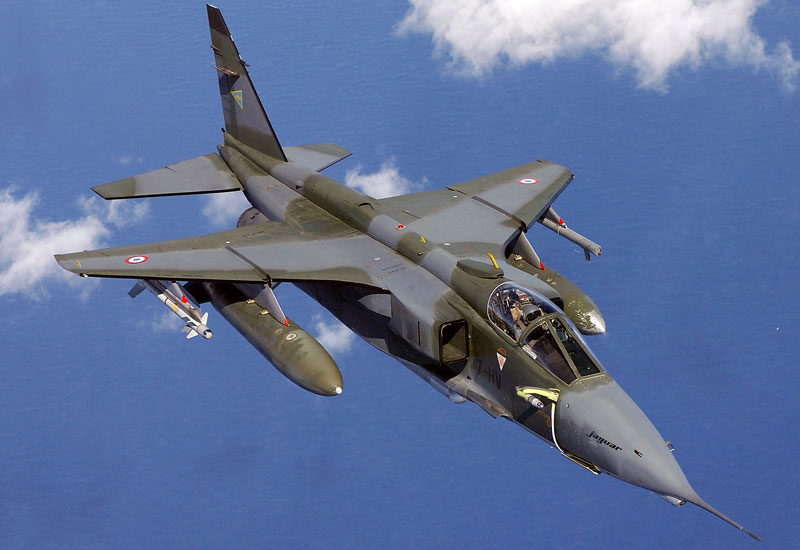
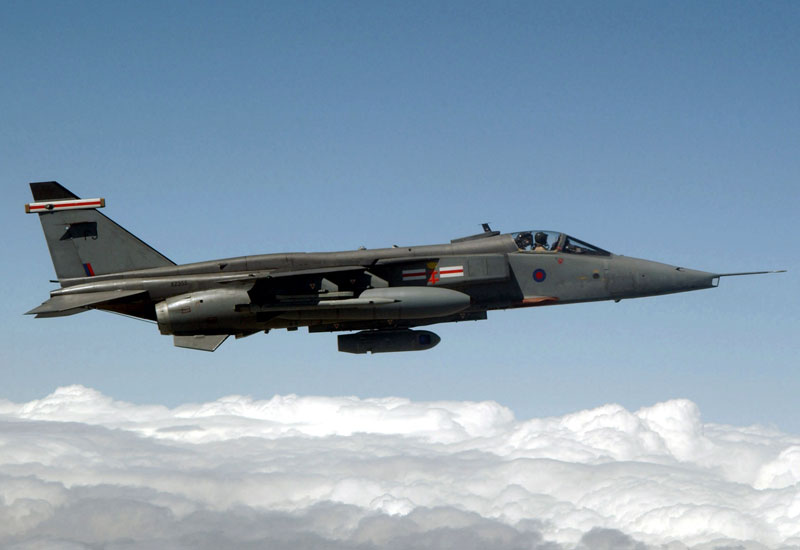
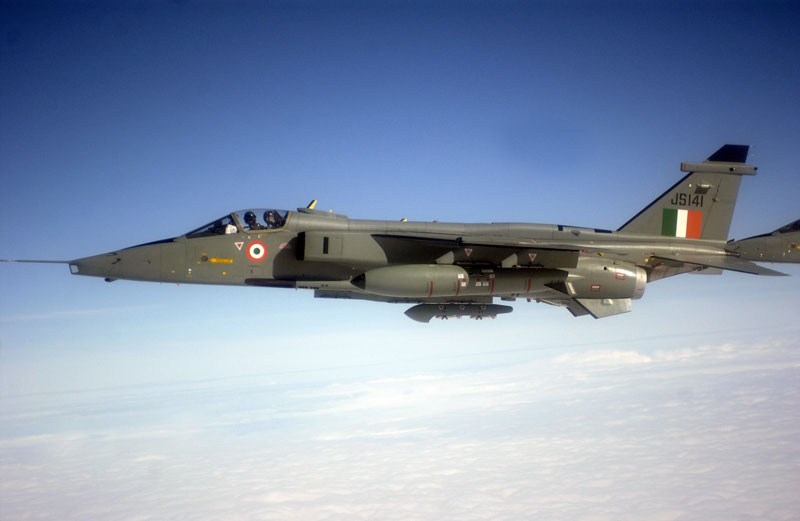
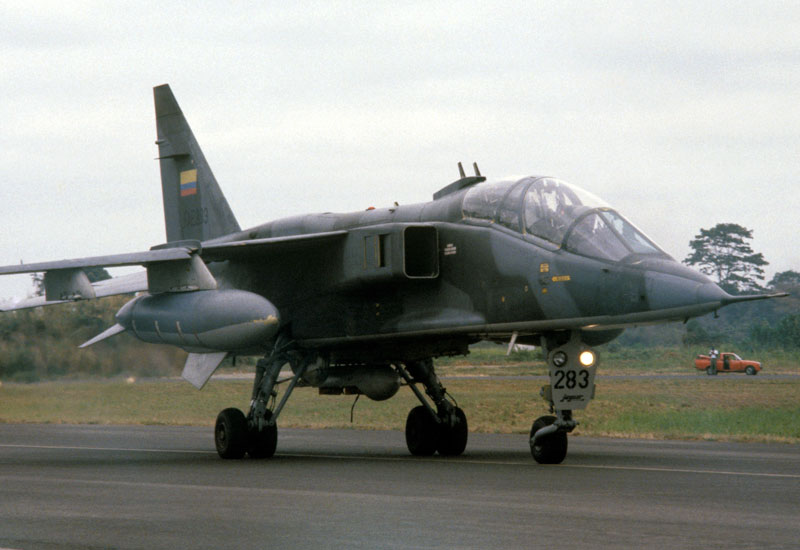
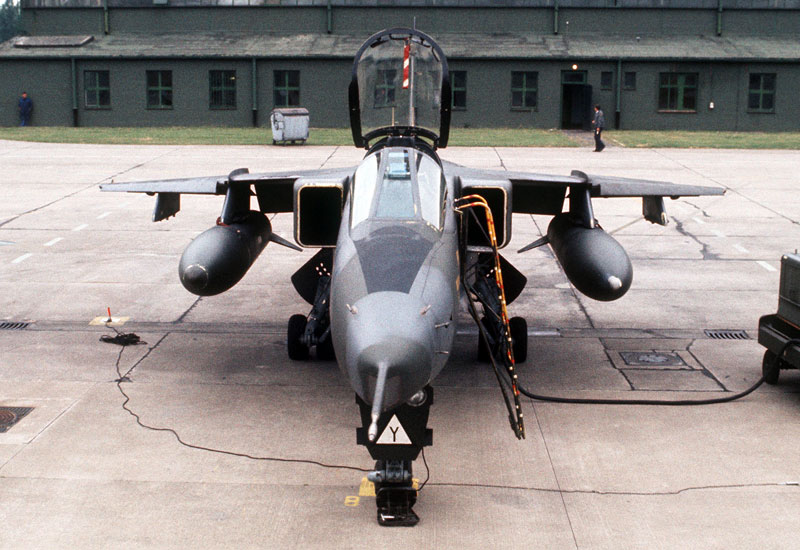
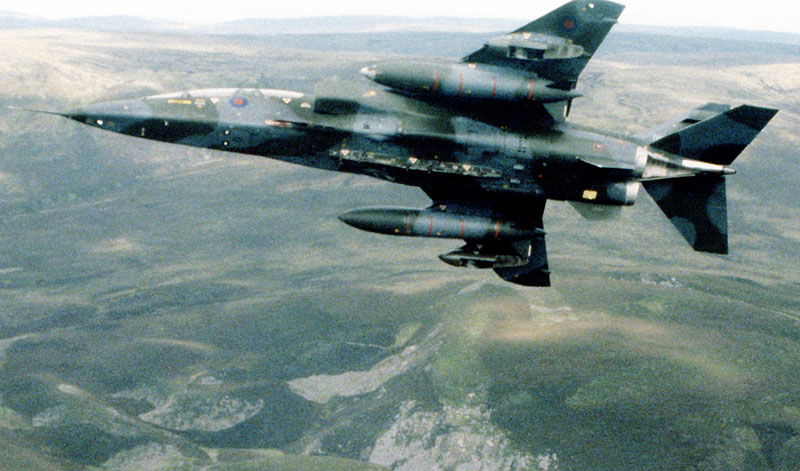
"The SEPECAT Jaguar was a joint French-British strike fighter endeavor that saw action in several notable conflicts of the 1990s."
Power & Performance Those special qualities that separate one aircraft design from another. Performance specifications presented assume optimal operating conditions for the SEPECAT Jaguar GR.1A Strike Fighter Aircraft.
2 x Rolls-Royce/Turbomeca Adour Mk 104 turbofan afterburning (reheat) engines delivering 8,040lb of thrust each. Propulsion
1,056 mph 1,700 kph | 918 kts Max Speed
45,207 ft 13,779 m | 9 miles Service Ceiling
528 miles 850 km | 459 nm Operational Range
Structure The nose-to-tail, wingtip-to-wingtip physical qualities of the SEPECAT Jaguar GR.1A Strike Fighter Aircraft.
1 (MANNED) Crew
55.2 ft 16.83 m O/A Length
28.5 ft (8.69 m) O/A Width
16.0 ft (4.89 m) O/A Height
16,976 lb (7,700 kg) Empty Weight
34,613 lb (15,700 kg) MTOW
Armament Available supported armament and special-mission equipment featured in the design of the SEPECAT Jaguar Strike Fighter Aircraft provided across 7 hardpoints.
STANDARD:
2 x 30mm ADEN OR DEFA internal cannons.
OPTIONAL:
Up to 10,000 lbs (4,500kg) of various air-to-air and air-to-surface external stores including Matra rocket pods (18 x 68mm SNEB rockets), AS-37 Martel air-to-surface missiles, conventional bombs, precision-guided drop bombs, anti-ship missiles, AIM-9 Sidewinder/Matra R550 "Magic" air-to-air missiles (as well as other short-range and medium-range types) and speciality mission pods as needed.
X
X
X
X
X
X
X
Hardpoints Key:
Centerline
Wingroot(L)
Wingroot(R)
Wing
Wingtip
Internal
Not Used
Variants Notable series variants as part of the SEPECAT Jaguar family line.
Breguet Br.121 - French Concept Designation
Jaguar A - Single-Seat, All-Weather Ground Attack Strike Fighter for French use.
Jaguar B - Two-Seat Trainer
Jaguar E - Two-Seat Trainer
Jaguar S - Single-Seat All-Weather Ground Attack Strike Fighter
Jaguar GR.Mk 1 - RAF Jaguar S.
Jaguar GR.Mk 1A - Upgraded GR.Mk 1 models.
Jaguar GR.Mk 1B - TIALD-capable upgraded GR.Mk 1 models.
Jaguar GR.Mk 3 - GR.Mk 1A and GR.Mk 1B models upgraded to Jaguar 96 avionics system.
Jaguar GR.Mk 3A - GR.Mk 3 model upgraded to Jaguar 97 avionics system.
Jaguar T.Mk 2 - RAF Twin-Seat Trainer based on Jaguar B.
Jaguar T.Mk 2A - T.Mk 2 trainer upgraded to GR.Mk 1A standard.
Jaguar T.Mk 2B - Upgraded T.Mk 2A models with TIALD capability.
Jaguar T.Mk 4 - T.Mk 2A trainer models upgraded to Jaguar 96 standard.
Jaguar M - Proposed Single-Seat Navy Strike Fighter; single prototype for evaluation; never produced.
Jaguar ACT - "Active Control Technology" Research Platform Conversion.
Jaguar "International" - Export Version of Jaguar B and Jaguar S models.
Jaguar ES - Exported Jaguar S model type for Ecuador.
Jaguar EB - Exported Jaguar B model type for Ecuador.
Jaguar OS - Exported Jaguar S model type for Oman.
Jaguar OB - Exported Jaguar B model type for Oman.
Jaguar IS - Export and locally-produced Jaguar all-weather ground attack and tactical strike platform for India (production by BAe and HAL).
Jaguar IT - Export and locally-produced Jaguar two-seat trainer model types for India (production by BAe and HAL).
Jaguar IM - International anti-shipping model for Indian Air Force.
Jaguar SN - Exported Jaguar S model type for Nigeria.
Jaguar BN - Exported Jaguar B model type for Nigeria.
Jaguar MAX - Proposed uprgaded/modernized Jaguar for the Indian Air Force; showcased at Aero India 2019; upgraded avionics, mission capabilities, full weapons support, digital assistance, variable mission pod fits, customizable cockpits, AESA radar fit.
The SEPECAT Jaguar was a joint aircraft venture between Britain and France to produce a supersonic, low-level strike fighter. The aircraft went on to find limited successes in the partnership and see equally limited sales on the foreign market. India joined the host nations as one of the largest supporters of the Jaguar but has since made plans to replace the type with a more modern breed. Despite its limited reach, the Jaguar went on to see combat actions in several notable conflicts during the 1990s and a few nations still maintain the aircraft in operational form. In all, some 543 total Jaguar aircraft were completed by SEPECAT, BAe and HAL of India.
In 1962, the British Royal Air Force and the French Air Force found themselves with a similar need for a new capable aircraft system. The British sought to replace their aging series of Folland Gnat T.Mk 1 and Hawker Hunter T.Mk 7 trainers with a modern advanced supersonic type while the French were looking for an intermediate subsonic aircraft type to replace their Fouga Magister and Lockheed T-33 jet trainers, their Dassault Mystere IV fighters and fill the gap behind their Mirage family of high performance fighters. In 1965, the two nations formally came together with an agreement and, in 1966, the two sides were represented by the British Aircraft Corporation (Warton Division) and Breguet. The collaborative effort was given the acronym of "SEPECAT" - "Societe Europeenne de Production de l'Avion d'Ecole de Combat et d'Appui Tactique" which translated to "European Production Company for the Combat Training and Tactical Support Aircraft". To showcase Breguet's lead in the design effort, BAC registered its company within France. The joint effort would become the first time that two major European nations would attempt to produce an operational combat aircraft jointly.
As the project gained steam, the Royal Air Force revised its need for an advanced two-seat jet trainer while the French Air Force was seeking a dual-role solution covering a ground-attack strike fighter with excellent Short Take-Off and Landing (STOL) capabilities as well as an advanced jet trainer. The need for both sides was further refined when both parties dropped their two-seat advanced trainer requirement and concentrated efforts on a close-support, single-seat strike and interdiction platform. The trainer requirement had indeed been filled by acceptance of the Hawker Siddeley Hawk for the British and the Alpha Jet for the French. The Royal Air Force now looked to replace their fleet of American-made McDonnell Douglas F-4 Phantom IIs (FG.R Mk 2 in RAF service) and drew up plans for a new aircraft to cover reconnaissance, strike and close-air support sorties. The French looked to replace their aged Dassault Etendard IV carrier aircraft. In addition to a single-seat, multi-role fighter design, a two-seat variant was envisioned to facilitate pilot conversion training to the new mount. Profits from the sale of the aircraft would be split 50/50 between BAC and Breguet. Several designs from both parties were researched before the sides settled on the Breguet Br.121 concept with the wings and high lift elements designed by BAC. The new aircraft was christened the "Jaguar".
As with the airframe, the powerplant would also be designed jointly by the British firm of Rolls-Royce and the French firm of Turbomeca as the "Adour" series. This new turbofan engine would be designed with afterburner capability to help make the aircraft supersonic in nature. In its early stages, a complicated variable-geometry air intake was entertained to help optimize engine efficiency at speeds in excess of Mach 1.0 but this thinking later gave way to a more conventional fixed intake design to help move series production along.
Design of the Jaguar was such that its high-wing loading design assisted both flight stability and broad munitions-carrying qualities at low-altitudes. The shoulder-mounted wings gave excellent ground clearance for a bevy of ordnance options that would suit the aircraft's ground attack role perfectly. Internally, the airframe was outfitted with self-sealing fuel tanks to contend with ground fire inherent in close-support actions. Fuel would be spread across four major internal compartments to include the front fuselage, middle fuselage, rear fuselage and both wing assemblies. The aircraft could also make use of three "plumbed" hardpoints - one centerline underfuselage and one to each underwing - to accept the mounting of external fuel droptanks to further increase operational ranges. An in-flight refueling probe was added to help expand the "reach" of the aircraft even further.
The initial Jaguar prototype became a two-seat aircraft for testing by the French. First flight was recorded on September 8th, 1968 from Istres with the Adour engines. The prototype was the first of eight such machines, each varying slightly though still unveiling the inherent differences in the "separate but equal" British and French requirements. The Adour engines proved adequate for level cruise flying but it was deemed underpowered during take-off actions, requiring the use of afterburner to get airborne or even achieve supersonic flight. Despite this lack of power, the engines still exhibited excellent life and gave the Jaguar good range from the start. Early production Jaguars were fitted with a pair of Adour Mk 101 series turbofan engines delivering up to 5,115lb of standard thrust and up to 7,304lb of thrust when utilizing afterburner (raw fuel pumped into the engine to produce short spurts of added thrust).
"Jaguar S" was the designation applied by SEPECAT to signify initial "strike" models. The French retained this designation once in service though the Royal Air Force applied the formal designation of "Jaguar GR.Mk 1" to the type. Each air force agreed on the purchase of 200 Jaguar machines. At this time, the Royal Air Force was penciled in to receive some 165 single-seat GR.Mk 1 strike versions to go along with 35 T.Mk 2 "Jaguar B" two-seat trainer types. "Jaguar A" designated similar single-seat attack models. France accepted no fewer than 160 "Jaguar A" single-seat models as well as 40 "Jaguar E" two-seat trainers.
Deliveries to French forces began in 1972 with the system being formally introduced for service the following year. Between the French and British designs, the French versions lacked the base power of the nav/attack systems as installed in their UK counterparts. In place of the 30mm ADEN cannons were a pair of 30mm DEFA cannons of French origin. At least half of the delivered examples were fitted with a laser rangefinder under the nose and 30 examples had provision for the ATLIS laser designator pod for use in conjunction with the AS.30L laser-guided missile series.
The initial British Jaguar S prototype (S06) was assigned the designation of XW560 and was of a single-seat design. First flight occurred on October 12th, 1969. Deliveries of British GR.Mk 1 began in 1973 and continued on into 1978. The aircraft was formally brought online by the RAF in 1974. Operational GR.Mk 1 models were divided across four nuclear attack squadrons based out of Bruggen in Germany and operated under the banners of Squadron No. 14, No. 17, No. 20 and No. 31. Additional deliveries made up the inventories of the No. 2 reconnaissance squadron out of Laarbruch, Germany and Squadron No. 6, No. 41 and No. 54 of Coltishall Wing. No. 41 was a dedicated reconnaissance squadron. All of these British units could be called upon to support NATO actions across Europe should the Cold War ever go "hot". Nuclear-capable Jaguars in RAF service were ultimately replaced in the role by Panavia Tornados.
The initial RAF Jaguar B - prototype B08 (XW566) - was first flown on August 30th, 1970. In the end, some 35 Jaguar Bs were delivered to the ranks of the RAF to which they were designated as the Jaguar T.Mk 2. Squadron No. 229 OCU of Lossiemouth was the lucky recipient which handled pilot conversion training to the new aircraft. The T.Mk 2 was eventually upgraded to the T.Mk 2A standard, incorporating the improved FIN1064 navigation/attack system as well as Adour Mk 104 series turbofan engines. Once in service, the Jaguar replaced mostly all of the American-made McDonnell F-4 Phantom IIs operating as reconnaissance, strike and attack platforms in RAF squadrons based across England and in Germany.
The Jaguar GR.Mk 1 was identifiable by its wedge-shaped nose assembly (French Jaguars had decidedly rounded noses) as well as a pod-like structure affixed to the vertical tail fin. A Ferranti ARI23231 Laser Ranging and Marked Target Seeker (LRMTS) were fitted into this hollow assembly and was essentially the heart of the aircraft's operational forte. A Marconi ARI18223 receiver was coupled to the Ferranti system. In the cockpit, the pilot was assisted by both a Heads-Up Display (HUD) providing relevant performance and mission information and a "look-down" moving-map display. Both instruments were fed by a Marconi-GEC 920ATC NAVigation and Weapon-Aiming Sub-System (NAVWASS).
The GR.Mk 1 production model was later upgraded to the GR.Mk 1A standard beginning in December of 1983 to feature a more advanced nav/attack system, new Adour Mk 104 engines and a laser rangefinder. The GR.Mk 1As were themselves upgraded to the GR.Mk 3 series standard to showcase the inclusion of a pilot helmet-mounted sight, improved electronic countermeasures (ECM) suite, a new cockpit Liquid Crystal Display (LCD), an integrated towed decoy system, installation of a TIALD pod (beginning in 1994), ASRAAM weapon capability and the Adour Mk 106 series turbofan engines (the ASRAAM weapon capability was never adapted due to a cut in defense spending). The new engine promised a performance thrust increase of 25%. The upgraded GR.Mk 3 production model spawned an upgraded trainer derivative in the T.Mk 4 two-seat model. TIALD-enabled Jaguars were further designated as Jaguar GR.1B (10 examples) including their T.Mk 2B trainers (2 examples). Fleet-wide use of TIALD brought about the Jaguar GR.3A (also known under "Jaguar 97") designation. An interim form existed as the GR.3 "Jaguar 96".
As a close-support platform, the Jaguar would be charged with accomplishing most of her battlefield work at low-to-middle altitude levels. As such, low-speed handling was a necessity for the pilot to allow for accurate ordnance delivery. After some operational practice, low-speed handling was further enhanced with the inclusion of double-slotted flaps fitted to the entire running length of the wing trailing edges.
The Jaguar A and Jaguar S models both fielded a retractable refueling probe along the starboard side of the forward fuselage to assist in in-flight refueling, further increasing operational ranges. Some Jaguar B models for the French held a fixed refueling probe in the nose as did some export production Jaguars. The Jaguar B model was the two-seat trainer version that fitted a second cockpit along an elongated fuselage. These airframes were completed with their full avionics suites and navigation systems but were sans the lasers that provided for their true war-making capacity. Additionally, the trainer models also lost the starboard side 30mm cannon, lacked radar warning receivers and were delivered without the in-flight refueling probes.
It is of note that the Jaguar in RAF service was not fitted with powerful radar to help in interception sorties as were the major mounts of the Cold War and they did not incorporate much of what made their McDonnell F-4 Phantom IIs such potent war machines. However, the Jaguar was still seen as an overall improvement considering the British need for she delivered a flexible weapons suite capable of accurate targeting in all-weather situations and her low-level flying at Mach 1 speed made her increasingly difficult to target and intercept by a given enemy. Consistent with other European aircraft designs, the Jaguar was also given excellent STOL capabilities that allowed her to utilize stretches of roadways as emergency airstrips in the event of all-out war in Europe.
Jaguar armament was highly flexible across two underwing hardpoints and a centerline underfuselage placement. The aircraft could field air-to-air missiles, air-to-surface missiles, conventional drop bombs, laser-guided bombs and rocket pods as needed. The high wings made for relatively easy access to each underwing hardpoint. For close-in work, there were a pair of 30mm cannons fitted under the cockpit floor (with 150 rounds per gun). In the Jaguar International export model, "overwing" hardpoints (as fielded by the BAC / English Electric Lightning) supported an additional pair of air-to-air missiles (restricted to the AIM-9 Sidewinder or Matra R550 Magic short-range missiles). The GR.Mk 1A was rated to carry up to 10,000lbs of external ordnance including fuel tanks.
It was only natural that this joint design effort produce a solution for the British and French navies. As such, the Jaguar "M" (prototype M05) was conceived as a navalized form of the base Jaguar. To cover the rigors of carrier-based operation, this single-seat variant utilized a reinforced structure and undercarriage and had her nose wheel leg lengthened. An arrestor hook was fitted aft and a laser rangefinder was standard.
M05 achieved first flight on November 14th, 1969 out of Melun/Villaroche and ended up at Istres on the 21st of that month for further evaluation by French authorities. By the 20th of April the following year, the M05 was handed over to the Royal Aircraft Establishment of Bedford in England to begin British trials from a dummy carrier deck. On July 10th, M05 completed her first successful launching by catapult. A dozen carrier deck landings and launches were completed by the 13th to which M05 was then utilized on actual carrier at sea from June 24th to July 14th, 1971. During this evaluation period, she was tested against catapult launches and arrestor cable retrievals with full external stores in place. From October 20th to the 27th of that same year, M05 completed twenty further carrier actions, these at her listed take-off weight.
Despite the promising start, French Navy authorities were keenly aware of the operating costs inherent in the new, complex system and began to curtail their procurement needs to just 100 Jaguar Ms. This, in effect, would result in less aircraft to replace their outgoing fleet of capable Dassault Etendard IV carrier-based fighters, forcing the Navy to consider other alternatives including American products.
In 1971, Dassault had purchased the Breguet aviation firm and, as the deal closed, Dassault inherited the Jaguar program by default - this including its 50% Jaguar profit sharing signed with the British. However, Dassault saw a much larger stake in the sale of their own products to the French Navy for they could yield 100% of the profit directly back to Dassault pockets. The Jaguar was something of a threat to the fine line of Mirage fighters already in play at the company and the corporation began pressing its new and improved "Super Etendard" fighter aircraft against the French Navy need. Despite a French government mandate in November of 1972 ordering Dassault to not push the Super Etendard, the French Navy went on to announce - just two months later - that it was purchasing Super Etendards to solidify its carrier air arm. This situation left a bad impression on the British half of the Jaguar program, many who now felt their partner had sold them out in pushing its own dedicated product line over that of the joint venture product - all in the name of bigger profits. As such, the Jaguar M navalized form failed to materialize.
To deliver the new Jaguar breed to the foreign market, the "Jaguar International" was developed. Manufacturing was handled by BAe and these aircraft were based on the Jaguar S / GR.Mk 1 strike model with some slight revisions. One particular item of note were the "overwing" hardpoints for short-range, air-to-air missiles as a standard feature. Additionally, Jaguar Internationals were given uprated engines.
India became the largest customer of the Jaguar International/Jaguar IS/Jaguar IT and began handling license-production of the aircraft by HAL (Hindustan Aeronautics Limited) under the designation of "Shamsher". 38 were purchased while a further 140 were produced in-house. Some were eventually fitted with Agave radar installations with provision to accept the capable "Sea Eagle" anti-ship missile (Jaguar IM). The Agave radar was then upgraded with Israeli Elbit EL/M-2032 radar for improved lethality. Some two-seater Jaguars in Indian service were also outfitted with the DARIN nav/attack system for night sorties. Engines have a planned upgrade by India to either Adour Mk 821 series or Honeywell F125IN. Indian Jaguars have seen service with No.5, No. 6, No. 14, No. 16, No. 27 and No. 224 squadrons.
France retired their fleet of Jaguars in 2005 with the British following in 2007 after a defense budget review. For the French, the Jaguar was replaced by the Dassault Rafale multirole fighter. For the British, the Eurofighter Typhoon has replaced the Jaguar. Other operators of the Jaguar system ultimately became Ecuador, Nigeria and Oman.
Only India actively operates the Jaguar in any capacity (2017). India has active plans to replace their aged Jaguars with the results of the Advanced Medium Combat Aircraft (AMCA) program in the near future. Oman Jaguars (Jaguar OS/OB) made it to the GR.Mk 3A standard before seeing retirement (in August 2014) and served with No. 8 and No. 20 squadrons. Ecuadorian Jaguars (Jaguar ES/EB) fell into storage but , during their active days, flew with Escuadron de Combate 2111. Nigerian Jaguars (Jaguar SN/BN) have all been retired.
The Jaguar went on to see combat operations in several high-profile conflicts. British and French Jaguars operated in the 1991 Gulf War while British Jaguars took part in the upcoming Balkan Wars. French Jaguars served in the Kosovo War (1998-1999) while India fielded their Jaguars in the Kargil War (1999) against Pakistan. Ecuador unleashed their Jaguars in a limited role during the 1995 Cenepa War with Peru.
December 2007 - The final flight of a British Royal Air Force Jaguar occurred on December 20th, 2007.
August 2017 - A first-flight was recorded of an Indian maritime-minded Jaguar strike aircraft. These are platforms being updated/modernized locally by Hindustan Aeronautics (HAL) under the "DARIN III" program. The program seeks to modernize the weapons capabilities (including support for AGM-84 "Harpoon" anti-ship missiles) of the aircraft as well as navigation, Electronic Warfare (EW) and avionics. The work was to have been completed by the end of 2017 but will run into 2022 due to various delays. Some 61 of the Indian fleet of 157 Jaguars will be upgraded in this fashion. India remains the only active user of the Jaguar line.
February 2019 - At Aero India 2019, a modernized, upgraded form of the Jaguar was unveiled by Hindustan Aeronautics Limited (HAL) of India as the "Jaguar MAX". Changes include an all-modern digital cockpit, support for all modern Indian Air Force weaponry, and Active, Electronically-Scanned Array (AESA) radar unit. Other improvements are a large-area cockpit display, built-in jamming capabilities, enhanced survivability, protected communications, and support various mission pods (radar/laser targeting, Electro-Optical (OP) and the like). One key addition would be the support of up to a dozen "swarming" drones.
Operators Global customers who have evaluated and/or operated the SEPECAT Jaguar. Nations are displayed by flag, each linked to their respective national aircraft listing.
Total Production: 543 Units Contractor(s): SEPECAT - France, UK / BAe - UK / HAL - India
[ Ecuador; France; India; Nigeria; Oman; United Kingdom ]
1 / 10
High-angled front right side top view of the SEPECAT Jaguar in flight
2 / 10
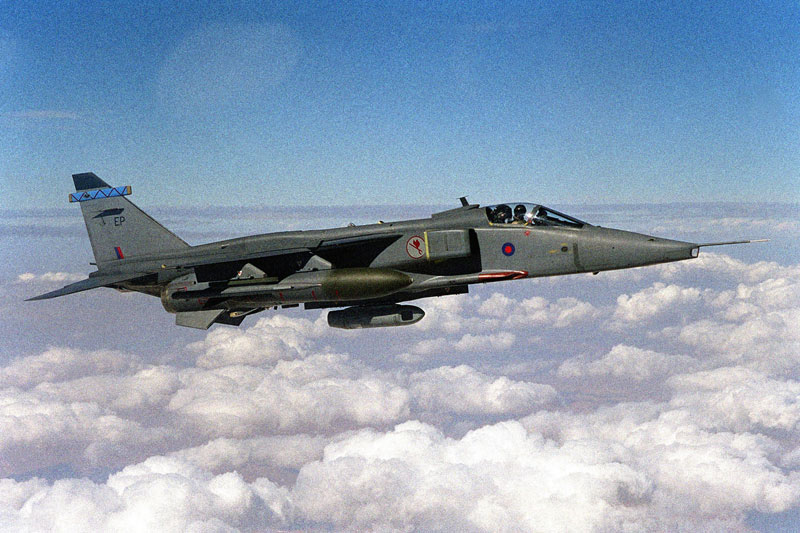
Right side view of a SEPECAT Jaguar in flight
3 / 10
Left side view of a SEPECAT Jaguar in flight
4 / 10
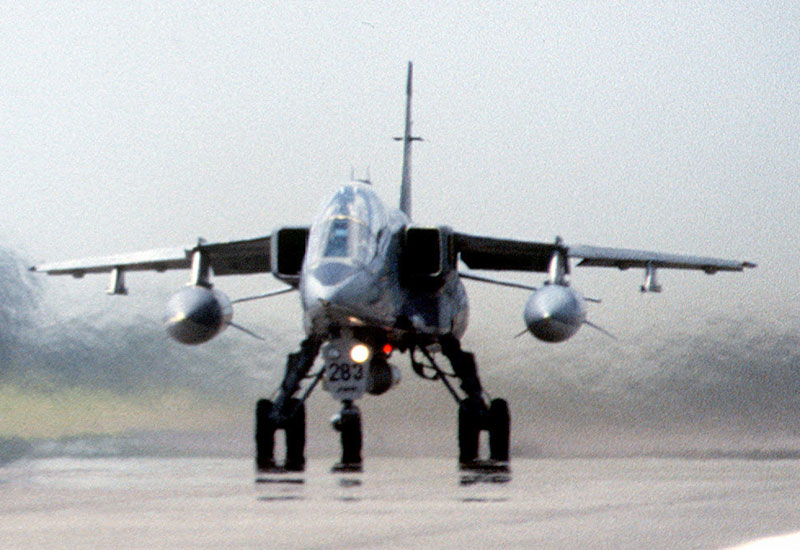
Front view of a SEPECAT Jaguar ready for take-off
5 / 10
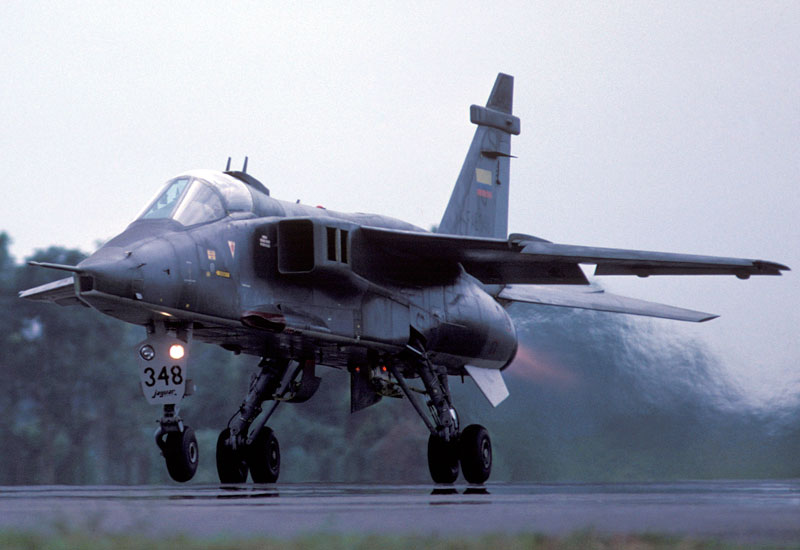
Front left side view of a SEPECAT Jaguar on the tarmac
6 / 10
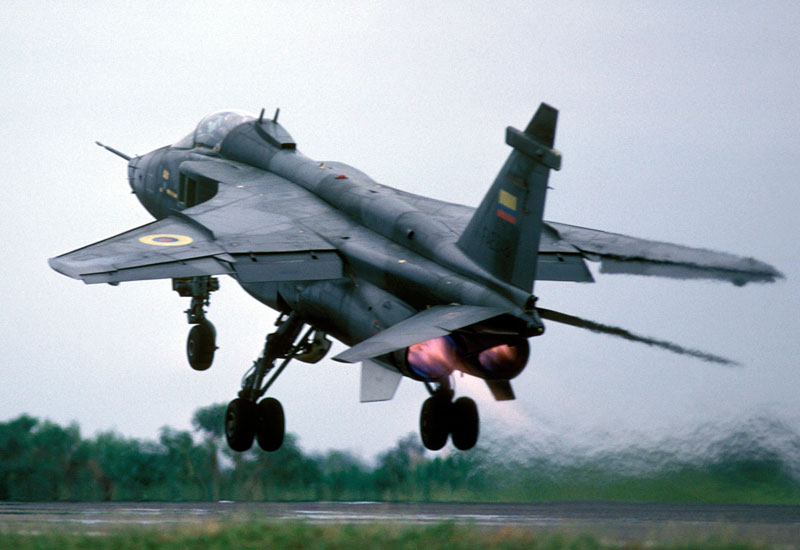
A SEPECAT Jaguar takes off with full afterburn
7 / 10
Right side view of an airborne SEPECAT Jaguar
8 / 10
Front right side view of a SEPECAT Jaguar at rest
9 / 10
Front view of a SEPECAT Jaguar being made ready for flight
The "Military Factory" name and MilitaryFactory.com logo are registered ® U.S. trademarks protected by all applicable domestic and international intellectual property laws. All written content, illustrations, and photography are unique to this website (unless where indicated) and not for reuse/reproduction in any form. Material presented throughout this website is for historical and entertainment value only and should not to be construed as usable for hardware restoration, maintenance, or general operation. We do not sell any of the items showcased on this site. Please direct all other inquiries to militaryfactory AT gmail.com. No A.I. was used in the generation of this content.