Military Factory
Military Pay Chart
Global Firepower
Military Industrial Complex
Second World War
Home
Military Pay Scale
Military Ranks
Small Arms
Aircraft
Land Systems
Navy
Education
Military Factory Facebook Logo
flag of Nazi Germany

Heinkel He P.1078C Fighter (1945)

Authored By Martin Foray | Last Updated: 4/20/2011

The Heinkel He P.1078C proposal was delivered for consideration in the Luftwaffe Emergency Fighter Program at the end of 1944.

Find a School Near You
Follow Military Factory on Facebook:
Trending on Military Factory:
Recent Articles:
Germany's Emergency Fighter Program was enacted in the middle of July in 1944 in response to the Allied bombing offensive taking out critical German war-making capabilities. Production was now to be centered around more defensive-minded fighter developments (both piston- and jet-powered types were entertained) in an effort to stave off complete elimination in the war. The program was, in essence, a last ditch effort by the Luftwaffe to win back air superiority from the Allies - the Allies now firmly entrenched in Europe and making their way towards Berlin with each passing week. Some of the key fighter developments that arose from this end-war initiative became the iconic title="Messerschmitt Me 262 Schwalbe jet fighter"Messerschmitt Me 262 Schwalbe (Swallow) and the budget-minded Heinkel He 162 Volksjager (People's Fighter).

Heinkel submitted several designs for consideration beyond their well-known Volksjager and the He P.1087C proposal was one such submission. However, unlike the Volksjager, the P.1078C would become nothing more than a "paper airplane" design destined to never see the light of day. Regardless, the German Luftwaffe had a need and there were plenty of German manufacturers yearning to help fill the proverbial void. The P.1087C was intended as the next logical step in German jet-powered fighter developments, engineers already looking to supplement and, ultimately, replace the earlier Me 262 and He 162 just now beginning to enter operational service in small numbers.

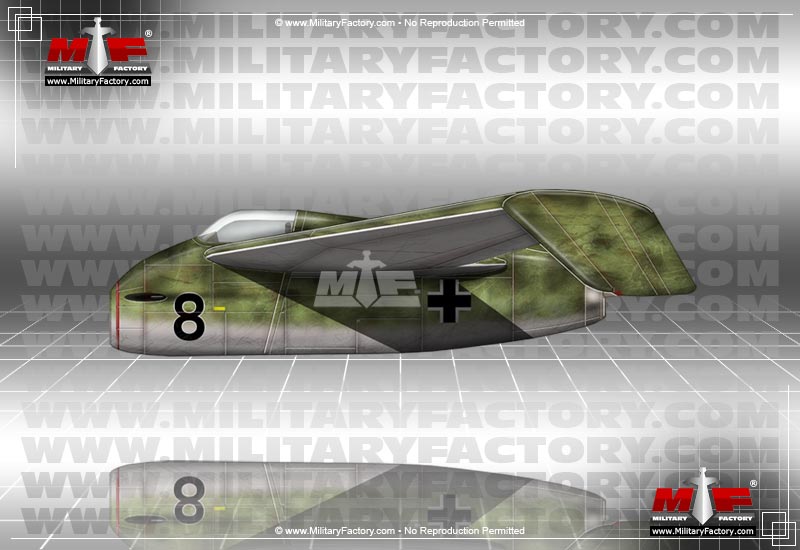
This particular Heinkel design proposal was associated with a Luftwaffe specification centered around use of the new Heinkel Hirth He S 011 series turbojet engine. The engine would output an estimated 2,866lbs of thrust to propel the Heinkel design at speeds of up to 630 miles per hour. To keep production costs down and expedite mass production, the He 1078C design was relatively simple in nature, utilizing wood wherever possible. The metal fuselage sported a length no longer than 17 feet and contained the armored cockpit, armament and relatively large single engine fitting (fuel was to be housed in the wings). Wingspan was just under 30 feet and the design as a whole just topped 7 feet, 8 inches in height. The armament would have consisted of 4 x MK 108 series cannons fitted as pairs to either side of the nose section. The nose section itself was rather short and acted as the air intake to aspirate the turbojet engine buried further aft in the design. The opening was rectangular in nature and conformed well to the fuselage's square appearance when viewed in the forward profile. The engine exhausted at the rear through a conventional exhaust ring. The cockpit was held well-forward in the design with the pilot seated under a small canopy allowing for limited viewing ahead and to the sides (the rear was obstructed by way of a short fuselage spine). The undercarriage was fully retractable and would have consisted of three landing gear legs: two main legs at amidships and a nose landing gear leg - all were single-wheeled installations. When at rest, this arrangement would have given the P.0178C a distinct "nose-up" appearance, in effect perhaps promoting quicker take-offs with the increased wing drag at speed. Since the jet-powered fighter would have been operating at high altitudes, the cockpit was to be fully pressurized for the safety of the pilot, requiring him to don a special aviation suit and oxygen equipment not unlike today's fighters pilots. A primitive ejection seat was to have been part of the overall production plan.

Perhaps the most identifiable portion of the P.1078Cs design was its wings. The assemblies were fitted high against the fuselage sides and extensively swept rearwards. Each wing was cranked upwards from fuselage centerline up to roughly three-quarters out and then capped with a short wing piece cranked sharply downwards. The reason for this design was largely related to aerodynamic principles that were still being researched at the time and the result was to have combated stress effects on the wings at high speeds. Ernst Heinkel was convinced of their ability to provide for increased maneuvering and agility during dogfights. It bears note that there were no horizontal tailplanes in the Heinkel design and the entire internal fuel load for the thirsty turbojet engine was to be stored across both of the wings. However, the wings were not armored which unduly would have exposed them to enemy fire even of the slightest degree.

German authorities eventually passed on the P.1078C proposal citing its irregular wing formation which could, in fact, be a detriment in high speed flight. The unprotected nature of the fuel stores was another sticking point for the submission and the P.1078C foundered from then on with little chance of advancement forcing Heinkel to abandon the design by late February, 1945. Germany would go on to capitulate in April of that year and sign a formal surrender with the Allied powers in May.

The Heinkel He P.1078C would become nothing more than another Luftwaffe footnote in the pages of aviation history concerning World War 2 though Ernst Heinkel himself was thought to have favored the P.1078C design and considered its tailless design with rear-mounted engine and cranked wings something of a revolutionary step forwards and quite unlike anything being put forth by other firms. As with other German secret projects in the late war years, it is left to the imagination as to the impact that such an aircraft may have had had it flown in an aggressive nature as intended.
Text ©2003-2013 www.MilitaryFactory.com • All Rights Reserved • No Reproduction Permitted
MilitaryFactory.com does NOT sell equipment/weaponry. Material presented throughout this website is for historical and entertainment value and should not to be construed as usable for hardware restoration, maintenance or general operation. Please consult manufacturers for such information. Our disclaimer. Email corrections / Comments to MilitaryFactory at Gmail dot com.
Picture of Heinkel He P.1078C
View All Images (1)

Specifications for the
Heinkel He P.1078C
Fighter


Country of Origin: Nazi Germany
Manufacturer: Heinkel - Nazi Germany
Initial Year of Service: 1945
Production: Not Available


Focus Model: Heinkel He P.1078C
Crew: 1


Length: 20.01ft (6.1m)
Width: 29.53ft (9.00m)
Height: 7.71ft (2.35m)
Weight (Empty): 5,410lbs (2,454kg)
Weight (MTOW): 8,642lbs (3,920kg)


Powerplant: 1 x Heinkel Hirth S 011 turbojet engine delivering 2,866lbs of thrust.


Maximum Speed: 396mph (637kmh; 344kts)
Maximum Range: 0miles (0km)
Service Ceiling: 0ft (0m; 0.0miles)
Rate-of-Climb: 98 feet per minute (30m/min)


Hardpoints: 0
Armament Suite:
4 x 30mm MK 108 cannons along forward fuselage sides (2 cannons per side).


Variants:
He P.1078C - Base Series Designation; never produced.


Operators: Nazi Germany

ALL AIRCRAFT CATEGORIES

BY DECADE:


1900 to 1909
1910 to 1919
1920 to 1929
1930 to 1939
1940 to 1949
1950 to 1959
1960 to 1969
1970 to 1979
1980 to 1989
1990 to 1999
2000 to 2009
2010 to 2019
2020 to 2029
VIEW ALL
Compare Aircraft


BY TYPE:


Anti-Submarine Warfare (ASW)
Attack Helicopters
Bomber Aircraft
Medium Bombers
Heavy Bombers
Close-Air Support (CAS)
Commercial Aircraft
Dive Bombers
Electronic Warfare Aircraft (EWA)
Experimental / X-Planes
Fighter Aircraft
Floatplane Aircraft
Flying Boat Aircraft
Aerial Refueling Tankers
Helicopters (ALL)
Interceptor Aircraft
Multi-Role Aircraft
Navy Carrier Aircraft
Night Fighters
Reconnaissance / Scout
Search & Rescue (SAR)
Scout Helicopters
Special Purpose
Torpedo Bombers
Trainer Aircraft
Transport Aircraft
Transport Helicopters
Unmanned Aerial Vehicles (UAVs)
Unmanned Combat Air Vehicles (UCAVs)


COLLECTIONS:


4th Generation Fighter Aircraft
5th Generation Fighter Aircraft
US X-Planes
Classic US Warbirds
French Military Helicopters
Grumman "Cats"
Howard Hughes Aircraft
Indian Air Force
Israeli Air Force
Libyan Aircraft
Modern Chinese Aircraft
Modern Chinese Fighters
Modern Military Aircraft
Modern North Korean Aircraft
Modern Trainer Aircraft
Modern US Aircraft
Mikoyan Aircraft
Sukhoi Aircraft
Syrian Aircraft
Top 10 Fighter Aircraft of All Time


AIRCRAFT BY CONFLICT:


Arab-Israeli War (1948)
Cuban Missile Crisis (1959-1962)
Falklands War (1982)
Indo-Pak War (1965, 1971)
Iran-Iraq War (1980-1988)
Lebanon War (1982)
Operation Allied Force (1999)
Operation Desert Storm (1991)
Six Day War (1967)
Spanish Civil War (1936)
Soviet-Afghan War (1979-1989)
Yom Kippur War (1973)


MISCELLANEOUS:


Aircraft Cockpits
Aircraft Manufacturers List
Aircraft Timeline

WORLD WAR 2:


1939 Aircraft
1940 Aircraft
1941 Aircraft
1942 Aircraft
1943 Aircraft
1944 Aircraft
1945 Aircraft
1946 Aircraft
Australian Aircraft
Battle of Britain Aircraft
Bombers
Four-Engine Bombers
British Aircraft
British Bombers
British Transports
Dive Bombers
Canadian Aircraft
Fighters
Chinese Aircraft
French Aircraft
German Aircraft
German Fighters
German Flying Boats
German Jets
Secret Weapons of the Luftwaffe
Italian Aircraft
Imperial Japanese Aircraft
Imperial Japanese Fighters
Mitsubishi Bombers
Navy Aircraft
Pearl Harbor
Polish Aircraft
Romanian Aircraft
US Aircraft
US Bombers
US Navy Aircraft
Soviet Aircraft
Torpedo Bombers
Trainer Aircraft
Transport Aircraft
Tuskegee Airmen Aircraft
W.A.S.P. Aircraft
WW2 Aircraft Ranked by Speed
VIEW ALL


WORLD WAR 1:


1914 Aircraft
1915 Aircraft
1916 Aircraft
1917 Aircraft
1918 Aircraft
Aircraft Timeline
Austro-Hungarian Aircraft
Bomber Aircraft
British Aircraft
Fighters
Flying Boats
French Aircraft
Imperial German Aircraft
Italian Aircraft
Scout Aircraft
Russian Empire Aircraft
US Aircraft
WW1 Aircraft Ranked by Speed
VIEW ALL


KOREAN WAR:


Australian Aircraft
Korean War Aces
Korean War Jets
North Korean Aircraft
US Military Aircraft
VIEW ALL


VIETNAM WAR:


Helicopters
North Vietnam Air Force
US Airpower
VIEW ALL


COLD WAR:


1950s French Aircraft
British V-Bombers
Cold War Bombers
Soviet Aircraft
Soviet Bombers
Soviet Interceptors
Soviet Helicopters
Strategic Air Command
US Aircraft
US Bombers
US Interceptors
VIEW ALL

Site Disclaimer | Privacy Policy | Site Map | MF Origins


©2013 www.MilitaryFactory.com • Content ©2003-2013 MilitaryFactory.com • All Rights Reserved • Site Contact Email: militaryfactory at gmail dot com. The "Military Factory" name and MilitaryFactory.com logo are registered ® trademarks and protected by all applicable domestic and international intellectual property laws.


Top MF Stuff: 2013 Military Pay Scale | Military Ranks | WW2 Weapons | Sniper Rifles | Kts to Mph | WW1 Aircraft | Automatic Rifles | Aircraft Cockpits | Vietnam War Weapons | Main Battle Tanks | Submachine Guns | Shotguns | French Military Victories


Most photographic images appearing on this site are courtesy of the United States Department of Defense and are approved for public use. Other images acquired through the public domain. Digital art work courtesy of Dan Alex. Business Consulting by Kyle Williams. Material presented throughout this website is for historical and entertainment value and should not to be construed as usable for hardware restoration, maintenance or general operation. Please consult manufacturers for such information.


eXTReMe Tracker