Military Factory
Military Pay Chart
Global Firepower
Military Industrial Complex
Second World War
Home
Military Pay Scale
Military Ranks
Small Arms
Aircraft
Land Systems
Navy
Education
Military Factory Facebook Logo
flag of Australia

CAC Wackett Basic Trainer (1941)

Authored By Staff Writer | Last Updated: 5/10/2013

The CAC Wackett trainer became the first aircraft design of the Commonwealth Aircraft Corporation of Australia.

Find a School Near You
Follow Military Factory on Facebook:
Trending on Military Factory:
Recent Articles:
The CAC Wackett was an indigenously designed and developed dedicated basic trainer for the Royal Australian Air Force (RAAF) during World War 2. CAC was perhaps best known for its CAC "Boomerang" fighter, which followed the Wackett into service, allowing an aero industry to be established in Australia during a particularly dangerous and volatile period for the country. The expansion of the Japanese in the Pacific was a real and ever-growing threat to Australian sovereignty and less foreign reliance on military goods would prove beneficial in the long run. The Wackett eventually served Australia, the Netherlands and Indonesia before seeing formal retirement and a second life in the post-war years under private ownership and as crop dusting platforms.

The Royal Australian Air Force delivered Specification 3/38 in 1938 seeking a dedicated training platform for new generations of Australian pilots. The type would have to be a cost-effective solution utilizing basic construction practices and feature tandem seating for two - student and instructor. Additionally, as the aircraft would be wholly-constructed in Australia, it would have to keep to a simply approach to utilize the industrial capabilities of the nation - ultimately relying on use of some steel, wood and fabric throughout its construction.

Australia entered World War 2 on September 3rd, 1939, declaring war on Germany days after its brazen invasion of Poland. Ultimately, the war would commit nearly 1 million Aussies in which over 27,000 would be killed. Australian forces fought across both Europe and North Africa alongside Britain and Commonwealth forces while, closer to home, it was also forced to help contain - and ultimately defeat - the Empire of Japan with an alliance including the United States and Britain. Australia proved a stout fighting force, particularly in the early going of the Pacific campaign - before the arrival of the United States in 1942 - when Australian shores were under direct threat from the Japanese.

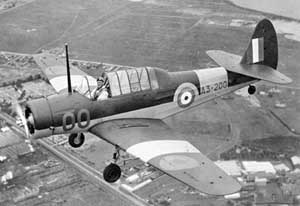
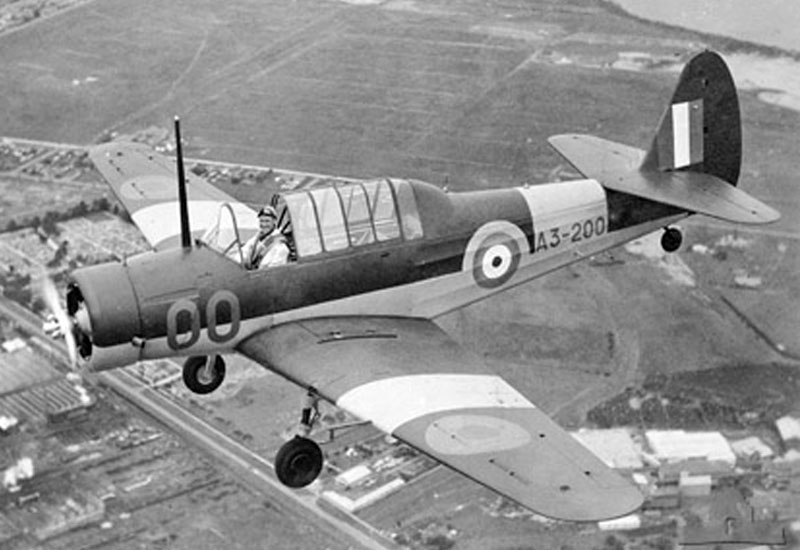
Commonwealth Aircraft Corporation, established since 1936 with the purpose of producing both aero engines and airframes, delivered its submission in the form of the CA-2. The design was developed around a tubular fuselage with steel understructure while wood was used to produce the skeleton of the wings. Fabric then covered the empennage while metal skin was used in the forward section. The crew sat in tandem as requested, under a heavily-framed canopy offering good views from either position. The nose section was rather short which allowed for improved forward views compared to contemporaries of the time. Wings were low-mounted appendages and the undercarriage was fixed with single-wheeled main legs and a single-wheeled tail leg.

With the CAC facility itself undergoing construction into late 1938, production of two prototype airframes was not completed until the following September of 1939. One prototype was fitted with the de Havilland "Gipsy Major" liquid-cooled inline piston engine - the same as powering the famous de Havilland Tiger Moth trainer of 1932 - and the other was completed with the de Havilland "Gipsy Six" liquid-cooled inline piston engine, powering aircraft such as the de Havilland Dragon Rapide airliner of 1934. First flight was recorded on September 19th, 1939 with the Gipsy Major-powered mount. The second prototype took to the air in November.

Testing yielded sub-par performance from the Gipsy Major-powered form and the following Gipsy Six-modified variant offered little more. As such, the decision was made to fit the type with the American-made Warner Aircraft Corporation "Scarab" radial piston engine series to power the finalized line. The initial prototypes were then re-engined in Scarab form and testing continued. Ultimately, the Royal Australian Air Force accepted the CAC design under the designation of CA-6 "Wackett" and a formal production order was signed - the aircraft entering service in March of 1941. By this time, the situation across the Pacific had grown to dangerous levels as Australia fell more and more under threat from the Japanese. It was not until the Americans formally entered the war after December 7th - the Japanese bombing of Pearl Harbor - that Australia could rely on extensive outside help. While the British Royal Navy was in action in the Pacific already, it was also trying to survive the German offensives in Europe.

Early production of Wacketts was hampered by shortages of both engines and propellers allowing engineers to revise the design before serial output solidified the airframe. CAC eventually produced some 200 Wacketts to serve as basic trainers for the RAAF with the last example delivered in April of 1942.

Wacketts managed an operational existence throughout the war though with dwindling numbers amidst a growing stable of other capable trainers arriving from overseas in number. This allowed many to be relegated to reserve and then storage until, after the war (1945), thirty examples were sold to the Netherlands for service in the Dutch East Indies. Still others made their way into private hands and the civilian sector. The Dutch airframes were then passed on to the newly established nation of Indonesia, independent of Dutch rule as of 1949.

World War 2 served to evolve Australia along several major fronts including industry. Prior to the war, it held no true heavy industrial base and this was grown in short order once the war forced growth. The Australian military also benefitted from the conflict in that it was allowed to be grown beyond its then-current form. Programs such as the Wackett and Boomerang only served to provide a self-reliance on military products and prove Australia as a modernized country.
Text ©2003-2013 www.MilitaryFactory.com • All Rights Reserved • No Reproduction Permitted
MilitaryFactory.com does NOT sell equipment/weaponry. Material presented throughout this website is for historical and entertainment value and should not to be construed as usable for hardware restoration, maintenance or general operation. Please consult manufacturers for such information. Our disclaimer. Email corrections / Comments to MilitaryFactory at Gmail dot com.
Picture of CAC Wackett
View All Images (1)

Specifications for the
CAC Wackett
Basic Trainer


Country of Origin: Australia
Manufacturer: Commonwealth Aircraft Corporation (CAC) - Australia
Initial Year of Service: 1941
Production: 202


Focus Model: CAC Wackett
Crew: 2


Length: 25.98ft (7.92m)
Width: 37.01ft (11.28m)
Height: 9.84ft (3.00m)
Weight (Empty): 1,909lbs (866kg)
Weight (MTOW): 2,590lbs (1,175kg)


Powerplant: 1 x Warner Aircraft Corporation Scarab radial piston engine developing 175 horsepower.


Maximum Speed: 115mph (185kmh; 100kts)
Maximum Range: 425miles (684km)
Service Ceiling: 0ft (0m; 0.0miles)
Rate-of-Climb: 0 feet per minute (0m/min)


Hardpoints: 0
Armament Suite:
None.


Variants:
CA-2 - Prototype Designation; two examples produced.


CA-6 - Production Model Designation; 200 examples produced.


Operators: Australia; Netherlands East Indies; Indonesia

ALL AIRCRAFT CATEGORIES

BY DECADE:


1900 to 1909
1910 to 1919
1920 to 1929
1930 to 1939
1940 to 1949
1950 to 1959
1960 to 1969
1970 to 1979
1980 to 1989
1990 to 1999
2000 to 2009
2010 to 2019
2020 to 2029
VIEW ALL
Compare Aircraft


BY TYPE:


Anti-Submarine Warfare (ASW)
Attack Helicopters
Bomber Aircraft
Medium Bombers
Heavy Bombers
Close-Air Support (CAS)
Commercial Aircraft
Dive Bombers
Electronic Warfare Aircraft (EWA)
Experimental / X-Planes
Fighter Aircraft
Floatplane Aircraft
Flying Boat Aircraft
Aerial Refueling Tankers
Helicopters (ALL)
Interceptor Aircraft
Multi-Role Aircraft
Navy Carrier Aircraft
Night Fighters
Reconnaissance / Scout
Search & Rescue (SAR)
Scout Helicopters
Special Purpose
Torpedo Bombers
Trainer Aircraft
Transport Aircraft
Transport Helicopters
Unmanned Aerial Vehicles (UAVs)
Unmanned Combat Air Vehicles (UCAVs)


COLLECTIONS:


4th Generation Fighter Aircraft
5th Generation Fighter Aircraft
US X-Planes
Classic US Warbirds
French Military Helicopters
Grumman "Cats"
Howard Hughes Aircraft
Indian Air Force
Israeli Air Force
Libyan Aircraft
Modern Chinese Aircraft
Modern Chinese Fighters
Modern Military Aircraft
Modern North Korean Aircraft
Modern Trainer Aircraft
Modern US Aircraft
Mikoyan Aircraft
Sukhoi Aircraft
Syrian Aircraft
Top 10 Fighter Aircraft of All Time


AIRCRAFT BY CONFLICT:


Arab-Israeli War (1948)
Cuban Missile Crisis (1959-1962)
Falklands War (1982)
Indo-Pak War (1965, 1971)
Iran-Iraq War (1980-1988)
Lebanon War (1982)
Operation Allied Force (1999)
Operation Desert Storm (1991)
Six Day War (1967)
Spanish Civil War (1936)
Soviet-Afghan War (1979-1989)
Yom Kippur War (1973)


MISCELLANEOUS:


Aircraft Cockpits
Aircraft Manufacturers List
Aircraft Timeline

WORLD WAR 2:


1939 Aircraft
1940 Aircraft
1941 Aircraft
1942 Aircraft
1943 Aircraft
1944 Aircraft
1945 Aircraft
1946 Aircraft
Australian Aircraft
Battle of Britain Aircraft
Bombers
Four-Engine Bombers
British Aircraft
British Bombers
British Transports
Dive Bombers
Canadian Aircraft
Fighters
Chinese Aircraft
French Aircraft
German Aircraft
German Fighters
German Flying Boats
German Jets
Secret Weapons of the Luftwaffe
Italian Aircraft
Imperial Japanese Aircraft
Imperial Japanese Fighters
Mitsubishi Bombers
Navy Aircraft
Pearl Harbor
Polish Aircraft
Romanian Aircraft
US Aircraft
US Bombers
US Navy Aircraft
Soviet Aircraft
Torpedo Bombers
Transport Aircraft
Tuskegee Airmen Aircraft
W.A.S.P. Aircraft
WW2 Aircraft Ranked by Speed
VIEW ALL


WORLD WAR 1:


1914 Aircraft
1915 Aircraft
1916 Aircraft
1917 Aircraft
1918 Aircraft
Aircraft Timeline
Austro-Hungarian Aircraft
Bomber Aircraft
British Aircraft
Fighters
Flying Boats
French Aircraft
Imperial German Aircraft
Italian Aircraft
Scout Aircraft
Russian Empire Aircraft
US Aircraft
WW1 Aircraft Ranked by Speed
VIEW ALL


KOREAN WAR:


Australian Aircraft
Korean War Aces
Korean War Jets
North Korean Aircraft
US Military Aircraft
VIEW ALL


VIETNAM WAR:


Helicopters
North Vietnam Air Force
US Airpower
VIEW ALL


COLD WAR:


1950s French Aircraft
British V-Bombers
Cold War Bombers
Soviet Aircraft
Soviet Bombers
Soviet Interceptors
Soviet Helicopters
Strategic Air Command
US Aircraft
US Bombers
US Interceptors
VIEW ALL

Site Disclaimer | Privacy Policy | Site Map | MF Origins


©2013 www.MilitaryFactory.com • Content ©2003-2013 MilitaryFactory.com • All Rights Reserved • Site Contact Email: militaryfactory at gmail dot com. The "Military Factory" name and MilitaryFactory.com logo are registered ® trademarks and protected by all applicable domestic and international intellectual property laws.


Top MF Stuff: 2013 Military Pay Scale | Military Ranks | WW2 Weapons | Sniper Rifles | Kts to Mph | WW1 Aircraft | Automatic Rifles | Aircraft Cockpits | Vietnam War Weapons | Main Battle Tanks | Submachine Guns | Shotguns | French Military Victories


Most photographic images appearing on this site are courtesy of the United States Department of Defense and are approved for public use. Other images acquired through the public domain. Digital art work courtesy of Dan Alex. Business Consulting by Kyle Williams. Material presented throughout this website is for historical and entertainment value and should not to be construed as usable for hardware restoration, maintenance or general operation. Please consult manufacturers for such information.


eXTReMe Tracker