Military Factory
Military Pay Chart
Global Firepower
Military Industrial Complex
Second World War
Home
Military Pay Scale
Military Ranks
Small Arms
Aircraft
Land Systems
Navy
Education
Military Factory Facebook Logo
flag of United States

Republic XF-84H Thunderscreech Experimental Fighter (1955)

Authored By Staff Writer | Last Updated: 10/18/2012

The Republic XF-84H attempted to mate a turbine engine with a supersonic propeller system but was limited to just two prototypes.

The Republic XF-84H was an experimental airframe based on the jet-powered, single-seat Republic F-84F Thunderstreak fighter. The XF-84H development attempted to mate the existing Republic fighter airframe to a turbine engine arrangement utilizing a supersonic propeller system to produce a speedy fighting platform as an alternative to the fuel-hungry, underpowered turbojet breeds of the time. However, issues abounded in such an endeavor and the program resulted in just two troublesome prototypes being built and none were ever tested by USAF test pilots before the complicated program was cancelled. The noise generated from the powerful turboprop engine - reportedly heard as far away as 25 miles - earned the XF-84H its nickname of "Thunderscreech", staying consistent with the "Thunder" naming classification of the original Republic fighter series.

Republic had garnered a fine name for itself in World War 2 thanks to their development of the P-47 Thunderbolt. The aircraft proved her worth as both a competent dogfighter (making many aces of her pilots) and a stable gunnery platform when charged with attacking ground targets across Europe and the Pacific (trains proved a favorite in the European Theater). As great as she was, the aircraft was dropped from service immediately after the war during huge military purges in peacetime America. By the time of the Korean War, Republic had put forth their F-84 "Thunderstreak" - a single-seat fighter powered by a turbojet engine and sporting straight monoplane wings. The aircraft was quickly outclassed by the arrival of the Soviet Mikoyan-Gurevich MiG-15 "Fagot" single-seat, swept-wing jet fighter and attempts at improving the Republic F-84 resulted in a swept-wing version all their own - the F-84F. Approximately 7,500 F-84s were eventually built despite their limitations and these were fielded in great numbers as a fighter-bombers during the war over the Korean Peninsula.

Origins of the XF-84H itself emerged from a United States Navy requirement for a carrier-based fighter aircraft that could take off under its own power without the need for catapult-assisted launches. Republic attempted to produce such a product with their "Project 3347" demonstrator of which the United States Air Force's Wright Air Development Center became a supporter of. The aircraft took the existing F-84F Thunderstreak airframe and fitted the experimental Allison XT40-A-1 turboprop engine (powered by a pair of coupled jet turbines spinning a supersonic, three-bladed propeller) in an amidships fitting directly behind the cockpit. From the engine ran an extension shaft under the cockpit floor to the propeller fitted to the nose of the aircraft. The tail was revised by raising the elevators high along the vertical tail fin and away from the powerful prop wash to be developed by the blades. The development, as a whole, had the potential to supply the airframe with the speed and performance of a turbojet-powered aircraft but, at the same time, could offer the improved ranges and low-fuel consumption of a propeller-driven airframe.

Project 3347 evolved to become the "XF-106" but this was later redesignated under the more familiar "XF-84H" to keep her F-84 Thunderstreak roots in check. The United States Navy had three such prototypes on order but eventually cancelled them, leaving two completed prototypes to be used as research aircraft for the USAF Propeller Laboratory based out of Wright-Patterson AFB. The XF-84H was constructed at Republic's fabled Farmingdale facility before being delivered to Edwards AFB by train. First flight was recorded on July 22nd, 1955.

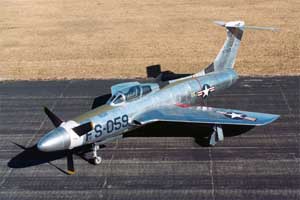
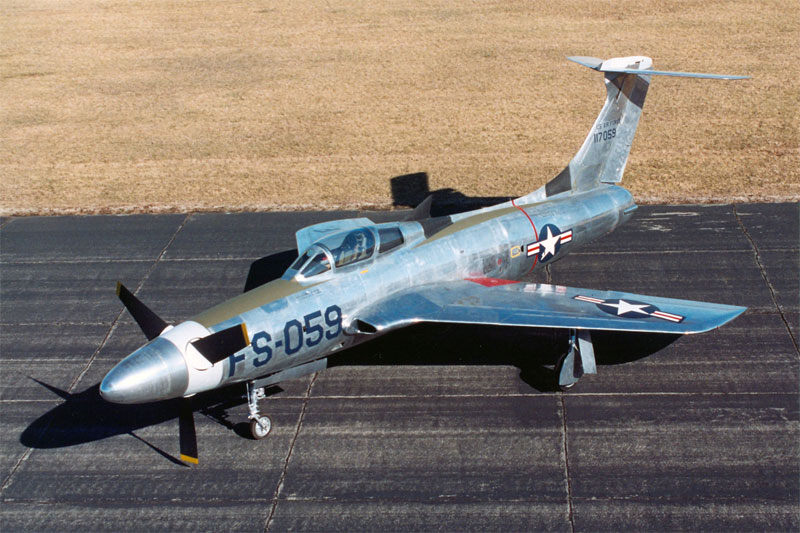
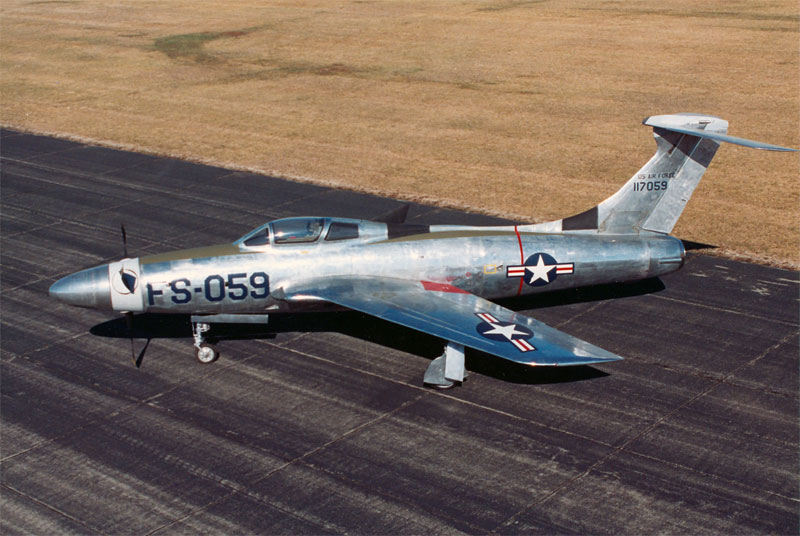
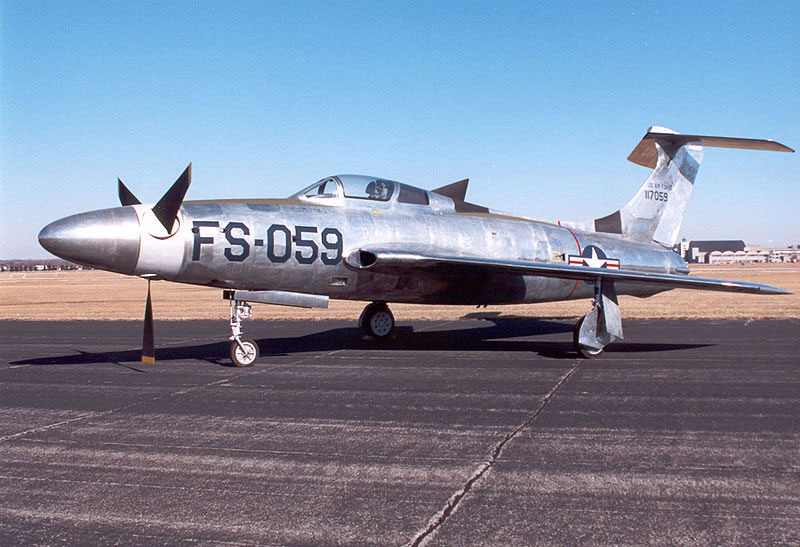
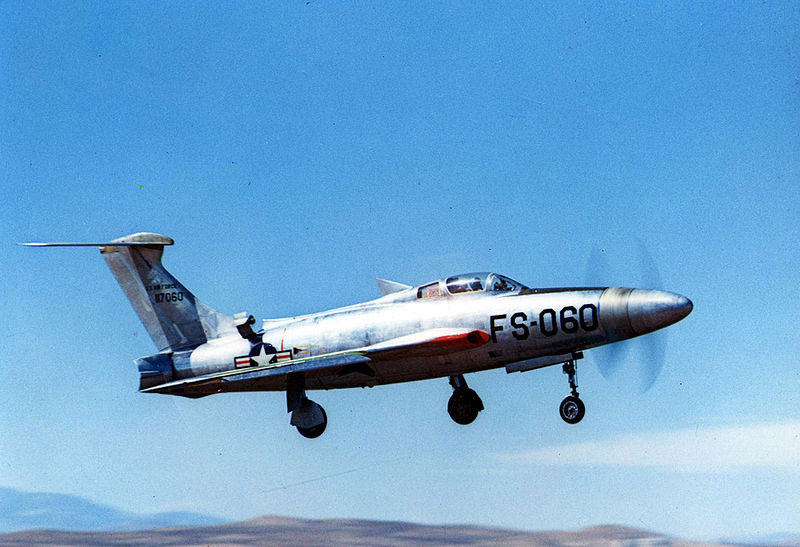
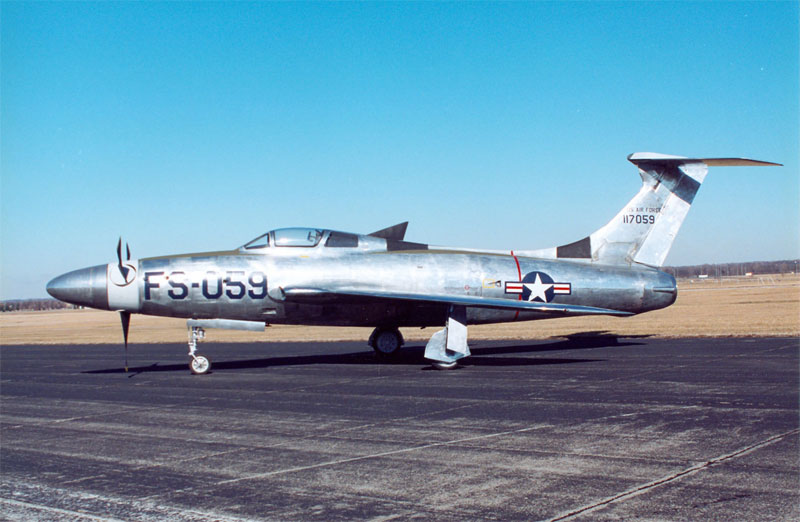
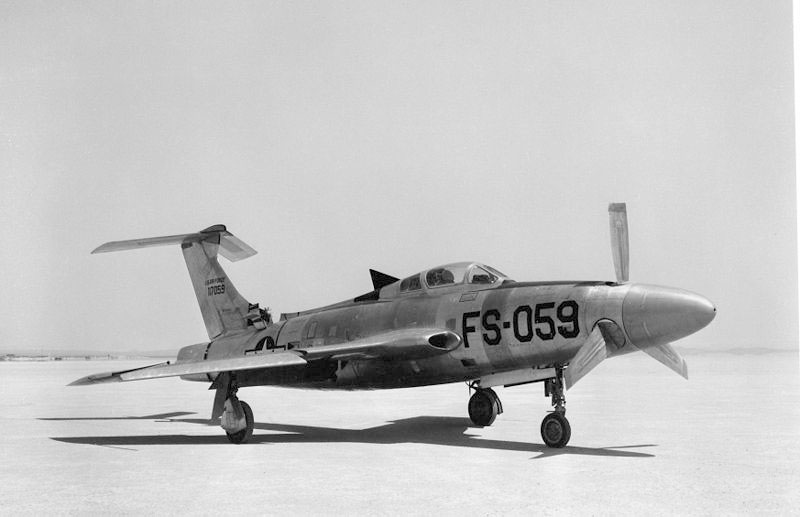
The XF-84H retained much of its appearance from the F-84F that it originated from. The obvious notable exception was the fitting of a nose cone containing the propeller system. She fielded a smooth, tubular fuselage that tapered off at the rear by the exhaust ring. Wings were swept back, mid-mounted monoplane assemblies and air intakes to aspirate the embedded turbines were fitted at the wing root leading edge. The cockpit sat aft of the nose cone and featured the same framing as found on the F-84F. A raised spine blocked most of the view to the rear. The empennage was dominated by a single vertical tail fin mounting a "T" style assembly that contained the horizontal planes - all tail surfaces were further swept back for maximum aerodynamic efficiency. The undercarriage was of the tricycle variety and dominated by the single-wheeled main landing gear legs retracting under each wing. The single-wheeled nose landing gear leg retracted rearwards forward of the cockpit floor.

The Allison XT40-A-1 series was a early-form turboprop engine that was made up by coupling Allison's T38 engines, these operating a single gearbox. The T38 was developed in the late 1940s and, itself, went on to become the successful line of T56 turboprop (powering such mounts as the Lockheed C-130 Hercules family). The XT40 powerplant was mated to the aforementioned three-bladed propeller system located at the front of the aircraft, each bade noticeably large in area though relatively stocky in appearance. This engine was noted for many things beyond its proposed inherent power (said to be capable of knocking down a standing man caught in her prop wash), not the least of these being the level of noise that the powerplant generated even when on idle. The XF-84H's propeller ran at supersonic speeds and created its own visible sonic booms in the process. The noise generated by the XF-84H engines was such that Republic was forced by the USAF Flight Test Center to run the remainder of their evaluations out of Rogers Dry lake in the Mojave Desert of California - such was the disruptive power of the Allison XT40-A-1 to USAF operations at Edwards.

Power was derived from the single Allison XT-40-A-1 turboprop engine delivering an impressive 5,850 horsepower. This supplied the aircraft with a top speed of 520 miles per hour, a range of about 2,000 miles and a service ceiling equal to about 40,000 feet. Rate-of-climb was measured at 5,000 feet per minute. A ram air turbine was also fitted to the airframe (aft near the fuselage spine, ahead of the vertical tail fin) on a retractable arm to be used in the event of an in-flight engine failure. However, as problems persisted with the Allison powerplant (ten of the eleven flights by the first prototype ended in forced landings), the ram air turbine was most always kept extended and ready for use in further test flights. Torque - the natural resulting force generated by a spinning object - from the massive power output eventually led to several revisions in the XF-84H airframe design, among these being the relocation of the left-side intake some 12 inches forward. Individual operating flaps were also trialed. Theoretically, the XF-84H could also gain beneficial thrust output from the jet wash exhausting at the rear of the fuselage and utilization of afterburner (raw fuel pumped directly into the engine for a boost in thrust) could push output upwards of 7,200 horsepower. However, the afterburner capability was never used during flight testing despite its installation.

In the whole of the program, the XF-84H was only produced in two prototypes - these being s/n 51-17059 (FS-059) and s/n 51-17060 (FS-060). The first prototype netted eleven total flights but at least ten of these ended in forced landings of the aircraft. At one point, even a Republic test pilot refused to take the XF-84H airborne ever again. The second prototype managed only a single flight. If doing the math, this resulted in just twelve total flights being reported between the pair. The inherent instability dangers of the airframe - coupled with the complicated and temperamental engine - meant that the XF-84H was doomed to a short lifespan. The program was officially cancelled by the USAF in September of 1956.

Following the cancellation of the Thunderscreech program, prototype 51-17059 spent her days as a "gate guardian" outside of the Meadows Field Airport in Bakersfield, California. She was fitted to a suspension rod and was showcased dramatically above the ground as if in flight - her propeller was actually being controlled by an installed electric motor for effect. In 1992, this aircraft was removed from her mounting and came under the attention of volunteers from the Ohio Air National Guard who saw it fit to restore her to museum display form. After some 3,000 hours of reconstruction, the XF-84H was handed over to its new owners for final display at the National Museum of the United States Air Force at Wright-Patterson AFB in Dayton, Ohio where she resides even today. Prototype 51-17060 is thought to have been scrapped at project's end, her Allison XT40-A-1 turboprop engine reportedly used during development of the Douglas A2D Skyshark.
Text ©2003-2013 www.MilitaryFactory.com • All Rights Reserved • No Reproduction Permitted
MilitaryFactory.com does NOT sell equipment/weaponry. Material presented throughout this website is for historical and entertainment value and should not to be construed as usable for hardware restoration, maintenance or general operation. Please consult manufacturers for such information. Our disclaimer. Email corrections / Comments to MilitaryFactory at Gmail dot com.
Picture of Republic XF-84H Thunderscreech
Pic of the Republic XF-84H Thunderscreech
Image of the Republic XF-84H Thunderscreech
View All Images (6)

Specifications for the
Republic XF-84H Thunderscreech
Experimental Fighter


Country of Origin: United States
Manufacturer: Republic Aviation - USA
Initial Year of Service: 1955
Production: 2


Focus Model: Republic XF-84H Thunderscreech
Crew: 1


Length: 51.41ft (15.67m)
Width: 33.40ft (10.18m)
Height: 15.32ft (4.67m)
Weight (Empty): 17,928lbs (8,132kg)
Weight (MTOW): 27,101lbs (12,293kg)


Powerplant: 1 x Allison XT40-A-1 turboprop engine (2 x T38 engines) delivering 5,850 horsepower.


Maximum Speed: 520mph (837kmh; 452kts)
Maximum Range: 1,988miles (3,200km)
Service Ceiling: 47,900ft (14,600m; 9.1miles)
Rate-of-Climb: 5,000 feet per minute (1,524m/min)


Hardpoints: 0
Armament Suite:
None.


Variants:
XF-84H "Thunderscreech" - Developmental designation; only two prototypes completed as S/N 51-17059 and S/N 51-17060; based on the Republic F-84F "Thunderstreak" airframe; project cancelled in 1956.


Operators:
United States

ALL AIRCRAFT CATEGORIES

BY DECADE:


1900 to 1909
1910 to 1919
1920 to 1929
1930 to 1939
1940 to 1949
1950 to 1959
1960 to 1969
1970 to 1979
1980 to 1989
1990 to 1999
2000 to 2009
2010 to 2019
2020 to 2029
VIEW ALL
Compare Aircraft


BY TYPE:


Anti-Submarine Warfare (ASW)
Attack Helicopters
Bomber Aircraft
Medium Bombers
Heavy Bombers
Close-Air Support (CAS)
Commercial Aircraft
Dive Bombers
Electronic Warfare Aircraft (EWA)
Experimental / X-Planes
Fighter Aircraft
Floatplane Aircraft
Flying Boat Aircraft
Aerial Refueling Tankers
Helicopters (ALL)
Interceptor Aircraft
Multi-Role Aircraft
Navy Carrier Aircraft
Night Fighters
Reconnaissance / Scout
Search & Rescue (SAR)
Scout Helicopters
Special Purpose
Torpedo Bombers
Trainer Aircraft
Transport Aircraft
Transport Helicopters
Unmanned Aerial Vehicles (UAVs)
Unmanned Combat Air Vehicles (UCAVs)


COLLECTIONS:


4th Generation Fighter Aircraft
5th Generation Fighter Aircraft
US X-Planes
Classic US Warbirds
French Military Helicopters
Grumman "Cats"
Howard Hughes Aircraft
Indian Air Force
Israeli Air Force
Libyan Aircraft
Modern Chinese Aircraft
Modern Chinese Fighters
Modern Military Aircraft
Modern North Korean Aircraft
Modern Trainer Aircraft
Modern US Aircraft
Mikoyan Aircraft
Sukhoi Aircraft
Syrian Aircraft
Top 10 Fighter Aircraft of All Time


AIRCRAFT BY CONFLICT:


Arab-Israeli War (1948)
Cuban Missile Crisis (1959-1962)
Falklands War (1982)
Indo-Pak War (1965, 1971)
Iran-Iraq War (1980-1988)
Lebanon War (1982)
Operation Allied Force (1999)
Operation Desert Storm (1991)
Six Day War (1967)
Spanish Civil War (1936)
Soviet-Afghan War (1979-1989)
Yom Kippur War (1973)


MISCELLANEOUS:


Aircraft Cockpits
Aircraft Manufacturers List
Aircraft Production
Aircraft Timeline

WORLD WAR 2:


1939 Aircraft
1940 Aircraft
1941 Aircraft
1942 Aircraft
1943 Aircraft
1944 Aircraft
1945 Aircraft
1946 Aircraft
Australian Aircraft
Battle of Britain Aircraft
Bombers
Four-Engine Bombers
British Aircraft
British Bombers
British Transports
Dive Bombers
Canadian Aircraft
Fighters
Chinese Aircraft
French Aircraft
German Aircraft
German Fighters
German Flying Boats
German Jets
Secret Weapons of the Luftwaffe
Italian Aircraft
Imperial Japanese Aircraft
Imperial Japanese Fighters
Mitsubishi Bombers
Navy Aircraft
Pearl Harbor
Polish Aircraft
Romanian Aircraft
US Aircraft
US Bombers
US Navy Aircraft
Soviet Aircraft
Torpedo Bombers
Trainer Aircraft
Transport Aircraft
Tuskegee Airmen Aircraft
W.A.S.P. Aircraft
WW2 Aircraft Ranked by Speed
VIEW ALL


WORLD WAR 1:


1914 Aircraft
1915 Aircraft
1916 Aircraft
1917 Aircraft
1918 Aircraft
Aircraft Timeline
Austro-Hungarian Aircraft
Bomber Aircraft
British Aircraft
Fighters
Flying Boats
French Aircraft
Imperial German Aircraft
Italian Aircraft
Scout Aircraft
Russian Empire Aircraft
US Aircraft
WW1 Aircraft Ranked by Speed
VIEW ALL


KOREAN WAR:


Australian Aircraft
Korean War Aces
Korean War Jets
North Korean Aircraft
US Military Aircraft
VIEW ALL


VIETNAM WAR:


Helicopters (ALL)
Transport Helicopters
North Vietnam Air Force
US Airpower
VIEW ALL


COLD WAR:


1950s French Aircraft
British V-Bombers
Cold War Bombers
Soviet Aircraft
Soviet Bombers
Soviet Interceptors
Soviet Helicopters
Strategic Air Command
US Aircraft
US Bombers
US Interceptors
VIEW ALL

Site Disclaimer | Privacy Policy | Site Map | MF Origins


©2013 www.MilitaryFactory.com • Content ©2003-2013 MilitaryFactory.com • All Rights Reserved • Site Contact Email: militaryfactory at gmail dot com. The "Military Factory" name and MilitaryFactory.com logo are registered ® trademarks and protected by all applicable domestic and international intellectual property laws.


Top MF Stuff: 2013 Military Pay Scale | Military Ranks | WW2 Weapons | Sniper Rifles | Kts to Mph | WW1 Aircraft | Automatic Rifles | Aircraft Cockpits | Vietnam War Weapons | Main Battle Tanks | Submachine Guns | Shotguns | French Military Victories


Most photographic images appearing on this site are courtesy of the United States Department of Defense and are approved for public use. Other images acquired through the public domain. Digital art work courtesy of Dan Alex. Business Consulting by Kyle Williams. Material presented throughout this website is for historical and entertainment value and should not to be construed as usable for hardware restoration, maintenance or general operation. Please consult manufacturers for such information.


eXTReMe Tracker