Military Factory
Military Pay Chart
Global Firepower
Military Industrial Complex
Second World War
Home
Military Pay Scale
Military Ranks
Small Arms
Aircraft
Land Systems
Navy
Education
Military Factory Facebook Logo
flag of United Kingdom

Felixstowe F.5 Reconnaissance Flying Boat (1917)

Authored By Staff Writer | Last Updated: 6/21/2010

The Felixstowe F-series became the standard flying boat for the RAF and was adopted by the Americans in time.

Find a School Near You
Follow Military Factory on Facebook:
Trending on Military Factory:
Recent Articles:
The Felixstowe F.5 series originated in the United Kingdom as a militarized flying boat in the last year of World War 1 (1918). Her design was credited to Lieutenant Commander John C. Porte of the Royal Navy (out of the "Seaplane Experimental Station" at Felixstowe - hence her designation). Porte had already taken the Curtiss H.12 flying boat (Curtiss Model H) and modified it into a better product when he designed his Felixstowe F.2a series. The F.2a series would go on to become the standard Royal Navy Air Service flying boat of World War 1 while the follow-up F.5 led a healthy existence during the post-war period defined as the "inter-war" years (in both military and civilian guises).

Porte continued to evolve the F.2a design and eventually produced the Felixstowe F.3 series. However, the new design being larger and thusly heavier, it suffered from poor handling while still benefiting from having greater range and an increased bomb load capacity - two good qualities for a flying boat to have. As such, development continued and ultimately resulted in the completely redesigned "F.5", essentially a design intended to mate together the benefits of both preceding designs to make for a single excellent sea-borne patrol platform - first flight followed in May of 1918. Despite the improved qualities exhibited from the prototype, the powers that be deemed that the F.5 should incorporate as many production elements of the existing F.3 as possible to help keep costs down and numbers steady. This resulted in production versions of the F.5 lacking much of the performance displayed by the prototype, the end-product finding it hard to even match the performance the preceding F.2a and F.3 it was intended to best.

Regardless, the F.5 went on to become the standard flying boat of the British Royal Air Force from 1918 onwards though missing out on operational service in World War 1 altogether. Production of the base F.5 military boat was as follows: Short Brothers (23 examples); Phoenix Dynamo Manufacturing Company (17 examples); Gosport Aviation (10 examples); Dick, Kerr & Company (2 examples); Seaplane Experimental Station (1 example).

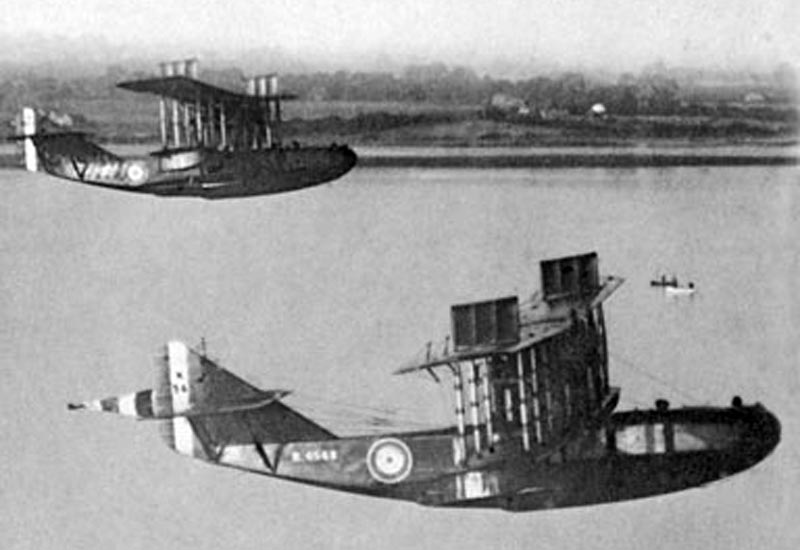
The Felixstowe F.5 maintained an elegant appearance consistent with flying boats of the time, made most identifiable by its hull-like fuselage. The fuselage was contoured where possible, bulbous at the lower portions to effectively displace water, with little detail to disrupt airflow. Wings were set amidships and were biplane in nature and slightly unequal in span, held in place by parallel bracing struts and cabling with pontoons located outboard. The engines were mounted between the upper and lower wing assemblies, well clear of salt spray from the sea. The fuselage tapered upwards towards the empennage which sported a single, large-area angular vertical tail fin and high-mounted, large-area horizontal tailplanes. Cabling extended from amidships rearwards towards the tail fin. The crew of four sat in open-air cockpits with accommodations for two pilots (seated side-by-side) and a pair of machine gunners - one manning the forward mount in the front circular cockpit and the other nestled between the two engine mounts amidships in another circular cockpit. Defensive armament centered around a collection of four Lewis aircraft machine guns, one set in a flexible mounting in the nose and the other two (or three) Lewis guns positioned along amidships. As a bomber, the F.5 could make use of four underwing bomb racks for the carrying of 4 x 230lb bombs. Power was derived from twin Rolls-Royce Eagle VIII series V12 inline piston engines delivering approximately 350 horsepower spinning two-bladed propellers. This provided for speeds of up to 88 miles per hour with a service ceiling of 6,800 feet and endurance for seven hours of flight time.

The base F.5 served with the British Royal Air Force and the Royal Naval Air Service branches. With the RAF, it made up the inventories of Squadrons No. 230, 231, 232, 238, 247, 249, 259, 261 and 267.

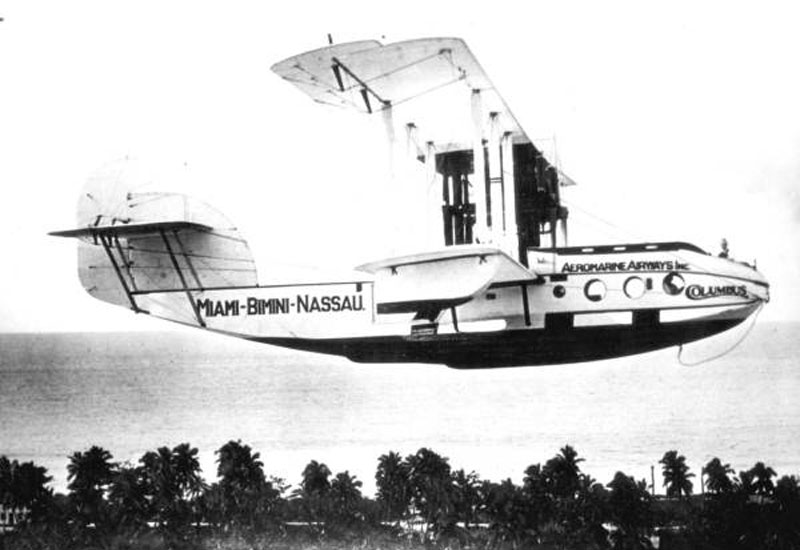
F.5 production was also undertaken by the Americans when the US Navy adopted the type into service in 1918. These were powered by a pair of Liberty engines and produced by Curtiss (60 examples), the US Naval Aircraft Factory (137 examples) in the US and by Canadian Aeroplanes (30 examples) out of Toronto, Canada. The Liberty-powered mounts came under the designation of "F.5L" and some 227 examples were built in all. F.5Ls were the US Navy's primary flying boat up until 1928 before being replaced by the PN-12 series. Curtiss F.5Ls also served in the civilian airliner role after some conversion. These were operated by the Aeromarine Plane and Motor Company beginning in 1919 under the company designation of "Aeromarine 75". Operators of this type included both the United States and Argentina.

Japan license-produced the F.5 for its Imperial Japanese Navy to the tune of 60 examples, these handled by the Hiro Naval Arsenal.

The F.5 served with the RAF up until August of 1925, replaced by the Supermarine Southhampton.
Text ©2003-2013 www.MilitaryFactory.com • All Rights Reserved • No Reproduction Permitted
MilitaryFactory.com does NOT sell equipment/weaponry. Material presented throughout this website is for historical and entertainment value and should not to be construed as usable for hardware restoration, maintenance or general operation. Please consult manufacturers for such information. Our disclaimer. Email corrections / Comments to MilitaryFactory at Gmail dot com.
Picture of Felixstowe F.5
Pic of the Felixstowe F.5
View All Images (2)

Specifications for the
Felixstowe F.5
Reconnaissance Flying Boat


Country of Origin: United Kingdom
Manufacturer: Short Bros; Phoenix Dynamo Mfg Co; Gosport Aviation Dick, Kerr & Co; Seaplane Experimental Station - UK
Initial Year of Service: 1917
Production: 280


Focus Model: Felixstowe F.5
Crew: 4


Length: 49.25ft (15.01m)
Width: 103.67ft (31.60m)
Height: 18.77ft (5.72m)
Weight (Empty): 9,101lbs (4,128kg)
Weight (MTOW): 12,681lbs (5,752kg)


Powerplant: 2 x Rolls-Royce Eagle VIII 12-cylinder Vee piston engines delivering 350 horsepower each.


Maximum Speed: 88mph (142kmh; 77kts)
Maximum Range: 590miles (950km)
Service Ceiling: 6,808ft (2,075m; 1.3miles)
Rate-of-Climb: 216 feet per minute (66m/min)


Hardpoints: 4
Armament Suite:
STANDARD:
1 x 7.7mm (0.303 caliber) Lewis machine gun in flexible nose mounting.
2 OR 3 x 7.7mm (0.303 caliber) Lewis machine gun in midship positions.

OPTIONAL:
4 x 230lb bombs along underwing racks.


Variants:
F.5 - Base Production Series Designation; 53 examples produced.


F.5L - American designation for F.5 production; fitted with Liberty engines; production by Naval Aircraft Factory; Curtiss and Canadien Aeroplanes of Canada; 227 examples produced.

Curtiss F.5L - Alternative American Designation

Aeromarine 75 - Civilian Airliner conversions from F.5L models.


Operators: Argentina; Japan; United Kingdom; United States

ALL AIRCRAFT CATEGORIES

BY DECADE:


1900 to 1909
1910 to 1919
1920 to 1929
1930 to 1939
1940 to 1949
1950 to 1959
1960 to 1969
1970 to 1979
1980 to 1989
1990 to 1999
2000 to 2009
2010 to 2019
2020 to 2029
VIEW ALL
Compare Aircraft


BY TYPE:


Anti-Submarine Warfare (ASW)
Attack Helicopters
Bomber Aircraft
Medium Bombers
Heavy Bombers
Close-Air Support (CAS)
Commercial Aircraft
Dive Bombers
Electronic Warfare Aircraft (EWA)
Experimental / X-Planes
Fighter Aircraft
Floatplane Aircraft
Flying Boat Aircraft
Aerial Refueling Tankers
Helicopters (ALL)
Interceptor Aircraft
Multi-Role Aircraft
Navy Carrier Aircraft
Night Fighters
Reconnaissance / Scout
Search & Rescue (SAR)
Scout Helicopters
Special Purpose
Torpedo Bombers
Trainer Aircraft
Transport Aircraft
Transport Helicopters
Unmanned Aerial Vehicles (UAVs)
Unmanned Combat Air Vehicles (UCAVs)


COLLECTIONS:


4th Generation Fighter Aircraft
5th Generation Fighter Aircraft
US X-Planes
Classic US Warbirds
French Military Helicopters
Grumman "Cats"
Howard Hughes Aircraft
Indian Air Force
Israeli Air Force
Libyan Aircraft
Modern Chinese Aircraft
Modern Chinese Fighters
Modern Military Aircraft
Modern North Korean Aircraft
Modern Trainer Aircraft
Modern US Aircraft
Mikoyan Aircraft
Sukhoi Aircraft
Syrian Aircraft
Top 10 Fighter Aircraft of All Time


AIRCRAFT BY CONFLICT:


Arab-Israeli War (1948)
Cuban Missile Crisis (1959-1962)
Falklands War (1982)
Indo-Pak War (1965, 1971)
Iran-Iraq War (1980-1988)
Lebanon War (1982)
Operation Allied Force (1999)
Operation Desert Storm (1991)
Six Day War (1967)
Spanish Civil War (1936)
Soviet-Afghan War (1979-1989)
Yom Kippur War (1973)


MISCELLANEOUS:


Aircraft Cockpits
Aircraft Manufacturers List
Aircraft Timeline

WORLD WAR 2:


1939 Aircraft
1940 Aircraft
1941 Aircraft
1942 Aircraft
1943 Aircraft
1944 Aircraft
1945 Aircraft
1946 Aircraft
Australian Aircraft
Battle of Britain Aircraft
Bombers
Four-Engine Bombers
British Aircraft
British Bombers
British Transports
Dive Bombers
Canadian Aircraft
Fighters
Chinese Aircraft
French Aircraft
German Aircraft
German Fighters
German Flying Boats
German Jets
Secret Weapons of the Luftwaffe
Italian Aircraft
Imperial Japanese Aircraft
Imperial Japanese Fighters
Mitsubishi Bombers
Navy Aircraft
Pearl Harbor
Polish Aircraft
Romanian Aircraft
US Aircraft
US Bombers
US Navy Aircraft
Soviet Aircraft
Torpedo Bombers
Transport Aircraft
Tuskegee Airmen Aircraft
W.A.S.P. Aircraft
WW2 Aircraft Ranked by Speed
VIEW ALL


WORLD WAR 1:


1914 Aircraft
1915 Aircraft
1916 Aircraft
1917 Aircraft
1918 Aircraft
Aircraft Timeline
Austro-Hungarian Aircraft
Bomber Aircraft
British Aircraft
Fighters
Flying Boats
French Aircraft
Imperial German Aircraft
Italian Aircraft
Scout Aircraft
Russian Empire Aircraft
US Aircraft
WW1 Aircraft Ranked by Speed
VIEW ALL


KOREAN WAR:


Australian Aircraft
Korean War Aces
Korean War Jets
North Korean Aircraft
US Military Aircraft
VIEW ALL


VIETNAM WAR:


Helicopters
North Vietnam Air Force
US Airpower
VIEW ALL


COLD WAR:


1950s French Aircraft
British V-Bombers
Cold War Bombers
Soviet Aircraft
Soviet Bombers
Soviet Interceptors
Soviet Helicopters
Strategic Air Command
US Aircraft
US Bombers
US Interceptors
VIEW ALL

Site Disclaimer | Privacy Policy | Site Map | MF Origins


©2013 www.MilitaryFactory.com • Content ©2003-2013 MilitaryFactory.com • All Rights Reserved • Site Contact Email: militaryfactory at gmail dot com. The "Military Factory" name and MilitaryFactory.com logo are registered ® trademarks and protected by all applicable domestic and international intellectual property laws.


Top MF Stuff: 2013 Military Pay Scale | Military Ranks | WW2 Weapons | Sniper Rifles | Kts to Mph | WW1 Aircraft | Automatic Rifles | Aircraft Cockpits | Vietnam War Weapons | Main Battle Tanks | Submachine Guns | Shotguns | French Military Victories


Most photographic images appearing on this site are courtesy of the United States Department of Defense and are approved for public use. Other images acquired through the public domain. Digital art work courtesy of Dan Alex. Business Consulting by Kyle Williams. Material presented throughout this website is for historical and entertainment value and should not to be construed as usable for hardware restoration, maintenance or general operation. Please consult manufacturers for such information.


eXTReMe Tracker