Military Factory
Military Pay Chart
Global Firepower
Military Industrial Complex
Second World War
Home
Military Pay Scale
Military Ranks
Small Arms
Aircraft
Land Systems
Navy
Education
Military Factory Facebook Logo
flag of Nazi Germany

Messerschmitt Me 209-II Fighter (1943)

Authored By Dan Alex | Last Updated: 4/19/2013

The Messerschmitt Me 209-II was designed as a possible replacement for the Luftwaffe's hugely popular Messerschmitt BF 109 fighter series.

Find a School Near You
Follow Military Factory on Facebook:
Trending on Military Factory:
Recent Articles:
The Messerschmitt Me 209-II was a proposed successor to the far-reaching Messerschmitt Bf 109 fighter. The Bf 109 was the standard German Luftwaffe fighter of World War 2 and developed quite a reputation during the conflict, lasting from beginning to end and appearing in multiple variants numbering some 33,000 production examples in whole. Much thought was given to making the new Me 209-II compatible with the existing BF 109 airframes, leading perhaps to some potential benefits during production and in-the-field fixes. As fate would have it, the Me 209-II suffered through its development process and the end-product was no better than the available fighter systems already in circulation. In all, only four Me 209-II prototypes were known to have been constructed before project's end.

A Note About the Me 209 Designation

While the "Me 209" designation was used before to cover the high-performance race plane series of 1938, the designation was also used for Messerschmitt's fighter prototype intended to replace the BF 109 and is oft-noted by a "II" or "2" to signify this difference. The two aircraft have little relation to one another except in manufacturer. The original Me 209 racer was not modified for combat nor was there thought to such action while the Me 209-II was very much a fighter thoroughbred at heart.

The Challenge

Messerschmitt had stuck gold with its all-metal BF 109 fighter series debuting in the Spanish Civil War. The aircraft featured a retractable undercarriage and an enclosed cockpit - quite novel concepts for 1930s fighter design. While the fighter was an excellent system for its time, it was still a design based in past thinking and its limitations during a modern war was beginning to show. Both Messerschmitt and Focke-Wulf looked to supply an answer for the burgeoning RLM (Air Ministry) need. Willy Messerschmitt penciled out a possible successor in his Me 209-II while Focke-Wulf put forth its wide-span Ta 152 and Fw 190D-9 fighter developments. All three combat systems were modified forms of their respective airframe origins to help ease impending production commitments. The Me 209-II borrowed heavily from the BF-109G model while the Fw 109D-9 and Ta 152 were both based on the successful Fw 190 fighter airframe.

Messerschmitt Me 209-II Walk-Around

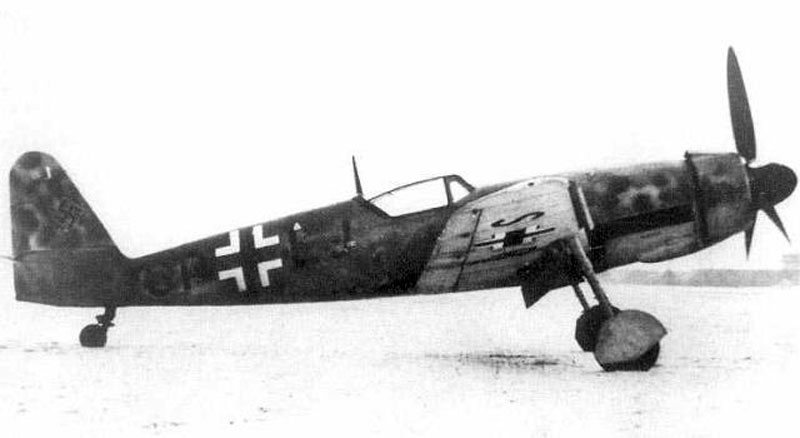
The Me 209-II maintained its obvious resemblance to the BF 109, in particular was its retention of the squared-off canopy. An all-new tail section was constructed and commonality of parts with the BF 109 (the BF 109 G-5 to be exact) was approximately 65%. The cockpit was set just forward of fuselage center and there was a raised "spine" obstructing the view to the "six". The engine was held within an elongated forward compartment and powered a three-blade propeller capped by a rounded spinner. The fuselage, as a whole, was a streamlined affair and appeared something akin to a thin flying pencil - though cleanly contoured and tampered off at the extreme aft end. Wings were low-mounted cantilever monoplane assemblies set under and forward of the cockpit floor with slight dihedral (upwards angle). The empennage was conventional, fitting a single vertical tail fin with a rounded top edge and applicable horizontal planes. The wide-track undercarriage was also conventional - giving the name to these sorts of aircraft as "tail draggers" - with single-wheeled main landing gear legs under each wing and a diminutive tail wheel under the empennage. The main legs retracted towards centerline.

Powerplant and Armament

While the Daimler-Benz DB 603A inline piston engine was intended to be used in the Me 209-II production form, its limited availability meant that a Junkers Jumo 213A series was also utilized during development. The selection of the Junkers engine led to some redesigning of the forward engine compartment and the applicable cooling system. Armament was much like the Bf 109, a combination of cannon and machine guns. Armament was fitted to the V5 prototype that included a 1 x 30mm MK 108 series cannon firing through the propeller hub and 2 x 13mm MG 131 machine guns in the wing roots. Only the follow-up V6 prototype varied this by replacing the MG 131 systems with a pair of 20mm MG 151/20 cannons. The V5 prototype achieved first flight on November 3rd, 1943, this fitting the Daimler-Benz 603A engine. A later upgrade fitted a Daimler-Benz DB 603G instead. The V6 prototype appeared in December of 1943 with first flight achieved sometime in April of 1944.

The End Draws Near

Despite the promising specifications, the Me 209-II proved no faster than the FW 190D-9. In fact, the Messerschmitt design recorded 31 miles per hour slower than the competing FW 190. To add insult to injury, there was nothing much in the way of handling benefits with the revised BF 109 airframe, working against any thought of furthering the Messerschmitt project in the least. Maximum speed was estimated at 423 miles per hour with a service ceiling equal to 36,000 feet. As such, the Me 209-II was cancelled in 1944 though Messerschmitt would continue its private development under the designation of "Me 109L" for a time.

Proposed Me 209-II Forms

Two production forms of the Me 209-II were planned and designated simply as "A1" and "A2". These differed slightly and were separated only by their selection of powerplant. The A1 would have been based on the V5 prototype fitting the Daimler-Benz DB 603G engine while the A2 would have been based on the V6 prototype fitting the Junkers Jumo 213E engine. As can be surmised, neither form was ever constructed let alone produced in any quantity. The Me 209H V1 designation was reserved for a proposed high-altitude form with a wider wingspan and a Daimler-Benz DB 603 engine.
Text ©2003-2013 www.MilitaryFactory.com • All Rights Reserved • No Reproduction Permitted
MilitaryFactory.com does NOT sell equipment/weaponry. Material presented throughout this website is for historical and entertainment value and should not to be construed as usable for hardware restoration, maintenance or general operation. Please consult manufacturers for such information. Our disclaimer. Email corrections / Comments to MilitaryFactory at Gmail dot com.
Picture of Messerschmitt Me 209-II
View All Images (1)

Specifications for the
Messerschmitt Me 209-II
Fighter


Country of Origin: Nazi Germany
Manufacturer: Messerschmitt - Germay
Initial Year of Service: 1943
Production: 4


Focus Model: Messerschmitt Me 209-II V5
Crew: 1


Length: 31.96ft (9.74m)
Width: 35.93ft (10.95m)
Height: 13.12ft (4.00m)
Weight (Empty): 7,361lbs (3,339kg)
Weight (MTOW): 9,006lbs (4,085kg)


Powerplant: 1 x Daimler-Benz DB 603G piston engine delivering 1,900 horsepower.


Maximum Speed: 421mph (678kmh; 366kts)
Maximum Range: 0miles (0km)
Service Ceiling: 36,089ft (11,000m; 6.8miles)
Rate-of-Climb: 0 feet per minute (0m/min)


Hardpoints: 0
Armament Suite:
PROPOSED (V5 Prototype):
1 x 30mm MK 108 cannon in propeller hub
2 x 13mm MG 131 machine guns in wing roots

ALTERNATIVE (V6 Prototype):
1 x 30mm MK 108 cannon in propeller hub
2 x 20mm MG 151/20 cannons in wings


Variants:
Me 209 V5 - Fitting 1 x 30mm MK 108 cannon in propeller hub and 2 x 13mm MG 131 machine guns in wing roots.


Me 209 V6 - Fitted with Jumo 213 series engine; armament of 20mm MG 151/20 cannons.

Me 209H V1 - Proposed High-Altitude Variant; increased wingspan; fitted with Daimler-Benz DB 603 series engine; based on the P.1091B high performance fighter.

Me 109L - Developmental Designation after project cancellation.

Me 209 A1 - Planned production fighter designation; to be fitted with DB 603G engines based on the V5 prototype.

Me 209 A2 - Planned production fighter designation; to be fitted with Jumo 213E engines based on the V6 prototype.


Operators: Nazi Germany

ALL AIRCRAFT CATEGORIES

BY DECADE:


1900 to 1909
1910 to 1919
1920 to 1929
1930 to 1939
1940 to 1949
1950 to 1959
1960 to 1969
1970 to 1979
1980 to 1989
1990 to 1999
2000 to 2009
2010 to 2019
2020 to 2029
VIEW ALL
Compare Aircraft


BY TYPE:


Anti-Submarine Warfare (ASW)
Attack Helicopters
Bomber Aircraft
Medium Bombers
Heavy Bombers
Close-Air Support (CAS)
Commercial Aircraft
Dive Bombers
Electronic Warfare Aircraft (EWA)
Experimental / X-Planes
Fighter Aircraft
Floatplane Aircraft
Flying Boat Aircraft
Aerial Refueling Tankers
Helicopters (ALL)
Interceptor Aircraft
Multi-Role Aircraft
Navy Carrier Aircraft
Night Fighters
Reconnaissance / Scout
Search & Rescue (SAR)
Scout Helicopters
Special Purpose
Torpedo Bombers
Trainer Aircraft
Transport Aircraft
Transport Helicopters
Unmanned Aerial Vehicles (UAVs)
Unmanned Combat Air Vehicles (UCAVs)


COLLECTIONS:


4th Generation Fighter Aircraft
5th Generation Fighter Aircraft
US X-Planes
Classic US Warbirds
French Military Helicopters
Grumman "Cats"
Howard Hughes Aircraft
Indian Air Force
Israeli Air Force
Libyan Aircraft
Modern Chinese Aircraft
Modern Chinese Fighters
Modern Military Aircraft
Modern North Korean Aircraft
Modern Trainer Aircraft
Modern US Aircraft
Mikoyan Aircraft
Sukhoi Aircraft
Syrian Aircraft
Top 10 Fighter Aircraft of All Time


AIRCRAFT BY CONFLICT:


Arab-Israeli War (1948)
Cuban Missile Crisis (1959-1962)
Falklands War (1982)
Indo-Pak War (1965, 1971)
Iran-Iraq War (1980-1988)
Lebanon War (1982)
Operation Allied Force (1999)
Operation Desert Storm (1991)
Six Day War (1967)
Spanish Civil War (1936)
Soviet-Afghan War (1979-1989)
Yom Kippur War (1973)


MISCELLANEOUS:


Aircraft Cockpits
Aircraft Manufacturers List
Aircraft Timeline

WORLD WAR 2:


1939 Aircraft
1940 Aircraft
1941 Aircraft
1942 Aircraft
1943 Aircraft
1944 Aircraft
1945 Aircraft
1946 Aircraft
Australian Aircraft
Battle of Britain Aircraft
Bombers
Four-Engine Bombers
British Aircraft
British Bombers
British Transports
Dive Bombers
Canadian Aircraft
Fighters
Chinese Aircraft
French Aircraft
German Aircraft
German Fighters
German Flying Boats
German Jets
Secret Weapons of the Luftwaffe
Italian Aircraft
Imperial Japanese Aircraft
Imperial Japanese Fighters
Mitsubishi Bombers
Navy Aircraft
Pearl Harbor
Polish Aircraft
Romanian Aircraft
US Aircraft
US Bombers
US Navy Aircraft
Soviet Aircraft
Torpedo Bombers
Trainer Aircraft
Transport Aircraft
Tuskegee Airmen Aircraft
W.A.S.P. Aircraft
WW2 Aircraft Ranked by Speed
VIEW ALL


WORLD WAR 1:


1914 Aircraft
1915 Aircraft
1916 Aircraft
1917 Aircraft
1918 Aircraft
Aircraft Timeline
Austro-Hungarian Aircraft
Bomber Aircraft
British Aircraft
Fighters
Flying Boats
French Aircraft
Imperial German Aircraft
Italian Aircraft
Scout Aircraft
Russian Empire Aircraft
US Aircraft
WW1 Aircraft Ranked by Speed
VIEW ALL


KOREAN WAR:


Australian Aircraft
Korean War Aces
Korean War Jets
North Korean Aircraft
US Military Aircraft
VIEW ALL


VIETNAM WAR:


Helicopters
North Vietnam Air Force
US Airpower
VIEW ALL


COLD WAR:


1950s French Aircraft
British V-Bombers
Cold War Bombers
Soviet Aircraft
Soviet Bombers
Soviet Interceptors
Soviet Helicopters
Strategic Air Command
US Aircraft
US Bombers
US Interceptors
VIEW ALL

Site Disclaimer | Privacy Policy | Site Map | MF Origins


©2013 www.MilitaryFactory.com • Content ©2003-2013 MilitaryFactory.com • All Rights Reserved • Site Contact Email: militaryfactory at gmail dot com. The "Military Factory" name and MilitaryFactory.com logo are registered ® trademarks and protected by all applicable domestic and international intellectual property laws.


Top MF Stuff: 2013 Military Pay Scale | Military Ranks | WW2 Weapons | Sniper Rifles | Kts to Mph | WW1 Aircraft | Automatic Rifles | Aircraft Cockpits | Vietnam War Weapons | Main Battle Tanks | Submachine Guns | Shotguns | French Military Victories


Most photographic images appearing on this site are courtesy of the United States Department of Defense and are approved for public use. Other images acquired through the public domain. Digital art work courtesy of Dan Alex. Business Consulting by Kyle Williams. Material presented throughout this website is for historical and entertainment value and should not to be construed as usable for hardware restoration, maintenance or general operation. Please consult manufacturers for such information.


eXTReMe Tracker