Military Factory
Military Pay Chart
Global Firepower
Military Industrial Complex
Second World War
Home
Military Pay Scale
Military Ranks
Small Arms
Aircraft
Land Systems
Navy
Education
Military Factory Facebook Logo
flag of United Kingdom

Fairey Gannet Anti-Submarine Warfare Aircraft (1953)

Authored By Staff Writer | Last Updated: 10/1/2010

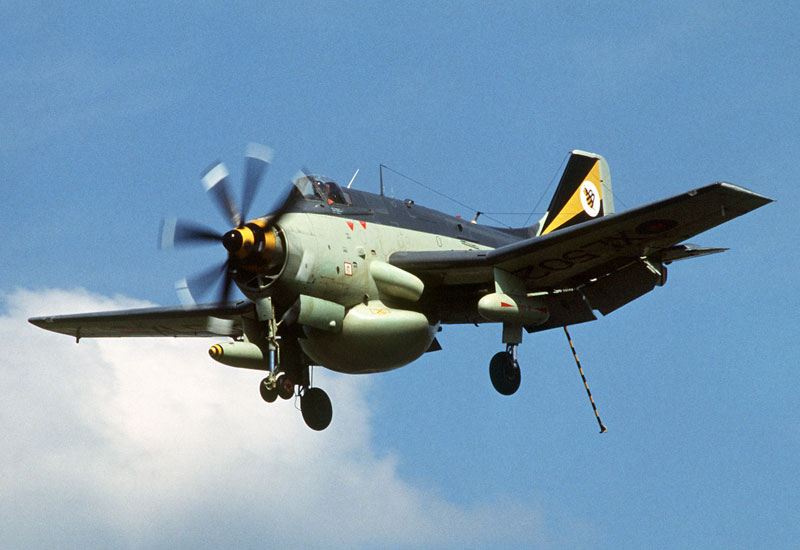
Distinctive features of the Gannet were its two contra-rotating propeller systems and crew of three.

Find a School Near You
Follow Military Factory on Facebook:
Trending on Military Factory:
Recent Articles:
The Fairey Gannet was a dedicated anti-submarine platform primarily serving the Fleet Air Arm of the British Royal Navy during the Cold War years. She was an aircraft design originating from a 1945 British Admiralty initiative (GR.17/45) requiring an advanced, carrier-based, anti-submarine warfare (ASW) platform. Both Fairey Aviation Company and Blackburn Aircraft responded with prototypes "Fairey 17" and "B-54" respectively. Both were of outwardly similar design, sporting conventional monoplane wings, stout reinforced airframes, internal bomb bays and a tricycle undercarriage. The "gannet" name was derived from the species of large seabirds common to the North Atlantic, the southern regions of Africa and the South Pacific (near Australia and New Zealand). Their predatory nature is such that they dive, at speed, upon unsuspecting prey in the water and can continue the chase of said prey while remaining submerged.

The Blackburn B-54 featured a piston engine while the follow-up prototype, the B-88, was fitted with a gas-powered turbine engine driving a large-radius contra-rotating propeller system. The internal bomb bay was affixed to the underside of the fuselage. The pilot and his observer sat in tandem under a framed canopy. The empennage was conventional, featuring a single vertical tail fin with a pair of horizontal planes. A radar scanner was mounted under the base of the empennage in a cylindrical fitting and was retractable into the fuselage. First flight was recorded on September 20th, 1949. Only three Blackburn prototypes were produced in all before the program was shelved in favor of the Fairey product.

The Fairey design (attributed to engineer H.E. Chaplin) made use of the Armstrong Siddeley Mamba gas-turbine engine in a dual configuration arrangement earning the pair the collective name of "Twin Mamba" or "Double Mamba". The arrangement showcased the engines in a side-by-side seating coupled to a single gearbox and powering contra-rotating propellers fitted to the nose of the aircraft. The engines exhausted from oblong ports along the sides of the fuselage, just above and aft of the wing trailing edges. The aircraft could be flown on just one engine in the event of a failure or to conserve fuel and could also operate with kerosene or diesel fuel as opposed to the more volatile high-octane fuel common to carrier piston engine aircraft of the time. The initial crew complement included the pilot, seated in the forward cockpit, and an observer, seated in a rear cockpit just aft of the pilot. Like the Blackburn design, the Fairey 17 also sported a retractable radome assembly under the base of the tail and an internal bomb bay compartment under the fuselage. The wings were cranked upwards outboard of the main landing gear legs. As the design was intended to be fielded from British carriers, the wings were designed to fold for optimal storage space; the assemblies took on a very distinct "Z" shape as a result, folding at two hinged locations and effectively "stacking" the wing vertically upon itself. The nose landing gear leg of the tricycle undercarriage gave the aircraft a distinct "nose up" appearance when at rest.

After the prototype was developed, the design was slightly revised to include a third crewmember as an additional observer. This added a third segregated cockpit to the layout, set just aft of amidships behind the wing yet ahead of the tail assembly. Of course this addition was not without effect and it was found to disrupted the airflow along the stabilizers on the tail forcing the use of small "finlets" along the fuselage sides aft of the wing assemblies to counter the issue. First flight of the Fairey 17 occurred on September 19th, 1949. On June 19th, 1950, the prototype made her first evaluation landing on the deck of the HMS Illustrious carrier. Content with the results, British authorities ordered the type for production as the Fairey "Gannet" AS Mark 1 (AS.Mk I) before the end of 1953. Deliveries of the first 100 aircraft began in April of 1954. That same year, a modified trainer variant was flown and accepted, entering service in 1955 as the T Mark 2 (T.Mk II). The first Gannet squadron for the Fleet Air Arm became 826 NAS, stationed on the HMS Eagle.

Production ran from 1953 until 1959 to which 348 examples were ultimately delivered by Fairey.

The AS Mark 1 (AS.Mk I) was the primary 3-seat production model of which 180 examples were built. The T Mark 2 (T.Mk II) became the primary training variant of the AS 1 production model. 35 of this type were produced. The AS Mark 4 (AS.Mk 4) soldiered on as an improved anti-submarine platform with a revised engine featuring greater output and was essentially the 170th production model onwards of the AS.Mk I. Eighty-two examples were produced. The COD Mark 4 (COD.Mk 4) were AS.Mk 4 production models revised for use as carrier-based transport aircraft. The T Mark 5 (T.Mk 5) was the trainer version of the AS.Mk 4 production model though only eight of this type were delivered. The A.Mk 6 were AS.Mk 4 models fitted with new and improved radar systems and revised electronics. The ECM.Mk 6 was an electronic countermeasures (ECM) land-based Gannet variant. The last production Gannet became the AEW.Mk 3 utilized by the Royal Navy as an airborne early warning (AEW) platform beginning in 1958. Forty-four examples of this type were ultimately built with first flight recorded on August of 1958. AEW.Mk 3 equipped four flights of No. 849 Squadron.

By the middle of the 1960s, the Fairey Gannet series - and its respective tasks - was being replaced by the Westland Whirlwind series of land- and carrier-based helicopters. The primary role of the Gannet now shifted wholly to use as electronic countermeasures platforms while some were revised as dedicated transports for passengers and cargo alike. It was about this time that the system was purchased by foreign parties including Australia, West Germany and Indonesia. The last of the Fairey Gannets was retired for good on December 15th, 1978, ending her long, yet useful, tenure for multiple naval parties.

The largest operator of the Fairey Gannet was the Fleet Air Arm of the British Royal Navy. The type was fielded through 700, 703, 703X, 719, 724, 725, 737, 744, 796, 810, 812, 814, 815, 816, 817, 820, 824, 825, 826, 831, 847, 849 Naval Air Squadrons. There was also B Flight on the HMS Ark Royal and D Flight on the HMS Eagle as well as the 1840 Naval Air Squadron of the Royal Naval Volunteer Reserve.

The Fairey Gannet was operated by the 724, 725, 816 and 817 squadrons of the Royal Australian Navy. The German Navy also operated the type with Marinefliegergeschwader 2 and Marinefliegergeschwader 3 up until 1963 and 1966 respectively. The aircraft was purchased in small quantities by the Indonesian Navy as well.
Text ©2003-2013 www.MilitaryFactory.com • All Rights Reserved • No Reproduction Permitted
MilitaryFactory.com does NOT sell equipment/weaponry. Material presented throughout this website is for historical and entertainment value and should not to be construed as usable for hardware restoration, maintenance or general operation. Please consult manufacturers for such information. Our disclaimer. Email corrections / Comments to MilitaryFactory at Gmail dot com.
Picture of Fairey Gannet
View All Images (1)

Specifications for the
Fairey Gannet
Anti-Submarine Warfare Aircraft


Country of Origin: United Kingdom
Manufacturer: Fairey Aviation Company - UK
Initial Year of Service: 1953
Production: 348


Focus Model: Fairey Gannet AS Mark 4
Crew: 3


Length: 43.01ft (13.11m)
Width: 54.36ft (16.57m)
Height: 13.68ft (4.17m)
Weight (Empty): 14,528lbs (6,590kg)
Weight (MTOW): 22,487lbs (10,200kg)


Powerplant: 1 x Armstrong Siddeley Double Mamba ASMD.3 turboprop engine developing 3,145 horsepower.


Maximum Speed: 300mph (482kmh; 260kts)
Maximum Range: 944miles (1,520km)
Service Ceiling: 21,982ft (6,700m; 4.2miles)
Rate-of-Climb: 310 feet per minute (94m/min)


Hardpoints: 2
Armament Suite:
Mission-specific. Up to 2,850lbs of internal and external stores including:

2 x Torpedoes (held internally)
16 x 60lb air-to-surface rockets
Conventional Drop Bombs
Depth Charges


Variants:
Gannet AS.Mk I - Anti-Submarine Model; 180 examples produced.


Gannet T.Mk II - Trainer Model based on the AS Mark 1 production model; 35 examples produced.

Gannet AEW.Mk 3 - Airborne Early Warning aircraft platform; 44 examples produced; Royal Navy use.

Gannet AS.Mk 4 - Anti-Submarine Model; improved performance from new engine; 82 examples produced.

Gannet COD.Mk 4 - Passenger/Cargo Transport based on AS Mark 4 models.

Gannet T.Mk 5 - Trainer Model based on the AS Mark 4 production model; 8 examples produced.

Gannet AS.Mk 6 - Improved Gannets fitting new electronics and radar systems; limited production.

Gannet ECM.Mk 6 - Electronic Countermeasures (ECM) Model; lad-based Gannets.


Operators: Australia; West Germany; Indonesia; United Kingdom

ALL AIRCRAFT CATEGORIES

BY DECADE:


1900 to 1909
1910 to 1919
1920 to 1929
1930 to 1939
1940 to 1949
1950 to 1959
1960 to 1969
1970 to 1979
1980 to 1989
1990 to 1999
2000 to 2009
2010 to 2019
2020 to 2029
VIEW ALL
Compare Aircraft


BY TYPE:


Anti-Submarine Warfare (ASW)
Attack Helicopters
Bomber Aircraft
Medium Bombers
Heavy Bombers
Close-Air Support (CAS)
Commercial Aircraft
Dive Bombers
Electronic Warfare Aircraft (EWA)
Experimental / X-Planes
Fighter Aircraft
Floatplane Aircraft
Flying Boat Aircraft
Aerial Refueling Tankers
Helicopters (ALL)
Interceptor Aircraft
Multi-Role Aircraft
Navy Carrier Aircraft
Night Fighters
Reconnaissance / Scout
Search & Rescue (SAR)
Scout Helicopters
Special Purpose
Torpedo Bombers
Trainer Aircraft
Transport Aircraft
Transport Helicopters
Unmanned Aerial Vehicles (UAVs)
Unmanned Combat Air Vehicles (UCAVs)


COLLECTIONS:


4th Generation Fighter Aircraft
5th Generation Fighter Aircraft
US X-Planes
Classic US Warbirds
French Military Helicopters
Grumman "Cats"
Howard Hughes Aircraft
Indian Air Force
Israeli Air Force
Libyan Aircraft
Modern Chinese Aircraft
Modern Chinese Fighters
Modern Military Aircraft
Modern North Korean Aircraft
Modern Trainer Aircraft
Modern US Aircraft
Mikoyan Aircraft
Sukhoi Aircraft
Syrian Aircraft
Top 10 Fighter Aircraft of All Time


AIRCRAFT BY CONFLICT:


Arab-Israeli War (1948)
Cuban Missile Crisis (1959-1962)
Falklands War (1982)
Indo-Pak War (1965, 1971)
Iran-Iraq War (1980-1988)
Lebanon War (1982)
Operation Allied Force (1999)
Operation Desert Storm (1991)
Six Day War (1967)
Spanish Civil War (1936)
Soviet-Afghan War (1979-1989)
Yom Kippur War (1973)


MISCELLANEOUS:


Aircraft Cockpits
Aircraft Manufacturers List
Aircraft Timeline

WORLD WAR 2:


1939 Aircraft
1940 Aircraft
1941 Aircraft
1942 Aircraft
1943 Aircraft
1944 Aircraft
1945 Aircraft
1946 Aircraft
Australian Aircraft
Battle of Britain Aircraft
Bombers
Four-Engine Bombers
British Aircraft
British Bombers
British Transports
Dive Bombers
Canadian Aircraft
Fighters
Chinese Aircraft
French Aircraft
German Aircraft
German Fighters
German Flying Boats
German Jets
Secret Weapons of the Luftwaffe
Italian Aircraft
Imperial Japanese Aircraft
Imperial Japanese Fighters
Mitsubishi Bombers
Navy Aircraft
Pearl Harbor
Polish Aircraft
Romanian Aircraft
US Aircraft
US Bombers
US Navy Aircraft
Soviet Aircraft
Torpedo Bombers
Trainer Aircraft
Transport Aircraft
Tuskegee Airmen Aircraft
W.A.S.P. Aircraft
WW2 Aircraft Ranked by Speed
VIEW ALL


WORLD WAR 1:


1914 Aircraft
1915 Aircraft
1916 Aircraft
1917 Aircraft
1918 Aircraft
Aircraft Timeline
Austro-Hungarian Aircraft
Bomber Aircraft
British Aircraft
Fighters
Flying Boats
French Aircraft
Imperial German Aircraft
Italian Aircraft
Scout Aircraft
Russian Empire Aircraft
US Aircraft
WW1 Aircraft Ranked by Speed
VIEW ALL


KOREAN WAR:


Australian Aircraft
Korean War Aces
Korean War Jets
North Korean Aircraft
US Military Aircraft
VIEW ALL


VIETNAM WAR:


Helicopters
North Vietnam Air Force
US Airpower
VIEW ALL


COLD WAR:


1950s French Aircraft
British V-Bombers
Cold War Bombers
Soviet Aircraft
Soviet Bombers
Soviet Interceptors
Soviet Helicopters
Strategic Air Command
US Aircraft
US Bombers
US Interceptors
VIEW ALL

Site Disclaimer | Privacy Policy | Site Map | MF Origins


©2013 www.MilitaryFactory.com • Content ©2003-2013 MilitaryFactory.com • All Rights Reserved • Site Contact Email: militaryfactory at gmail dot com. The "Military Factory" name and MilitaryFactory.com logo are registered ® trademarks and protected by all applicable domestic and international intellectual property laws.


Top MF Stuff: 2013 Military Pay Scale | Military Ranks | WW2 Weapons | Sniper Rifles | Kts to Mph | WW1 Aircraft | Automatic Rifles | Aircraft Cockpits | Vietnam War Weapons | Main Battle Tanks | Submachine Guns | Shotguns | French Military Victories


Most photographic images appearing on this site are courtesy of the United States Department of Defense and are approved for public use. Other images acquired through the public domain. Digital art work courtesy of Dan Alex. Business Consulting by Kyle Williams. Material presented throughout this website is for historical and entertainment value and should not to be construed as usable for hardware restoration, maintenance or general operation. Please consult manufacturers for such information.


eXTReMe Tracker