Military Factory
Military Pay Chart
Global Firepower
Military Industrial Complex
Second World War
Home
Military Pay Scale
Military Ranks
Small Arms
Aircraft
Land Systems
Navy
Education
Military Factory Facebook Logo
flag of United States

Beechcraft XA-38 Grizzly / Destroyer (Model 28) Tactical / Heavy Attack Aircraft (1944)

Authored By Staff Writer | Last Updated: 9/9/2009

The XA-38 Grizzly would have been a potent ground-attack component to the Allied cause if it entered production.

Find a School Near You
Follow Military Factory on Facebook:
Trending on Military Factory:
Recent Articles:
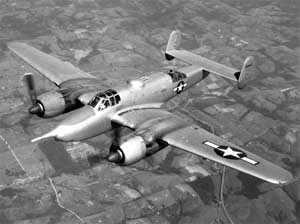
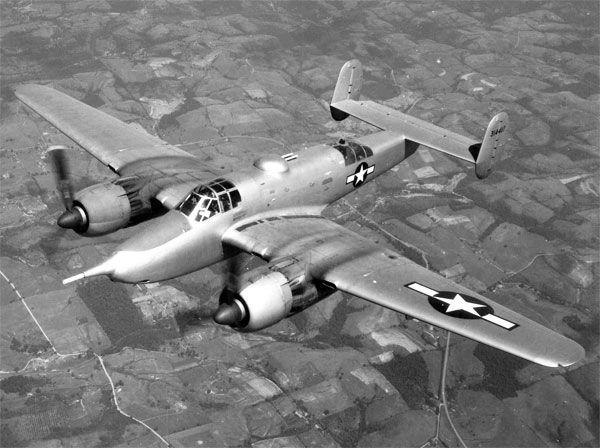
The XA-38 was a developmental twin-engine heavy fighter produced by the Beech Aircraft firm. By all accounts, she was a stable and fast aircraft comparable to even the single engine speedsters of her day. As promising as her design was, her potential was never realized as the engines slated for the type were reserved for the four-engined Boeing B-29 Superfortress heavy bombers taking precedence. As such, only two XA-38 prototypes were ever built with the project ultimately shelved at the end of the war. Should she have flown in quantity, she might have presented the Empire of Japan with a formidable adversary capable of engaging tanks, vehicles, ships and submarines with equal - and lethal - fervor.

The United States Army Air Force (USAAF - forerunner to the United States Air Force) entered into a contractual agreement with Beech Aircraft in December of 1942 after considering the company's Beechcraft Model 28 system. The contract called for two initial prototypes to be built as the XA-38 to fulfill a requirement that involved replacing the Douglas A-20 Havocs then in service. This new aircraft would have to exceed in all areas the A-20 excelled at wile making for one truly potent ground attack component vital to eliminating the dug-in Japanese foes throughout the Pacific Theater. The A-20, itself, had its origins in 1939 design and was introduced into operational service in 1941. Its armament and light bombing capabilities allowed the Havoc to make a name for itself in the early years of the war, eventually being fielded by the United States, French, British and Soviet forces. Production of the type finally ended on September 20th, 1944 and a need for its replacement was inevitable. The XA-38 achieved first flight on May 7th, 1944 with Beech test pilot Vern Carstens at the controls, launching from the Beech Aircraft airfield in Wichita, Kansas. It was then flown to Elgin Field in Florida to undergo testing with the US Army.

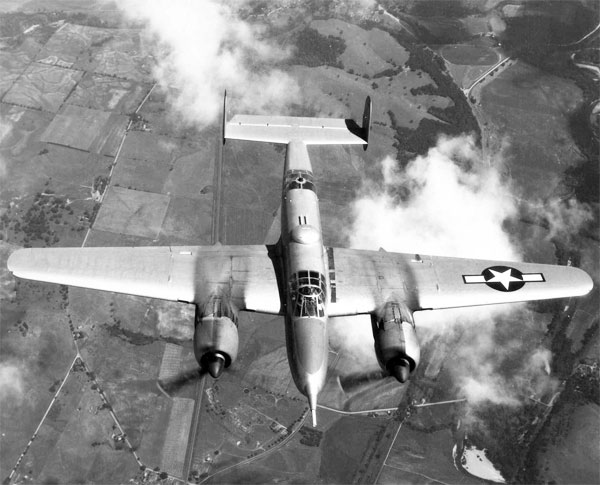
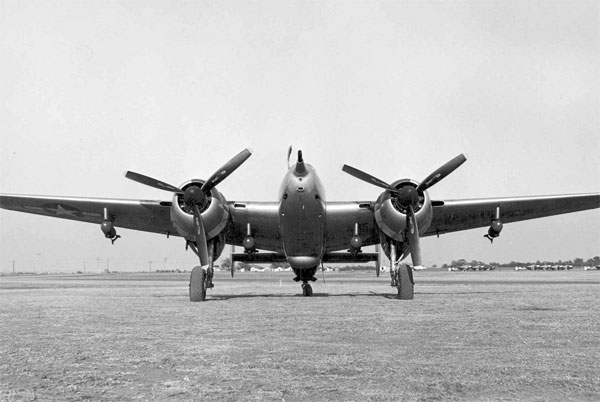
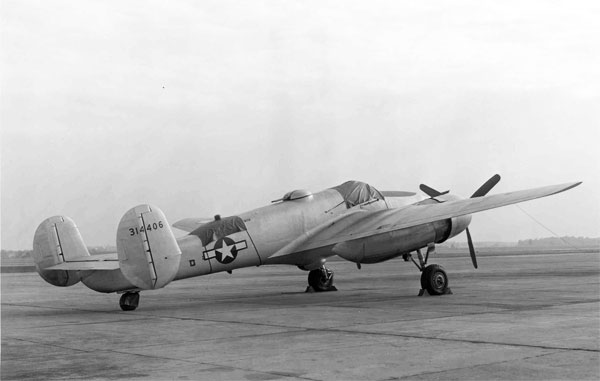
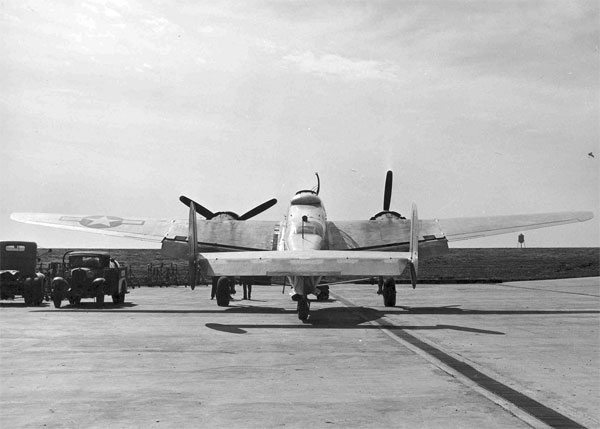
Design of the XA-38 centered around the large 75mm cannon armament mounted in the nose. The cannon was positioned as such that the barrel protruded from the nose cone assembly of the clean all-metal airframe. The fuselage was of a conventional design featuring a forward cockpit area and a rear gunner station and fit together as four main sections for ease of maintenance and repairs. Wings were mid-mounted monoplane assemblies (based on the airfoil of the NACA-2300 series) joining the fuselage to each side of the cockpit and designed with a heated leading edge and surfaces to prevent ice from forming at higher altitudes. On the wings were fitted twin Wright R-3350-53 series air-cooled radial piston engines capable of delivering an astounding 2,700 horsepower each while driving three-bladed, constant speed Hamilton Standard propellers. Cooling was provided for through specially-designed circular cowlings and controlled via automatic flaps. The engine nacelles were fitted to the wing leading edges and protruded some, nearly to the extension length of the fuselage nose. The empennage was conventional and featured a horizontal tailplane with two vertical tail fins. The undercarriage was a typical "tail dragger", with two forward single-wheeled landing gears and a single-wheeled tail system - all fully retractable via hydraulics with a backup pneumatic emergency system. Crew accommodations amounted to the pilot and a gunner housed under in separate glazed canopies. The gunner sat in a dorsal position on the empennage.

While the primary armament of the XA-38 was its nose-mounted 75mm cannon (the entire forward nose section was hinged to open upwards for easy access to the cannon), this was further augmented by no fewer than 6 x .50 caliber Browning air-cooled heavy machine guns. Two were fitted to the lower forward nose section in a forward-firing fixed position while the remaining four were placed in dorsal ad ventral General Electric-brand remote-controlled turrets (two machine guns to a turret). These turrets were traced via periscope sights by the gunner in his rear cabin. Additional external stores would have been conventional drop bombs, a torpedo, smoke bombs, depth charges, chemical tanks and drop tanks. With its accessible hinged nose assembly, the XA-38 was envisioned to fit other adaptable armament systems on-the-fly.

Performance-wise, the XA-38 shined based on reports of the test pilots and servicemen that had the privilege of flying her. She posted stable flight characteristics but was most notable for her top speed. Her speed was comparable - or better in some cases - to the top-flight single-engine fighters of her day. In one such trial, a chase plane sent up to monitor the XA-38 was found lagging behind the twin-engined beauty. Other impressive performance feats showcased the XA-38's ability to take-off and land in shorter distances at low speed than even her contemporary single-engined brethren. Her powerplants and airframe undoubtedly proved reliable in subsequent evaluations.

A maximum speed of 376 miles-per-hour was recorded along with a service ceiling topping 27,800 feet with twin Wright 2,700 horsepower engines and a crew of two. Comparatively, the A-20 Havoc sported a top speed of 339 miles-per-hour with a service ceiling of 23,700 feet with twin Wright 1,700 horsepower engines and a crew of three.

The XA-38 would go down as a true American "what-might-have-been" story for a top straight-line speed coupled with a lethal armament package made for one successful aircraft in the Second World War. It is believed that the XA-38 would not have disappointed has it been ordered into production and been available in some number. As fate would have it, the system fell by the wayside as the B-29's took her engines, the need for dedicated attack craft dwindles and the war came to its inevitable close a year later.

Regardless, the XA-38 remains an interesting study. The XA-38 went under the name of "Destroyer" but was more popularly remembered as the "Grizzly". It is known that one of the XA-38 prototypes fell the way of the scrap yard while the whereabouts of the other prototype are unknown.
Text ©2003-2013 www.MilitaryFactory.com • All Rights Reserved • No Reproduction Permitted
MilitaryFactory.com does NOT sell equipment/weaponry. Material presented throughout this website is for historical and entertainment value and should not to be construed as usable for hardware restoration, maintenance or general operation. Please consult manufacturers for such information. Our disclaimer. Email corrections / Comments to MilitaryFactory at Gmail dot com.
Picture of Beechcraft XA-38 Grizzly / Destroyer (Model 28)
Pic of the Beechcraft XA-38 Grizzly / Destroyer (Model 28)
Image of the Beechcraft XA-38 Grizzly / Destroyer (Model 28)
View All Images (5)

Specifications for the
Beechcraft XA-38 Grizzly / Destroyer (Model 28)
Tactical / Heavy Attack Aircraft


Country of Origin: United States
Manufacturer: Beechcraft / Beech Aircraft Corporation - USA
Initial Year of Service: 1944
Production: 2


Focus Model: Beechcraft XA-38 Gizzly / Destroyer (Model 28)
Crew: 2


Length: 51.67ft (15.75m)
Width: 67.06ft (20.44m)
Height: 15.49ft (4.72m)
Weight (Empty): 22,481lbs (10,197kg)
Weight (MTOW): 36,330lbs (16,479kg)


Powerplant: 2 x Wright GR-3350-43 Cyclone radial piston engines of 2,300 horsepower each.


Maximum Speed: 370mph (595kmh; 321kts)
Maximum Range: 1,625miles (2,615km)
Service Ceiling: 28,999ft (8,839m; 5.5miles)
Rate-of-Climb: 0 feet per minute (0m/min)


Hardpoints: 2
Armament Suite:
STANDARD:
1 x 75mm T15E1 cannon in nose
2 x 12.7mm Browning air-cooled heavy machine guns fixed in lower fuselage nose.
2 x 12.7mm Browning air-cooled heavy machine guns in remote-controlled dorsal turret.
2 x 12.7mm Browning air-cooled heavy machine guns in remote-controlled ventral turret.

OPTIONAL (up to 2,000lbs of external stores):
Conventional Drop Bombs
Fuel Droptanks
Smoke Screen Chemical Tanks
Torpedoes
Depth Charges


Variants:
Model 28 - Beechcraft Company Designation


XA-38 "Grizzly" - Demonstrator Designation


Operators: United States

ALL AIRCRAFT CATEGORIES

BY DECADE:


1900 to 1909
1910 to 1919
1920 to 1929
1930 to 1939
1940 to 1949
1950 to 1959
1960 to 1969
1970 to 1979
1980 to 1989
1990 to 1999
2000 to 2009
2010 to 2019
2020 to 2029
VIEW ALL
Compare Aircraft


BY TYPE:


Anti-Submarine Warfare (ASW)
Attack Helicopters
Bomber Aircraft
Medium Bombers
Heavy Bombers
Close-Air Support (CAS)
Commercial Aircraft
Dive Bombers
Electronic Warfare Aircraft (EWA)
Experimental / X-Planes
Fighter Aircraft
Floatplane Aircraft
Flying Boat Aircraft
Aerial Refueling Tankers
Helicopters (ALL)
Interceptor Aircraft
Multi-Role Aircraft
Navy Carrier Aircraft
Night Fighters
Reconnaissance / Scout
Search & Rescue (SAR)
Scout Helicopters
Special Purpose
Torpedo Bombers
Trainer Aircraft
Transport Aircraft
Transport Helicopters
Unmanned Aerial Vehicles (UAVs)
Unmanned Combat Air Vehicles (UCAVs)


COLLECTIONS:


4th Generation Fighter Aircraft
5th Generation Fighter Aircraft
US X-Planes
Classic US Warbirds
French Military Helicopters
Grumman "Cats"
Howard Hughes Aircraft
Indian Air Force
Israeli Air Force
Libyan Aircraft
Modern Chinese Aircraft
Modern Chinese Fighters
Modern Military Aircraft
Modern North Korean Aircraft
Modern Trainer Aircraft
Modern US Aircraft
Mikoyan Aircraft
Sukhoi Aircraft
Syrian Aircraft
Top 10 Fighter Aircraft of All Time


AIRCRAFT BY CONFLICT:


Arab-Israeli War (1948)
Cuban Missile Crisis (1959-1962)
Falklands War (1982)
Indo-Pak War (1965, 1971)
Iran-Iraq War (1980-1988)
Lebanon War (1982)
Operation Allied Force (1999)
Operation Desert Storm (1991)
Six Day War (1967)
Spanish Civil War (1936)
Soviet-Afghan War (1979-1989)
Yom Kippur War (1973)


MISCELLANEOUS:


Aircraft Cockpits
Aircraft Manufacturers List
Aircraft Timeline

WORLD WAR 2:


1939 Aircraft
1940 Aircraft
1941 Aircraft
1942 Aircraft
1943 Aircraft
1944 Aircraft
1945 Aircraft
1946 Aircraft
Australian Aircraft
Battle of Britain Aircraft
Bombers
Four-Engine Bombers
British Aircraft
British Bombers
British Transports
Dive Bombers
Canadian Aircraft
Fighters
Chinese Aircraft
French Aircraft
German Aircraft
German Fighters
German Flying Boats
German Jets
Secret Weapons of the Luftwaffe
Italian Aircraft
Imperial Japanese Aircraft
Imperial Japanese Fighters
Mitsubishi Bombers
Navy Aircraft
Pearl Harbor
Polish Aircraft
Romanian Aircraft
US Aircraft
US Bombers
US Navy Aircraft
Soviet Aircraft
Torpedo Bombers
Trainer Aircraft
Transport Aircraft
Tuskegee Airmen Aircraft
W.A.S.P. Aircraft
WW2 Aircraft Ranked by Speed
VIEW ALL


WORLD WAR 1:


1914 Aircraft
1915 Aircraft
1916 Aircraft
1917 Aircraft
1918 Aircraft
Aircraft Timeline
Austro-Hungarian Aircraft
Bomber Aircraft
British Aircraft
Fighters
Flying Boats
French Aircraft
Imperial German Aircraft
Italian Aircraft
Scout Aircraft
Russian Empire Aircraft
US Aircraft
WW1 Aircraft Ranked by Speed
VIEW ALL


KOREAN WAR:


Australian Aircraft
Korean War Aces
Korean War Jets
North Korean Aircraft
US Military Aircraft
VIEW ALL


VIETNAM WAR:


Helicopters
North Vietnam Air Force
US Airpower
VIEW ALL


COLD WAR:


1950s French Aircraft
British V-Bombers
Cold War Bombers
Soviet Aircraft
Soviet Bombers
Soviet Interceptors
Soviet Helicopters
Strategic Air Command
US Aircraft
US Bombers
US Interceptors
VIEW ALL

Site Disclaimer | Privacy Policy | Site Map | MF Origins


©2013 www.MilitaryFactory.com • Content ©2003-2013 MilitaryFactory.com • All Rights Reserved • Site Contact Email: militaryfactory at gmail dot com. The "Military Factory" name and MilitaryFactory.com logo are registered ® trademarks and protected by all applicable domestic and international intellectual property laws.


Top MF Stuff: 2013 Military Pay Scale | Military Ranks | WW2 Weapons | Sniper Rifles | Kts to Mph | WW1 Aircraft | Automatic Rifles | Aircraft Cockpits | Vietnam War Weapons | Main Battle Tanks | Submachine Guns | Shotguns | French Military Victories


Most photographic images appearing on this site are courtesy of the United States Department of Defense and are approved for public use. Other images acquired through the public domain. Digital art work courtesy of Dan Alex. Business Consulting by Kyle Williams. Material presented throughout this website is for historical and entertainment value and should not to be construed as usable for hardware restoration, maintenance or general operation. Please consult manufacturers for such information.


eXTReMe Tracker