Military Factory
Military Pay Chart
Global Firepower
Military Industrial Complex
Second World War
Home
Military Pay Scale
Military Ranks
Small Arms
Aircraft
Land Systems
Navy
Education
Military Factory Facebook Logo
flag of United Kingdom

Blackburn Firebrand Strike Fighter / Fleet Fighter (1945)

Authored By Staff Writer | Last Updated: 4/21/2009

The Backburn Firebrand was arrived too late to see action in World War 2 - and maybe that's a good thing.

Find a School Near You
Follow Military Factory on Facebook:
Trending on Military Factory:
Recent Articles:
The Blackburn Firebrand was a carried-based strike fighter aircraft developed by Blackburn Aircraft of the United Kingdom. She was a design of G.E. Petty and went on to live a troubled development before reaching operation status thanks to an engine switch that effectively doomed the Firebrand to mediocrity. Despite the aircraft appearing during the middle years of World War 2 and achieving first flight by February 27th, 1942, the Blackburn Firebrand - in its definitive production form - simply arrived too late in the conflict to ever see combat.

The British Air Ministry brought about Specification N.11/40 requiring a capable, high-performance, single-seat fighter for use on Royal Navy carriers. The selected powerplant for the new fighter was to be the impressive Napier Sabre III, a 24-cylinder H-type inline engine. Blackburn responded with its Firebrand proposal and developed the unarmed B-36 prototype. This was followed by the armed F.Mk I prototype that produced 9 working examples.

At the same time that the Firebrand was being developed, the Hawker Typhoon was ready to hit the assembly lines and effectively "stole" the available Napier Sabre III engines. As such, Blackburn was forced to re-engine their design and settle on the Bristol Centaurus VII 18-cylinder radial piston powerplant. This redesign also forced a rethinking in the intended roles of the Firebrand. Along with its fighter duties, the Firebrand was now envisioned to double as a strike platform capable of delivering bombs, rockets and even a torpedo (ala the Hawker Typhoon). The new design was fitted with lengthened wings and appropriate munitions provisions in the form of pylons. The resulting product became the B-45 model - achieving first flight on March 31st, 1943 - and entered production as the TF.Mk II. Like the F.Mk I model before it, the TF.Mk II was limited to just 12 production examples.

An attempt at improving the Firebrand line came in the form of the Centaurus VII-engined TF.Mk III model. This "improved" design revealed flaws in low-speed flight thanks to poor rudder control and a tremendous amount of torque output from the new engine. A first flight was achieved on December 21st, 1943 and further testing resulted in the deaths of two test pilots along with months of re-evaluation before the Firebrand was even successfully test-landed on a carrier deck. Despite the successful landing, the aircraft was deemed too dangerous for use as a production aircraft. As such, this particular Firebrand model was dropped from production contention.

Model B-46 became the true improved Firebrand as the TF.Mk IV model, first flying on May 17th, 1945. A new engine - the Bristol Centaurus IX engine - was allocated to the TF.Mk IV as well as a revised tail with increased surface areas. Dive brakes were installed on both the upper and lower wing assemblies for improved control. The TF.Mk IV became the first quantitative and somewhat definitive Firebrand in production with 102 examples produced. At least 40 of these aircraft were later converted to the newer TF.Mk 5 standard.

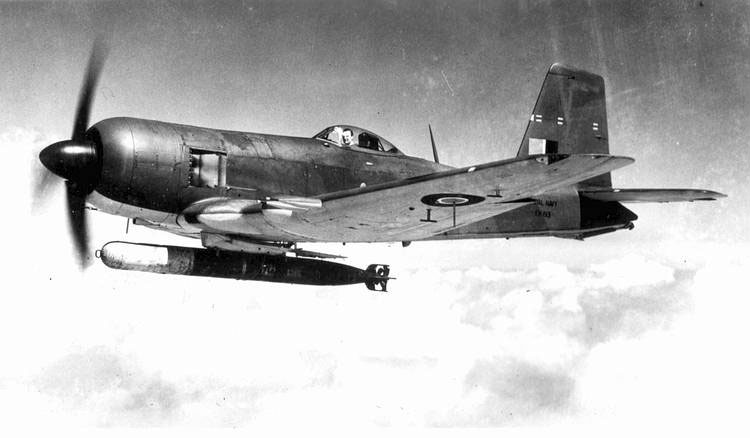
Externally, design of the Firebrand showcased some similarities to the Hawker Tempest with its slim and streamlined fuselage and large propeller spinner. The cockpit was situated at the middle of the fuselage and featured a two-piece bubble-style canopy affording the pilot with relatively excellent all-around vision. Wings were low-mounted monoplane systems with dihedral and positioned fairly forward along the fuselage sides. The empennage was dominated by a large vertical tail fin with horizontal planes positioned well behind the vertical tail unit. The undercarriage was of a conventional "tail-dragger" arrangement featuring two main landing gears and a single tail wheel. All three systems were fully retractable.

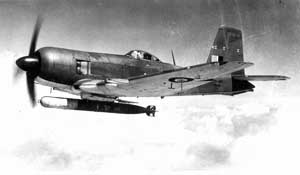
As with most of the British fighters of the time, cannon armament was the standard firepower for the Firebrand. This consisted of 4 x 20mm Hispano Mk II series cannons mounted in pairs on each wing. For a more direct increase to its lethality, the Firebrand could sport a single 1,850lb 18" Mark XVII series torpedo running centerline under the fuselage or 2 x 1,000lb bombs under the wings - one to a wing pylon.

The definitive TF.Mk IV Firebrand sported the Bristol Centaurus IX series, 18-cylinder, air-cooled, radial piston engine with a listed output of 2,500 horsepower powering a four-bladed propeller system. Performance specifications included a top speed of 350 miles per hour with a listed cruise speed of 289 miles per hour. Range was equivalent to 1,250 miles when fitted with drop tanks. A rate-of-climb of 2,600 feet-per-minute was possible with a service ceiling of approximately 28,500 feet.

The TF.Mk 5 followed the TF.Mk IV into service with subtle aerodynamic related revisions. Production only lasted through 68 examples. The improved TF.Mk 5A finished up the Firebrand line to which total production amounted to 193 examples, lasting from 1943 through 1947.

The Firebrand served solely with the United Kingdom's Royal Navy (RN) Fleet Air Arm (FAA). The FAA squadrons utilizing the type were the 700, 703, 708, 736, 738, 759, 764, 767, 778, 787, 799, 813 and the 827 Naval Air Squadrons. The Blackburn Firebrand was officially operated by the British Royal Navy from 1943 through 1953 before facing retirement from operational status.
Text ©2003-2013 www.MilitaryFactory.com • All Rights Reserved • No Reproduction Permitted
MilitaryFactory.com does NOT sell equipment/weaponry. Material presented throughout this website is for historical and entertainment value and should not to be construed as usable for hardware restoration, maintenance or general operation. Please consult manufacturers for such information. Our disclaimer. Email corrections / Comments to MilitaryFactory at Gmail dot com.
Picture of Blackburn Firebrand
View All Images (1)

Specifications for the
Blackburn Firebrand
Strike Fighter / Fleet Fighter


Country of Origin: United Kingdom
Manufacturer: Blackburn Aircraft - UK
Initial Year of Service: 1945
Production: 193


Focus Model: Blackburn Firebrand TF.Mk IV
Crew: 1


Length: 39.37ft (12m)
Width: 51.25ft (15.62m)
Height: 14.93ft (4.55m)
Weight (Empty): 11,354lbs (5,150kg)
Weight (MTOW): 16,226lbs (7,360kg)


Powerplant: 1 x Bristol Centaurus IX 18-cylinder radial engine developing 2,500hp.


Maximum Speed: 348mph (560kmh; 302kts)
Maximum Range: 1,243miles (2,000km)
Service Ceiling: 28,510ft (8,690m; 5.4miles)
Rate-of-Climb: 2,600 feet per minute (792m/min)


Hardpoints: 2
Armament Suite:
4 x 20mm Hispano Mk II cannons, two cannons to a wing.

OPTIONAL:
2 x 1,000lb drop bombs OR 1 x 1,850lb torpedo


Variants:
B-37 - Unarmed Prototype


F.Mk I - Armed Prorotype; 9 examples produced.

TF.Mk II (B-45) - Initial Strike/Torpedo Fighter Variant based on F.Mk I model; increased wingspan; provision for single torpedo under fuselage; 12 production examples.

TF.Mk III - Fitted with Bristol Centaurus VII series radial engine due to shortage of Sabre engines; never produced due to terrible rudder control and increased torque from Centaurus powerplant.

TF.Mk IV (B-46) - Fitted with Centaurus IX series engine; increased tail surface area with enlarged rudder; upper and lower wing-mounted dive brakes; first mass production Firebrand with 102 examples produced; at least 40 examples later converted to later TF.Mk 5 standard.

TF.Mk 5 - Subtle physical improvements throughout; 68 examples produced.

TF.Mk 5A - Final Production Model; powered ailerons.


Operators: United Kingdom

ALL AIRCRAFT CATEGORIES

BY DECADE:


1900 to 1909
1910 to 1919
1920 to 1929
1930 to 1939
1940 to 1949
1950 to 1959
1960 to 1969
1970 to 1979
1980 to 1989
1990 to 1999
2000 to 2009
2010 to 2019
2020 to 2029
VIEW ALL
Compare Aircraft


BY TYPE:


Anti-Submarine Warfare (ASW)
Attack Helicopters
Bomber Aircraft
Medium Bombers
Heavy Bombers
Close-Air Support (CAS)
Commercial Aircraft
Dive Bombers
Electronic Warfare Aircraft (EWA)
Experimental / X-Planes
Fighter Aircraft
Floatplane Aircraft
Flying Boat Aircraft
Aerial Refueling Tankers
Helicopters (ALL)
Interceptor Aircraft
Multi-Role Aircraft
Navy Carrier Aircraft
Night Fighters
Reconnaissance / Scout
Search & Rescue (SAR)
Scout Helicopters
Special Purpose
Torpedo Bombers
Trainer Aircraft
Transport Aircraft
Transport Helicopters
Unmanned Aerial Vehicles (UAVs)
Unmanned Combat Air Vehicles (UCAVs)


COLLECTIONS:


4th Generation Fighter Aircraft
5th Generation Fighter Aircraft
US X-Planes
Classic US Warbirds
French Military Helicopters
Grumman "Cats"
Howard Hughes Aircraft
Indian Air Force
Israeli Air Force
Libyan Aircraft
Modern Chinese Aircraft
Modern Chinese Fighters
Modern Military Aircraft
Modern North Korean Aircraft
Modern Trainer Aircraft
Modern US Aircraft
Mikoyan Aircraft
Sukhoi Aircraft
Syrian Aircraft
Top 10 Fighter Aircraft of All Time


AIRCRAFT BY CONFLICT:


Arab-Israeli War (1948)
Cuban Missile Crisis (1959-1962)
Falklands War (1982)
Indo-Pak War (1965, 1971)
Iran-Iraq War (1980-1988)
Lebanon War (1982)
Operation Allied Force (1999)
Operation Desert Storm (1991)
Six Day War (1967)
Spanish Civil War (1936)
Soviet-Afghan War (1979-1989)
Yom Kippur War (1973)


MISCELLANEOUS:


Aircraft Cockpits
Aircraft Manufacturers List
Aircraft Timeline

WORLD WAR 2:


1939 Aircraft
1940 Aircraft
1941 Aircraft
1942 Aircraft
1943 Aircraft
1944 Aircraft
1945 Aircraft
1946 Aircraft
Australian Aircraft
Battle of Britain Aircraft
Bombers
Four-Engine Bombers
British Aircraft
British Bombers
British Transports
Dive Bombers
Canadian Aircraft
Fighters
Chinese Aircraft
French Aircraft
German Aircraft
German Fighters
German Flying Boats
German Jets
Secret Weapons of the Luftwaffe
Italian Aircraft
Imperial Japanese Aircraft
Imperial Japanese Fighters
Mitsubishi Bombers
Navy Aircraft
Pearl Harbor
Polish Aircraft
Romanian Aircraft
US Aircraft
US Bombers
US Navy Aircraft
Soviet Aircraft
Torpedo Bombers
Trainer Aircraft
Transport Aircraft
Tuskegee Airmen Aircraft
W.A.S.P. Aircraft
WW2 Aircraft Ranked by Speed
VIEW ALL


WORLD WAR 1:


1914 Aircraft
1915 Aircraft
1916 Aircraft
1917 Aircraft
1918 Aircraft
Aircraft Timeline
Austro-Hungarian Aircraft
Bomber Aircraft
British Aircraft
Fighters
Flying Boats
French Aircraft
Imperial German Aircraft
Italian Aircraft
Scout Aircraft
Russian Empire Aircraft
US Aircraft
WW1 Aircraft Ranked by Speed
VIEW ALL


KOREAN WAR:


Australian Aircraft
Korean War Aces
Korean War Jets
North Korean Aircraft
US Military Aircraft
VIEW ALL


VIETNAM WAR:


Helicopters
North Vietnam Air Force
US Airpower
VIEW ALL


COLD WAR:


1950s French Aircraft
British V-Bombers
Cold War Bombers
Soviet Aircraft
Soviet Bombers
Soviet Interceptors
Soviet Helicopters
Strategic Air Command
US Aircraft
US Bombers
US Interceptors
VIEW ALL

Site Disclaimer | Privacy Policy | Site Map | MF Origins


©2013 www.MilitaryFactory.com • Content ©2003-2013 MilitaryFactory.com • All Rights Reserved • Site Contact Email: militaryfactory at gmail dot com. The "Military Factory" name and MilitaryFactory.com logo are registered ® trademarks and protected by all applicable domestic and international intellectual property laws.


Top MF Stuff: 2013 Military Pay Scale | Military Ranks | WW2 Weapons | Sniper Rifles | Kts to Mph | WW1 Aircraft | Automatic Rifles | Aircraft Cockpits | Vietnam War Weapons | Main Battle Tanks | Submachine Guns | Shotguns | French Military Victories


Most photographic images appearing on this site are courtesy of the United States Department of Defense and are approved for public use. Other images acquired through the public domain. Digital art work courtesy of Dan Alex. Business Consulting by Kyle Williams. Material presented throughout this website is for historical and entertainment value and should not to be construed as usable for hardware restoration, maintenance or general operation. Please consult manufacturers for such information.


eXTReMe Tracker