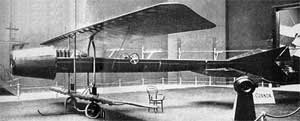
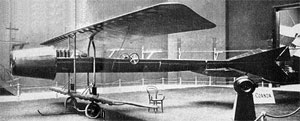
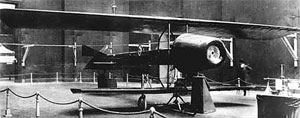
"Romanian inventor Henri Coanda considered his Coanda-1910 aircraft the first jet-propelled aircraft in history."
Power & Performance Those special qualities that separate one aircraft design from another. Performance specifications presented assume optimal operating conditions for the Coanda-1910 Experimental Thermojet-Powered Aircraft.
1 x 4-cylinder water-cooled inline engine developing 50 horsepower driving a compressor developing 38 lb of thrust. Propulsion
Structure The nose-to-tail, wingtip-to-wingtip physical qualities of the Coanda-1910 Experimental Thermojet-Powered Aircraft.
1 (MANNED) Crew
41.0 ft 12.50 m O/A Length
33.8 ft (10.30 m) O/A Width
926 lb (420 kg) MTOW
Variants Notable series variants as part of the Coanda Model 1910 family line.
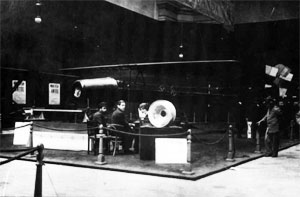
This invention by Romanian inventor Henri Coanda was in the works as early as 1905 - an experimental attempt featuring a ducted fan engine. The aircraft was showcased to the public during the 2nd International Aeronautical Exhibition (Paris) in 1910 at a time when developments in aviation were of considerable interest. For its time, the Coanda-1910 aircraft was something of a unique specimen for it featured no propeller for its propulsion system - a common quality of all early powered aircraft. Instead, the Coanda-1910 aircraft showcased a piston engine driving a multi-blade centrifugal blower for its propulsion.
Unfortunately for the Coanda-1910, the world of aviation remained quite content with the growing power and capabilities of the gas-powered piston-driven propeller aircraft to which the Coanda entry fell into obscurity in a short amount of time. Coanda claimed to have achieved flight with his creation even before jet technology achieved widespread interest or development. Many publications gloss over Coanda's contributions to the field of jet-powered flight while others are in support of him and his invention(s).
Despite its flimsy appearance, the Coanda-1910 utilized many traditional aircraft components - wing mainplanes sat over and under a tubular fuselage (biplane arrangement), a front-mounted engine, and a finned tail unit. The Coanda utilized a "sesquiplane" wing layout with the lower wing span shorter than that of the top unit. The engine was mounted at the extreme front of the very slim fuselage, the latter constructed mostly of wood covered over in fabric. Exposed support struts and cabling, common to all aircraft of this period, were also used where appropriate. The pilot's position was behind the engine in an open-air cockpit offering little protection from the elements. The wheeled undercarriage was fixed and under the forward mass with a tail skid at rear. The tail unit utilized a cruciform fin arrangement.
The aircraft used a combination of piston engine and jet engine drive power - relying on internal combustion and not a gas-powered turbine (common to turbojets). The traditional combustion engine provided power to a compressor to generate compressed air which was then mixed with fuel, ignited, and forcibly extracted from special chambers mounted on either side of the fuselage. The resulting force of this expelled reaction was to provide forward propulsion for the aircraft.
It is said that the Coanda-1910 achieved a single short flight in an accidental way - while ground testing the engine (with Henri Coanda at the controls), the powerplant forced the plane airborne for a short time. As Henri himself was not a pilot by trade, he quickly lost control of the aircraft and crashed it to the ground, the force throwing him clear of the now-burning wreckage (with some slight injuries). Despite the loss of the machine, Henri noted an effect occurring with the expelled gases and how they seemed to conform to the sides of his aircraft. This observation alone would lead Henri to research that would span decades more in culminating as the "Coanda Effect" - effect named in his honor.
Whether or not pursuing this technology so early in the century would have had much of an impact in making a faster military-minded fighter remains to the imagination of the reader. As one side argues it would have been an improvement over propeller-driven designs featured in World War 1 (1914-1918), the other side argues with equal fervor that the practice of thermojet propulsion would not have made a significant impact in terms of performance gains on the whole. Obviously the old "wood, canvas, and wire" approach in the Coanda's construction would have had to have been reviewed to produce a more sustainable design carrying a powerful jet.
In the end, Henri Coanda's 1910 invention was never furthered into practical use - no doubt the complexity of the propulsion method and the fact that his design was realistically years ahead of anything else available in 1910. During World War 2 (1939-1945), the Italian Campini-Caproni CC.2 turbojet/piston-powered test aircraft carrying on some of what was established through Coanda's work. In this instance, the technology was overshadowed quickly by the developments in turbojet technology by both the British and the Germans - marking the Italian CC.2 as a technological dead end.
Henri Coanda went on to have a successful aircraft design career with several firms including the British concern of Bristol. His "thermojet revolution" never took hold. History shows German Hans von Ohain generally given the title of designer of the first jet engine for manned/powered aircraft flight while British officer Frank Whittle is regarded as the first to complete development of, and have a jet engine patented, for flight.
The Bucharest National Military Museum holds a full-scale replica of the Coanda-1910.
Operators Global customers who have evaluated and/or operated the Coanda Model 1910. Nations are displayed by flag, each linked to their respective national aircraft listing.
Total Production: 1 Units Contractor(s): Henri Coanda - Romania
The "Military Factory" name and MilitaryFactory.com logo are registered ® U.S. trademarks protected by all applicable domestic and international intellectual property laws. All written content, illustrations, and photography are unique to this website (unless where indicated) and not for reuse/reproduction in any form. Material presented throughout this website is for historical and entertainment value only and should not to be construed as usable for hardware restoration, maintenance, or general operation. We do not sell any of the items showcased on this site. Please direct all other inquiries to militaryfactory AT gmail.com. No A.I. was used in the generation of this content.