Military Factory
Military Pay Chart
Global Firepower
Military Industrial Complex
Second World War
Home
Military Pay Scale
Military Ranks
Small Arms
Aircraft
Land Systems
Navy
Education
Military Factory Facebook Logo
flag of Nazi Germany

Arado Ar E.654 (Kampfzerstorer / Skorpion) Heavy Fighter / Bomber Destroyer (1943)

Authored By Staff Writer | Last Updated: 6/30/2012

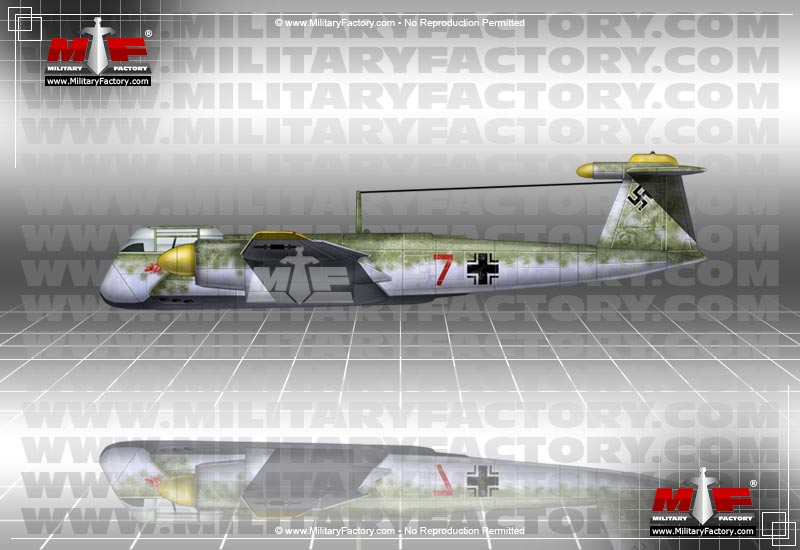
The E.654 received its Skorpion moniker from the distinctive design of its tail.

Find a School Near You
Follow Military Factory on Facebook:
Trending on Military Factory:
Recent Articles:
The Arado Ar E.654 was proposed as a heavy fighter / destroyer platform designed from another Arado product - the Ar 240. Though the Ar 240 model eventually saw operational service with the Luftwaffe (albeit in limited numbers), the Ar E.654 would never see the light of day. Its unconventional engine arrangement provided some technological barriers to contend with so much so that the complex system was eventually shelved altogether.

The E.654 maintained some visual similarities to the Ar 240 with two wing-mounted engine nacelles, a crew of two and a long streamlined fuselage. Whereas the Ar 240 held its Daimler-Benz engines wholly in the wing nacelles, the E.654 attempted to utilize a more complex approach in order to maximize overall streamlining and benefit engine protection. The E.654 was designed to house the twin Daimler-Benz DB 614 OR 627 series engines within the fuselage itself while running the propellers via multiple gear shafts. This approach was highly apparent in the general design of the exterior of the aircraft as it would not have exhibited quite the large nacelles as those found on contemporary systems. Additionally, keeping the engine within the fuselage added some element of protection to the units as the fuselage was generally the most well-protected part of any aircraft, able to sustain large amounts of damage before losing integrity. The smaller nacelles also provided for better side visibility over the engines themselves, an issue apparent in the design of the Ar 240, that aircraft sporting its large wing-mounted engines to either side of the cockpit. A standard landing gear system was envisioned with the main gears recessing into each nacelle and a retractable tail wheel operating under the rearward portion of the fuselage. The tail section was dominated by a very distinguishable arrangement featuring a high-mounted tailplane with a protruding appendage - an interesting design approach even for this time.

The cockpit was of a glazed variety, again following the lead of the Ar 240 before it. The seating area was held well-forward in the fuselage providing exceptional views outward, above and down. The pilot sat extreme forward with the gunner seated directly behind in a back-to-back seating arrangement. The gunner would have operated the rear-ward facing machine guns through a periscope system.

At the heart of any heavy fighter was its offensive armament and the E.654 did not disappoint. A battery of 6 x Mk 103 series 30mm heavy cannons was arranged in groups of three in bulges on either side of the lower fuselage. Defensively, the E.654 utilized a system similar to the Arado Ar 240 aircraft - with the rear gunner controlling a dorsal and ventral turret (each fitted with 2 x MG 131 series 13mm heavy machine guns) in recessed positions near the base top and bottom positions of the empennage.

In all respects, the E.654 would have been a serviceable aircraft but the complexity inherent in the engine layout and operation doomed the type to the drawing board - similar to the fate that fell the E.561 proposal. Getting materials and parts for such a complex system proved too much for Luftwaffe technicians to address - especially when one considers the defensive war Germany was becoming embroiled in. It seems that the multi-shaft arrangement of the E.654's design would have developed other engineering obstacles as well with most of the issues no doubt related to potential vibration caused by the engine and shaft layout and maintaining the proper level of power generated at the engine, which would then have to be translated through the shaft and eventually to the propeller.

The E.654 received an internal project name of "Skorpion", no doubt due to the stinger-like protrusion at the top of the tail fin. It was also known by the descriptive name of "Kampfzerstorer". Arado designer Walter Blume headed up the project.
Text ©2003-2013 www.MilitaryFactory.com • All Rights Reserved • No Reproduction Permitted
MilitaryFactory.com does NOT sell equipment/weaponry. Material presented throughout this website is for historical and entertainment value and should not to be construed as usable for hardware restoration, maintenance or general operation. Please consult manufacturers for such information. Our disclaimer. Email corrections / Comments to MilitaryFactory at Gmail dot com.
Picture of Arado Ar E.654 (Kampfzerstorer / Skorpion)
View All Images (1)

Specifications for the
Arado Ar E.654 (Kampfzerstorer / Skorpion)
Heavy Fighter / Bomber Destroyer


Country of Origin: Nazi Germany
Manufacturer: Arado Flugzeugwerke - Germany
Initial Year of Service: 1943
Production: Not Available


Focus Model: Arado Ar E.654 (Kampfzerstorer / Skorpion)
Crew: 2


Length: 42.03ft (12.81m)
Width: 47.05ft (14.34m)
Height: 12.96ft (3.95m)
Weight (Empty): 0lbs (0kg)
Weight (MTOW): 0lbs (0kg)


Powerplant: 2 x Daimler-Benz DB 614 OR DB 627 engines.


Maximum Speed: 0mph (0kmh; 0kts)
Maximum Range: 0miles (0km)
Service Ceiling: 0ft (0m; 0.0miles)
Rate-of-Climb: 0 feet per minute (0m/min)


Hardpoints: 0
Armament Suite:
PROPOSED: 6 x MK 103 fixed-forward cannons at forward fuselage sides.
2 x MG 131 13mm machine guns in dorsal fuselage position (periscope aimed).
2 x MG 131 13mm machine guns in ventral fuselage position (periscope aimed).


Variants:
E.654 - Base Developmental Series Designation


Operators: Nazi Germany

ALL AIRCRAFT CATEGORIES

BY DECADE:


1900 to 1909
1910 to 1919
1920 to 1929
1930 to 1939
1940 to 1949
1950 to 1959
1960 to 1969
1970 to 1979
1980 to 1989
1990 to 1999
2000 to 2009
2010 to 2019
2020 to 2029
VIEW ALL
Compare Aircraft


BY TYPE:


Anti-Submarine Warfare (ASW)
Attack Helicopters
Bomber Aircraft
Medium Bombers
Heavy Bombers
Close-Air Support (CAS)
Commercial Aircraft
Dive Bombers
Electronic Warfare Aircraft (EWA)
Experimental / X-Planes
Fighter Aircraft
Floatplane Aircraft
Flying Boat Aircraft
Aerial Refueling Tankers
Helicopters (ALL)
Interceptor Aircraft
Multi-Role Aircraft
Navy Carrier Aircraft
Night Fighters
Reconnaissance / Scout
Search & Rescue (SAR)
Scout Helicopters
Special Purpose
Torpedo Bombers
Trainer Aircraft
Transport Aircraft
Transport Helicopters
Unmanned Aerial Vehicles (UAVs)
Unmanned Combat Air Vehicles (UCAVs)


COLLECTIONS:


4th Generation Fighter Aircraft
5th Generation Fighter Aircraft
US X-Planes
Classic US Warbirds
French Military Helicopters
Grumman "Cats"
Howard Hughes Aircraft
Indian Air Force
Israeli Air Force
Libyan Aircraft
Modern Chinese Aircraft
Modern Chinese Fighters
Modern Military Aircraft
Modern North Korean Aircraft
Modern Trainer Aircraft
Modern US Aircraft
Mikoyan Aircraft
Sukhoi Aircraft
Syrian Aircraft
Top 10 Fighter Aircraft of All Time


AIRCRAFT BY CONFLICT:


Arab-Israeli War (1948)
Cuban Missile Crisis (1959-1962)
Falklands War (1982)
Indo-Pak War (1965, 1971)
Iran-Iraq War (1980-1988)
Lebanon War (1982)
Operation Allied Force (1999)
Operation Desert Storm (1991)
Six Day War (1967)
Spanish Civil War (1936)
Soviet-Afghan War (1979-1989)
Yom Kippur War (1973)


MISCELLANEOUS:


Aircraft Cockpits
Aircraft Manufacturers List
Aircraft Timeline

WORLD WAR 2:


1939 Aircraft
1940 Aircraft
1941 Aircraft
1942 Aircraft
1943 Aircraft
1944 Aircraft
1945 Aircraft
1946 Aircraft
Australian Aircraft
Battle of Britain Aircraft
Bombers
Four-Engine Bombers
British Aircraft
British Bombers
British Transports
Dive Bombers
Canadian Aircraft
Fighters
Chinese Aircraft
French Aircraft
German Aircraft
German Fighters
German Flying Boats
German Jets
Secret Weapons of the Luftwaffe
Italian Aircraft
Imperial Japanese Aircraft
Imperial Japanese Fighters
Mitsubishi Bombers
Navy Aircraft
Pearl Harbor
Polish Aircraft
Romanian Aircraft
US Aircraft
US Bombers
US Navy Aircraft
Soviet Aircraft
Torpedo Bombers
Transport Aircraft
Tuskegee Airmen Aircraft
W.A.S.P. Aircraft
WW2 Aircraft Ranked by Speed
VIEW ALL


WORLD WAR 1:


1914 Aircraft
1915 Aircraft
1916 Aircraft
1917 Aircraft
1918 Aircraft
Aircraft Timeline
Austro-Hungarian Aircraft
Bomber Aircraft
British Aircraft
Fighters
Flying Boats
French Aircraft
Imperial German Aircraft
Italian Aircraft
Scout Aircraft
Russian Empire Aircraft
US Aircraft
WW1 Aircraft Ranked by Speed
VIEW ALL


KOREAN WAR:


Australian Aircraft
Korean War Aces
Korean War Jets
North Korean Aircraft
US Military Aircraft
VIEW ALL


VIETNAM WAR:


Helicopters
North Vietnam Air Force
US Airpower
VIEW ALL


COLD WAR:


1950s French Aircraft
British V-Bombers
Cold War Bombers
Soviet Aircraft
Soviet Bombers
Soviet Interceptors
Soviet Helicopters
Strategic Air Command
US Aircraft
US Bombers
US Interceptors
VIEW ALL

Site Disclaimer | Privacy Policy | Site Map | MF Origins


©2013 www.MilitaryFactory.com • Content ©2003-2013 MilitaryFactory.com • All Rights Reserved • Site Contact Email: militaryfactory at gmail dot com. The "Military Factory" name and MilitaryFactory.com logo are registered ® trademarks and protected by all applicable domestic and international intellectual property laws.


Top MF Stuff: 2013 Military Pay Scale | Military Ranks | WW2 Weapons | Sniper Rifles | Kts to Mph | WW1 Aircraft | Automatic Rifles | Aircraft Cockpits | Vietnam War Weapons | Main Battle Tanks | Submachine Guns | Shotguns | French Military Victories


Most photographic images appearing on this site are courtesy of the United States Department of Defense and are approved for public use. Other images acquired through the public domain. Digital art work courtesy of Dan Alex. Business Consulting by Kyle Williams. Material presented throughout this website is for historical and entertainment value and should not to be construed as usable for hardware restoration, maintenance or general operation. Please consult manufacturers for such information.


eXTReMe Tracker