Global Firepower | Military Industrial Complex | Second World War History
Home | Military Pay Scale Chart | Aircraft | Infantry Weapons | Military Vehicles | Navy Ships | Military Education | French Military Victories | Military Ranks | WW2 Weapons
Military Factory Latest from Military Factory
Thumbnail picture of the Dardo infantry fighting vehicle
Dardo IFV
Thumbnail picture of the Supermarine Scimitar fighter
Supermarine Scimitar
Thumbnail picture of the Centauro B1 8x8 tank killer
Centauro 8x8
Thumbnail picture of the Novi Avion fighter
Novi Avion
Thumbnail picture of the FR F2 bolt-action sniper rifle
FR F2
Thumbnail picture of the Lebel Model 1886 bolt-action rifle
Lebel Model 1886
2009 Military Pay Scale Chart - for Army, Navy, Air Force and Marines
  BY DECADE
    · 1900 to 1909
    · 1910 to 1919
    · 1920 to 1929
    · 1930 to 1939
    · 1940 to 1949
    · 1950 to 1959
    · 1960 to 1969
    · 1970 to 1979
    · 1980 to 1989
    · 1990 to 1999
    · 2000 to 2009
    · 2010 to 2019
    · View All Aircraft
  BY TYPE
    · Attack Helicopters
    · Bombers
    · Close-Support
    · Commercial
    · Dive Bombers
    · Experimental
    · Fighters
    · Floatplanes
    · Flying Boats
    · Fuel Tankers
    · Helicopters
    · Interceptors
    · Multi-Role
    · Navy Aircraft
    · Night-Fighters
    · Recon Aircraft
    · Recon Helos
    · Special Purpose
    · Torpedo Bombers
    · Trainer Aircraft
    · Transport Aircraft
    · Transport Helos
    · UAVs
  WORLD WAR 2
    · Full List
    · 1939
    · 1940
    · 1941
    · 1942
    · 1943
    · 1944
    · 1945
    · Australia
    · Battle of Britain
    · Bombers
    · Britain
    · Dive Bombers
    · Canada
    · Fighters
    · China
    · France
    · Germany
    · German Fighters
    · German Jets
    · Italy
    · Japan
    · Mitsubishi Bombers
    · Poland
    · USA Aircraft
    · USA Bombers
    · Soviet Union
    · Torpedo Bombers
  WORLD WAR 1
    · Full List
    · 1914
    · 1915
    · 1916
    · 1917
    · 1918
    · Aces
    · Austria-Hungary
    · Bombers
    · Britain
    · Fighters
    · France
    · Germany
    · Italy
    · Recon Aircraft
    · Russia
    · USA
  KOREAN WAR
    · Full List
    · Aces
    · Australia
    · USA
    · North Korea
  VIETNAM WAR
    · Full List
    · United States
    · North Vietnam

Military Factory > Military Aircraft > Arado Ar E.555
 
 
More Pictures Cockpit View 3 View Plan QuickGraphs StatsCentral

Arado Ar E.555

Development into the Arado Ar E.555 series was halted in December of 1944, no doubt due to the advance of the Allies.
By Staff Writer

Bookmark and Share

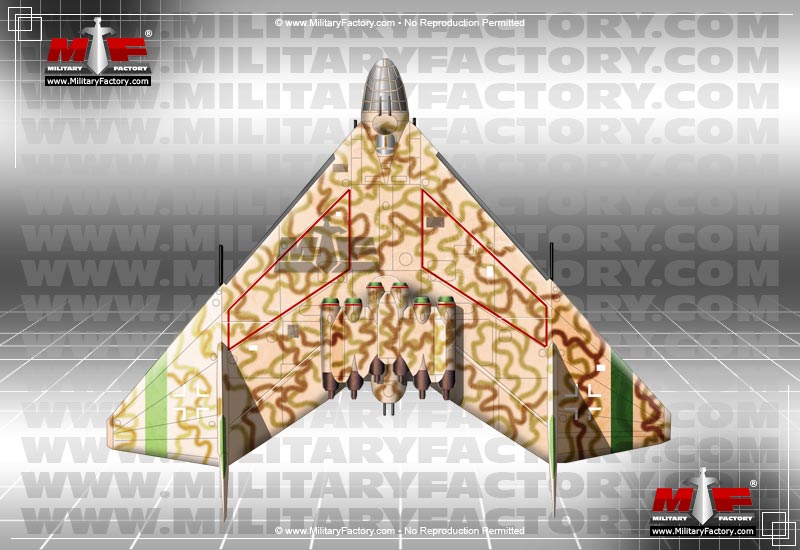
Arado proposed this E.555 flying wing concept towards the end of 1943 as a high-speed long-range bomber. The flying wing concept had eluded aircraft engineers for decades but it was seen as a potentionally stable design allowing for greater payloads and control. Arado produced no fewer than 15 flying wing E.555 designs of various types for the RLM throughout 1944 - each with considerable groundbreaking features.

The base E.555 was the E.555-1, an all-metal flying wing concept with a delta shape. Two large vertical fin surfaces were attached to either wing assembly with the fuselage contained in the forward-most portion of the gull-like wing assemblies. The engines were to be a cluster of six BMW 003A series turbojets held slightly off of the fuselage and maintained in the aft area of the design. Requirements stated that this new bomber possess the ability to carry upwards of 8,818lbs and thusly the E.555-1 was designed with a large under-fuselage internal bomb bay. The flying wing concept also played well into the design requirement of long range, needing to meet some 3,107 miles of flight time. The cockpit was pressurized to allow for high altitude work. It is assumed no fewer than 3 personnel would crew the system as there was a need for a pilot, copilot, and at least one gunner. Landing gears were of the tricycle type now beginning to take hold in newer aircraft designs. The E.555 would have utilized such a layout with the wing-installed gears were tandem for a total of four wheels to a gear. The nose gear was of a single arrangement mounting two wheels side-by-side.

Defensive armament consisted of a remote-controlled dorsal turret mounting twin MG 151/20 20mm cannons. This turret was located just aft of the cockpit and had a 360 degree rotation plus elevation. A second turret was mounted at the rear of the fuselage/wing area and was remote-controlled by a crewmember via periscope. This position also mounted twin MG 151/20 20mm cannons and the gunner sat in his position just aft of the dorsal turret behind the cockpit. Fixed forward-firing MK 103 30mm cannons were added to either wing root (one cannon per side) to round out the armament.

The E.555 was planned in many forms covering E.555-1 to E.555-11 (14). Each version differed mainly in powerplant used, either of BMW or Heinkel branding. Beyond that, the wing design changed somewhat between designs and some were featured with twin tail booms or a traditional empennage as opposed to the base flying wing originally envisioned. E.555-1 featured 6 x BMW 003 series turbojet engines, all mounted in a cluster above and at the extreme aft of the fuselage. E.555-2 was to be fitted with just four turbojet engines but these of Heinkel brand (He S 011). E.555-3 was designed with 2 x BMW 018 series engines while E.555-4 saw 3 x BMW 018 fitted. E.555-6 also had 3 x BMW 018 engines but featured a redesign of the wing elements. E.555-7 followed along the lines of the E.555-1 design but had 3 x BMW 018 engines instead of six with some subtle changes to the wing area. E.555-8a/8b saw a more radical take on the E.555 series design as a whole. It featured a swept-back wing surface area but twin tail booms ala the Lockheed P-38 Lightning, joined the ends by a single horizontal surface. E.555-9 was similar to this but the booms were not connect at the ends and featured outboard elevators. E.555-10 was similar to -9 but had outboard and inboard elevators to each tail boom end. E.555-11 was perhaps the most modern of all the E.555 design attempts as a complete traditional tail section was used with the 4 x BMW 018 engines all mounted atop the fuselage along the middle of the fusleage. Wings were still kept as swept-back. Along with the base E.555-1, the E.555-11 was perhaps the design with most promise.

By the end of 1944, the RLM gave up on the E.555 and ordered Arado to do the same. It is assumed because of the strides made by the Allies in capturing more and more German strongholds that resources needed to be put into a defensive war consisting primarily of fighters than bombers. Seeing it that the E.555's primary role was that of bomber and little else, there was no need to continually put more time, money and effort into a system that was limited in scope for the type of war Germany needed to fight by 1945.

Text ©2003-2009 www.MilitaryFactory.com • All Rights Reserved • No Reproduction Without Permission • Corrections / Comments to MilitaryFactory at Gmail dot com

Last Revision: 9/9/2009


  Specifications for the Arado Ar E.555-1
arrow downDimensions:
Length: 0.00ft (0.00m)
Width:69.55ft (21.20m)
Height: 16.40ft (5.00m)

arrow downPerformance: About MACH
Max Speed: 534mph (860kmh; 464kts)
Max Range: 2,983miles (4,800km)
Rate-of-Climb: 0ft/min (0m/min)
Service Ceiling: 49,213ft (15,000m; 9.3miles)

arrow downStructure:
Accommodation: 3
Hardpoints: 0
Empty Weight: 0lbs (0kg)
MTOW: 52,911lbs (24,000kg)

arrow downPowerplant:
Engine(s): 6 x BMW 003A turbojet engines.
arrow downArmament Suite:
2 x MK 103 30mm cannons in wing roots
2 x MG 151/20 20mm cannons in remote-controlled dorsal turret
2 x MG 151/20 20mm cannons in remote-controlled tail turret position (periscope-controlled)

  Pictures of the Arado Ar E.555
     
Picture of Arado Ar E.555
Picture of the Arado Ar E.555
Image of the Arado Ar E.555
     
arrow upView All 3 Images

CompareX2 CompareX4 Conversions Dictionary Acronyms

Compare and Contrast Military Aircraft Specifications

  Special Aircraft Collections
Aircraft by Conflict:
Falklands War
Indo-Pak War
Operation Allied Force
Operation Desert Storm
Six Day War
Yom Kippur War

Special Collections:
American X-Planes
Classic US Warbirds
Grumman "Cats"
Indian Air Force
Israeli Air Force
Mikoyan-Gurevich
V-Bombers


Korean Air War:
Korean War Aircraft
Aces
Australia
United States
North Korea

Vietnam Air War:
Vietnam War Aircraft

Cold War
Cold War Aircraft
United States
Soviet Union
Soviet Bombers of the Cold War

Modern Aircraft
Modern Military Aircraft
United States

Miscellaneous
MiG-15 Versus Sabre
Top 10 Fighters of All Time


  Recent Military Aircraft Additions
Thumbnail picture of the Supermarine Scimitar fighter
Supermarine Scimitar
Thumbnail picture of the Novi Avion fighter
Novi Avion
Thumbnail picture of the Arado Ar TEW 16/43-23 jet-powered fighter
Arado TEW 16/43

  Contacting MilitaryFactory.com
We can only get better if you tell us how. You can contact MilitaryFactory.com at MilitaryFactory at gmail dot com (replace "at" with "@" and "dot with ".") with any questions, comments or corrections. We also accept related military imagery that you approve for us to use on our website. Keep in mind, however, that due to volume, we may not directly respond to your inquiry. Please add us to your list of non-blocked recipients!
Flying Boats

  Aircraft Quick Profile


Picture of the Arado Ar E.555
Image courtesy of Dan Alex.

flag of Nazi Germany
1943

Designation: Arado Ar E.555
Classification Type: Long-Range / High-Speed Bomber
Contractor: Arado Flugzeugwerke - Germany

Country of Origin: Nazi Germany
Production Total: Not Available

Operators: Nazi Germany


  Variants
E.555-1 - 6 x BMW 003 series engines

E.555-2 - 4 x Heinkel He S 011 series engines; similar in design to E.555-1 model.

E.555-3 - 2 x BMW 018 series engines; similar in design to E.555-1 model.

E.555-4 - 3 x BMW 018 series engines - Redesign wings.

E.555-6 - 3 x BMW 018 series engines; extended wing surface area.

E.555-7 - 3 x BMW 018 series engines; lengthened rudders.

E.555-8a/8b - 3 x BMW 018 series engines; connected boom aft sections.

E.555-9 - 3 x BMW 018 series engines; extended tail booms with seperated elevator assemblies to each boom.

E.555-10 - 3 x BMW 018 series engines; extended tail booms with seperate elevator surfaces for each individual boom.

E.555-111(14) - 4 x BMW 018 series engines; single vertical tail surface section with traditional empennage.

  Collections
  • Sons of Empire - WW2 Aircraft of Japan
  • Aircraft of the Battle of Britain
  • X-Planes Throughout History
  • French Aircraft of the Great War
  • The German Luftwaffe in World War 2
  • Nightfighters - In a Class All Themselves
  • The Top Ten Fighters of All Time
  • Carrier "Born" Aircraft - Navy Mounts
  • If Boats Could Fly - Flying Boat Aircraft


Free GI Bill Guide

Top MF Stuff: Military Pay Scale Chart | Military Ranks | World War 2 Weapons | Sniper Rifles | Conversion Calculators


©2009 www.MilitaryFactory.com • Content ©2003-2009 MilitaryFactory.com • All Rights Reserved • Disclaimer Privacy Policy Site Map Origins
Most photographic images appearing on this site are courtesy of the United States Department of Defense and are approved for public use.
Other images acquired through the public domain. Digital art work courtesy of Dan Alex.
Business Consulting by Kyle Williams

Material presented throughout this website is for historical and entertainment value and should not to be construed as usable for
hardware restoration, maintenance or general operation. Please consult manufacturers for such information.

Site Contact: militaryfactory at gmail dot com (replace "at" with "@" and "dot" with ".") eXTReMe Tracker