Arado Ar E.530
The Arado E.530 lost out to the Messerschmitt Zwilling series of similar design.
By Staff Writer
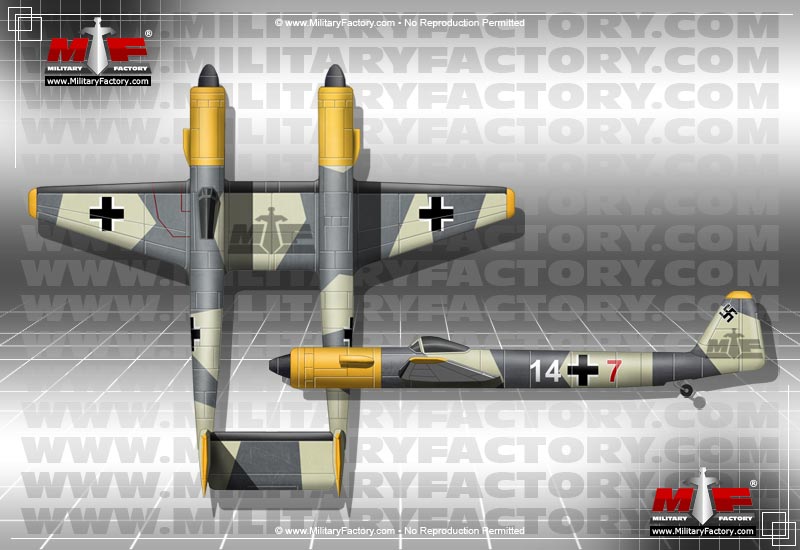
The idea of twin fuselage aircraft was always in the minds of military aircraft engineers throughout the Second World War. Conceivably, these systems would offer up double the performance and capabilities of their single fuselage counterparts and receive the ability to take on roles outside of their intended realms. The North American F-82 "Twin-Mustang" was really the only successful venture into this type of aircraft mating, though many attempts - such as this E.530 by Arado Flugzeuwerke were proposed. In Germany, this style of aircraft was typified with the designation of "Zwilling" meaning "twin".
The E.530 was design for comparison against the Arado Ar 440 but resembled the proposed Bf 109Z series. Both fuselage portions of the E.530 were pencil-like and joined by a central wing structure and an aft elevator horizontal surface. Wings were straight-edged, similar to that on the Messerschmitt Bf 109 series. Envisioned as a single-seat, fast bomber, the E.530 could have conceivably succeeded in its intended role based on the power of the conceived powerplant (consisting of a pair of Daimler-Benz DB 603 G series piston engines) and the aircraft's overall size and tubular shape. Crew accommodation amounted to one pilot positioned in the port-side fuselage which was to also contain a pressurized cockpit allowing high-altitude exposure. In terms of armament, offensive and defensive firepower were not included in the design. Instead, the potency of the E.530 system lay in the ability for the aircraft to carry a single 1,100lb bomb in an under wing rack positioned directly center between the two fuselages. Beyond that, the E.530 had no other option but to flee any direct encounters.
When compared with the Messerschmitt Bf 109Z "Zwilling" design, logistics in construction of the E.530 design would have been problematic. Whereas the Bf 109Z could depend on a surplus of production parts already in circulation (as it was closely related to the base Bf 109 fighter), the E.530 was effectively an all-new design needing specialized parts to complete its construction on any level. As a result, the Arado Ar E.530 design was not followed up on and - considering the supply demands for Germany at the time - it's no doubt that the E.530 would have had a hard time existing in a country facing a defensive battle against the Allies.
Text ©2003-2009 www.MilitaryFactory.com • All Rights Reserved •
No Reproduction Without Permission • Corrections / Comments to MilitaryFactory at Gmail dot com
Last Revision: 9/9/2009
|