Global Firepower | Military Industrial Complex | Second World War History
Home | Military Pay Scale Chart | Aircraft | Infantry Weapons | Military Vehicles | Navy Ships | Military Education | French Military Victories | Military Ranks | WW2 Weapons
Military Factory Latest from Military Factory
Thumbnail picture of the Dardo infantry fighting vehicle
Dardo IFV
Thumbnail picture of the Supermarine Scimitar fighter
Supermarine Scimitar
Thumbnail picture of the Centauro B1 8x8 tank killer
Centauro 8x8
Thumbnail picture of the Novi Avion fighter
Novi Avion
Thumbnail picture of the FR F2 bolt-action sniper rifle
FR F2
Thumbnail picture of the Lebel Model 1886 bolt-action rifle
Lebel Model 1886
2009 Military Pay Scale Chart - for Army, Navy, Air Force and Marines
  BY DECADE
    · 1900 to 1909
    · 1910 to 1919
    · 1920 to 1929
    · 1930 to 1939
    · 1940 to 1949
    · 1950 to 1959
    · 1960 to 1969
    · 1970 to 1979
    · 1980 to 1989
    · 1990 to 1999
    · 2000 to 2009
    · 2010 to 2019
    · View All Aircraft
  BY TYPE
    · Attack Helicopters
    · Bombers
    · Close-Support
    · Commercial
    · Dive Bombers
    · Experimental
    · Fighters
    · Floatplanes
    · Flying Boats
    · Fuel Tankers
    · Helicopters
    · Interceptors
    · Multi-Role
    · Navy Aircraft
    · Night-Fighters
    · Recon Aircraft
    · Recon Helos
    · Special Purpose
    · Torpedo Bombers
    · Trainer Aircraft
    · Transport Aircraft
    · Transport Helos
    · UAVs
  WORLD WAR 2
    · Full List
    · 1939
    · 1940
    · 1941
    · 1942
    · 1943
    · 1944
    · 1945
    · Australia
    · Battle of Britain
    · Bombers
    · Britain
    · Dive Bombers
    · Canada
    · Fighters
    · China
    · France
    · Germany
    · German Fighters
    · German Jets
    · Italy
    · Japan
    · Mitsubishi Bombers
    · Poland
    · USA Aircraft
    · USA Bombers
    · Soviet Union
    · Torpedo Bombers
  WORLD WAR 1
    · Full List
    · 1914
    · 1915
    · 1916
    · 1917
    · 1918
    · Aces
    · Austria-Hungary
    · Bombers
    · Britain
    · Fighters
    · France
    · Germany
    · Italy
    · Recon Aircraft
    · Russia
    · USA
  KOREAN WAR
    · Full List
    · Aces
    · Australia
    · USA
    · North Korea
  VIETNAM WAR
    · Full List
    · United States
    · North Vietnam

Military Factory > Military Aircraft > Curtiss-Wright XP-55 Ascender
 
 
More Pictures Cockpit View 3 View Plan QuickGraphs StatsCentral

Curtiss-Wright XP-55 Ascender

The XP-55 was a novel attempt at a pusher-prop aircraft design, though hampered by less-then-stellar performance.
By Staff Writer

Bookmark and Share

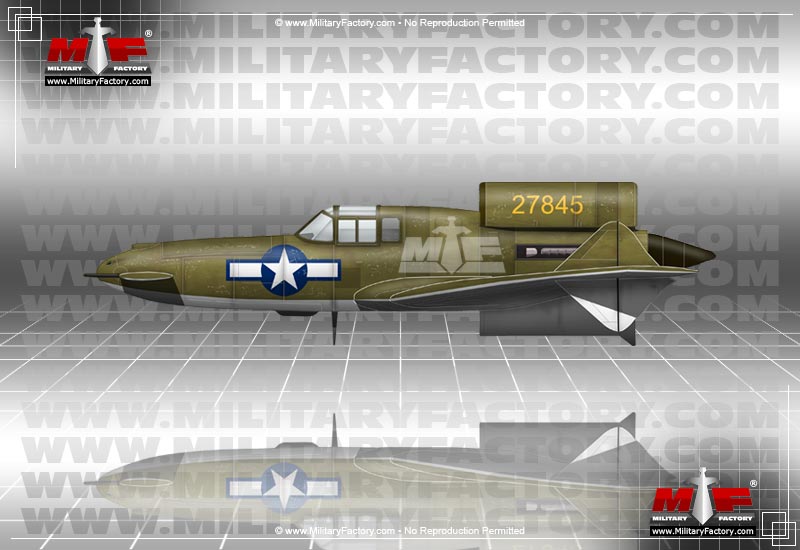
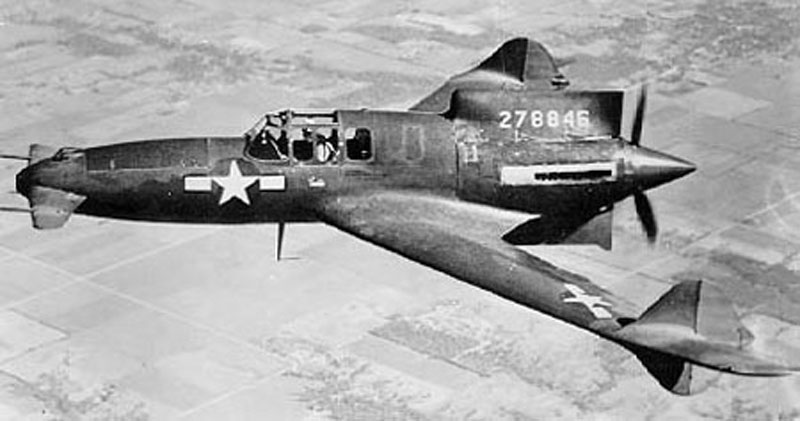
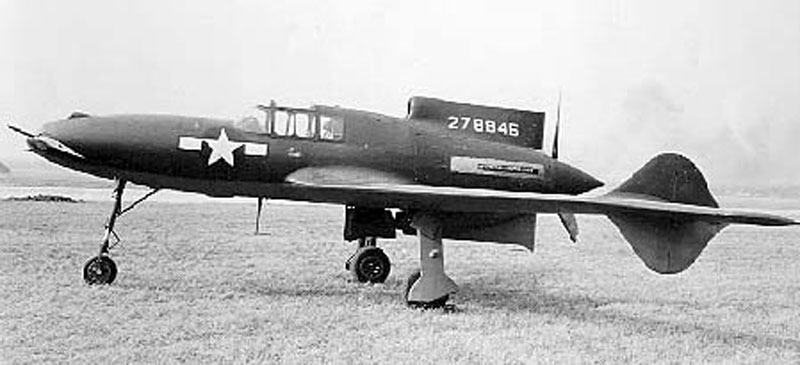
The XP-55 Ascender was an unorthodox attempt by the Curtiss-Wright company that produced just three prototype models. Answering a United States Army Air Corps call for unconventional aircraft designs, the XP-55 fit the bill with its pusher engine mounted at rear, swept-back wings and forward canard mountings. Less-then-stellar flight testing results and mechanical delays with the expected powerplant would eventually doom the project and leave two surviving prototypes (one would later be lost at an air show).

The XP-55 was a single-seat single-engine design. The pusher-type engine was mounted to the extreme rear and differed from traditional pull designs with the engine mounted at front. This left the pilot with a commanding forward view. Wings were highly swept which was another departure from the straight wing designs that continued on in jet fighter developments well into the Korean War. First drawings and scale models were completed and assessed as early as 1940 to which the Army Air Corps needed more convincing. As a result, Curtiss took it upon itself to produce a flyable full scale model - this one to be designated in-house as the CW-24B. The test aircraft differed some from the final three prototypes developed from the granted contract of 1942. The test bed flew with a Menasco C68-5 powerplant, whereas the final prototype models were fitted each with the Allison V-1710 engine. Initially, the XP-55 was to utilize an entirely new engine design in the form of a Pratt & Whitney design known as the X-1800. But developmental issues with the powerplant forced Curtiss to use an existing - yet proven - model instead.

Armament for the XP-55 was originally drawn up to include a pair of 20mm cannon to go along with twin 12.7mm (.50 caliber) machine guns. This arrangement was revisited and revised to a quad .50 caliber array during the testing phase and this standard armament stayed with the life of the program. The design offered up benefits in this way in that the armament could be fully fitted into the nose assembly, seeing it that the engine was now mounted behind the cockpit seating area, opening up the nose to more spacious armament. Firepower could also be more concentrated in this fashion as opposed to a combination of wing and nose-mounted armament.

The XP-55 would go on to feature a host of interesting design elements. For Curtiss, it would become its first design to feature a powered tricycle landing gear assembly (though fixed on the initial test models). The absence of a true rudder resulted in smaller vertical surfaces mounted far off onto the wings. The use of forward canards was also revolutionary as was the ejection system - the propeller had to be jettisoned before the pilot could eject himself, ensuring the pilot would not eject and hit the spinning propeller system at rear by accident. It should be noted that designs similar to this were also being trialed by the Japanese (in the J7W1 Shinden) and Germans (in the Henschel P.75) during the Second World War and was by no means unique to American aircraft design efforts.

The final verdict on the XP-55 rang in hard when it was realized that the system could not match the performance available to contemporary and traditionally-designed fighters. Additionally, the latter years of the Second World War were already bringing about the advent of jet-propulsion effectively negating any more development or advances in propeller systems research. As such, the series was limited in production totals and became the stuff for aviation aficionados and museum buffs.

Text ©2003-2009 www.MilitaryFactory.com • All Rights Reserved • No Reproduction Without Permission • Corrections / Comments to MilitaryFactory at Gmail dot com

Last Revision: 9/9/2009


  Specifications for the Curtiss-Wright XP-55 Ascender
arrow downDimensions:
Length: 29.53ft (9.00m)
Width:40.68ft (12.40m)
Height: 9.84ft (3.00m)

arrow downPerformance: About MACH
Max Speed: 390mph (628kmh; 339kts) Rate-of-Climb: 0ft/min (0m/min)
Service Ceiling: 34,449ft (10,500m; 6.5miles)

arrow downStructure:
Accommodation: 1
Hardpoints: 0
Empty Weight: 6,354lbs (2,882kg)
MTOW: 7,710lbs (3,497kg)

arrow downPowerplant:
Engine(s): 1 x Allison V-1710-95 liquid-cooled V12 engine generating 1,275hp.
arrow downArmament Suite:
Proposed:
2 x 20mm cannon
2 x 12.7mm machine guns

Actual:
4 x 12.7mm machine guns

  Pictures of the Curtiss-Wright XP-55 Ascender
     
Picture of Curtiss-Wright XP-55 Ascender
Picture of the Curtiss-Wright XP-55 Ascender
Image of the Curtiss-Wright XP-55 Ascender
     
arrow upView All 3 Images

CompareX2 CompareX4 Conversions Dictionary Acronyms

Compare and Contrast Military Aircraft Specifications

  Special Aircraft Collections
Aircraft by Conflict:
Falklands War
Indo-Pak War
Operation Allied Force
Operation Desert Storm
Six Day War
Yom Kippur War

Special Collections:
American X-Planes
Classic US Warbirds
Grumman "Cats"
Indian Air Force
Israeli Air Force
Mikoyan-Gurevich
V-Bombers


Korean Air War:
Korean War Aircraft
Aces
Australia
United States
North Korea

Vietnam Air War:
Vietnam War Aircraft

Cold War
Cold War Aircraft
United States
Soviet Union
Soviet Bombers of the Cold War

Modern Aircraft
Modern Military Aircraft
United States

Miscellaneous
MiG-15 Versus Sabre
Top 10 Fighters of All Time


  Recent Military Aircraft Additions
Thumbnail picture of the Supermarine Scimitar fighter
Supermarine Scimitar
Thumbnail picture of the Novi Avion fighter
Novi Avion
Thumbnail picture of the Arado Ar TEW 16/43-23 jet-powered fighter
Arado TEW 16/43

  Contacting MilitaryFactory.com
We can only get better if you tell us how. You can contact MilitaryFactory.com at MilitaryFactory at gmail dot com (replace "at" with "@" and "dot with ".") with any questions, comments or corrections. We also accept related military imagery that you approve for us to use on our website. Keep in mind, however, that due to volume, we may not directly respond to your inquiry. Please add us to your list of non-blocked recipients!
Flying Boats

  Aircraft Quick Profile


Picture of the Curtiss-Wright XP-55 Ascender
Image courtesy of Dan Alex.

flag of United States
1943

Designation: Curtiss-Wright XP-55 Ascender
Classification Type: Pursuit Fighter Prototype
Contractor: Curtiss - USA

Country of Origin: United States
Production Total: 3

Operators: the United States of America


  Variants
XP-55 - Reserved Model Series Designation; produced in three prototype examples in the s/n 42-78845, s/n 42-78846 and the s/n 42-78847.

CW-24B - Designation as applied to by the Curtiss company to a full working model of the XP-55.

P-55 - Reserved Production Model Designation

  Collections
  • Sons of Empire - WW2 Aircraft of Japan
  • Aircraft of the Battle of Britain
  • X-Planes Throughout History
  • French Aircraft of the Great War
  • The German Luftwaffe in World War 2
  • Nightfighters - In a Class All Themselves
  • The Top Ten Fighters of All Time
  • Carrier "Born" Aircraft - Navy Mounts
  • If Boats Could Fly - Flying Boat Aircraft


Free GI Bill Guide

Top MF Stuff: Military Pay Scale Chart | Military Ranks | World War 2 Weapons | Sniper Rifles | Conversion Calculators


©2009 www.MilitaryFactory.com • Content ©2003-2009 MilitaryFactory.com • All Rights Reserved • Disclaimer Privacy Policy Site Map Origins
Most photographic images appearing on this site are courtesy of the United States Department of Defense and are approved for public use.
Other images acquired through the public domain. Digital art work courtesy of Dan Alex.
Business Consulting by Kyle Williams

Material presented throughout this website is for historical and entertainment value and should not to be construed as usable for
hardware restoration, maintenance or general operation. Please consult manufacturers for such information.

Site Contact: militaryfactory at gmail dot com (replace "at" with "@" and "dot" with ".") eXTReMe Tracker