Military Factory
Military Pay Chart
Global Firepower
Military Industrial Complex
Second World War
Home
Military Pay Scale
Military Ranks
Small Arms
Aircraft
Land Systems
Navy
Education
Military Factory Facebook Logo
flag of United States

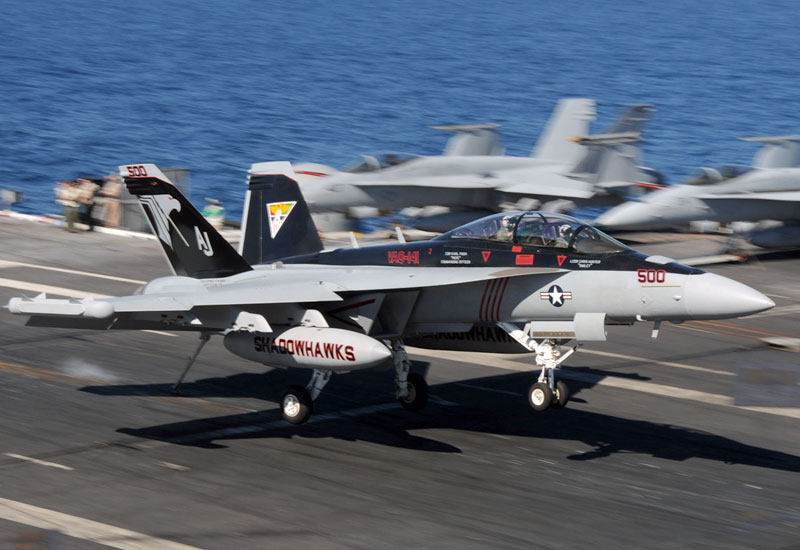
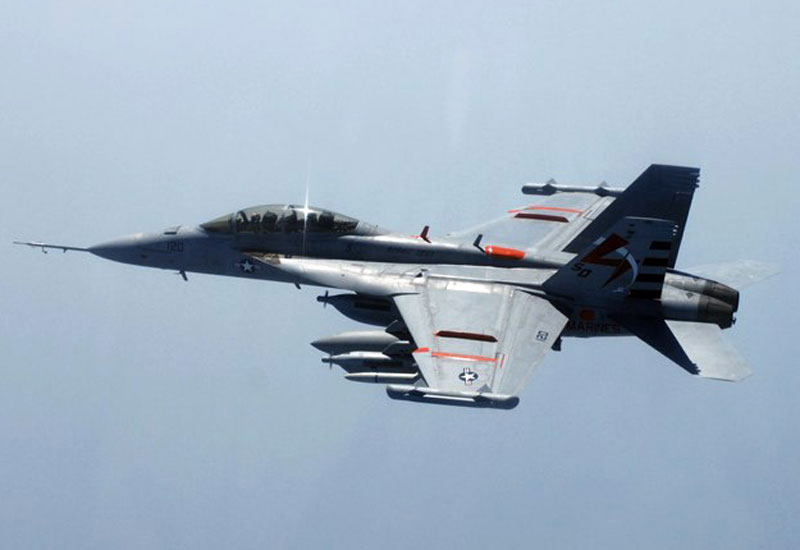
Boeing EA-18G Growler Electronic Warfare Platform (2009)

Authored By Dan Alex | Last Updated: 8/30/2012

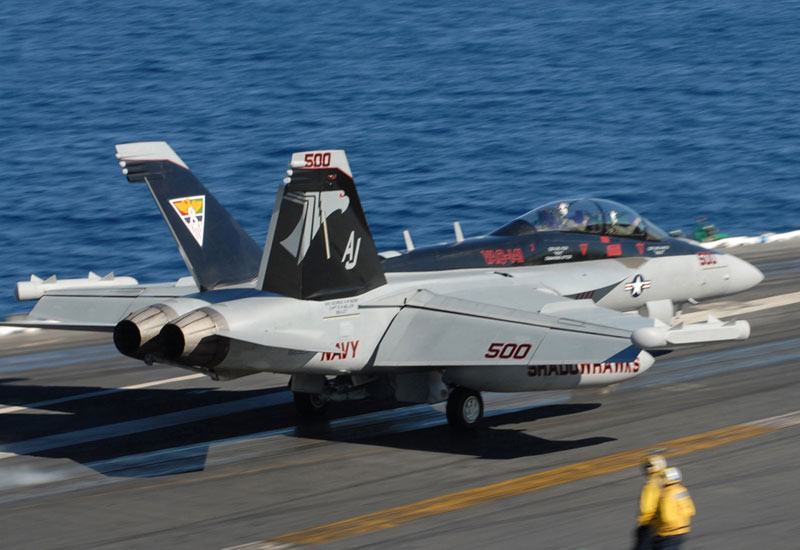
The EA-18G Growler is based on the airframe of the F/A-18F Super Hornet carrier strike fighter.

Find a School Near You
Follow Military Factory on Facebook:
Trending on Military Factory:
Recent Articles:
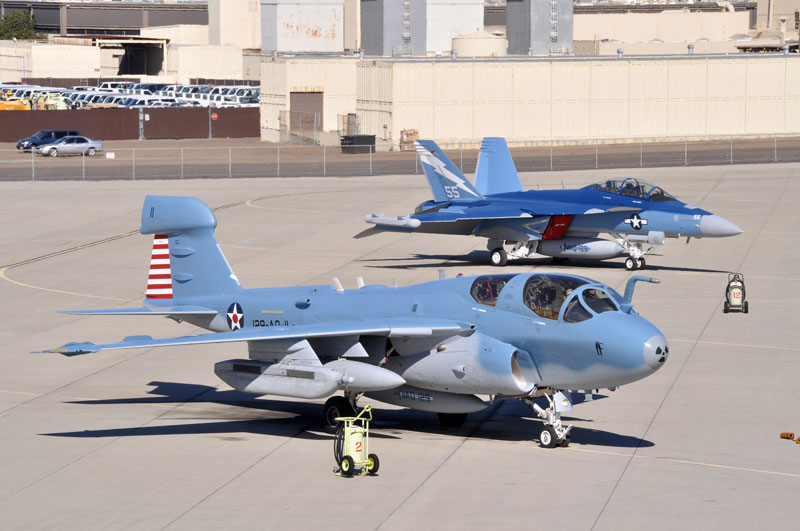
The Boeing EA-18G "Growler" was designed and developed to overtake the Electronic Warfare Aircraft (EWA) role from the venerable Grumman EA-6B "Prowler" of the United States Navy. The Prowler has served through several decades and notable conflicts while itself being a further evolution of the original Grumman A-6 "Intruder" carrier-based strike aircraft. The USN has long forged use of its proven aircraft airframes to undertake the vital EWA role, resulting in budget-conscious solutions to a very important battlefield need. The Growler - based on the F/A-18F Super Hornet Block II production model - intends to take the EWA mantle from the Prowler through a good portion of the new millennium, utilizing the latest in jamming software and onboard equipment to blind enemy air defenses. While Boeing serves as the major manufacturing label on the Growler product, it is also being completed with assistance from Northrop as well as General Electric, the latter responsible for the engines. The Growler stocks the ranks of USN squadrons VAQ-129, VAQ-130, VAQ-132, VAQ-135, VAQ-137, VAQ-138 and VAQ-141.

Suppression of air defenses has long been a concern for any warplanner. Since the advent of military aviation beginning with World War 1, there brought forth a response for ground-based cannons to effectively engage incoming formations of enemy aircraft. World War 2 gave rise to the use of radar and ground-based gunnery was further improved through better ammunition design and implementation of rudimentary computers. By the time of the Cold War, missile technology was at the fore front of air defense networks and suitable counters were needed to suppress, or outright destroy, these networks before dedicated strike aircraft could penetrate enemy airspace to strike at targets. This gave rise to the EWA platform whose sole purpose was suppression and destruction of air defense targets through use of specialized equipment and weaponry while offering communications-jamming facilities rendering the enemy "blind" during the action. Such aircraft were used to devastating effect in the Persian Gulf War - the first true "digital" war - ahead of the main aerial strike formations. For decades, the Grumman EA-6B "Prowler" had served in this role for the USN and now the newer Growler will be fielded as her successor. Her inherent Super Hornet multirole qualities will also allow her to escort dedicated, strike-minded allies into enemy territory while providing a swathe of electronic protection.

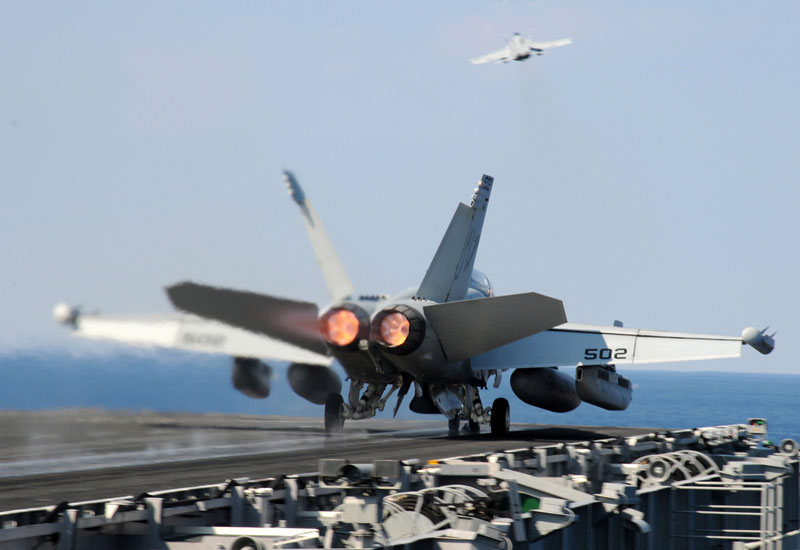
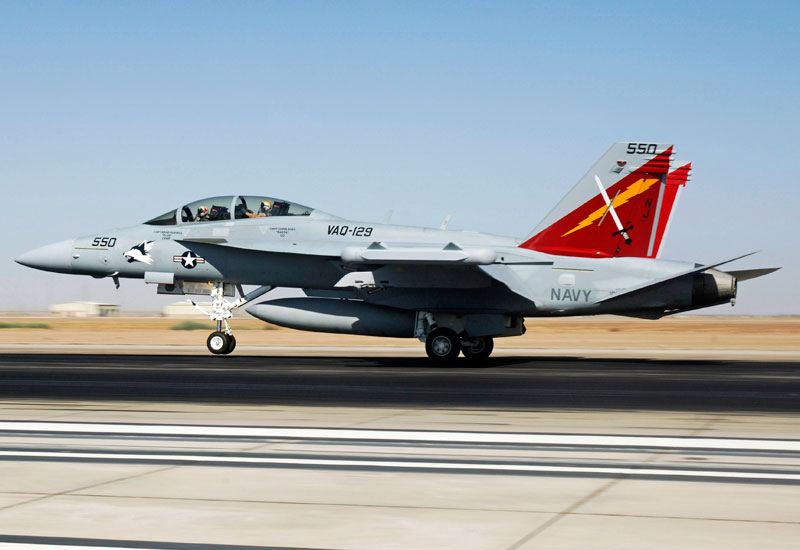
A new demonstration aircraft based on the F/A-18F "Super Hornet" two-seat, carrier-based strike aircraft was first flown in November of 2001. Having liked what it saw, the USN signed a development contract with The Boeing Company in December of 2003 for further development which began in 2004. Two evaluation aircraft - the "EA-1" and "EA-2" - were then constructed for the various testing phases to come. First flight of a true EA-18G "Growler" was recorded on August 15th, 2006 and this was subsequently followed by delivery of the first production-quality Growler in 2007. Fleet Readiness Squadron VAQ-129 of Naval Air Station Whidbey Island, Washington, received the Growler on June 3rd, 2008. Sea trials were successfully completed in August of 2008 from deck of the aircraft carrier USS Dwight D. Eisenhower. Initial Operational Test and Evaluation wrapped up in May of 2009 and formal introduction of the system for operational status within the USN inventory commenced on September 22nd, 2009. Full-rate production was ordered by the US Government in November of 2009 and first examples (perhaps as many as 46) were already on hand by the end of 2010. The Growler currently remains in production and deliveries to USN groups are still underway. It is expected that some 58 Growlers will be delivered in a first batch production series and at least 114 total Growlers will stock the USN inventory in years to come. On September 28th, 2010, Boeing received a contract for 66 Super Hornets and a further 58 Growlers from the US Navy, with delivery of these airframes to span from 2012 to 2015. The procurement of the EA-18G Growler will happen alongside procurement of Super Hornets for budgetary reasons as the EA-18G shares up to 99% commonality of parts with the F/A-18E and F/A-18F Super Hornets which means that the system will be allowed to grow as the Super Hornet series itself grows, keeping future costs within check as a result. The F/A-18F itself is a proven multirole airframe based on the successful F/A-18 Hornet fighter series that replaced the legendary Grumman F-14 Tomcat interceptors on US Navy carriers. The multirole nature of the Hornet series has translated well up to this point and the arrival of the Growler only solidifies the Hornet's foothold within the American air arm - for both the United States Navy and the United States Marine Corps. Despite its modifications to the new "Growler" standard, the EA-18G maintains much of the base performance specifications of the original Super Hornet it is based on, making it an inherently potent weapons delivery platform. Beyond the USN, the Australian Air Force has shown interest in procurement of the Growler, they already having committed to the purchase of two-dozen F/A-18 Super Hornets.

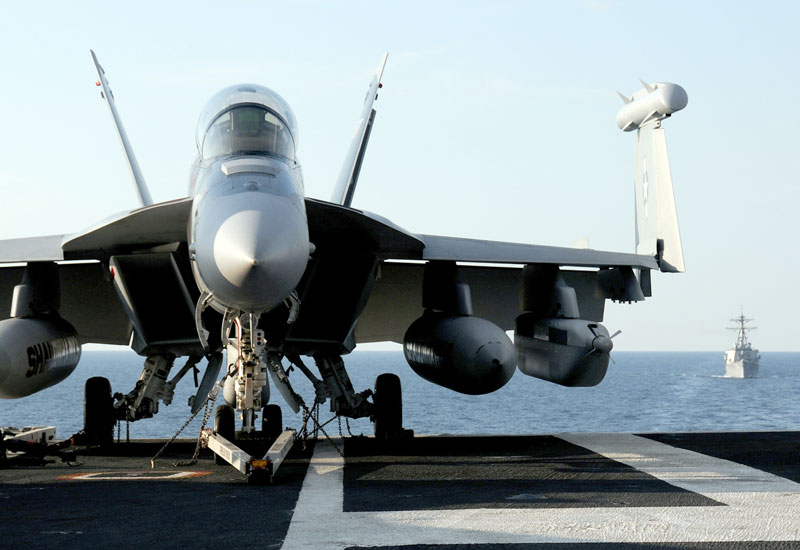
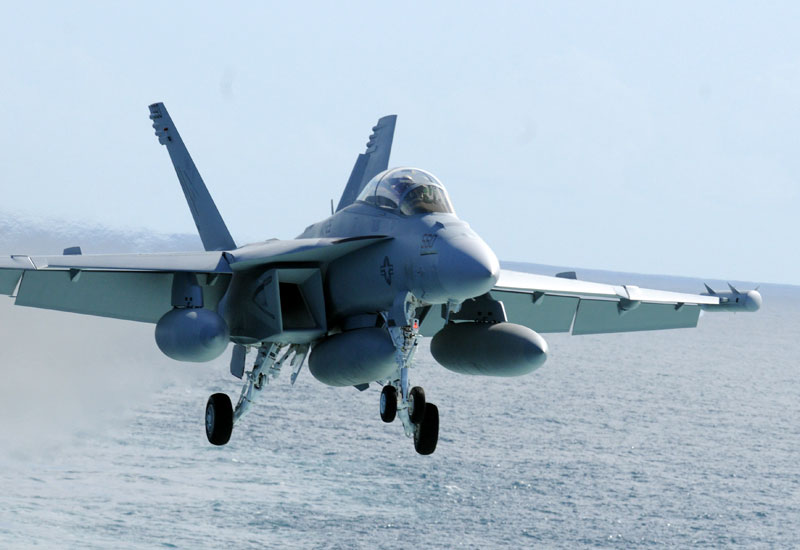
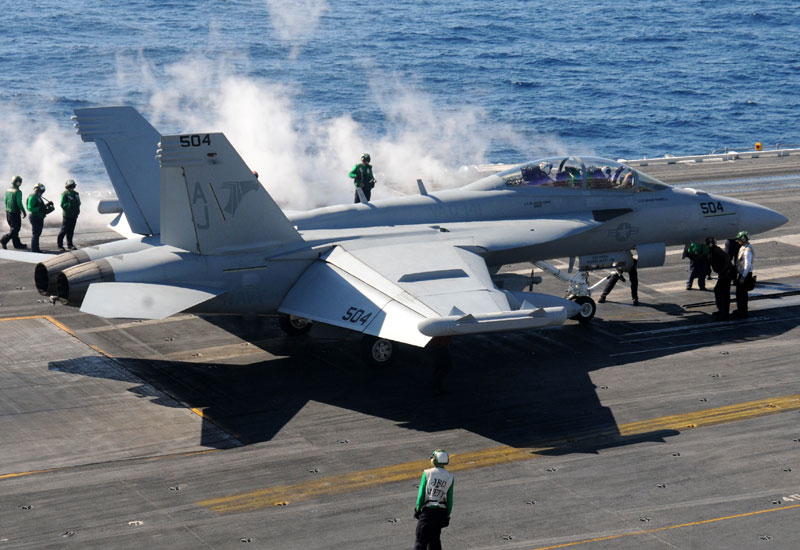
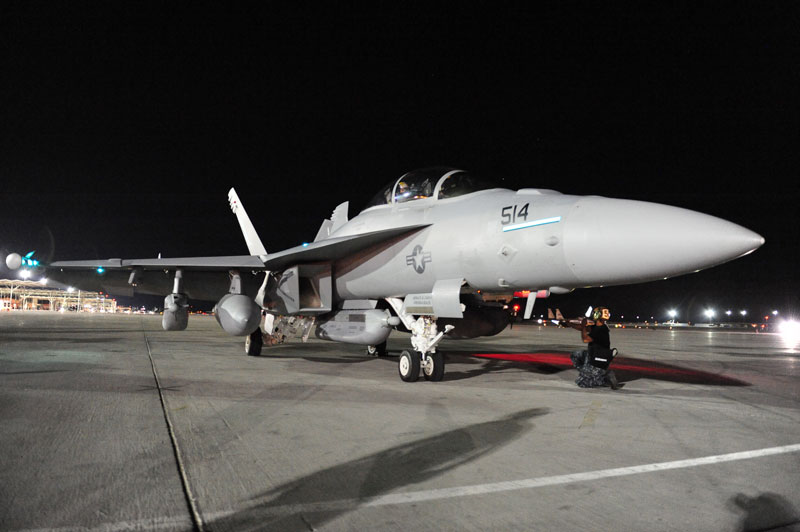
The Growler is crewed by two personnel made up of the pilot and the systems officer (unlike the Prowler's four-man crew) and are seated in tandem with the pilot in the forward cockpit and the systems officer in the rear cockpit. Outwardly, the Growler shares much of the appearance from the Super Hornet (and base Hornet) from which it was developed from. The cockpit is situated behind a long nose cone assembly housing the Raytheon AN/APG-79 Active Electronically Scanned Array (AESA) radar system. Wing roots are extended well forward of the wings, creating something of a shroud over and ahead of the slanted rectangular air intakes. The air intakes straddle the fuselage and aspirate the twin engine arrangement. Wings are set well aft of amidships (a decidedly Hornet design feature) and are slightly swept in shape. Each are cleared to carry thousands of pounds of ordnance for a variety of sortie types. The empennage is dominated by a pair of outward canted vertical tail fins - the Hornet's telltale identifiable sign - as well as extremely rear-set horizontal tail planes. The engines exhaust at the rear of the aircraft through a pair of circular rings. The undercarriage is of the tricycle arrangement and fully retractable. For carrier service, the Growler maintains the Hornet's tow cable arrestor hook system as well as folding wings for ease of storage. The electronic warfare equipment primarily resides in what would be the internal cannon bay on the strike-ready Super Hornet and the equipment is further spread into two wingtip pods - these hardpoints usually reserved for the AIM-9 Sidewinder on the combat-minded Super Hornet.

The Growler is powered by a pair of General Electric F414-GE-400 turbofan engines offering up to 14,000lbs of thrust each and up to 22,000lbs of thrust with afterburner ("reheat"). This supplies the airframe with a top speed nearing 1,200 miles per hour (Mach 1.8) at altitude and a range of 1,470 miles. Her combat radius is listed at 450 miles with a ferry range of 2,000 miles. The Growler's service ceiling is over 50,000 feet and, thusly, each crewmember is supplied an oxygen system and ejection seat.

Unlike other fighter aircraft, the Growler maintains no standard internal cannon armament for close-in fighting. She will, however, make due with munitions and specialized equipment spread across nine total hardpoints - 1 x centerline, 2 x fuselage and 6 x underwing - for the purpose of combating signal waves. The wingtips are reserved for the mounting of AN/ALQ-218 wideband precision receiving pods while AN/ALQ-99 Tactical Jamming System High Band Jamming Pods are a standard fit under the wings (to counter radar-guided missile threats). An AN/ALQ-99 Low Band Jamming Pod also figures into the mix and the ALQ-227 Communication Countermeasures Set will be utilized to suppress enemy communications. A pair of 480 US gallon fuel drop tanks are used for increased operational ranges. For benefit to itself, the Growler will field the "Interference Cancellation System" (INCANS) to supply the crew with uninterrupted lines of communications with friendlies. Primary armament will be AGM-88 HARM (High-Speed Anti-Radiation Missiles) for combating radar threats. For self-defense, the Growler will be fitted with the AIM-120 AMRAAM medium-ranged, air-to-air missile. The AGM-154 Joint StandOff Weapon (JSOW) air-to-surface precision-guided missile system has reportedly been mentioned for use in the Growler system for striking at ground targets. In all, she is cleared to carry some 17,750lbs of external ordnance and her integration of key mission systems will ensure that she is more potent than any Suppression of Enemy Air Defense (SEAD) aircraft before her.

August 2012 - At the cost of $1.5 Australian Dollars, the Royal Australian Air Force has committed to the conversion of 12 of its existing 24 F/A-18F Super Hornets to the Growler standard, making Australia the first foreign operator of the EA-18G Growler system (joining the USN).
Text ©2003-2013 www.MilitaryFactory.com • All Rights Reserved • No Reproduction Permitted
MilitaryFactory.com does NOT sell equipment/weaponry. Material presented throughout this website is for historical and entertainment value and should not to be construed as usable for hardware restoration, maintenance or general operation. Please consult manufacturers for such information. Our disclaimer. Email corrections / Comments to MilitaryFactory at Gmail dot com.
Picture of Boeing EA-18G Growler
Pic of the Boeing EA-18G Growler
Image of the Boeing EA-18G Growler
View All Images (11)

Specifications for the
Boeing EA-18G Growler
Electronic Warfare Platform


Country of Origin: United States
Manufacturer: Boeing - USA
Initial Year of Service: 2009
Production: 114


Focus Model: Boeing EA-18G Growler
Crew: 2


Length: 60.07ft (18.31m)
Width: 44.69ft (13.62m)
Height: 16.01ft (4.88m)
Weight (Empty): 30,565lbs (13,864kg)
Weight (MTOW): 65,918lbs (29,900kg)


Powerplant: 2 x General Electric F414-GE-400 turbofan engines developing 22,000lbf each with afterburner.


Maximum Speed: 1,181mph (1,900kmh; 1,026kts)
Maximum Range: 1,458miles (2,346km)
Service Ceiling: 50,853ft (15,500m; 9.6miles)
Rate-of-Climb: 0 feet per minute (0m/min)


Hardpoints: 11 (including wingtip mounts)
Armament Suite:
Mission-special weapons and equipment on nine external hardpoints (2 x wingtip, 6 x underwing, 2 x underfuselage and 1 x centerline underfuselage) can include any of the following:

AN/ALQ-218 Detection Pods (wingtips)
AN/ALQ-99 High Band Jamming Pods
AN/ALQ-99 Low Band Jamming Pod
AN/ASQ-228 ATFLIR
SHARP
2 x 480 US gallon fuel drop tanks
2 x AGM-88 HARM anti-radiation missiles
2 x AIM-120 AMRAAM medium-range air-to-air missiles.
2 x AGM-154 JSOW "Joint Stand-Off Weapon"


Variants:
EA-18G "Growler" - Base Series Designation; conversion from F/A-18F Super Hornet two-seat strike model.


Operators: Australia; United States

ALL AIRCRAFT CATEGORIES

BY DECADE:


1900 to 1909
1910 to 1919
1920 to 1929
1930 to 1939
1940 to 1949
1950 to 1959
1960 to 1969
1970 to 1979
1980 to 1989
1990 to 1999
2000 to 2009
2010 to 2019
2020 to 2029
VIEW ALL
Compare Aircraft


BY TYPE:


Anti-Submarine Warfare (ASW)
Attack Helicopters
Bomber Aircraft
Medium Bombers
Heavy Bombers
Close-Air Support (CAS)
Commercial Aircraft
Dive Bombers
Electronic Warfare Aircraft (EWA)
Experimental / X-Planes
Fighter Aircraft
Floatplane Aircraft
Flying Boat Aircraft
Aerial Refueling Tankers
Helicopters (ALL)
Interceptor Aircraft
Multi-Role Aircraft
Navy Carrier Aircraft
Night Fighters
Reconnaissance / Scout
Search & Rescue (SAR)
Scout Helicopters
Special Purpose
Torpedo Bombers
Trainer Aircraft
Transport Aircraft
Transport Helicopters
Unmanned Aerial Vehicles (UAVs)
Unmanned Combat Air Vehicles (UCAVs)


COLLECTIONS:


4th Generation Fighter Aircraft
5th Generation Fighter Aircraft
US X-Planes
Classic US Warbirds
French Military Helicopters
Grumman "Cats"
Howard Hughes Aircraft
Indian Air Force
Israeli Air Force
Libyan Aircraft
Modern Chinese Aircraft
Modern Chinese Fighters
Modern Military Aircraft
Modern North Korean Aircraft
Modern Trainer Aircraft
Modern US Aircraft
Mikoyan Aircraft
Sukhoi Aircraft
Syrian Aircraft
Top 10 Fighter Aircraft of All Time


AIRCRAFT BY CONFLICT:


Arab-Israeli War (1948)
Cuban Missile Crisis (1959-1962)
Falklands War (1982)
Indo-Pak War (1965, 1971)
Iran-Iraq War (1980-1988)
Lebanon War (1982)
Operation Allied Force (1999)
Operation Desert Storm (1991)
Six Day War (1967)
Spanish Civil War (1936)
Soviet-Afghan War (1979-1989)
Yom Kippur War (1973)


MISCELLANEOUS:


Aircraft Cockpits
Aircraft Manufacturers List
Aircraft Timeline

WORLD WAR 2:


1939 Aircraft
1940 Aircraft
1941 Aircraft
1942 Aircraft
1943 Aircraft
1944 Aircraft
1945 Aircraft
1946 Aircraft
Australian Aircraft
Battle of Britain Aircraft
Bombers
Four-Engine Bombers
British Aircraft
British Bombers
British Transports
Dive Bombers
Canadian Aircraft
Fighters
Chinese Aircraft
French Aircraft
German Aircraft
German Fighters
German Flying Boats
German Jets
Secret Weapons of the Luftwaffe
Italian Aircraft
Imperial Japanese Aircraft
Imperial Japanese Fighters
Mitsubishi Bombers
Navy Aircraft
Pearl Harbor
Polish Aircraft
Romanian Aircraft
US Aircraft
US Bombers
US Navy Aircraft
Soviet Aircraft
Torpedo Bombers
Transport Aircraft
Tuskegee Airmen Aircraft
W.A.S.P. Aircraft
WW2 Aircraft Ranked by Speed
VIEW ALL


WORLD WAR 1:


1914 Aircraft
1915 Aircraft
1916 Aircraft
1917 Aircraft
1918 Aircraft
Aircraft Timeline
Austro-Hungarian Aircraft
Bomber Aircraft
British Aircraft
Fighters
Flying Boats
French Aircraft
Imperial German Aircraft
Italian Aircraft
Scout Aircraft
Russian Empire Aircraft
US Aircraft
WW1 Aircraft Ranked by Speed
VIEW ALL


KOREAN WAR:


Australian Aircraft
Korean War Aces
Korean War Jets
North Korean Aircraft
US Military Aircraft
VIEW ALL


VIETNAM WAR:


Helicopters
North Vietnam Air Force
US Airpower
VIEW ALL


COLD WAR:


1950s French Aircraft
British V-Bombers
Cold War Bombers
Soviet Aircraft
Soviet Bombers
Soviet Interceptors
Soviet Helicopters
Strategic Air Command
US Aircraft
US Bombers
US Interceptors
VIEW ALL

Site Disclaimer | Privacy Policy | Site Map | MF Origins


©2013 www.MilitaryFactory.com • Content ©2003-2013 MilitaryFactory.com • All Rights Reserved • Site Contact Email: militaryfactory at gmail dot com. The "Military Factory" name and MilitaryFactory.com logo are registered ® trademarks and protected by all applicable domestic and international intellectual property laws.


Top MF Stuff: 2013 Military Pay Scale | Military Ranks | WW2 Weapons | Sniper Rifles | Kts to Mph | WW1 Aircraft | Automatic Rifles | Aircraft Cockpits | Vietnam War Weapons | Main Battle Tanks | Submachine Guns | Shotguns | French Military Victories


Most photographic images appearing on this site are courtesy of the United States Department of Defense and are approved for public use. Other images acquired through the public domain. Digital art work courtesy of Dan Alex. Business Consulting by Kyle Williams. Material presented throughout this website is for historical and entertainment value and should not to be construed as usable for hardware restoration, maintenance or general operation. Please consult manufacturers for such information.


eXTReMe Tracker