Military Factory
Military Pay Chart
Global Firepower
Military Industrial Complex
Second World War
Home
Military Pay Scale
Military Ranks
Small Arms
Aircraft
Land Systems
Navy
Education
Military Factory Facebook Logo
flag of France

Sud Aviation / Aerospatiale SA 330 Puma Medium Transport / Assault Helicopter (1969)

Authored By Staff Writer | Last Updated: 5/2/2011

The SA 330 Puma helicopter has gone into operational service with no fewer than 40 military forces worldwide.

Find a School Near You
Follow Military Factory on Facebook:
Trending on Military Factory:
Recent Articles:
The Puma began life as a product of Sud Aviation designed to meet an French Army requirement for an all-weather, medium-lift, multi-purpose utility helicopter to replace the aging set of Sikorsky S-58 systems in French service. Additional requirements stipulated operation in day or night environments with potential operations of the type reaching virtually in any region of the world. Though originally designed and produced under the Sud Aviation banner (hence the "SA" in the model designation), ownership of the helicopter changed hands when Sud merged with SEREB and Nord Aviation becoming Aerospatiale.

Two prototypes were constructed under the designation of Alouette V (SA 330A) with the first one flying on April 15th, 1965 from Marignane. These designs were based in the Super Frelon helicopters though the SA 330 was modernized through-and-through right down to construction methods utilized. The prototypes were subsequently followed by 6 pre-production aircraft which were evaluated into the middle of 1968. Results proved the design to be sound, showcasing good speed and agility and proving to be reliable for a complex system of this type. Production of the now-designated SA 330B "Puma" officially began in September of that year to which some 697 total examples were eventually produced. The Puma officially entered operational service in 1970. Pumas went on to serve in no fewer than 40 air forces and armies worldwide - from Albania to Zaire - making it one of the most successful helicopter designs of all time.

As an aside, 1967 found the Royal Air Force (RAF) taking an interest in the French-based system as well and tabbed it for their own revamped needs resulting in an Aerospatiale-Westland joint production partnership. This joint venture would also produce the likes of the fabulous Lynx multi-role and Gazelle light helicopters of which both militaries would field in some number. For the RAF, the arrival of the Puma favorably brought about the end use for their Whirlwind and Belvedere series. British Pumas went under the designation of Puma HC.Mk 1.

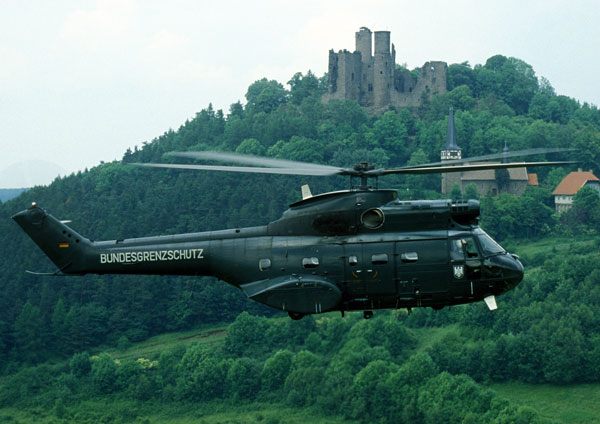
At its core, the Puma is powered by twin Turbomeca Turmo IVC turboshaft engines developing 1,575 horsepower each powering a four-bladed main rotor and five-bladed tail rotor (the latter interestingly mounted to the starboard side of the tailfin). Distinctive to the Puma design is that the powerplants are mounted well forward of the cabin rooftop above the stout and contoured fuselage and exhaust at about the middle of the design. Performance figures include a never-exceed speed of 169 miles-per-hour, maximum speed of 159 miles-per-hour, a range of 360 miles and a service ceiling of 15,750 feet with a rate-of-climb nearing 1,400 feet-per-minute.
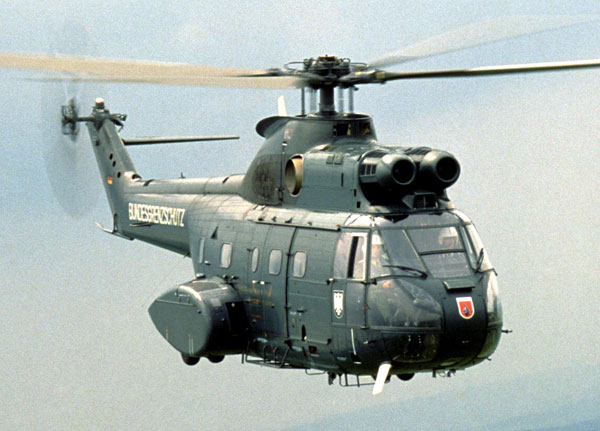
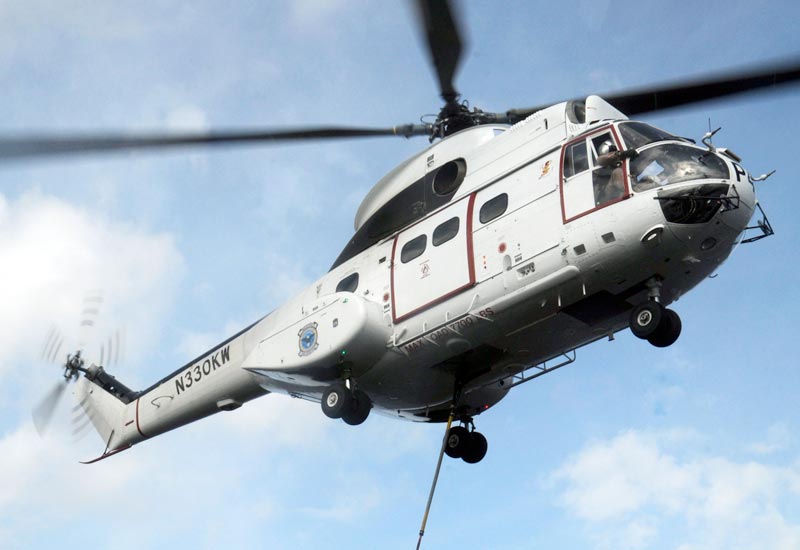
The forward section of the fuselage fitted the two-man cockpit along with heavy glazing offering up excellent views of the action forward, to the sides, above and below with the forward windshield made up of sloping panels. The fuselage also features windows for the crew cabin. A typical crew is three personnel made up of the pilot, co-pilot and flight engineer. A further 16 passengers can be brought aboard. Both pilots are afforded hinged automobile-style doors while large cabin doors span either fuselage side. The undercarriage is fully retractable and features a conventional arrangement of two main two-wheeled landing gears in lower-fuselage side sponsons and a single nose gear fitting two wheels. The empennage consists of a conventional elevated extension adorned with a single vertical tail fin and a single horizontal tail plane mounted to the port side. The five-bladed tail rotor is mounted to starboard.

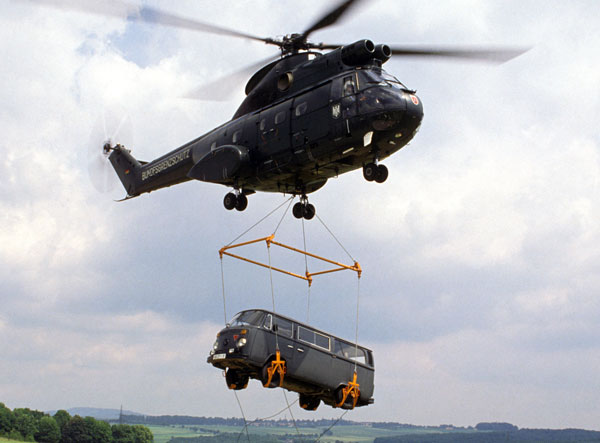
As with most multi-role helicopter systems, armament for the Puma is optional, mission-specific and operator-specific. 7.62mm machine guns are the norm while 20mm cannons have also been fielded. In the cargo transport role, provisions were made for the use of an external load hook for underslung cargo carrying.

Notable versions of production Pumas include the initial French Army production SA 330B models, the SA 330C initial export models and the SA 330F initial civilian export production model. Others include the Westland-produced SA 330E for the Royal Air Force, the upgraded SA 330H for the French Army and the SA 330Z prototype sporting a Fenestron shrouded tail rotor. The South African firm Atlas Aircraft Corporation locally-produced the similar Oryx for their Air Force while IPTN of Indonesia did the same with their NAS 330J's. Westland jumped into the fray to offer the Puma HC.Mk 1 for the RAF, these being based on the SA 330E model series. Romania is the other foreign producer of the type, fielding it under its home-made IAR 330 guise produced by ICA.

Notable Puma operators have included the Royal Air Force, South Africa and Lebanon. Civilian-based operators reside in the United States, South Africa and Germany. The Puma was replaced on the Aerospatiale line by the much improved AS332 "Super Puma", this time falling under the Eurocopter product banner though similarly retaining the "AS" (for Aerospatiale) in the model designation.
Text ©2003-2013 www.MilitaryFactory.com • All Rights Reserved • No Reproduction Permitted
MilitaryFactory.com does NOT sell equipment/weaponry. Material presented throughout this website is for historical and entertainment value and should not to be construed as usable for hardware restoration, maintenance or general operation. Please consult manufacturers for such information. Our disclaimer. Email corrections / Comments to MilitaryFactory at Gmail dot com.
Picture of Sud Aviation / Aerospatiale SA 330 Puma
Pic of the Sud Aviation / Aerospatiale SA 330 Puma
Image of the Sud Aviation / Aerospatiale SA 330 Puma
View All Images (5)

Specifications for the
Sud Aviation / Aerospatiale SA 330 Puma
Medium Transport / Assault Helicopter


Country of Origin: France
Manufacturer: Aerospatiale - France / Westland - UK
Initial Year of Service: 1969
Production: 697


Focus Model: Sud Aviation / Aerospatiale SA 330H Puma
Crew: 3 + 16


Length: 59.55ft (18.15m)
Width: 49.21ft (15.00m)
Height: 16.86ft (5.14m)
Weight (Empty): 7,796lbs (3,536kg)
Weight (MTOW): 15,432lbs (7,000kg)


Powerplant: 2 x Turbomeca Turmo IVC turboshaft engines generating 1,575shp each and driving main blade and tail blade rotors.


Maximum Speed: 170mph (273kmh; 147kts)
Maximum Range: 360miles (580km)
Service Ceiling: 15,748ft (4,800m; 3.0miles)
Rate-of-Climb: 1,400 feet per minute (427m/min)


Hardpoints: 0
Armament Suite:
Mission-specific depending on role and operator. May include machine guns and cannons as needed.


Variants:
Alouette IV - Initial Series Designation


SA 330A - Base Series Designation initially produced by Sud Aviation; eight prototypes.

SA 330B – Initial Production Example Models

SA 330Ba - Designation for SA 330H model when in French service.

SA 330C – Initial Export Variant Model

SA 330E - Basis of HC.Mk 1 RAF model produced by Westland for trials program.

SA 330F - Export Variant

SA 330G - Fitted with Turmo IVC turboshaft engines; production now by Aerospatiale.

SA 330H - Militarized Variant similar to the SA 330G; some standardized from SA 330F models.

SA 330J - Produced with new blade construction; based overall on SA 300G model series; civilian equivalent of "L" model.

SA 330L - Produced with new blade construction; based overall on SA 330H model series; defintive military Puma.

SA 330R - Stretched Fuselage Variant of which only one produced; led to development of SA 332 Super Puma model series.

SA 330S - Portugal model featuring Makila 1 turboshaft engines and composite blades.

SA 330Z - Fitted with fenestron tail rotor assembly; developmental aircraft for SA 360 "Dauphin".

IAR 330L - Romanian-produced Puma based on SA 330L model series; transport variant and gunship variant (fitted with 20mm cannon gunpods and side-mounted launch rails for rockets and missiles).

IAR SOCAT Puma - Nose-mounted FLIR system; 20mm turret cannon; anti-tank missile mounts; based on IAR 330L model series; produced in conjunction with Israeli Elbit corporation.

SA 332 "Super Puma" – First flew in 1978; fitted with de-icing equipment, more powerful engines, single-wheel landing gear systems and new composite main rotor blades.

SA 360 "Dauphin"

HC.Mk 1 - Based on SA 330E model but in RAF service; built under license by Westland; 48 such models produced at Yeovil.

Atlas Oryx - South African-produced indigenous model based on SA 330.

NSA-330 - Indonesian license-produced Puma based on the SA 330L model.


Operators: Albania; Argentina; Belgium; Brazil; Cambodia; Cameroon; Chile; Ivory Coast; Ecuador; Ethiopia; France; Gabon; Gambia; Germany (civilian); Guinea; Indonesia; Iran; Kenya; Kuwait; Lebanon; Malawi; Mexico; Morocco; Nepal; Nigeria; Pakistan; Philippines; Protugal; Romania; Slovenia; South Africa; Spain; Sudan; Togo; United Arab Emirates; United Kingdom; United States; Venezuela; Zaire
ALL AIRCRAFT CATEGORIES

BY DECADE:


1900 to 1909
1910 to 1919
1920 to 1929
1930 to 1939
1940 to 1949
1950 to 1959
1960 to 1969
1970 to 1979
1980 to 1989
1990 to 1999
2000 to 2009
2010 to 2019
2020 to 2029
VIEW ALL
Compare Aircraft


BY TYPE:


Anti-Submarine Warfare (ASW)
Attack Helicopters
Bomber Aircraft
Medium Bombers
Heavy Bombers
Close-Air Support (CAS)
Commercial Aircraft
Dive Bombers
Electronic Warfare Aircraft (EWA)
Experimental / X-Planes
Fighter Aircraft
Floatplane Aircraft
Flying Boat Aircraft
Aerial Refueling Tankers
Helicopters (ALL)
Interceptor Aircraft
Multi-Role Aircraft
Navy Carrier Aircraft
Night Fighters
Reconnaissance / Scout
Search & Rescue (SAR)
Scout Helicopters
Special Purpose
Torpedo Bombers
Trainer Aircraft
Transport Aircraft
Transport Helicopters
Unmanned Aerial Vehicles (UAVs)
Unmanned Combat Air Vehicles (UCAVs)


COLLECTIONS:


4th Generation Fighter Aircraft
5th Generation Fighter Aircraft
US X-Planes
Classic US Warbirds
French Military Helicopters
Grumman "Cats"
Howard Hughes Aircraft
Indian Air Force
Israeli Air Force
Libyan Aircraft
Modern Chinese Aircraft
Modern Chinese Fighters
Modern Military Aircraft
Modern North Korean Aircraft
Modern Trainer Aircraft
Modern US Aircraft
Mikoyan Aircraft
Sukhoi Aircraft
Syrian Aircraft
Top 10 Fighter Aircraft of All Time


AIRCRAFT BY CONFLICT:


Arab-Israeli War (1948)
Cuban Missile Crisis (1959-1962)
Falklands War (1982)
Indo-Pak War (1965, 1971)
Iran-Iraq War (1980-1988)
Lebanon War (1982)
Operation Allied Force (1999)
Operation Desert Storm (1991)
Six Day War (1967)
Spanish Civil War (1936)
Soviet-Afghan War (1979-1989)
Yom Kippur War (1973)


MISCELLANEOUS:


Aircraft Cockpits
Aircraft Manufacturers List
Aircraft Timeline

WORLD WAR 2:


1939 Aircraft
1940 Aircraft
1941 Aircraft
1942 Aircraft
1943 Aircraft
1944 Aircraft
1945 Aircraft
1946 Aircraft
Australian Aircraft
Battle of Britain Aircraft
Bombers
Four-Engine Bombers
British Aircraft
British Bombers
British Transports
Dive Bombers
Canadian Aircraft
Fighters
Chinese Aircraft
French Aircraft
German Aircraft
German Fighters
German Flying Boats
German Jets
Secret Weapons of the Luftwaffe
Italian Aircraft
Imperial Japanese Aircraft
Imperial Japanese Fighters
Mitsubishi Bombers
Navy Aircraft
Pearl Harbor
Polish Aircraft
Romanian Aircraft
US Aircraft
US Bombers
US Navy Aircraft
Soviet Aircraft
Torpedo Bombers
Transport Aircraft
Tuskegee Airmen Aircraft
W.A.S.P. Aircraft
WW2 Aircraft Ranked by Speed
VIEW ALL


WORLD WAR 1:


1914 Aircraft
1915 Aircraft
1916 Aircraft
1917 Aircraft
1918 Aircraft
Aircraft Timeline
Austro-Hungarian Aircraft
Bomber Aircraft
British Aircraft
Fighters
Flying Boats
French Aircraft
Imperial German Aircraft
Italian Aircraft
Scout Aircraft
Russian Empire Aircraft
US Aircraft
WW1 Aircraft Ranked by Speed
VIEW ALL


KOREAN WAR:


Australian Aircraft
Korean War Aces
Korean War Jets
North Korean Aircraft
US Military Aircraft
VIEW ALL


VIETNAM WAR:


Helicopters
North Vietnam Air Force
US Airpower
VIEW ALL


COLD WAR:


1950s French Aircraft
British V-Bombers
Cold War Bombers
Soviet Aircraft
Soviet Bombers
Soviet Interceptors
Soviet Helicopters
Strategic Air Command
US Aircraft
US Bombers
US Interceptors
VIEW ALL

Site Disclaimer | Privacy Policy | Site Map | MF Origins


©2013 www.MilitaryFactory.com • Content ©2003-2013 MilitaryFactory.com • All Rights Reserved • Site Contact Email: militaryfactory at gmail dot com. The "Military Factory" name and MilitaryFactory.com logo are registered ® trademarks and protected by all applicable domestic and international intellectual property laws.


Top MF Stuff: 2013 Military Pay Scale | Military Ranks | WW2 Weapons | Sniper Rifles | Kts to Mph | WW1 Aircraft | Automatic Rifles | Aircraft Cockpits | Vietnam War Weapons | Main Battle Tanks | Submachine Guns | Shotguns | French Military Victories


Most photographic images appearing on this site are courtesy of the United States Department of Defense and are approved for public use. Other images acquired through the public domain. Digital art work courtesy of Dan Alex. Business Consulting by Kyle Williams. Material presented throughout this website is for historical and entertainment value and should not to be construed as usable for hardware restoration, maintenance or general operation. Please consult manufacturers for such information.


eXTReMe Tracker