Military Factory
Military Pay Chart
Global Firepower
Military Industrial Complex
Second World War
Home
Military Pay Scale
Military Ranks
Small Arms
Aircraft
Land Systems
Navy
Education
Military Factory Facebook Logo
flag of France

Aerospatiale / Eurocopter Super Puma / AS 532 Cougar Multi-role Medium Lift Helicopter (1982)

Authored By Staff Writer | Last Updated: 10/5/2011

The AS 332 Super Puma was based on the successful SA 330 Puma design and is a larger aircraft with newer engines.

The Super Puma was developed by French-based Aerospatiale (formerly Sud Aviation) form the successful AS 330 Puma series of medium-lift utility helicopters. The newer Super Puma design was essentially a base Puma with an improved avionics suite, enlarged fuselage, new Turbomeca-brand Makila-type 1,700 shaft horsepower turboshaft engines, intake fitters, ventral fin structure along the tail boom, revised nose assembly and a composite main rotor blade. Since the type entered production, Aerospatiale had merged with Germany's Daimler-Benz Aerospace AG (DASA) to become Eurocopter in 1992. The Super Puma is now marketed under the Eurocopter brand label though it still retains the "AS" (for Aerospatiale) designation in its model number.

The Super Puma prototype achieved first flight on September 13th, 1978. The prototype was designated as the AS 331. The new design, being larger than the Puma, was allowed greater cabin space for more passengers and more fuel for greater ranges. The nose featured provisions for the Honeywell Primus 500 or Bendix/King RDR 1400 series weather radars. Super Pumas were eventually produced in short and long fuselage versions. Early users of Super Pumas became the commercial oil industry where the large helicopter proved popular in shuttling oil rig workers to and fro.

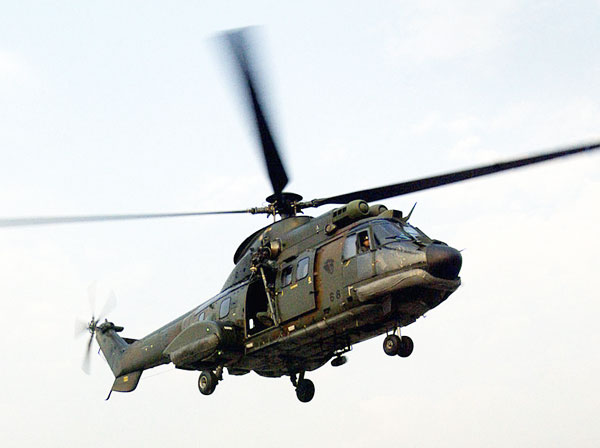
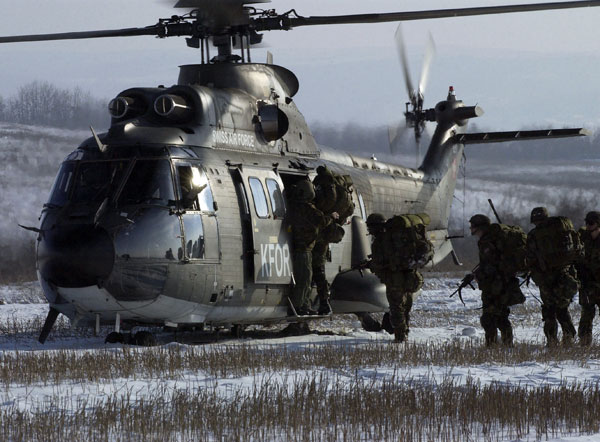
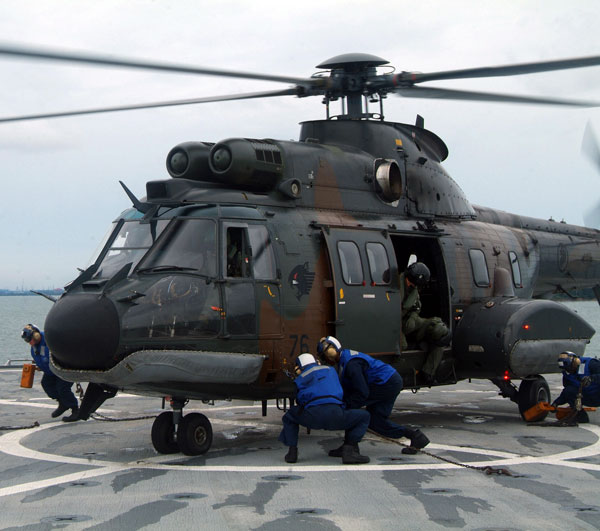
Externally, the Super Puma shares many of its characteristics with the preceding Puma design. Its engines are mounted forward and high atop the fuselage exhausting outwards above the crew cabin. The engines power a four-bladed composite construction main rotor and five-bladed tail rotor mounted to starboard. The pilot and co-pilot are fitted into a glazed forward-mounted canopy with excellent views in all vital directions. Each pilot is afforded an automobile-style door for easy entry and exit. The fuselage sides are dominated by two large cabin doors (one door to a side) with cabin windows. The undercarriage is full retractable and features two main landing gears (single-wheeled) recessing into low-mounted fuselage side sponsons as well as a nose gear fitting two wheels recessing behind and under the cockpit floor. Like the Puma series before it, the Super Puma features an elevated empennage with a single vertical tail fin and a horizontal tailplane jutting out of the portside of the fin.

Like the Puma before it, the Super Puma has been widely accepted into service with dozens of countries around the world. The Super Puma has since been branched into a dozen or so variants beginning with the AS 331 prototype. This produced the AS 332A commercial pre-production models followed by the first commercial production examples designated as the AS 332C. Military pre-production models became the AS 332B followed by the initial militarized forms in the AS 332B1. The AS 332 C1 was a dedicated Search & Rescue (SAR) example equipped with six cabin stretchers and a surface search radar. The AS 332F became a militarized anti-submarine and anti-ship variant while the AS 332F1 was a base navalized Super Puma modified to contend with the rigors of the salty ocean environment.

The AS 332L first flew on October 10th, 1980, appeared as a new civilian production model and sported a lengthened fuselage for an increase in its cabin space and fuel capacity as well as uprated turboshaft engines. Operations of the type were certified in 1983. The AS 332L1 was a similar model featuring an even more lengthened fuselage containing an airliner-type interior and uprated Makila 1A1 turboshaft engines and made its operational appearance in 1986. The AS 332M became a militarized version of the AS 332L model while the AS 332M1 was a similar militarized AS 332L with a lengthened fuselage.

The AS 332L2 "Super Puma Mk II" was a further civilian-based transport development of the type beginning service in 1993 and featuring a long-fuselage for an extra row of seats. These Super Pumas were also given a spheriflex rotor head with EFIS flight instrumentation as well as longer main rotor blades with parabolic tips and a four-axis Automatic Flight-Control System (AFCS). The cockpit was updated to include four large multi-function LCD screens. Passenger seating is between 19 and 24 persons. A 15-passenger VIP model (Super Puma Mk II VIP) is also available complete with galley and toilet.

The AS 332L1 utilized twin Turbomeca Makila 1A1-series turboshaft engines running at 1,742 shaft horsepower each while the AS 332L2 fitted twin Turbomeca 1A2-series turboshaft engines rated at 1,819 shaft horsepower each. Top speed for the AS 332L1 was 278 kilometers-per-hour with a range of 841 kilometers and a service ceiling of 20,000 feet. Rate-of-climb was listed at 1,618 feet-per-minute. Comparatively, the AS 332L2 operated at a top speed of 278 kilometers-per-hour, a range of 831 kilometers, a service ceiling of 23,622 feet and a rate-of-climb of 1,614 feet-per-minute.

The AS 332L has seen extensive production and use during its run. These are now being replaced by the newer AS 332L2 Super Puma MK II series. Bristow Helicopters acquired no fewer than 31 custom AS 332L's for its North Sea-based offshore oil rig work. Customizations included folding cabin seats, life rafts, jettisonable cabin doors, IFR instrumentation, de-icing equipment, baggage compartments and North Sea-related navigational aid equipment. These came under the designation of "Tiger" (sometimes called "Super Tigers").

Indonesian Aerospace (formally IPTN) has license-produced the Super Puma as the NAS 332L1 of which at least 7 were sold to Iran in a 1996 deal.

Beginning in 1990, Super Pumas were separated in their civilian and militarized forms by the latter taking on the production designation of AS 532 "Cougar" (civilian models still retained their AS 332 designations). The Cougar family now consists of the AS 532MC Mk I (note the "Mk I" mark designation was retroactively applied to previous Super Puma forms) as a Search & Rescue (SAR) platform, the AS 532SC Mk I as a short-fuselage anti-submarine variant, the AS 532U2 Mk II as an unarmed base model, the AS 532A2 Mk II as another Search & Rescue form, the AS 532L2 Mk II featuring a lengthened fuselage for extra seating and extended main rotor blades, and the simplified AS 532 "Cougar 100" with fixed landing gear. Militarized Super Puma/Cougar aircraft can display a broad range of armaments including 7.62mm general purpose cabin-door machine guns (on pintle mountings), 7.62mm gun pods, rocket pods, anti-ship missiles and various makes of air-to-surface missiles.

The Eurocopter EC 225 civilian and its EC 725 militarized variant is an improved version of the Puma family line. This system first flew in November of 2000 and features a five-bladed main rotor assembly. It also has a larger cabin with newer Makila 1A4 turboshaft engines featuring FADEC (Full Authority Digital Engine Control), a greater Maximum Take-Off Weight (MTOW) and revised EFIS avionics.

Civilian operators of the Super Puma (in varied forms) includes Australia, Azerbaijan, Brazil, Germany, Finland, Norway, Canada, Hong Kong, Iceland, Japan, Malaysia, Puerto Rico, Morocco and the United Kingdom. Military operators include Argentina, Brazil, Chile, China, Ecuador, Greece, Indonesia, Kuwait, Mexico, Nigeria, Oman, Panama, Saudi Arabia, Singapore, Spain, Switzerland, Sweden, Thailand, Venezuela and Vietnam.

A recent Super Puma-related accident occurred on April 1st, 2009 involving a Bond Offshore Helicopter Super Puma AS 332L2 model. This system crashed into the North Sea killing all 16 personnel on board. The cause of the accident is reportedly related to the main rotor gearbox which had suffered failure in the flight.
Text ©2003-2013 www.MilitaryFactory.com • All Rights Reserved • No Reproduction Permitted
MilitaryFactory.com does NOT sell equipment/weaponry. Material presented throughout this website is for historical and entertainment value and should not to be construed as usable for hardware restoration, maintenance or general operation. Please consult manufacturers for such information. Our disclaimer. Email corrections / Comments to MilitaryFactory at Gmail dot com.
Picture of Aerospatiale / Eurocopter Super Puma / AS 532 Cougar
Pic of the Aerospatiale / Eurocopter Super Puma / AS 532 Cougar
Image of the Aerospatiale / Eurocopter Super Puma / AS 532 Cougar
View All Images (3)

Specifications for the
Aerospatiale / Eurocopter Super Puma / AS 532 Cougar
Multi-role Medium Lift Helicopter


Country of Origin: France
Manufacturer: Aerospatiale / Eurocopter - France
Initial Year of Service: 1982
Production: 540


Focus Model: Eurocopter AS 532U2 Cougar Mk II
Crew: 3 + 19


Length: 51.02ft (15.55m)
Width: 60.01ft (18.29m)
Height: 16.11ft (4.91m)
Weight (Empty): 10,902lbs (4,945kg)
Weight (MTOW): 21,493lbs (9,749kg)


Powerplant: 2 x Turbomeca Makila 1A2 turboshaft engines generating 1,845shp while driving a four-blade main rotor and tail rotor.


Maximum Speed: 170mph (273kmh; 147kts)
Maximum Range: 494miles (795km)
Service Ceiling: 13,448ft (4,099m; 2.5miles)
Rate-of-Climb: 1,260 feet per minute (384m/min)


Hardpoints: 2
Armament Suite:
Mission-Specific / Operator-Specific optional armament can include any of the following:

7.62mm Gun Pods
Rocket Pods
AM 39 Exocet Anti-Ship Missiles
Air-to-Suface Missiles (Various Makes)
7.62mm Cabin Door Machine Guns on Pintle Mounts


Variants:
SA 330 "Puma" - Initial Puma Series Helicopter on which the Super Puma series is based on.


AS 331 - Super Puma Prototype; stretched fuselage; new engines consisting of Makila turboshafts.

AS 332 "Super Puma" - Base Series Designation;

AS 332A - Pre-Production Commercial Models

AS 332B - Pre-Production Military Models

AS 332B1 - Initial Military Production Model Designation

AS 332C - Initial Commercial Production Model Designation

AS 332C1 - Dedicated Search and Rescue Platform; fitted with search radar system and six medical stretchers.

AS 332F - Anti-Submarine / Anti-Ship Version

AS 332F1 - Dedicated Navalized Super Puma

AS 332L - Commercial Model fitted with new engines; lengthened fuselage; increased fuel capacity; enlarged cabin area; based on militarized AS 332M.

AS 332L1 - Commercial Model; lengthened fuselage; revised cabin interior.

AS 332L2 "Super Puma" Mk II - Commercial Model; EFIS flight instrumentation; lengthened fuselage; spheriflex rotor heads; lengthened main rotor blades with parabolic tips.

AS 332L2 "Super Puma" Mk II VIP - Fifteen passenger VIP transport fitted with galley and toilet.

As 332L2 "Super Puma" Mk III - Proposed offshore/oil rig support model with 25% more cabin space.

AS 332M - Military Model based on the AS 332L; fitted with uprated Makila 1A1 series turboshaft engines.

AS 332M1 - Military Model; lengthened fuselage

NAS 332L1 - Indonesian Aerospace/IPTN license-production Super Puma; 7 examples sold to Iran.

AS 532 "Cougar" Mk I - Redesignated militarized Super Pumas by Eurocopter from 1990 onwards.

AS 532MC "Cougar" Mk I - Search and Rescue Variant; short fuselage model series.

AS 532SC "Cougar" Mk I - Short fuselage model series; anti-submarine variant.

AS 532U2 "Cougar" Mk II - Unarmed Cougar Model.

AS 532A2 "Cougar" Mk II - Search and Rescue Model.

AS 532L2 "Cougar" Mk II - Stretched fuselage; extra seating; extended main rotor blades.

AS 532 "Cougar 100" - Fixed landing gear; simplifications added throughout.

EC 725 - Larger cabin; five-blade main rotor system; fitted with Makila 1A4 turboshaft engines featuring FADEC; increased take-off weight; improved EFIS avionics suite.

EC 225 - Civil Variant based on the militarized EC 725 model.


Operators:
Argentina; Australia; Azerbaijan; Brazil; Cameroon; Canada; Chile; China; Ecuador; France; Germany; Greece; Finland; Iceland; Indonesia; Iran; Japan; Jordan; Kuwait; Malaysia; Mexico; Morocco; Nepal; Netherlands; Nigeria; Norway; Oman; Panama; Puerto Rico; Qatar; Saudi Arabia; Singapore; South Korea; Spain; Sweden; Switzerland; Sweden; Thailand; Togo; Turkey; UAE; United Kingdom; Venezuela; Vietnam

ALL AIRCRAFT CATEGORIES

BY DECADE:


1900 to 1909
1910 to 1919
1920 to 1929
1930 to 1939
1940 to 1949
1950 to 1959
1960 to 1969
1970 to 1979
1980 to 1989
1990 to 1999
2000 to 2009
2010 to 2019
2020 to 2029
VIEW ALL
Compare Aircraft


BY TYPE:


Anti-Submarine Warfare (ASW)
Attack Helicopters
Bomber Aircraft
Medium Bombers
Heavy Bombers
Close-Air Support (CAS)
Commercial Aircraft
Dive Bombers
Electronic Warfare Aircraft (EWA)
Experimental / X-Planes
Fighter Aircraft
Floatplane Aircraft
Flying Boat Aircraft
Aerial Refueling Tankers
Helicopters (ALL)
Interceptor Aircraft
Multi-Role Aircraft
Navy Carrier Aircraft
Night Fighters
Reconnaissance / Scout
Search & Rescue (SAR)
Scout Helicopters
Special Purpose
Torpedo Bombers
Trainer Aircraft
Transport Aircraft
Transport Helicopters
Unmanned Aerial Vehicles (UAVs)
Unmanned Combat Air Vehicles (UCAVs)


COLLECTIONS:


4th Generation Fighter Aircraft
5th Generation Fighter Aircraft
US X-Planes
Classic US Warbirds
French Military Helicopters
Grumman "Cats"
Howard Hughes Aircraft
Indian Air Force
Israeli Air Force
Libyan Aircraft
Modern Chinese Aircraft
Modern Chinese Fighters
Modern Military Aircraft
Modern North Korean Aircraft
Modern Trainer Aircraft
Modern US Aircraft
Mikoyan Aircraft
Sukhoi Aircraft
Syrian Aircraft
Top 10 Fighter Aircraft of All Time


AIRCRAFT BY CONFLICT:


Arab-Israeli War (1948)
Cuban Missile Crisis (1959-1962)
Falklands War (1982)
Indo-Pak War (1965, 1971)
Iran-Iraq War (1980-1988)
Lebanon War (1982)
Operation Allied Force (1999)
Operation Desert Storm (1991)
Six Day War (1967)
Spanish Civil War (1936)
Soviet-Afghan War (1979-1989)
Yom Kippur War (1973)


MISCELLANEOUS:


Aircraft Cockpits
Aircraft Manufacturers List
Aircraft Production
Aircraft Timeline

WORLD WAR 2:


1939 Aircraft
1940 Aircraft
1941 Aircraft
1942 Aircraft
1943 Aircraft
1944 Aircraft
1945 Aircraft
1946 Aircraft
Australian Aircraft
Battle of Britain Aircraft
Bombers
Four-Engine Bombers
British Aircraft
British Bombers
British Transports
Dive Bombers
Canadian Aircraft
Fighters
Chinese Aircraft
French Aircraft
German Aircraft
German Fighters
German Flying Boats
German Jets
Secret Weapons of the Luftwaffe
Italian Aircraft
Imperial Japanese Aircraft
Imperial Japanese Fighters
Mitsubishi Bombers
Navy Aircraft
Pearl Harbor
Polish Aircraft
Romanian Aircraft
US Aircraft
US Bombers
US Navy Aircraft
Soviet Aircraft
Torpedo Bombers
Trainer Aircraft
Transport Aircraft
Tuskegee Airmen Aircraft
W.A.S.P. Aircraft
WW2 Aircraft Ranked by Speed
VIEW ALL


WORLD WAR 1:


1914 Aircraft
1915 Aircraft
1916 Aircraft
1917 Aircraft
1918 Aircraft
Aircraft Timeline
Austro-Hungarian Aircraft
Bomber Aircraft
British Aircraft
Fighters
Flying Boats
French Aircraft
Imperial German Aircraft
Italian Aircraft
Scout Aircraft
Russian Empire Aircraft
US Aircraft
WW1 Aircraft Ranked by Speed
VIEW ALL


KOREAN WAR:


Australian Aircraft
Korean War Aces
Korean War Jets
North Korean Aircraft
US Military Aircraft
VIEW ALL


VIETNAM WAR:


Helicopters (ALL)
Transport Helicopters
North Vietnam Air Force
US Airpower
VIEW ALL


COLD WAR:


1950s French Aircraft
British V-Bombers
Cold War Bombers
Soviet Aircraft
Soviet Bombers
Soviet Interceptors
Soviet Helicopters
Strategic Air Command
US Aircraft
US Bombers
US Interceptors
VIEW ALL

Site Disclaimer | Privacy Policy | Site Map | MF Origins


©2013 www.MilitaryFactory.com • Content ©2003-2013 MilitaryFactory.com • All Rights Reserved • Site Contact Email: militaryfactory at gmail dot com. The "Military Factory" name and MilitaryFactory.com logo are registered ® trademarks and protected by all applicable domestic and international intellectual property laws.


Top MF Stuff: 2013 Military Pay Scale | Military Ranks | WW2 Weapons | Sniper Rifles | Kts to Mph | WW1 Aircraft | Automatic Rifles | Aircraft Cockpits | Vietnam War Weapons | Main Battle Tanks | Submachine Guns | Shotguns | French Military Victories


Most photographic images appearing on this site are courtesy of the United States Department of Defense and are approved for public use. Other images acquired through the public domain. Digital art work courtesy of Dan Alex. Business Consulting by Kyle Williams. Material presented throughout this website is for historical and entertainment value and should not to be construed as usable for hardware restoration, maintenance or general operation. Please consult manufacturers for such information.


eXTReMe Tracker