|
|
| |
|
Airco DH.9
The planned successor to the DH.4, the DH.9 failed in most respects.
By Staff Writer
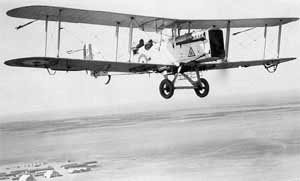
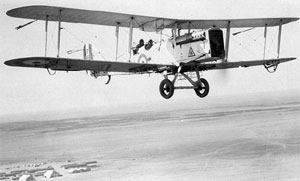
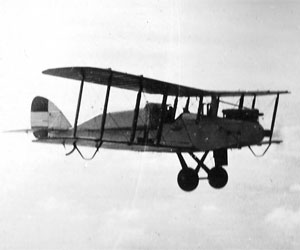
The AirCo / de Havilland DH.9 was a further revision of the DH.4 bomber. Design was accomplished by the de Havilland company with production handled by the Aircraft Manufacturing Company ("AirCo" or "Airco"). The series was first delivered in 1917.
The DH.9 shared a few of the major elements found on the DH.4 including the landing gear, tail section and the wing assemblies. The DH.9 differed from the DH.4 in that it positioned the gunner and pilot closer together and was fitted with a more powerful engine. The new fuselage was also intended to streamline the aircraft and take away stress from the engine. Initial tests revealed that the base DH.9 was simply too underpowered and not much of an upgrade over the DH.4 (which it was meant to replace) thusly the system was redesigned as the DH.9A model. The DH.9A model tried to address performance issues and defensive drawbacks by incorporating a larger wingspan and a forward-firing pilot-manned machine gun and a gun assembly to the rear for the gunner.
Not a spectacular aircraft in any regard, the DH.9 saw a poor service record in World War One with catastrophic losses (most due to mechanical and performance issues than actual enemy fire). Notable deficiencies in the system included a limited service ceiling, fuel consumption issues at altitudes higher than 10,000 feet and engine reliability problems.
If there was one role that the DH.9 proved at least somewhat adequate in was in coastal patrol assignments when hunting down the German U-boats (less chance of running into enemy aircraft or ground fire in this role). Though generally inadequate over most skies, the DH.9 was naturally more successful in poorly defended areas during the course of the war - most notably in the Middle East over Palestine and over Macedonia.
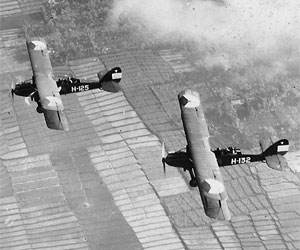
The DH.9 series saw some life after the war in civil transportation world with many countries utilizing it in this role. Final production of the DH.9 extended into 1920. The United States of America produced the DH.9 with the help of the Engineering Division and designated the aircraft the USD-9 (1,415 produced by the US). Incidentaly, an American-produced engine - the 400hp Packard Liberty - would be used to power the DH.9A models.
Text ©2003-2009 www.MilitaryFactory.com • All Rights Reserved •
No Reproduction Without Permission • Corrections / Comments to MilitaryFactory at Gmail dot com
Last Revision: 8/29/2008 • Special Thanks to Piet H.
|
| |
|
|
| |
| Specifications for the Airco DH.9 |
Dimensions: |
Length: 30.41ft (9.27m)
Width:65.35ft (19.92m)
Height: 11.29ft (3.44m)
|
Performance: |
About MACH |
Max Speed: 113mph (182kmh; 98kts)
Rate-of-Climb: 0ft/min (0m/min)
Service Ceiling: 15,518ft (4,730m; 2.9miles)
|
|
Structure: |
Accommodation: 2
Hardpoints: 2
Empty Weight: 2,235lbs (1,014kg)
MTOW: 3,799lbs (1,723kg)
|
Powerplant: |
| Engine(s): 1 x Armstrong Siddeley Puma water-cooled inline piston engine generating 230hp. |
|
Armament Suite: |
1 x .303 Vickers machine gun (forward facing)
1 OR 2 x .303 Lewis machine gun(s) in rear on scarff ring position.
External bomb loadout capacity of up to 460lbs (209 kg).
|
|
|
| Pictures of the Airco DH.9 |
|
| Special Aircraft Collections |
|
|
| Recent Military Aircraft Additions |
|
| Contacting MilitaryFactory.com |
| We can only get better if you tell us how. You can contact MilitaryFactory.com at MilitaryFactory at gmail dot com (replace "at" with "@" and "dot with ".") with any questions, comments or corrections. We also accept related military imagery that you approve for us to use on our website. Keep in mind, however, that due to volume, we may not directly respond to your inquiry. Please add us to your list of non-blocked recipients! |
|
|

Aircraft Quick Profile |
 |
| 1917 |
Designation: Airco DH.9
Classification Type: Biplane Light Bomber
Contractor: Airco - United Kingdom
Country of Origin: United Kingdom
Production Total: Not Available |
 |
|
Operators: Belgium, Afghanistan, Australia, Canada, Eire, Greece, Hejaz, Latvia, Netherlands, New Zealand, Peru, Romania, Spain, Switzerland, the United Kingdom and the United States of America.
|
|
|
|
| Variants |
DH.4 - Original Model on which DH.9 was revised from.
DH.9 - Base production model with decreased area between pilot and gunner positions of which over 3,000 produced.
DH.9A - Improved powerplant
DH.9B - Civilian Conversion Model to accommodate pilot and two passengers.
DH.9C - Civilian Conversion Model to accommodate pilot and three passengers.
DH.9J - Updated powerplant (Armstrong Siddeley Jaguar III radial piston engine generating 385-hp); Pilot trainer.
DH.9J M'pala I - Conversion for South Africa fitted with Bristol Jupiter VI radial piston engine generating 450hp.
M'pala II - Conversion model for South Africa fitted with Bristol Jupiter VIII radial piston engine generating 480hp.
Mantis - Conversion model for South Africa fitted with Wolseley Viper piston engine generating 200hp.
|
|
|