Military Factory
Military Pay Chart
Global Firepower
Military Industrial Complex
Second World War
Home
Military Pay Scale
Military Ranks
Small Arms
Aircraft
Land Systems
Navy
Education
Military Factory Facebook Logo
flag of Soviet Union

Kamov Ka-50 (Black Shark) / (Hokum) Attack Helicopter (1995)

Authored By Staff Writer | Last Updated: 7/16/2010

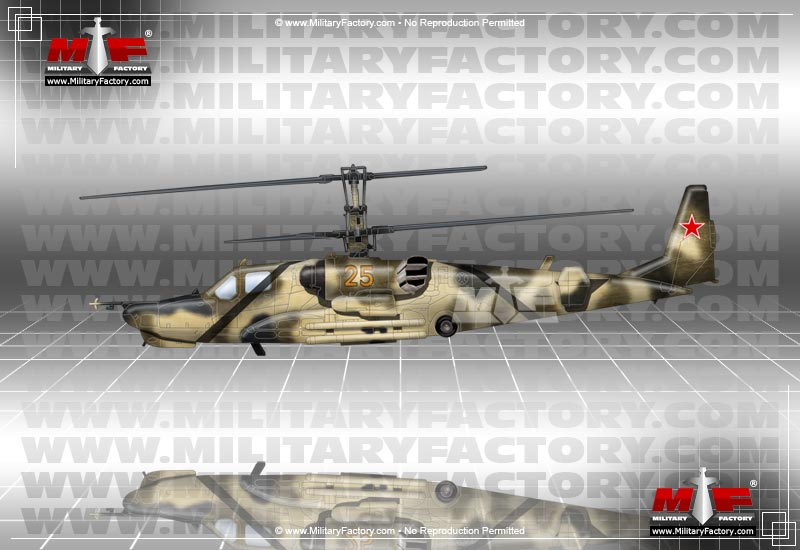
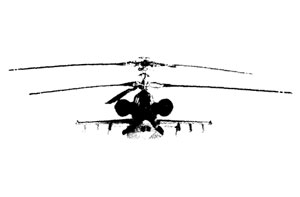
The Ka-50 Hokum features the Kamov trademark counter-rotating blades.

The Kamov Ka-50 Chernaya Akula (or "Black Shark" and Codenamed "Hokum" by NATO) series of attack helicopter was developed in the latter years of the Cold War and did not enter operational service with Russian military forces until 1995. It features many interesting and unique design elements for a weapon of this classification and - at least on paper - would seem to give all other modern attack helicopters and ground armor units a run for their money thanks to the inherent capabilities in the distinct design. The need for a new Russian attack helicopter was developed after hard-earned lessons in the Soviet-Afghanistan Conflict

Development of the Ka-50 began in 1977, producing the V.80 prototype. The V-80 went airborne on July 27th, 1982 and evolved to become the V-80Sh-1 pre-production model. The Ka-50 squared off against the Mil Mi-28 "Havoc" - a conventional two-seat attack helicopter in competitive trials and was selected ahead of the Mil product in 1986. Funding delayed production for a time and renewed trials in 1994 did the Ka-50 project no better. The new trials brought both helicopter types online for production - first the Ka-50 and then the Mi-28 - though both production requirements were severely limited. The Ka-50 entered service in 1995 and has produced about 32 examples. Comparatively, the Mi-28 was introduced into service in 1996 and has seen only 43 built for the Russian Air Force while Venezuela has ordered a further 14.

Black Shark Walk-Around

From a design standpoint, the Ka-50 is very unconventional. The cockpit is situated forward in the fuselage with the engines just aft and t either side of the cockpit. Wings are fitted just under these powerplants and sport four hardpoints for a variety of ordnance options. Wingtip bulges are visible and field the aircraft's defensive anti-missile suite in the form of chaff and flare dispensers. Armor is such that all major components, systems and pilot are protected from weapon calibers ranging up to 20mm and 23mm. IR-suppressed exhausts and self-sealing fuel tanks assist the Black Shark in surviving the modern battlefield, important to consider when this type of aircraft is required to operate at low altitudes in hot zones. Engines are fitted high against the fuselage in an effort to keep the helicopter's critical powerplant system as far away from enemy ground fire as possible. The undercarriage - consisting of a tricycle-wheeled landing gear system - is fully retractable and promotes a "low to the ground" appearance when the helicopter is at rest. Construction of the Ka-50 involves more than 35% composite materials.

The most distinct feature of the Kamov Ka-50 is something of a Kamov-brand identifier - the twin contra-rotating co-axial main rotors. In this type of arrangement, the Ka-50 negates the need to balance the inherent power of the main rotor with a tail rotor unit common on most any other helicopter. In the Black Shark's case, the pair of counter-rotating main rotors (that is, each main rotor spins in the opposite direction of one another) balance the torque affect of one another out making for a stable and relatively responsive platform. It is a much noted fact that the loss of a tail rotor assembly to any modern helicopter more often than not spells certain doom for the system and crew alike. The Ka-50 makes use its main rotor assemblies to negate the possibility that the Black Shark can be lost through a direct hit on its tail section. As a result, combat survivability is greatly increased though at the expense of a more complicated set up.

In addition to combat factors, the deletion of the tail rotor assembly has a direct increase to the overall top speed, making it one of the fastest - if not THE fastest - attack helicopters in service. With power derived from the twin Klimov TV3-117VK turboshaft engines of 2,226 horsepower each, none of this output needs to be diverted to a tail rotor assembly and can instead be optimized to the centrally-located twin main rotors instead. Performance specifications include a top speed of 242 miles per hour (168 cruise speed), a range of 720 miles, a service ceiling of up to 18,000 feet and a rate-of-climb nearing 1,870 feet per minute.

Another noticeable design element present in the Ka-50 is the use of a single crewmember to command all of the available systems of the Black Shark. Though most contemporary attack helicopters utilize a dedicated pilot and gunner to split the tasks as related to combat, the Ka-50 provides the pilot a full suite of automated systems to keep the bird aloft and actively hunting. With attention given to this unique facet of the Black Shark's design, it remains to be seen whether the arrangement is actually a viable one considering the amount of instruments and systems the pilot must monitor and react to on any given sortie - particularly under intense combat conditions. In any case, the limitation of a single crewmember means the design also saves on weight that can be allocated to more vital components of the Ka-50 including armor and weapons.

Battlefield survivability of the Ka-50 is given another major boost in the way of an ejection system in the K-37 ejection seat. Though quite uncommon in attack helicopters of today, the Black Shark features a complicated but life-saving process that can potentially save the pilots life. The system ejection process begins by having the twin main rotors ejected via controlled explosives followed by the ejection of the pilot a short moment later. This in itself sets the Black Shark apart from any other attack helicopter in this category and adds another thoughtful element to the survival design philosophy.

Weapons Suite

As with any attack helicopter, armament is the true heart of the design. Available munitions include the latest in Russian anti-tank air-to-surface missiles and anti-aircraft air-to-air missiles mounted on four external hardpoints on port and starboard wingstubs. The main weapon of the Ka-50 in the anti-tank hunting role is the tube-launched AT-16 Vikhr-M laser-guided air-to-surface anti-tank missile system. The missile has an operational range of up nearly five miles, offers armor penetration and can reach speeds of Mach 1.8. The Ka-50, and its two-seat variant, the Ka-52, as well as the Su-25T "Frogfoot" are all cleared for using the missile system. Additionally, the Ka-50 is slated to carry traditional gunship weaponry including munition-dispensing rocket pods featuring various warhead types. The Black Shark can also carry external fuel pods for increased range, gun pods and drop bombs as required.

The base armament of the Ka-50 series is a single 30mm Shipunov 2A42 cannon cleared for firing Armor-Piercing (AP) or High-Explosive Fragmentation (HE-FRAG) ammunition. Though conventional attack helicopters field their cannon in a stand-alone, fully-traversable powered mounting under the fuselage chin, the Black Shark fits the cannon along the starboard side of the fuselage just aft and below the cockpit. This offers some benefits to the design in that the weapon system is placed closer to the helicopters center of gravity for optimal balance. The semi-rigid installation produces less recoil and makes for a more accurate weapons delivery. An obvious drawback to the layout is that the entire helicopter must then be turned towards the direction of the target but integration with the helicopter's weapon system reportedly allows for response times to be as quick as those found on the Hughes Apache 30mm chin-mounted chain gun system.

Production

After evaluation, the Ka-50 was selected for service in the Russian Air Force while the Mil Mi-28 was selected years later - both facing limited production totals. The system combined a great amount of armor protection, survivability, firepower and performance capabilities when compared to its competitors and was destined to become a major player in the Cold War world. With the fall of the Soviet Empire, the future of the Ka-50 was put into jeopardy until a resurgence in military funding kicked the Ka-50 production lines back into full service. Though only some 30 or so total examples were known to have been produced up to this point, it is understood that the Ka-50 will still make up the backbone of the Russian attack helicopter arm for the foreseeable future.

Variants

The Ka-50 has appeared in only a few variants and some developmental types that tried to shore up limitations in the original design. The V-80 represented the original's prototype designation and was followed by two V-80Sh-1 "Shturmovik-1" pre-production models. A night-capable Ka-50 appeared in the form of the Ka-50N and Ka-50Sh types, fitted with FLIR and electro-optic sights attached to either Russian- or French-originated avionics. The Ka-50-2 was to represent three proposed export products based on the Ka-52 "Alligator". The Ka-50-2 "Erdogan" was in competition for Turkish sale and represented a joint Kamov/Israeli attempt to fit Israel avionics and "glass" cockpit into a tandem twin-seat cockpit. The Erdogan eventually lost out to the Bell Helicopter-Textron AH-1Z "King Cobra".

The Ka-52 Alligator

The Ka-52 "Alligator" was a revised Ka-50 design with twin-seating in a side-by-side cockpit arrangement and is classified as an all-weather, day/night capable attack system. Developed in 1994, the Ka-52 sports a redesigned forward fuselage to accommodate space for the wider two-seat cockpit and a radome fitted under the new nose cone though it retains up to 85% of the Ka-50 airframe. This new addition helps the Ka-52 in being able to track and allocate targets to supporting Ka-50 units. Other external defining features of the type include a pair of turreted day/night FLIR and TV sighting systems - one fitted under the nose and the other above the cockpit - Thales-based avionics, helmet-mounted sights, IR sensor, laser rangefinder and a mast-mounted radar antenna. Despite the addition of radar, the addition of the second crewmember and an all-new designation, the Ka-52 still retains all of the weapons capabilities and explosive lethality of the base Ka-50. First flight of the Alligator came on June 25th, 1997.

Fool Me Once...

It should be noted that originally - in an attempt to fool Western observers - the Ka-50 had a second cockpit "painted" onto the fuselage. This worked well as the Ka-50 was reported by the West to be of a two-seat tandem cockpit design, with a pilot seated in the rear in a raised position over the gunner in front. Though a two-seat version of the Ka-50 ultimately was revealed, this featured side-by-side seating instead.

First Blood

The Ka-50 saw limited operational combat for the first time in December 2000, engaging ground forces in Chechnya and proved a capable attack system over the rugged and forested mountain terrain.

The Future of the Ka-50

India is considering the purchase of several Kamov Ka-50 systems as of 2008 while also entertaining proposals from other systems including the Mil Mi-28 and the Eurocopter Tiger. The Russian Air Force operates some 15 Ka-50s and 10 Ka-52s in its inventory. It is expected that any further new-build aircraft will be of the more-capable Ka-52 model.

A dedicated and highly technical flight simulator of the Kamov Ka-50 Black Shark was developed by Eagle Dynamics and has received critical acclaim for its precise modeling of the twin-rotor beast.
Text ©2003-2013 www.MilitaryFactory.com • All Rights Reserved • No Reproduction Permitted
MilitaryFactory.com does NOT sell equipment/weaponry. Material presented throughout this website is for historical and entertainment value and should not to be construed as usable for hardware restoration, maintenance or general operation. Please consult manufacturers for such information. Our disclaimer. Email corrections / Comments to MilitaryFactory at Gmail dot com.
Picture of Kamov Ka-50 (Black Shark) / (Hokum)
Pic of the Kamov Ka-50 (Black Shark) / (Hokum)
Image of the Kamov Ka-50 (Black Shark) / (Hokum)
View All Images (4)

Specifications for the
Kamov Ka-50 (Black Shark) / (Hokum)
Attack Helicopter


Country of Origin: Soviet Union
Manufacturer: Kamov - Soviet Union
Initial Year of Service: 1995
Production: 32


Focus Model: Kamov Ka-50 (Black Shark) / (Hokum)
Crew: 1


Length: 0.00ft (0m)
Width: 47.57ft (14.50m)
Height: 16.17ft (4.93m)
Weight (Empty): 0lbs (0kg)
Weight (MTOW): 23,810lbs (10,800kg)


Powerplant: 2 x Klimov TV3-117VK turboshaft engines generating 2,226shp and driving two three-blade counter-rotating co-axial main rotors.


Maximum Speed: 193mph (310kmh; 167kts)
Maximum Range: 323miles (520km)
Service Ceiling: 13,123ft (4,000m; 2.5miles)
Rate-of-Climb: 1,575 feet per minute (480m/min)


Hardpoints: 4
Armament Suite:
STANDARD:
1 x 30mm Shipunov 2A42 cannon fitted along the starboard side of the fuselage.

OPTIONAL:
Mission-specific armament can include a combination of the following across four underwing hardpoints:

12 x AT-16 Vikhr-M Laser-Guided Air-to-Surface Anti-Tank Missiles
12 x AS-12 "Kegler" air-to-surface missiles
4 x Vympel R-73 (AA-11 "Archer") short-range air-to-air missiles
4 x S-8 HE / Munitions-Dispensing Rocket Pods (80 total rockets)
4 x S-13 Munitions-Dispensing Rocket Pods
4 x 23mm Gun Pods
4 x 1,100lb bombs
Fuel Tanks


Variants:
V-80 - Prototype Model Designation


V-80Sh-1 - Pre-Production Prototype; two examples produced; "Shturmovik-1" designation for "single seat assaulter".

Ka-50 "Black Shark" - Production Model Designation based on the V-80Sh-1 pre-production models.

Ka-50N "Nochnoy" - Developmental Night-Capable Variant with FLIR.

Ka-50Sh "Shar" - Developmental Night-Capable Variant with FLIR.

Ka-50-2 - Proposed Export Designation

Ka-50-2 "Erdogan" - Proposed Turkish attack helicopter requirement; developed jointly by Kamov and Israeli Aircraft Industries (IAI); Israeli avionics and "glass" tandem twin-seat; never purchased or produced.

Ka-52 "Alligator" - All weather, day/night two-seat side-by-side cockpit.


Operators:
Russia

ALL AIRCRAFT CATEGORIES

BY DECADE:


1900 to 1909
1910 to 1919
1920 to 1929
1930 to 1939
1940 to 1949
1950 to 1959
1960 to 1969
1970 to 1979
1980 to 1989
1990 to 1999
2000 to 2009
2010 to 2019
2020 to 2029
VIEW ALL
Compare Aircraft


BY TYPE:


Anti-Submarine Warfare (ASW)
Attack Helicopters
Bomber Aircraft
Medium Bombers
Heavy Bombers
Close-Air Support (CAS)
Commercial Aircraft
Dive Bombers
Electronic Warfare Aircraft (EWA)
Experimental / X-Planes
Fighter Aircraft
Floatplane Aircraft
Flying Boat Aircraft
Aerial Refueling Tankers
Helicopters (ALL)
Interceptor Aircraft
Multi-Role Aircraft
Navy Carrier Aircraft
Night Fighters
Reconnaissance / Scout
Search & Rescue (SAR)
Scout Helicopters
Special Purpose
Torpedo Bombers
Trainer Aircraft
Transport Aircraft
Transport Helicopters
Unmanned Aerial Vehicles (UAVs)
Unmanned Combat Air Vehicles (UCAVs)


COLLECTIONS:


4th Generation Fighter Aircraft
5th Generation Fighter Aircraft
US X-Planes
Classic US Warbirds
French Military Helicopters
Grumman "Cats"
Howard Hughes Aircraft
Indian Air Force
Israeli Air Force
Libyan Aircraft
Modern Chinese Aircraft
Modern Chinese Fighters
Modern Military Aircraft
Modern North Korean Aircraft
Modern Trainer Aircraft
Modern US Aircraft
Mikoyan Aircraft
Sukhoi Aircraft
Syrian Aircraft
Top 10 Fighter Aircraft of All Time


AIRCRAFT BY CONFLICT:


Arab-Israeli War (1948)
Cuban Missile Crisis (1959-1962)
Falklands War (1982)
Indo-Pak War (1965, 1971)
Iran-Iraq War (1980-1988)
Lebanon War (1982)
Operation Allied Force (1999)
Operation Desert Storm (1991)
Six Day War (1967)
Spanish Civil War (1936)
Soviet-Afghan War (1979-1989)
Yom Kippur War (1973)


MISCELLANEOUS:


Aircraft Cockpits
Aircraft Manufacturers List
Aircraft Production
Aircraft Timeline

WORLD WAR 2:


1939 Aircraft
1940 Aircraft
1941 Aircraft
1942 Aircraft
1943 Aircraft
1944 Aircraft
1945 Aircraft
1946 Aircraft
Australian Aircraft
Battle of Britain Aircraft
Bombers
Four-Engine Bombers
British Aircraft
British Bombers
British Transports
Dive Bombers
Canadian Aircraft
Fighters
Chinese Aircraft
French Aircraft
German Aircraft
German Fighters
German Flying Boats
German Jets
Secret Weapons of the Luftwaffe
Italian Aircraft
Imperial Japanese Aircraft
Imperial Japanese Fighters
Mitsubishi Bombers
Navy Aircraft
Pearl Harbor
Polish Aircraft
Romanian Aircraft
US Aircraft
US Bombers
US Navy Aircraft
Soviet Aircraft
Torpedo Bombers
Trainer Aircraft
Transport Aircraft
Tuskegee Airmen Aircraft
W.A.S.P. Aircraft
WW2 Aircraft Ranked by Speed
VIEW ALL


WORLD WAR 1:


1914 Aircraft
1915 Aircraft
1916 Aircraft
1917 Aircraft
1918 Aircraft
Aircraft Timeline
Austro-Hungarian Aircraft
Bomber Aircraft
British Aircraft
Fighters
Flying Boats
French Aircraft
Imperial German Aircraft
Italian Aircraft
Scout Aircraft
Russian Empire Aircraft
US Aircraft
WW1 Aircraft Ranked by Speed
VIEW ALL


KOREAN WAR:


Australian Aircraft
Korean War Aces
Korean War Jets
North Korean Aircraft
US Military Aircraft
VIEW ALL


VIETNAM WAR:


Helicopters (ALL)
Transport Helicopters
North Vietnam Air Force
US Airpower
VIEW ALL


COLD WAR:


1950s French Aircraft
British V-Bombers
Cold War Bombers
Soviet Aircraft
Soviet Bombers
Soviet Interceptors
Soviet Helicopters
Strategic Air Command
US Aircraft
US Bombers
US Interceptors
VIEW ALL

Site Disclaimer | Privacy Policy | Site Map | MF Origins


©2013 www.MilitaryFactory.com • Content ©2003-2013 MilitaryFactory.com • All Rights Reserved • Site Contact Email: militaryfactory at gmail dot com. The "Military Factory" name and MilitaryFactory.com logo are registered ® trademarks and protected by all applicable domestic and international intellectual property laws.


Top MF Stuff: 2013 Military Pay Scale | Military Ranks | WW2 Weapons | Sniper Rifles | Kts to Mph | WW1 Aircraft | Automatic Rifles | Aircraft Cockpits | Vietnam War Weapons | Main Battle Tanks | Submachine Guns | Shotguns | French Military Victories


Most photographic images appearing on this site are courtesy of the United States Department of Defense and are approved for public use. Other images acquired through the public domain. Digital art work courtesy of Dan Alex. Business Consulting by Kyle Williams. Material presented throughout this website is for historical and entertainment value and should not to be construed as usable for hardware restoration, maintenance or general operation. Please consult manufacturers for such information.


eXTReMe Tracker