Military Factory
Military Pay Chart
Global Firepower
Military Industrial Complex
Second World War
Home
Military Pay Scale
Military Ranks
Small Arms
Aircraft
Land Systems
Navy
Education
Military Factory Facebook Logo
flag of United States

Sikorsky SH-60 Seahawk Multi-Mission Maritime Helicopter (1984)

Authored By Staff Writer | Last Updated: 1/15/2013

The Sikorsky SH-60 Seahawk has proven a capable maritime performer with several of the world's leading navies.

Find a School Near You
Follow Military Factory on Facebook:
Trending on Military Factory:
Recent Articles:
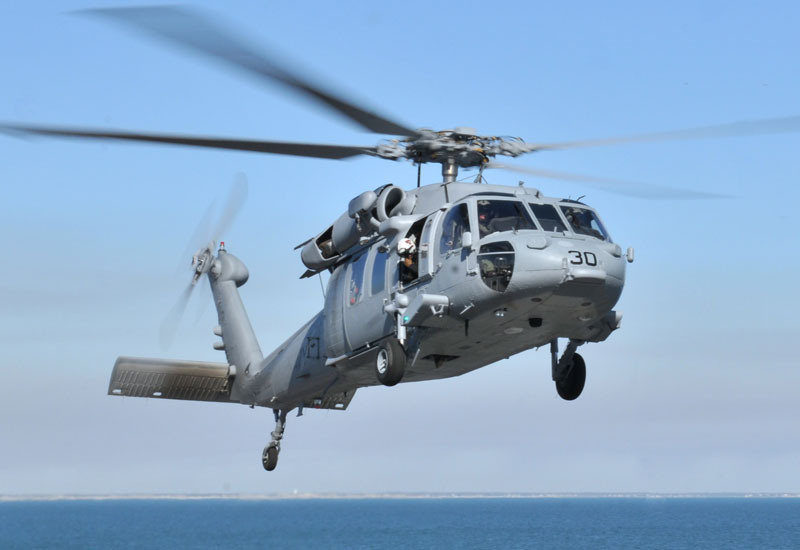
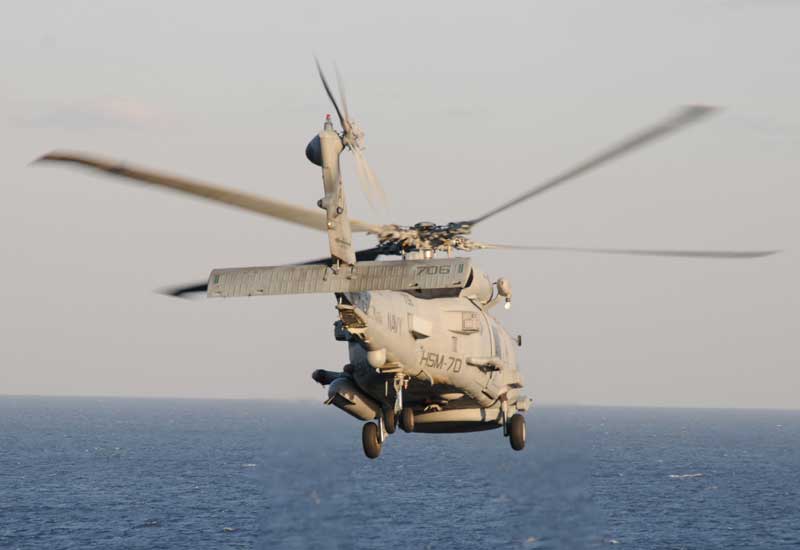
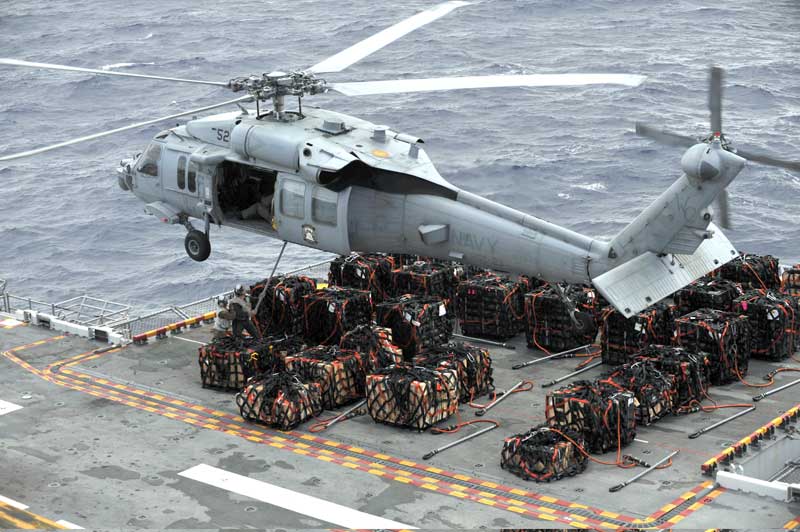
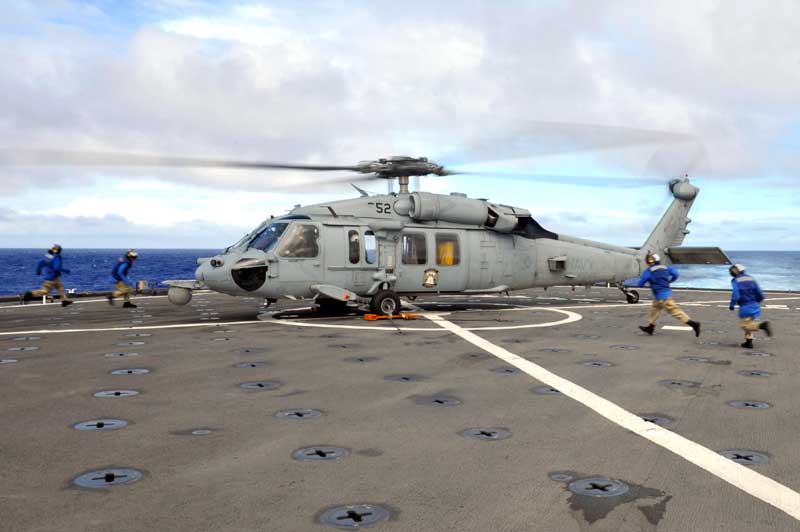
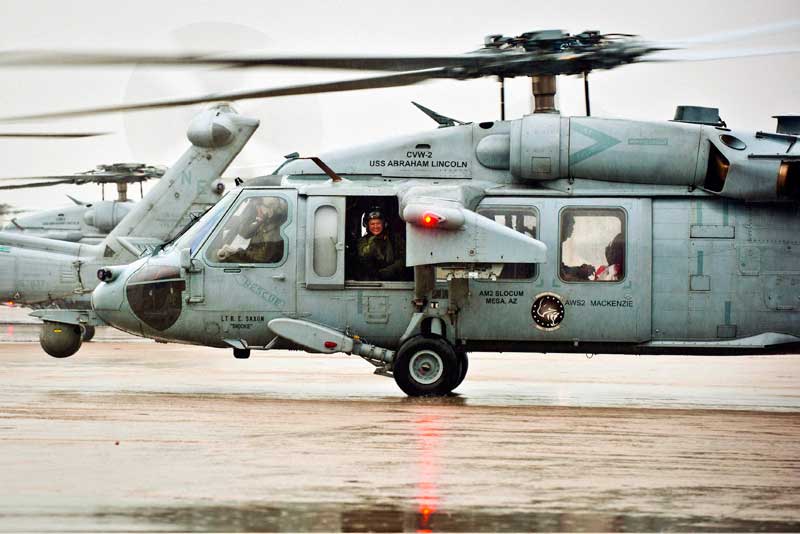
The Sikorsky SH-60 "Seahawk" is the navalized derivative of the ubiquitous land-based UH-60 "Black Hawk" series transport helicopters. Origins of the UH-60 go as far back as the 1970s to which the helicopter recorded its first flight on November 29th, 1974 and formally entered service with the United States Army in 1979. To date, some 4,000 units have been delivered and serving across multiple military forces around the globe. The UH-60 was then adopted by the United States Navy in a navalized form with a first flight recorded on December 12th, 1979. Formal introduction into service occurred in 1984 with frontline service ongoing as of this writing (2013). The SH-60 remains the primary helicopter of the United States Navy.

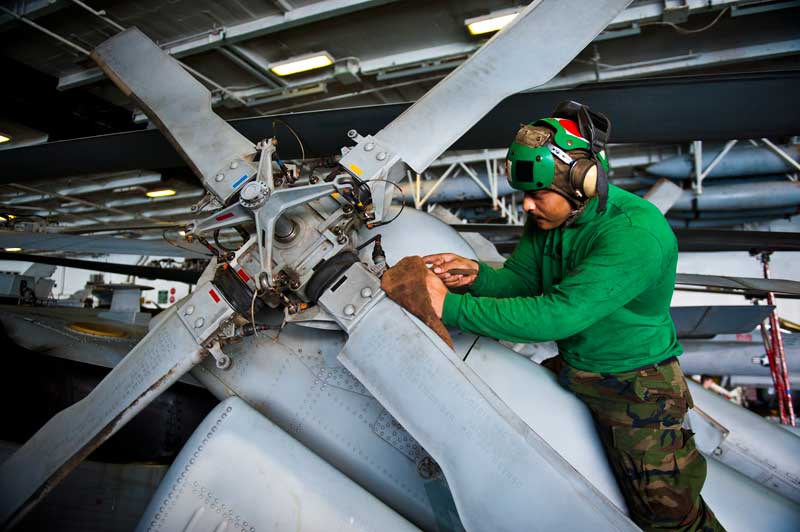
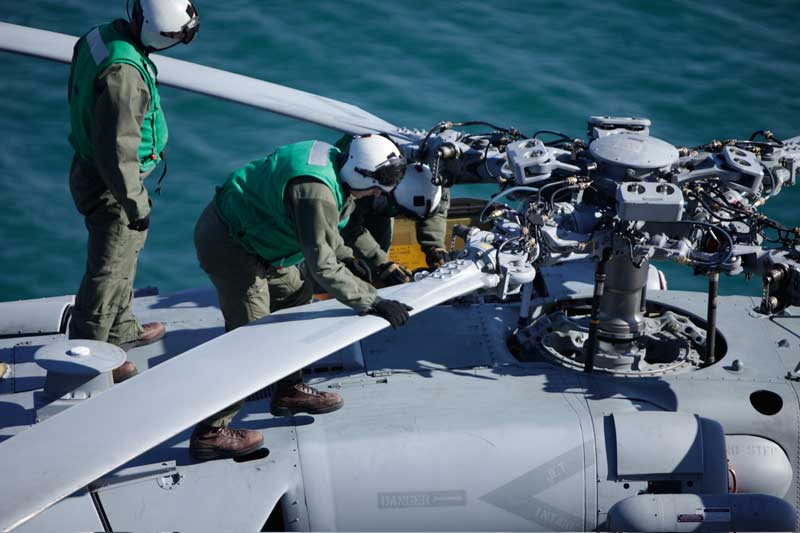
While originating from the land-based UH-60, the SH-60 features over-water qualities that are required of maritime aircraft. This includes folding appendages (tail, horizontal stabilizer, collapsing main rotor) for onboard stowage, strengthened understructures for the abuses of shipborne landings and specialized coatings to protect against the corrosive effects of the salty sea air. Prior to the 1970s, the US Navy relied on their trusty Kaman SH-2 Seasprite multi-mission helicopters aboard aircraft carriers and accompanying surface ships. However, Seasprites were introduced in the late 1950s with applicable technology of the time and were soon superseded by more modern developments. As such, the situation forced the US Navy to modernize its rotary-wing fleet which included following the US Army's lead by selecting Sikorsky Model S-70 helicopter as its primary mount under the designation of SH-60 "Seahawk". The initial production versions were recognized as "SH-60B" in line with the Sikorsky S-70B model design.

The selection of the S-70 allowed for a high degree of commonality in parts between the US Army UH-60 and the US Navy SH-60 - up to 80% was common across both platforms which improved logistics and repair times and costs. The overall design appearance of the US Navy helicopter remained largely the same with its twin turboshaft layout, four-bladed main rotor and fixed wheeled undercarriage. The two-man cockpit was held well-forward in the design with good visibility (the instrument panel takes up a good deal of height) while the passenger/cargo cabin was set to the rear under the engine installations. If the S-70 design proved anything it was in its multi-mission capabilities which have since endeared the type to other world powers beyond the United States.

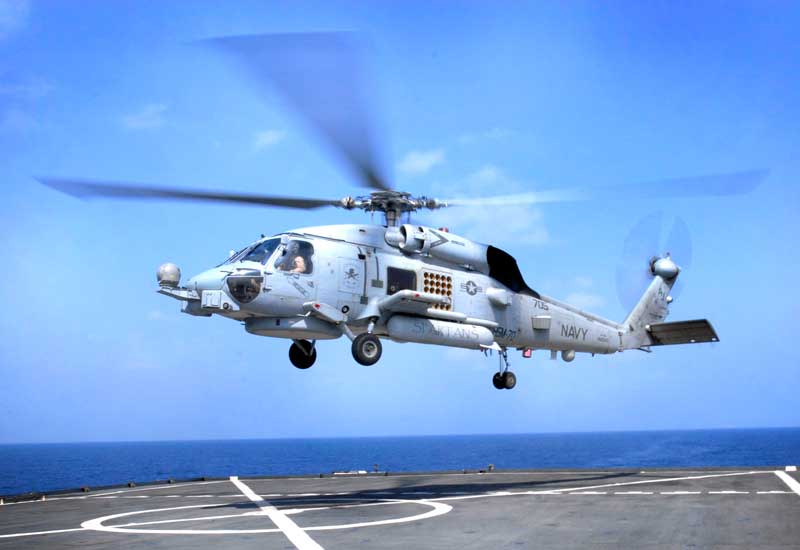
Unlike the Army's UH-60, the Navy's SH-60 did away with the left side sliding access door for cabin entry/exit (replaced by solid fuselage wall). Additionally, the aircraft mounted uprated turboshaft engines for more power as well as a electrically-collapsing main rotor blade (all blades collapse to the rear) assembly for a more compact footprint aboard ships. The horizontal stabilizers were also designed to fold for this same reason while the vertical tail unit swung over portside just aft of the tailwheel. The tailwheel structure was relocated forward to reduce the surface contact area aboard space-strapped ships and allow the tail to hinge. Optional wingstubs could be added to either side of the fuselage for the carrying of valuable mission equipment and weaponry.

Key to the existence of the SH-60 is support for the LAMPS (Light Airborne Multi-Purpose System) utilized by the US Navy. LAMPS is an advanced avionics package that was developed to counter enemy submarines while also supporting search and rescue (SAR) sorties. The SH-2 Seasprite utilized the original LAMPS Mk I system while the Seahawk was slated to use the more modern LAMPS Mk III series (an Mk II model was eventually abandoned).

The US Navy first contracted for five YSH-60B prototypes outfitted to specifications (including LAMPS III). After a first flight in late 1979, testing continued before production was ordered, resulting in first-batch unit availability to USN elements by 1984. Operational service officially began the following year as SH-60Bs were stationed across all manner of US Navy surface ships. Since their adoption, SH-60Bs have given stellar shipborne service.

The Seahawk is stocked with the APS-124 series search radar system as well as the ALQ-142 ESM. A 25-tube sonobouy launcher is mounted near the left main landing gear structure. The aircraft is generally crewed by three to four primary personnel including two pilots and a missions specialist (up to eleven passengers can fit in the cabin depending on the production model in question). Beyond its sophisticated array of sensory equipment, the Seahawk can be outfitted with 3 x Mark 46/54 series torpedoes, AGM-114 Hellfire air-to-surface missiles or AGM-119 Penguin anti-ship missiles to engage enemy vessels. Point defense is provided by an optional general purpose machine gun or minigun to either side of the fuselage as required. An Mk 44 Mod 0 cannon can also be installed and used in the mine clearing role.

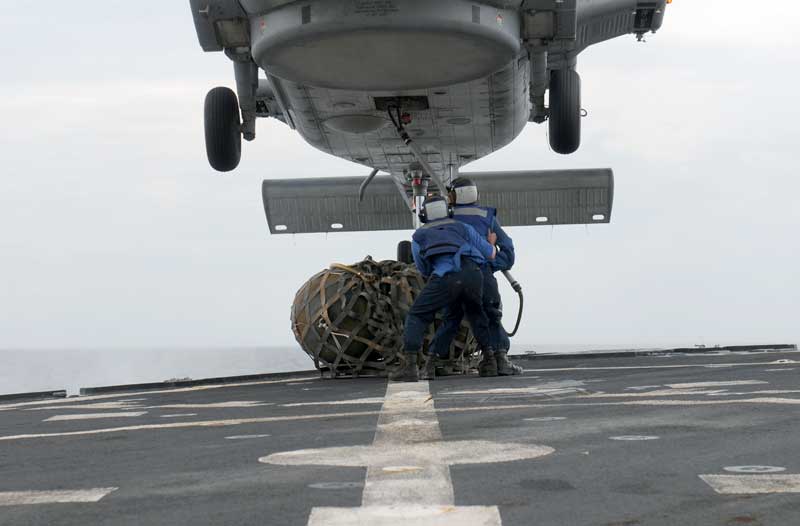
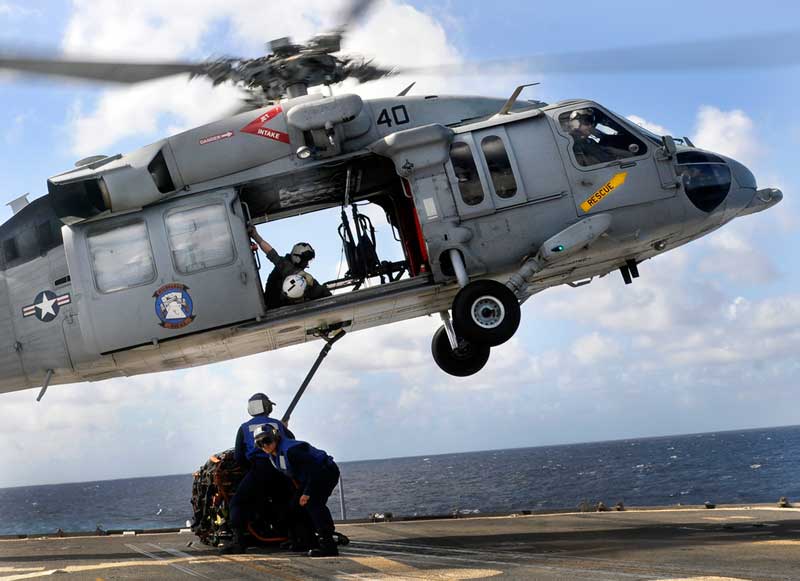
The Seahawk is powered by 2 x General Electric T700-GE-401C turboshaft engines delivering 1,890 shaft horsepower each coupled to a four-bladed main rotor and four-bladed tail rotor. The tail rotor is offset to the starboard side of the aircraft and used to stabilize forward flight (countering the torque of the main rotor blades). This arrangement provides a top speed of 170 miles per hour with a range out to 520 miles and service ceiling of 12,000 feet. A rate-of-climb of 1,650 feet per minute is reported. Depending on the production model, the Seahawk is also cleared to haul up to 9,000lbs of cargo under its fuselage (via sling load) as well as 4,000lbs in its cabin.

All told, the Seahawk can be called upon to undertake a variety of critical missions including at-sea resupply, search and rescue of downed pilots and sailors, humanitarian relief, special forces insertion/extraction, MEDEVAC, cargo hauling, submarine/surface warship hunting and mine warfare. The type has also been developed into a series of related, though mission-specific, marks as follows:

The SH-60F "Oceanhawk" is a dedicated aircraft carrier-based anti-submarine warfare platform of which 81 have been produced. The HH-60H "Rescue Hawk", as its name suggests, is utilized in the search and rescue role at sea, some 42 having been built. The HH-60 "Jayhawk" is an HH-60H-based version developed to specific US Coast Guard standards. The MH-60R "Seahawk" is a a modernized version of the SH-60B complete with the "LAMPS Mk III Block II Upgrade" and support for improved missiles and torpedoes. The MH-60S "Knighthawk" is a cargo-hauling platform developed to replace the aging Boeing CH-46 Sea Knight tandem rotor transports.

The CH-60E was a proposed USMC troop transport that fell to naught. Developmental prototypes of mentioned production marks have included the YSH-60R (becoming the MH-60R) and the YCH-60S (becoming the MH-60S).

The Seahawk has also been slightly modified for foreign purchase to which customers are largely made up of US-friendly nations and include Australia, Brazil, Denmark, Greece, Japan, Spain, Taiwan, Singapore, Thailand and Turkey. Export variants on recognized as S-70B "Seahawk" while their civilian counterparts are the S-70C. The SH-60J is an anti-submarine mount for the Japanese Maritime Self Defense Force (JMSDF).

The US Navy currently operates over 40 SH-60-related squadrons (including reserves) as of early 2013 and has procured hundreds of units since 1985 with over 700 helicopters having been delivered by Sikorsky to all parties in that span.
Text ©2003-2013 www.MilitaryFactory.com • All Rights Reserved • No Reproduction Permitted
MilitaryFactory.com does NOT sell equipment/weaponry. Material presented throughout this website is for historical and entertainment value and should not to be construed as usable for hardware restoration, maintenance or general operation. Please consult manufacturers for such information. Our disclaimer. Email corrections / Comments to MilitaryFactory at Gmail dot com.
Picture of Sikorsky SH-60 Seahawk
Pic of the Sikorsky SH-60 Seahawk
Image of the Sikorsky SH-60 Seahawk
View All Images (24)

Specifications for the
Sikorsky SH-60 Seahawk
Multi-Mission Maritime Helicopter


Country of Origin: United States
Manufacturer: Sikorsky Aircraft - USA
Initial Year of Service: 1984
Production: 713


Focus Model: Sikorsky SH-60B Seahawk
Crew: 4


Length: 64.80ft (19.75m)
Width: 53.64ft (16.35m)
Height: 17.06ft (5.20m)
Weight (Empty): 15,201lbs (6,895kg)
Weight (MTOW): 17,758lbs (8,055kg)


Powerplant: 2 x General Electric T700-GE-401C turboshaft engines delivering 1,890 shaft horsepower each.


Maximum Speed: 207mph (333kmh; 180kts)
Maximum Range: 437miles (704km)
Service Ceiling: 18,996ft (5,790m; 3.6miles)
Rate-of-Climb: 1,650 feet per minute (503m/min)


Hardpoints: 2
Armament Suite:
OPTIONAL:

1 OR 2 x M60 7.62mm general purpose machine gun OR M240 general purpose machine gun OR 1 x GAU-16/A machine gun OR 1 x GAU-17/A minigun.
4 OR 8 x AGM-114 Hellfire anti-tank missiles (SS-60B/HH-60H and MH-60S Block III).
3 x Mark 46 torpedoes OR 3 x Mark 54 Torpedoes
4 x AGM-119 Penguin anti-ship missiles
1 x 30mm Mk 44 Mod 0 RAMICS mine-clearing cannon


Variants:
YSH-60B - Evaluation Prototype


SH-60B - Production version based on the YSH-60B developmental model.

NSH-60B - Flight Test Platform

SH-60F "Oceanhawk"

NSH-60F - Based on the SH-60F; developed for VH-60N Cockpit Upgrade Program.

HH-60H "Rescue Hawk" - Search and Rescue (SAR) Platform.

YSH-60R

MH-60R

YCH-60S "Knighthawk"

MH-60S "Knighthawk"

S-70B - Export Designation

S-70B-1 - Anti-Submarine Platform for Spanish Navy; fitted with LAMPS.

S-70B-2 - Anti-Submarine Platform for Royal Australian Navy; based on SH-60B.

S-70B-3 (SH-60J) - Anti-Submarine Platform for Japanese Navy.

S-70B-6 "Aegean Hawk" - Based on Taiwanese S-70C(M)1/2; blend of SH-60B and SH-60F production models for Greek military.

S-70B-7 - Export Model for Thailand Navy

S-70C(M)-1/2 "Thunderhawk" - Export Model for Taiwan Navy.

S-70A(N) "Naval Hawk" - Blend of S-70A "Black Hawk" with S-70B "Seahawk" for maritime role.


Operators: Australia; Brazil; Greece; Japan; Spain; Taiwan; Singapore; Thailand; Turkey; United States

ALL AIRCRAFT CATEGORIES

BY DECADE:


1900 to 1909
1910 to 1919
1920 to 1929
1930 to 1939
1940 to 1949
1950 to 1959
1960 to 1969
1970 to 1979
1980 to 1989
1990 to 1999
2000 to 2009
2010 to 2019
2020 to 2029
VIEW ALL
Compare Aircraft


BY TYPE:


Anti-Submarine Warfare (ASW)
Attack Helicopters
Bomber Aircraft
Medium Bombers
Heavy Bombers
Close-Air Support (CAS)
Commercial Aircraft
Dive Bombers
Electronic Warfare Aircraft (EWA)
Experimental / X-Planes
Fighter Aircraft
Floatplane Aircraft
Flying Boat Aircraft
Aerial Refueling Tankers
Helicopters (ALL)
Interceptor Aircraft
Multi-Role Aircraft
Navy Carrier Aircraft
Night Fighters
Reconnaissance / Scout
Search & Rescue (SAR)
Scout Helicopters
Special Purpose
Torpedo Bombers
Trainer Aircraft
Transport Aircraft
Transport Helicopters
Unmanned Aerial Vehicles (UAVs)
Unmanned Combat Air Vehicles (UCAVs)


COLLECTIONS:


4th Generation Fighter Aircraft
5th Generation Fighter Aircraft
US X-Planes
Classic US Warbirds
French Military Helicopters
Grumman "Cats"
Howard Hughes Aircraft
Indian Air Force
Israeli Air Force
Libyan Aircraft
Modern Chinese Aircraft
Modern Chinese Fighters
Modern Military Aircraft
Modern North Korean Aircraft
Modern Trainer Aircraft
Modern US Aircraft
Mikoyan Aircraft
Sukhoi Aircraft
Syrian Aircraft
Top 10 Fighter Aircraft of All Time


AIRCRAFT BY CONFLICT:


Arab-Israeli War (1948)
Cuban Missile Crisis (1959-1962)
Falklands War (1982)
Indo-Pak War (1965, 1971)
Iran-Iraq War (1980-1988)
Lebanon War (1982)
Operation Allied Force (1999)
Operation Desert Storm (1991)
Six Day War (1967)
Spanish Civil War (1936)
Soviet-Afghan War (1979-1989)
Yom Kippur War (1973)


MISCELLANEOUS:


Aircraft Cockpits
Aircraft Manufacturers List
Aircraft Timeline

WORLD WAR 2:


1939 Aircraft
1940 Aircraft
1941 Aircraft
1942 Aircraft
1943 Aircraft
1944 Aircraft
1945 Aircraft
1946 Aircraft
Australian Aircraft
Battle of Britain Aircraft
Bombers
Four-Engine Bombers
British Aircraft
British Bombers
British Transports
Dive Bombers
Canadian Aircraft
Fighters
Chinese Aircraft
French Aircraft
German Aircraft
German Fighters
German Flying Boats
German Jets
Secret Weapons of the Luftwaffe
Italian Aircraft
Imperial Japanese Aircraft
Imperial Japanese Fighters
Mitsubishi Bombers
Navy Aircraft
Pearl Harbor
Polish Aircraft
Romanian Aircraft
US Aircraft
US Bombers
US Navy Aircraft
Soviet Aircraft
Torpedo Bombers
Trainer Aircraft
Transport Aircraft
Tuskegee Airmen Aircraft
W.A.S.P. Aircraft
WW2 Aircraft Ranked by Speed
VIEW ALL


WORLD WAR 1:


1914 Aircraft
1915 Aircraft
1916 Aircraft
1917 Aircraft
1918 Aircraft
Aircraft Timeline
Austro-Hungarian Aircraft
Bomber Aircraft
British Aircraft
Fighters
Flying Boats
French Aircraft
Imperial German Aircraft
Italian Aircraft
Scout Aircraft
Russian Empire Aircraft
US Aircraft
WW1 Aircraft Ranked by Speed
VIEW ALL


KOREAN WAR:


Australian Aircraft
Korean War Aces
Korean War Jets
North Korean Aircraft
US Military Aircraft
VIEW ALL


VIETNAM WAR:


Helicopters
North Vietnam Air Force
US Airpower
VIEW ALL


COLD WAR:


1950s French Aircraft
British V-Bombers
Cold War Bombers
Soviet Aircraft
Soviet Bombers
Soviet Interceptors
Soviet Helicopters
Strategic Air Command
US Aircraft
US Bombers
US Interceptors
VIEW ALL

Site Disclaimer | Privacy Policy | Site Map | MF Origins


©2013 www.MilitaryFactory.com • Content ©2003-2013 MilitaryFactory.com • All Rights Reserved • Site Contact Email: militaryfactory at gmail dot com. The "Military Factory" name and MilitaryFactory.com logo are registered ® trademarks and protected by all applicable domestic and international intellectual property laws.


Top MF Stuff: 2013 Military Pay Scale | Military Ranks | WW2 Weapons | Sniper Rifles | Kts to Mph | WW1 Aircraft | Automatic Rifles | Aircraft Cockpits | Vietnam War Weapons | Main Battle Tanks | Submachine Guns | Shotguns | French Military Victories


Most photographic images appearing on this site are courtesy of the United States Department of Defense and are approved for public use. Other images acquired through the public domain. Digital art work courtesy of Dan Alex. Business Consulting by Kyle Williams. Material presented throughout this website is for historical and entertainment value and should not to be construed as usable for hardware restoration, maintenance or general operation. Please consult manufacturers for such information.


eXTReMe Tracker