Global Firepower | Military Industrial Complex | Second World War History
Home | Military Pay Scale Chart | Aircraft | Infantry Weapons | Military Vehicles | Navy Ships | Military Education | French Military Victories | Military Ranks | WW2 Weapons
Military Factory Latest from Military Factory
Thumbnail picture of the Dardo infantry fighting vehicle
Dardo IFV
Thumbnail picture of the Supermarine Scimitar fighter
Supermarine Scimitar
Thumbnail picture of the Centauro B1 8x8 tank killer
Centauro 8x8
Thumbnail picture of the Novi Avion fighter
Novi Avion
Thumbnail picture of the FR F2 bolt-action sniper rifle
FR F2
Thumbnail picture of the Lebel Model 1886 bolt-action rifle
Lebel Model 1886
2009 Military Pay Scale Chart - for Army, Navy, Air Force and Marines
  BY DECADE
    · 1900 to 1909
    · 1910 to 1919
    · 1920 to 1929
    · 1930 to 1939
    · 1940 to 1949
    · 1950 to 1959
    · 1960 to 1969
    · 1970 to 1979
    · 1980 to 1989
    · 1990 to 1999
    · 2000 to 2009
    · 2010 to 2019
    · View All Aircraft
  BY TYPE
    · Attack Helicopters
    · Bombers
    · Close-Support
    · Commercial
    · Dive Bombers
    · Experimental
    · Fighters
    · Floatplanes
    · Flying Boats
    · Fuel Tankers
    · Helicopters
    · Interceptors
    · Multi-Role
    · Navy Aircraft
    · Night-Fighters
    · Recon Aircraft
    · Recon Helos
    · Special Purpose
    · Torpedo Bombers
    · Trainer Aircraft
    · Transport Aircraft
    · Transport Helos
    · UAVs
  WORLD WAR 2
    · Full List
    · 1939
    · 1940
    · 1941
    · 1942
    · 1943
    · 1944
    · 1945
    · Australia
    · Battle of Britain
    · Bombers
    · Britain
    · Dive Bombers
    · Canada
    · Fighters
    · China
    · France
    · Germany
    · German Fighters
    · German Jets
    · Italy
    · Japan
    · Mitsubishi Bombers
    · Poland
    · USA Aircraft
    · USA Bombers
    · Soviet Union
    · Torpedo Bombers
  WORLD WAR 1
    · Full List
    · 1914
    · 1915
    · 1916
    · 1917
    · 1918
    · Aces
    · Austria-Hungary
    · Bombers
    · Britain
    · Fighters
    · France
    · Germany
    · Italy
    · Recon Aircraft
    · Russia
    · USA
  KOREAN WAR
    · Full List
    · Aces
    · Australia
    · USA
    · North Korea
  VIETNAM WAR
    · Full List
    · United States
    · North Vietnam

Military Factory > Military Aircraft > Aerospatiale / British Aerospace Concorde
 
 
More Pictures Cockpit View 3 View Plan QuickGraphs StatsCentral

Aerospatiale / British Aerospace Concorde

The world's first supersonic passenger transport was pulled from service in October of 2003.
By Staff Writer

Bookmark and Share

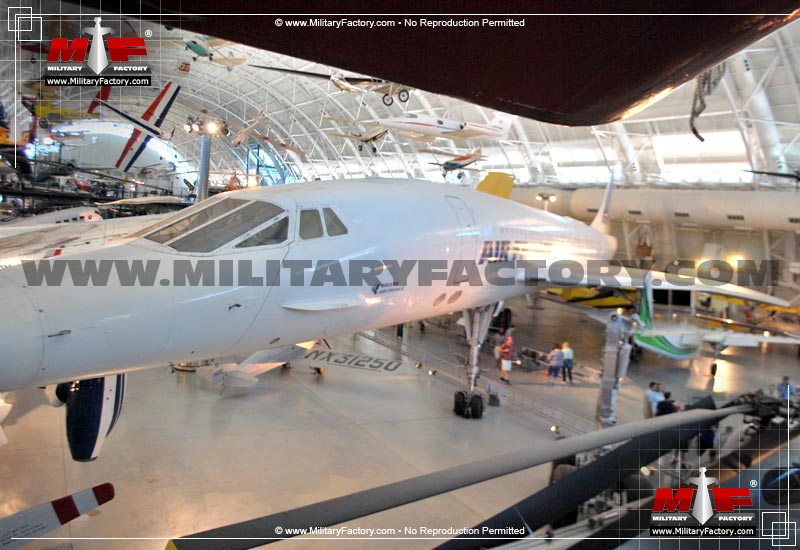
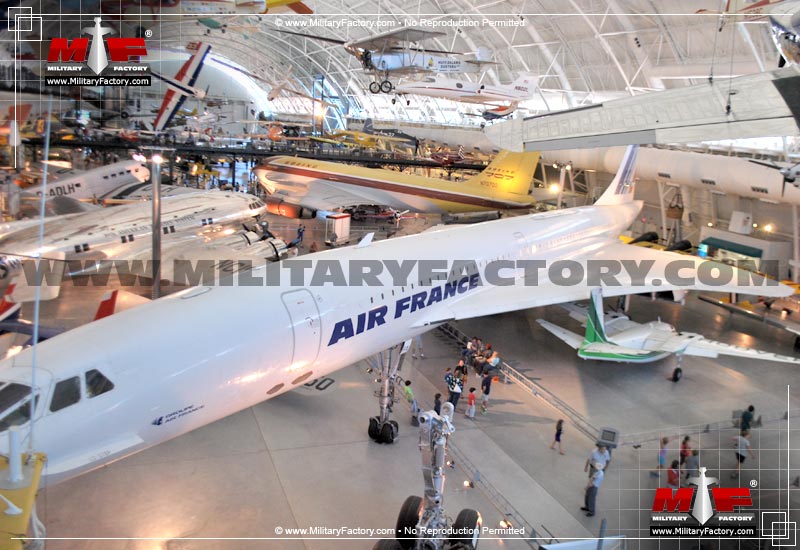
One of the great aviation stories to come out of a post-Cold War world, the British and French-made Concorde stands as the only supersonic passenger transport ever designed and flown on a regular basis. The system offered upper-crust passengers the ability to cross distances around the world in a matter of hours as opposed to the overnight flights experienced by standard passenger transports of the time. In the end, however, a changing world and economic pressures forced the retirement of the Concorde fleet, leaving most never to have traveled one of the finest technological marvels of the twentieth century.

The Concorde originally began as two separate projects being fielded by the British firm of British Aerospace (which now also controlled British Aircraft Corporation) and the French bureau of Aerospatiale (which now also controlled Sud Aviation). With other nations trying to field their own individual supersonic designs, Britain and France entered into a formal agreement to save cost and development resources by producing a joint product. As early as 1962, the Concorde was being developed with the first two prototypes - one British and one French - flying in 1969.

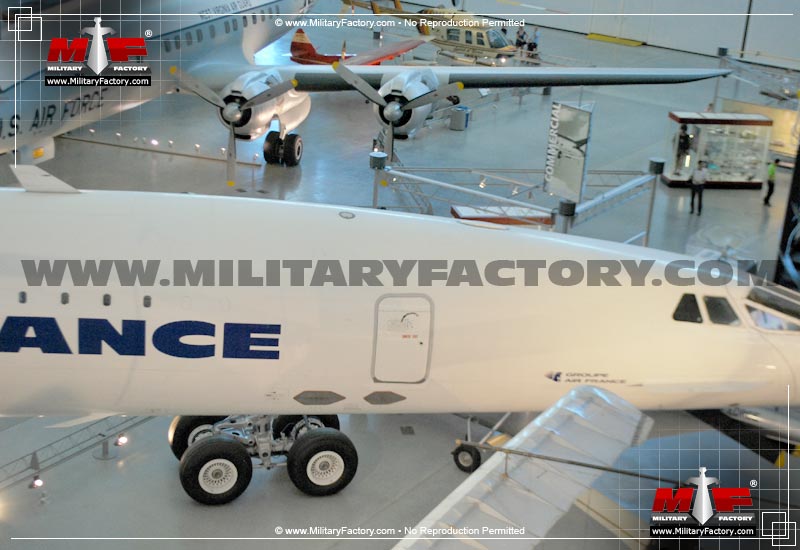
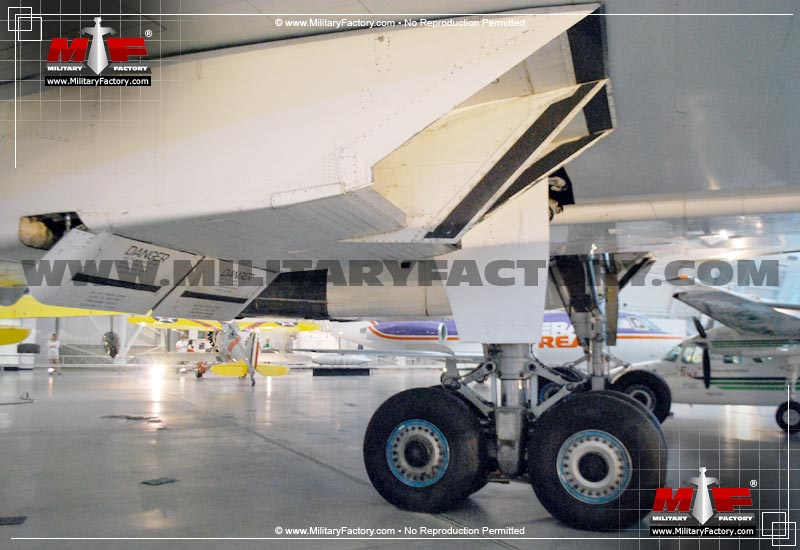
British contractors handled construction of three portions of the main forward part of the fuselage. Additionally they were charged with the vertical tail assembly, engine ducts and their corresponding nacelles and the rear portion of the fuselage. Other work including the installation of the four powerplants, electrical, oxygen and fuel control systems. Conversely, French contractors were charged with handling the construction of the delta-wing assembly, avionics, communications and hydraulic controls. Engine development was split between the two firms of Rolls-Royce and SNECMA. The resulting powerplant was the Olympus 593 Mk 610, offering nearly 40,000lbs of thrust each with up to 17 percent afterburning potential. Four such engines would be fitted underneath the wings, two to each wing.

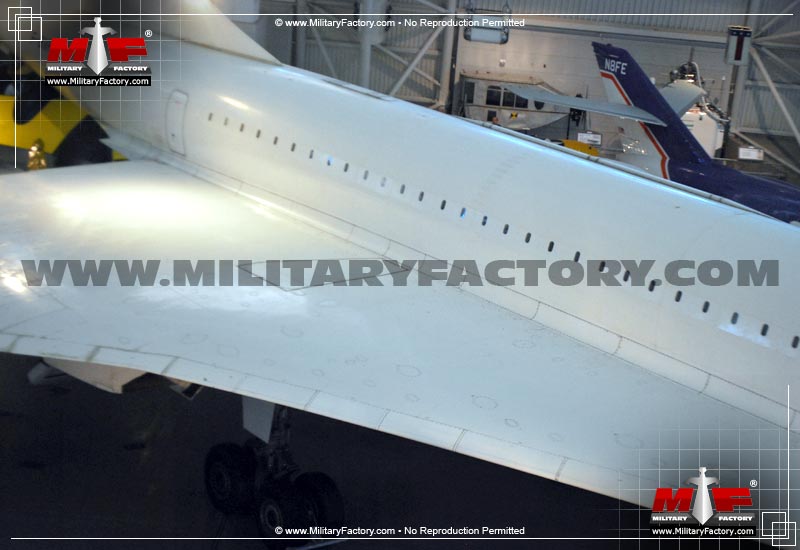
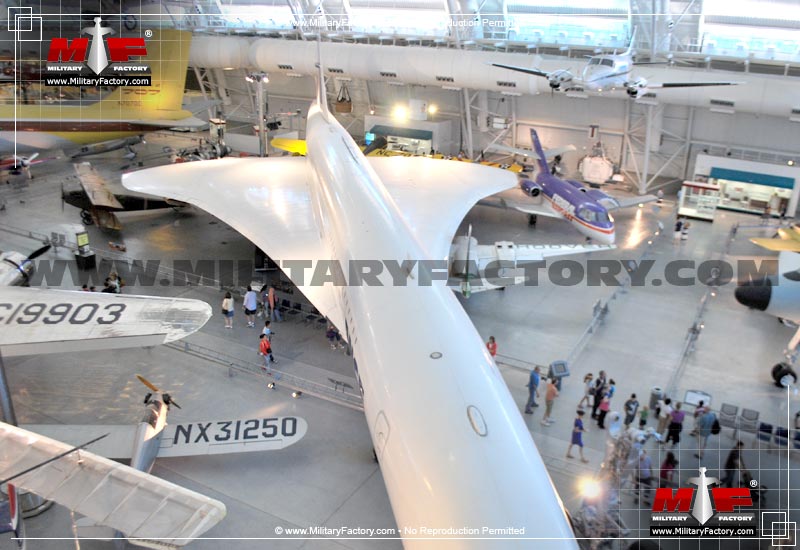
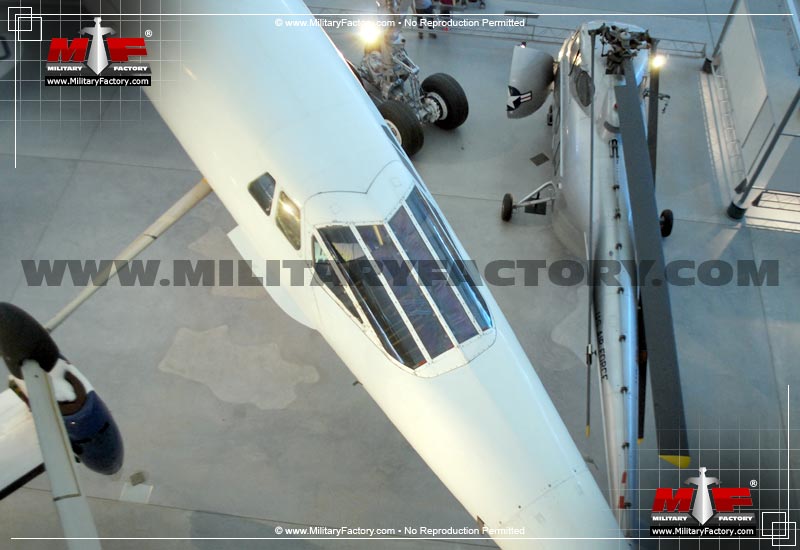
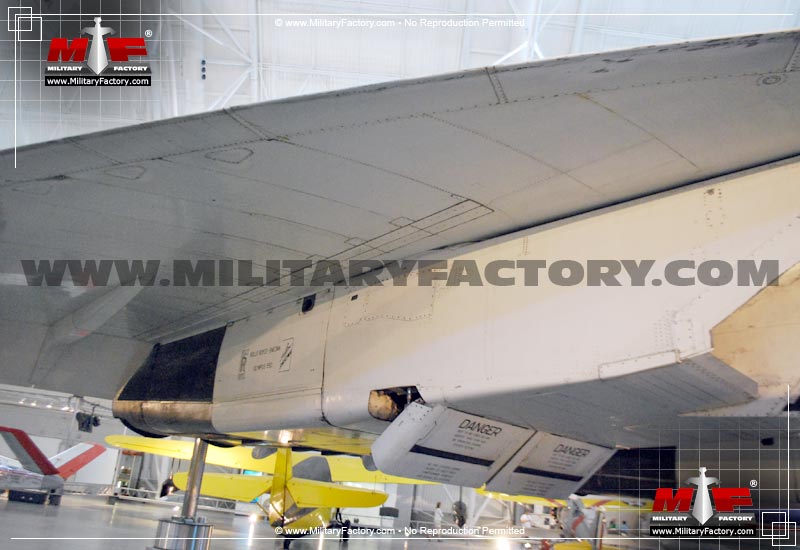
The Concorde was designed to offer up the slightest in the way of air resistance, with designers settling on a slim fuselage with a low-wing monoplane delta wing layout. A single vertical tail surface was mounted at rear with elevators added to the main wing system instead of on the empennage. The high speeds of supersonic flight required that the design be of a pencil-type shape, obscuring the flight crew's view below when taxing. As such, the nose cone was made into a positional assembly, allowing it to be positioned down when the aircraft was taxing or flying at low-speeds/low-altitude.

Ingenuity throughout the design did not take a back seat either. The fuel tanks mounted throughout the large-area delta wings served double duty as heat sinks for the wing assemblies themselves during high-speed flight. Titanium - a popular component of high-speed/high-altitude flight - was utilized throughout the design. Internally, the Concorde was crewed by three standard personnel with four flight crew attendants. The standard seating configuration allowed for up to 100 passengers though as many as 128 (some sources show 144) could be allowed.

From the outset, the dream of supersonic flight had specifications for the Concorde reaching speeds at around Mach 2.5. Unfortunately this was deemed non-practical in terms of construction materials proposed. As such, the maximum speed was sacrificed to a still-impressive Mach 2 and an equally impressive range of over 4,000 miles with an altitude ceiling of around 60,000 feet.

In the end, the Concorde lived up to expectations but failed to create enough of an international buzz to warrant continued production for export orders. Only 14 examples of the Concorde were produced during its production run, allocating seven to the British and seven to the French. The only other operator of the system was Singapore, which had leased a few examples. As impressive as the Concorde was, economic and environmental pressures set in. The aircraft was proving difficult to maintain in a fuel-strapped economy and many countries disallowed use of a supersonic aircraft, generating sonic booms with over-flights over populated areas, limited the Concorde to traveling over large spans of open water - particularly the Atlantic. An accident in 2000 grounded the fleet for a year until the British and French jointly decided against continuing flights of the Concorde series. Such was the end of the supersonic era of passenger flight.

Text ©2003-2009 www.MilitaryFactory.com • All Rights Reserved • No Reproduction Without Permission • Corrections / Comments to MilitaryFactory at Gmail dot com

Last Revision: 6/30/2009


  Specifications for the Aerospatiale / British Aerospace Concorde
arrow downDimensions:
Length: 203.74ft (62.10m)
Width:83.83ft (25.55m)
Height: 37.40ft (11.40m)

arrow downPerformance: About MACH
Max Speed: 1,354mph (2,179kmh; 1,177kts)
Max Range: 4,090miles (6,582km)
Rate-of-Climb: 0ft/min (0m/min)
Service Ceiling: 60,007ft (18,290m; 11.4miles)

arrow downStructure:
Accommodation: 3 + 7 + 144
Hardpoints: 0
Empty Weight: 169,998lbs (77,110kg)
MTOW: 408,001lbs (185,066kg)

arrow downPowerplant:
Engine(s): 4 x Rolls-Royce/SNECMA Olympus 593 Mk 610 turbojet engines generating 38,050lbs of thrust each with afterburn.
arrow downArmament Suite:
None.

  Pictures of the Aerospatiale / British Aerospace Concorde
     
Picture of Aerospatiale / British Aerospace Concorde
Picture of the Aerospatiale / British Aerospace Concorde
Image of the Aerospatiale / British Aerospace Concorde
     
arrow upView All 18 Images

CompareX2 CompareX4 Conversions Dictionary Acronyms

Compare and Contrast Military Aircraft Specifications

  Special Aircraft Collections
Aircraft by Conflict:
Falklands War
Indo-Pak War
Operation Allied Force
Operation Desert Storm
Six Day War
Yom Kippur War

Special Collections:
American X-Planes
Classic US Warbirds
Grumman "Cats"
Indian Air Force
Israeli Air Force
Mikoyan-Gurevich
V-Bombers


Korean Air War:
Korean War Aircraft
Aces
Australia
United States
North Korea

Vietnam Air War:
Vietnam War Aircraft

Cold War
Cold War Aircraft
United States
Soviet Union
Soviet Bombers of the Cold War

Modern Aircraft
Modern Military Aircraft
United States

Miscellaneous
MiG-15 Versus Sabre
Top 10 Fighters of All Time


  Recent Military Aircraft Additions
Thumbnail picture of the Supermarine Scimitar fighter
Supermarine Scimitar
Thumbnail picture of the Novi Avion fighter
Novi Avion
Thumbnail picture of the Arado Ar TEW 16/43-23 jet-powered fighter
Arado TEW 16/43

  Contacting MilitaryFactory.com
We can only get better if you tell us how. You can contact MilitaryFactory.com at MilitaryFactory at gmail dot com (replace "at" with "@" and "dot with ".") with any questions, comments or corrections. We also accept related military imagery that you approve for us to use on our website. Keep in mind, however, that due to volume, we may not directly respond to your inquiry. Please add us to your list of non-blocked recipients!
Flying Boats

  Aircraft Quick Profile


Picture of the Aerospatiale / British Aerospace Concorde
Image courtesy of the United States Department of Defense.

flag of France
1969

Designation: Aerospatiale / British Aerospace Concorde
Classification Type: Supersonic Passenger Transport
Contractor: Aerospatiale - France / British Aerospace - United Kingdom

Country of Origin: France
Production Total: 14

Operators: United Kingdom; France; Singapore (limited lease).


  Variants
Concorde - Base Series Designation

  Collections
  • Sons of Empire - WW2 Aircraft of Japan
  • Aircraft of the Battle of Britain
  • X-Planes Throughout History
  • French Aircraft of the Great War
  • The German Luftwaffe in World War 2
  • Nightfighters - In a Class All Themselves
  • The Top Ten Fighters of All Time
  • Carrier "Born" Aircraft - Navy Mounts
  • If Boats Could Fly - Flying Boat Aircraft


Free GI Bill Guide

Top MF Stuff: Military Pay Scale Chart | Military Ranks | World War 2 Weapons | Sniper Rifles | Conversion Calculators


©2009 www.MilitaryFactory.com • Content ©2003-2009 MilitaryFactory.com • All Rights Reserved • Disclaimer Privacy Policy Site Map Origins
Most photographic images appearing on this site are courtesy of the United States Department of Defense and are approved for public use.
Other images acquired through the public domain. Digital art work courtesy of Dan Alex.
Business Consulting by Kyle Williams

Material presented throughout this website is for historical and entertainment value and should not to be construed as usable for
hardware restoration, maintenance or general operation. Please consult manufacturers for such information.

Site Contact: militaryfactory at gmail dot com (replace "at" with "@" and "dot" with ".") eXTReMe Tracker