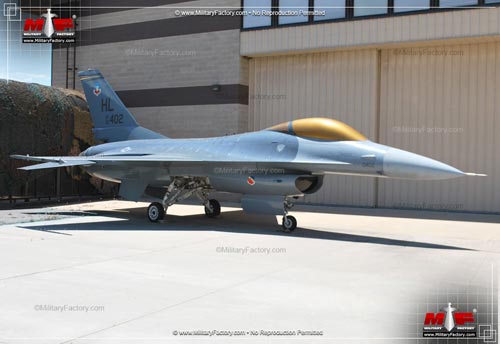
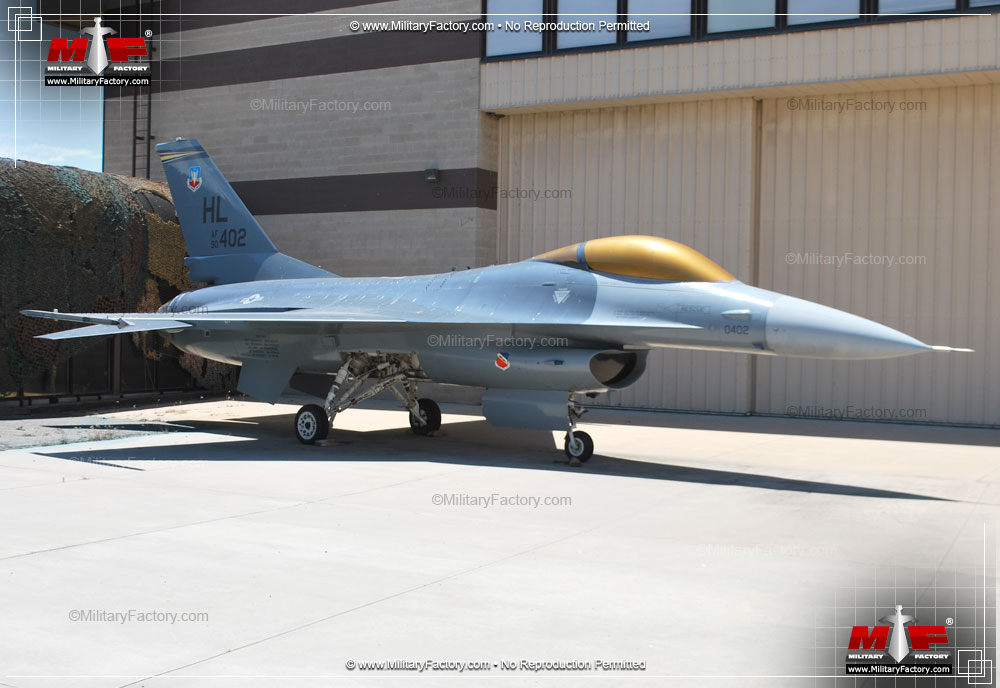
"The multirole-minded Lockheed F-16 Fighting Falcon has proven a favorite in the export market with over 20 operators committed to the type."
Power & Performance Those special qualities that separate one aircraft design from another. Performance specifications presented assume optimal operating conditions for the Lockheed Martin F-16C Fighting Falcon (Block 50) Lightweight Multirole 4th Generation Fighter.
1 x General Electric F110-GE-100 afterburning turbofan engine developing 28,600 lb of thrust with reheat. Propulsion
1,317 mph 2,120 kph | 1,145 kts Max Speed
50,000 ft 15,240 m | 9 miles Service Ceiling
2,622 miles 4,220 km | 2,279 nm Operational Range
50,000 ft/min 15,240 m/min Rate-of-Climb
Structure The nose-to-tail, wingtip-to-wingtip physical qualities of the Lockheed Martin F-16C Fighting Falcon (Block 50) Lightweight Multirole 4th Generation Fighter.
1 (MANNED) Crew
49.2 ft 15.00 m O/A Length
32.8 ft (10.00 m) O/A Width
15.7 ft (4.80 m) O/A Height
18,960 lb (8,600 kg) Empty Weight
42,329 lb (19,200 kg) MTOW
Armament Available supported armament and special-mission equipment featured in the design of the Lockheed Martin F-16 Fighting Falcon Lightweight Multirole 4th Generation Fighter provided across 9 (including wingtip mounts) hardpoints.
STANDARD:
1 x 20mm M61A1 Gatling-style internal automatic cannon.
OPTIONAL:
Depending on production model, up to 17,000lb of mixed external stores including mission equipment pods, ECM pods and fuel tanks. Ordnance options include AIM-9 Sidewinder short-range air-to-air missiles, AIM-120 AMRAAM medium-range air-to-air missiles, AGM-65 Maverick air-to-ground missiles, Penguin Anti-Ship missiles, Runway Denial Bombs, Cluster Bombs, Laser-Guided Bombs, GPS-Guided Bombs, and Conventional Drop Bombs.
X
X
X
X
X
X
X
X
X
Hardpoints Key:
Centerline
Wingroot(L)
Wingroot(R)
Wing
Wingtip
Internal
Not Used
Variants Notable series variants as part of the Lockheed Martin F-16 Fighting Falcon family line.
F-16 "Fighting Falcon" - Base Series Name.
F-16A - Single-Seat and Base Production Model; production Blocks 1, 5, 10, 15 (enlarged horizontal stabilizers) and 20.
F-16B - Two-Seat Variant of F-16A production model.
F-16C - Single-Seat Improvement Program Model appearing in 1984; Block 25 with modernized avionics and radar; all-weather service; support for AIM-7 and AIM-120 AMRAAM; includes Blocks 30/32, 40/42 and 50/52.
F-16D - Two-Seat Improvement Program Model; Block 25 with modernized avionics and radar; all-weather service; support for AIM-7 and AIM-120 AMRAAM; includes Blocks 30/32, 40/42 and 50/52.
F-16E - Single-Seat; based on F-16C Block 50/52; improved radar and avionics; uprated General Electric turbofan engine; UAE export model
F-16F - Two-Seat; based on F-16D Block 50/52; improved radar and avionics; uprated General Electric turbofan engine; UAE export model
F-16N - 22 produced for the US Navy based on the F-16C model series.
TF-16N - 4 produced for the US Navy based on the F-16D model series.
F-16XL - Delta-Wing Technology Demonstrator based on the F-16A.
F-2 - Mitsubishi-produced multi-role fighter based on the General Dynamics F-16 for Japanese Self-Defense Forces; dimensionally larger than American F-16.
F-16I "Sufa" (Storm) - Israeli export order delivered in dual-seat fighter configuration; advanced development of the F-16 fighter series; based on the F-16D model series.
F-16IN - Proposed MRCA competition development based on F-16E/F Block 60; since abandoned.
F-16IQ - Projected Iraqi Export Model; 18 marked for possible sale
F-16V "Viper" - Proposed modernized and improved F-16 variant in development with Lockheed.
KF-16 - South Korean Air Force local license production variant.
QF-16A - Unmanned drone version developed by Boeing.
F-16 Block 70/72 - Advanced model developed for Indian use / local production.
The General Dynamics (now Lockheed Martin) F-16 "Fighting Falcon" was a product of Cold War-development and introduced along the lines of agility, lightweight classification and controlled costs - a multirole fighter to serve alongside the air superiority-minded McDonnell Douglas F-15 "Eagle". First flying on January 20th, 1974, the F-16 was formally introduced on August 17th, 1978 and has since seen production reach over 4,500 units with sales to over 25 foreign parties. Modernization programs have helped to evolve the F-16 in reaching all-new capabilities over the modern battlefield, allowing the system to retain a viable presence in the increasingly computer-controlled airspaces of today. Its multirole nature allows the standard aircraft design to undertake a variety of roles as required and customizability allows each operator to field local weaponry, systems and equipment as needed.
Despite its given name of "Fighting Falcon", the F-16 is also recognized under the nickname of "Viper". As it stands by today's classification conventions, the F-16 is deemed a "Fourth Generation Fighter" now that the Lockheed F-22 Raptor has officially ushered in the era of the "Fifth Generation Fighter". However, the costs associated with 5th generation types ensure that many 4th generation models will continue flying into the 2030s.
The F-16 in U.S. service (and perhaps elsewhere) is expected to be replaced by the highly touted Lockheed F-35 "Lightning II" stealth-minded strike fighter. However, mounting delays and cost overruns in the program have extended the useful service lives of existing Fourth Generation Fighters like the F-16s for the near future, prompting various modernization programs to be enacted in keep the aircraft flying for years to come. Additionally, the procurement costs associated with new technology will keep the F-16 a mainstay of foreign air powers for the foreseeable decade and perhaps beyond.
Falcon Roots
The F-16 was born from the USAF's LightWeight Fighter (LWF) program emerging in the early 1970s. The program intended to validate the prospect of a light, single-engine, single-seat fighter form against the norm of heavier, twin-engined designs which proved the call of the day. The field originally included submissions from Boeing, General Dynamics, Lockheed, LTV and Northrop but this was eventually whittled down to the two major players in General Dynamics and Northrop. General Dynamics put forth their "YF-16" against Northrop's "YF-17" and two prototypes each were allowed under the competition. The YF-16 went airborne for the first time on January 20th, 1974 and differentiated from the Northrop design by its single-engine approach (the YF-17 utilized two in a side-by-side arrangement). After a year of evaluations, the USAF formally selected the YF-16 as its LWF winner and production mounts took on the finalized F-16 designation, earning itself the nickname of "Fighting Falcon" (the YF-17 eventually evolved to be selected as the U.S. Navy's F/A-18 "Hornet" in another subsequent program).
After the USAF arranged for production to begin in 1975, the aircraft was also taken on by European parties aligned with American interests. This included the likes of Belgium, Denmark, Netherlands and Norway who agreed on localized production of the type. The first production-quality F-16 went airborne for the first time in 1978 marking the start of a now-storied aviation career.
At the time of its inception, the F-16 became the first production-quality military fighter to feature Fly-By-Wire (FBW) controlling. This was coupled to a "relaxed" airframe design to allow for maximum effort from the onboard digital processing scheme and improved responsiveness considerably.
F-16 Walk-Around
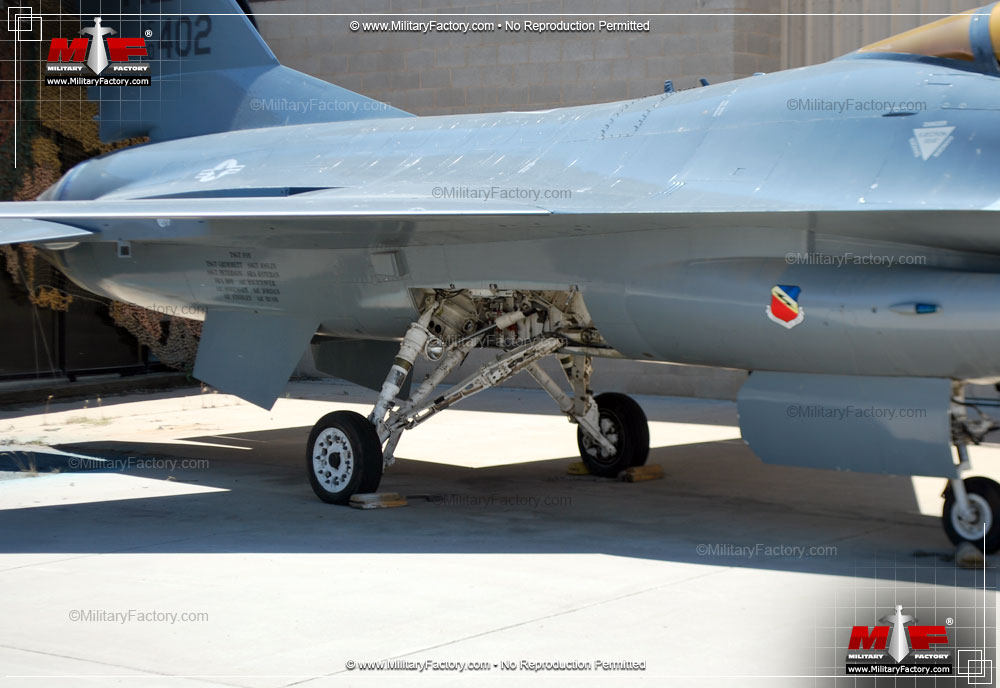
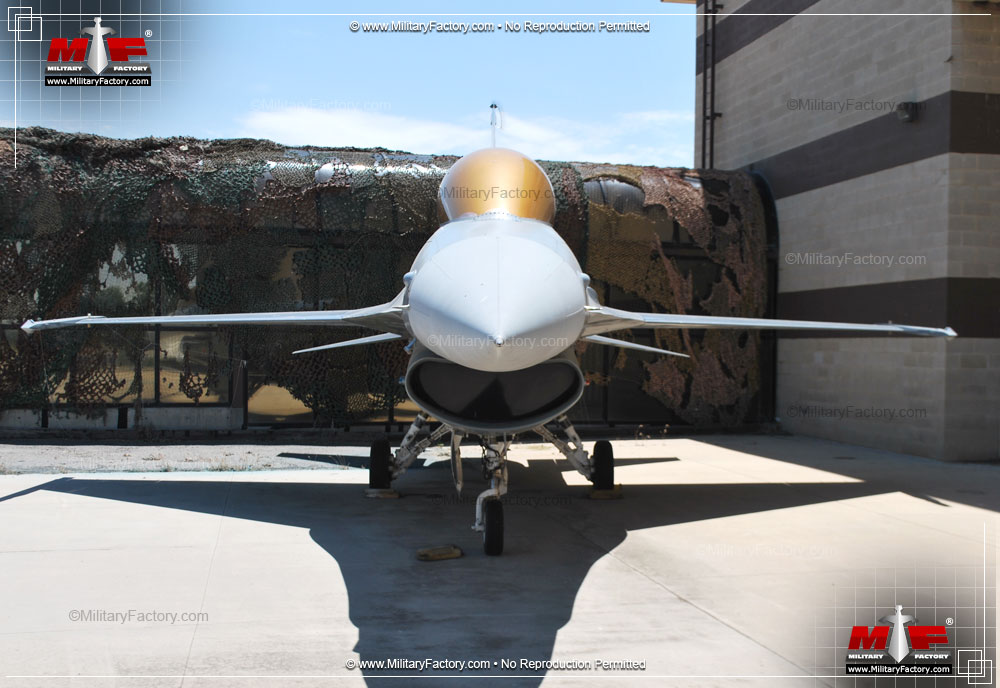
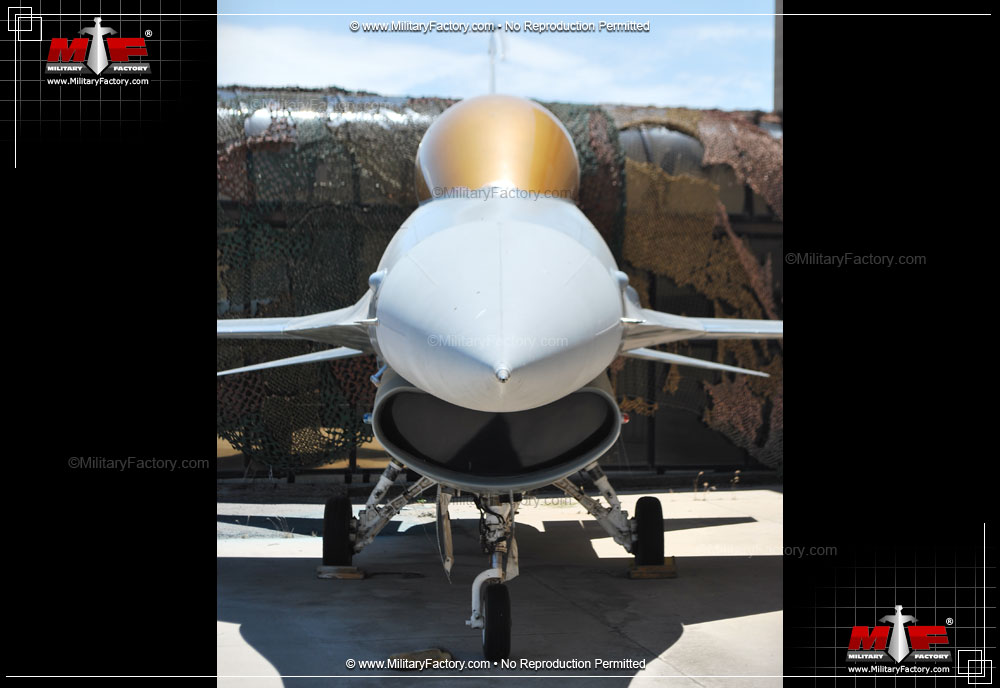
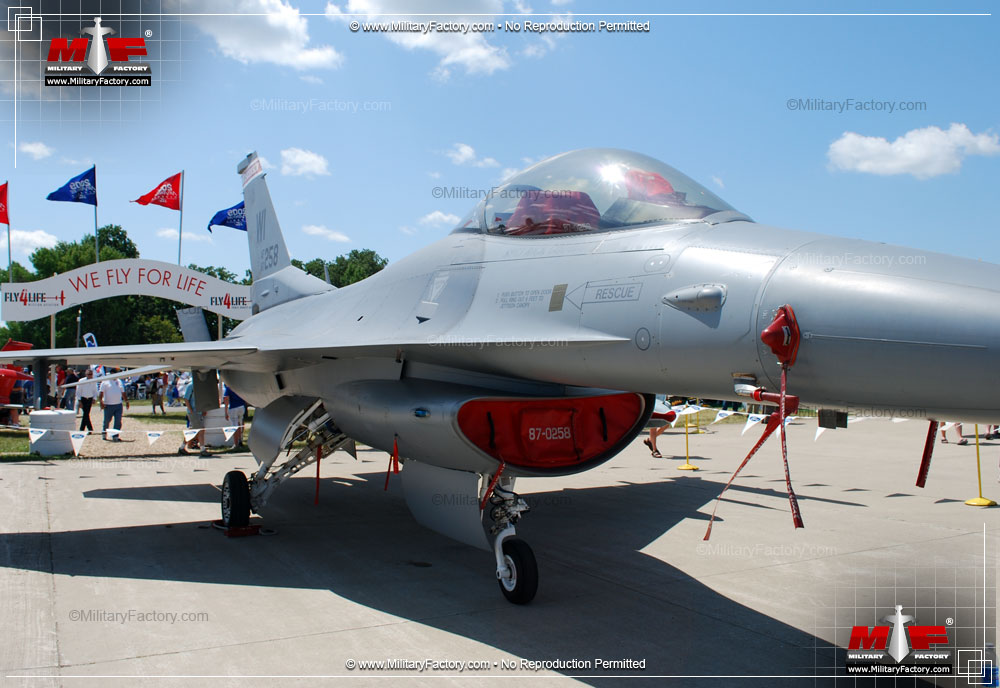
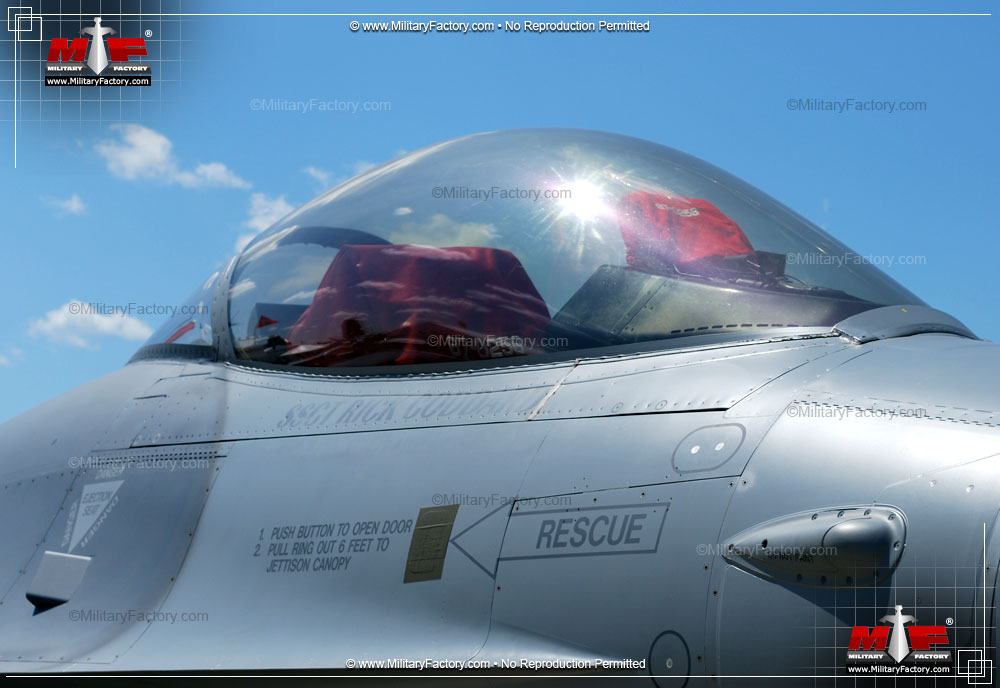
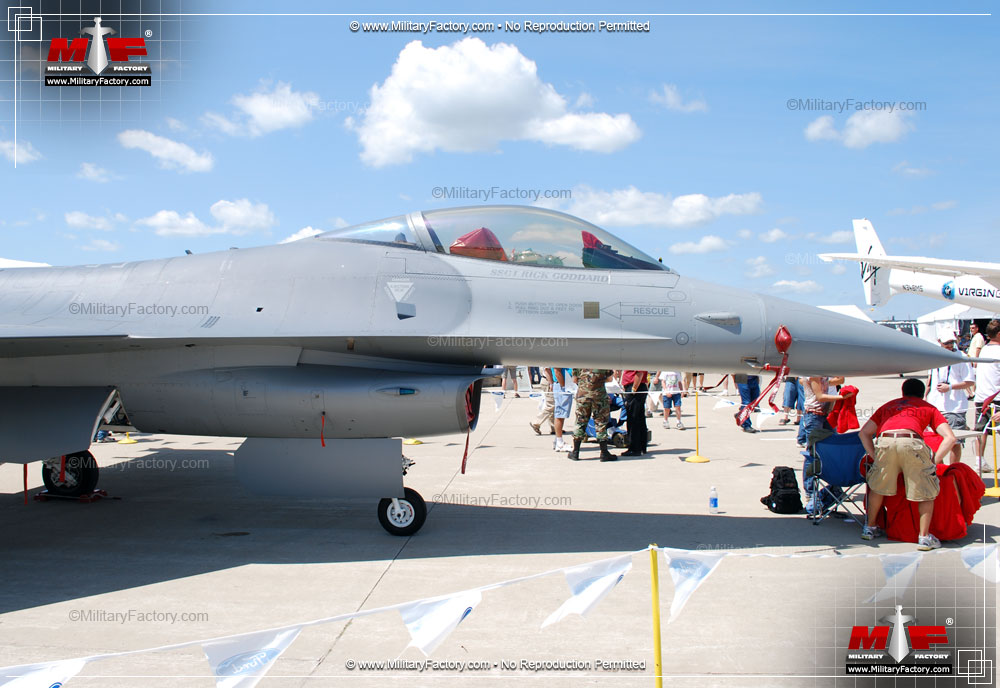
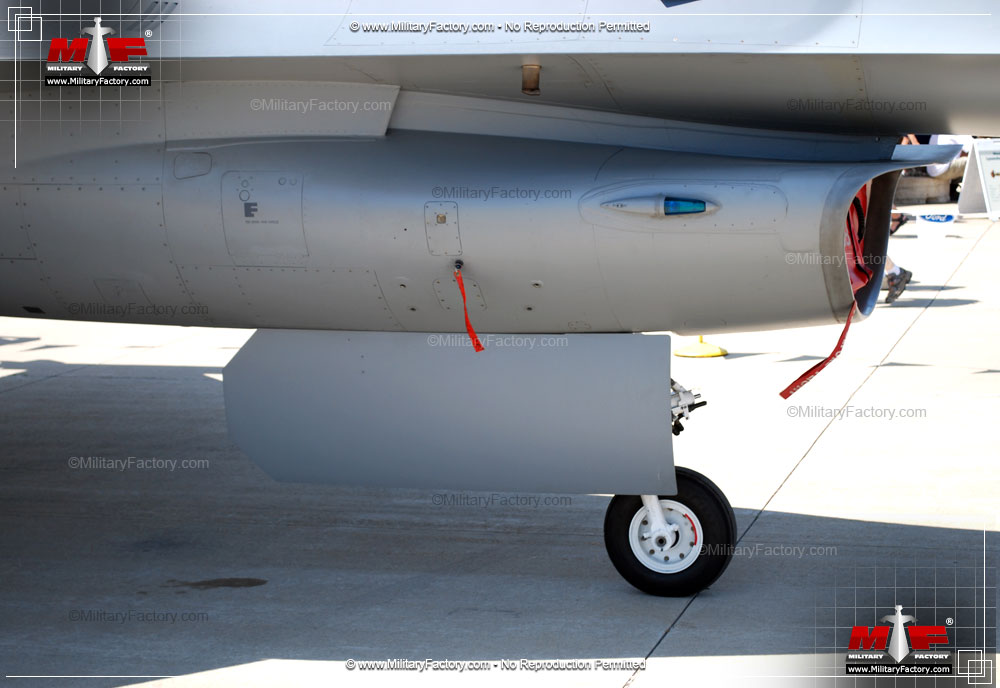
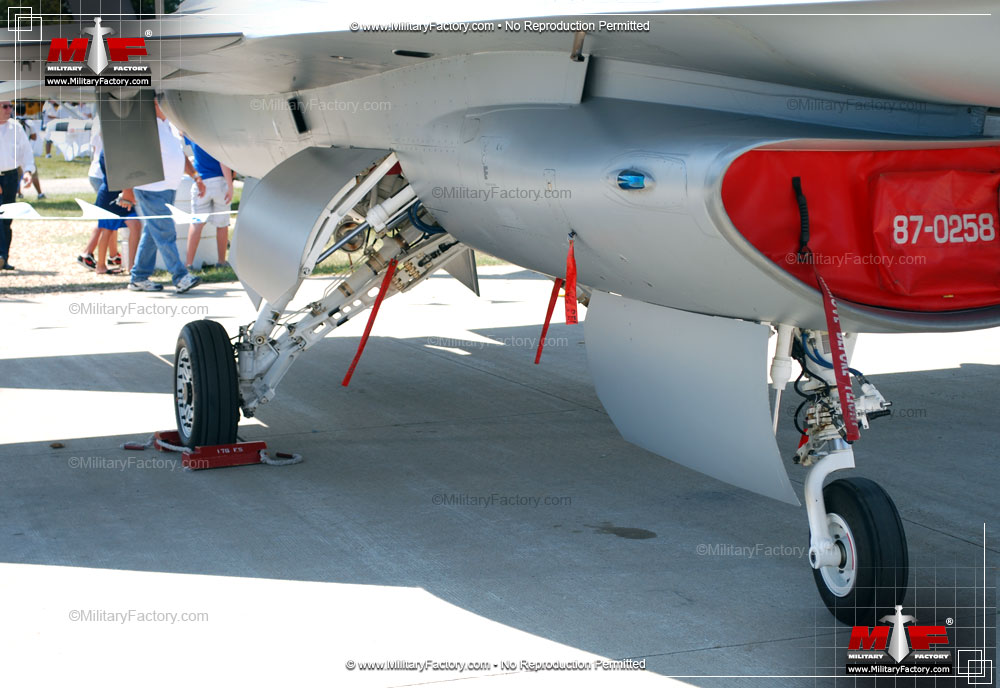
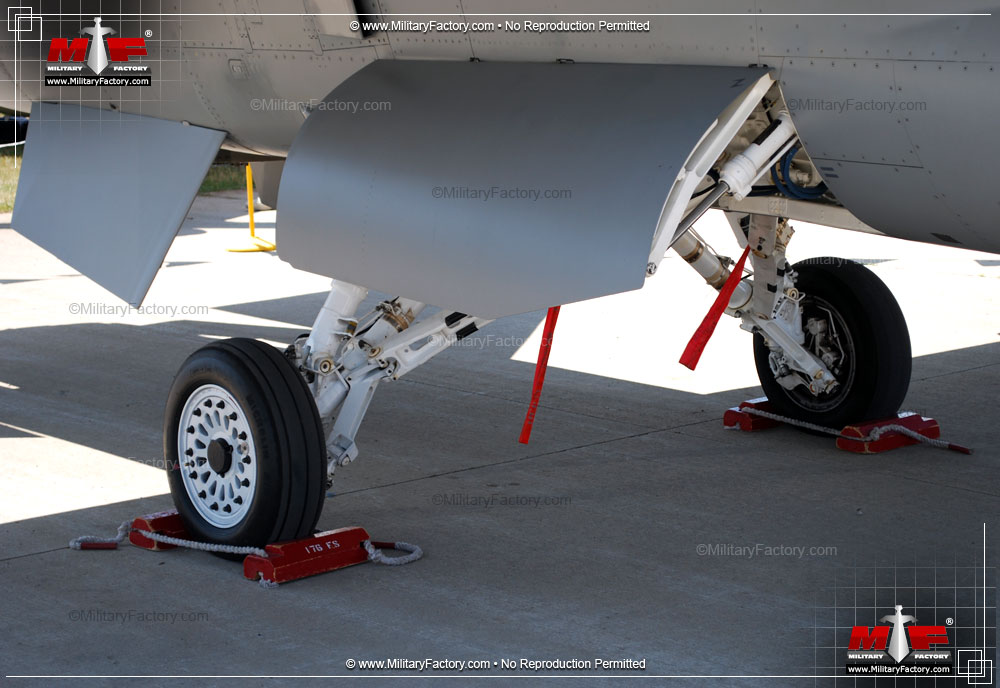
Externally, the F-16 became a well-contoured, streamlined aircraft with extensive blending used in the wings and fuselage. The pilot sat in a cockpit that was well-forward in the fuselage length, given a very commanding view of the surrounding area through a large, unobstructed canopy. The cockpit included a HOTAS (Hands-On Throttle And Stick) configuration (sidestick controller) for piloting efficiency as well as a noticeably-reclined (30-degrees) ejection seat. The nose cone housed the radar system which was coupled to in-flight systems and the weapon stores. The main wing appendages were swept along their leading edges and each wingtip supported an AIM-9 "Sidewinder" short-range air-to-air missile. The empennage consisted of a single vertical tail fin and a pair of horizontal planes. Ventral strakes were noted under the tail unit. The engine was buried deep within the fuselage and aspirated through an oblong air intake found under the cockpit and exhausted through a single ring at the base of the tail rudder. Each main wing supported multiple ordnance hardpoints with the inboard most plumbed for fuel stores. There also proved a centerline hardpoint, also plumbed, which helped to grant the aircraft considerably increased operating ranges. The undercarriage rather narrow-track in its arrangement and all-centralized around the belly. The undercarriage consisted of three single-wheeled legs with two main legs under center mass and a nose leg just aft and under the cockpit.
Armament-wise, the F-16 was granted a 20mm M61 Vulcan 6-barreled Gatling-type internal cannon for close-in work. Beyond its typical wingtip missile armament, the aircraft eventually supported medium-range air-to-air missiles, air-to-surface missiles, precision-guided munitions and conventional drop ordnance (cluster bombs, general purpose bombs, runway denial weapons, etc...).
All told, the F-16 has evolved to become a proven, multi-faceted war machine which enables it undertake a plethora of mission types - from interception to patrol and general strike to anti-radar. Foreign buyers have also added localized ordnance options to the existing F-16 armament suite for a more customized approach to war. Beyond the given armament options, the F-16 also supports mission-specific equipment such as Electronic CounterMeasures (ECM) pods, targeting pods, sensor pods and chaff/flare dispenser pods. The original radar was the Westinghouse (Northrop Grumman) APG-66 series.
F-16 Maturation
The F-16 has matured along many variant lines since its adoption. The original single-seat multirole model was the F-16A and these were joined by two-seat F-16B models which added a second cockpit. In 1984, improved forms emerged as the F-16C and F-16D (single- and twin-seat models respectively). These brought about improved avionics and radar functionality as well as "all-weather" capability and ground strike qualities. In supporting the newer AIM-120 "AMRAAM" medium range air-to-air missile, the aircraft was granted a Beyond Visual Range (BVR) engagement/kill capability. The tail fin was extended slightly forward and a new wide-angled HUD was introduced. Production of F-16s has spanned across several notable "Blocks", each containing changes all their own. C/D models also made up the F-16N/TF-16N mounts used in US Navy aggressor training.
The popular F-16C "Block 50" model is powered by a single General Electric F110-GE-100 series afterburning turbofan engine outputting 17,150lbs of dry thrust and28,600lbs of thrust with reheat applied. The aircraft is capable of reaching speeds of 915 miles per hour (sea level, March 1.2) and can see speeds top Mach 2 in at altitude. Ferry range is 2,600 miles with fuel drop tanks applied while a combat radius under relatively heavy bomb load is equal to about 350 miles. The airframe can reach a service ceiling of 50,000 feet with a 50,000 feet-per-minute rate-of-climb - these qualities making it a sound, quick-responding interceptor.
The F-16 E- and F-models (single- and twin-seat versions respectively) are more offerings and feature the more powerful F110-132 series afterburning engine. They are also outfitted with AN/APG-80 AESA (Active Electronically-Scanned Array) radar and all-modern avionics. This particular model series formed the basis of the "F-16IN" ("Super Viper") intended for India's MRCA (Medium Multi-Role Combat Aircraft) program but eventually dropped from contention. The similar F-16I designation marks a twin-seat development in use by the Israeli Air Force.
The F-16 has served across many air powers beyond the U.S. since its arrival. Procurement and, in some cases local production, were granted to allies in Belgium, Egypt, Greece, Indonesia, Israel, Norway, Pakistan, Poland, Taiwan, Singapore, Thailand and Turkey (among others). The remerging Iraqi Air Force has relatively recently committed to the purchase of F-16 Fighting Falcons for its revitalized inventory (announced September 2010). These aircraft will carry the designation of "F-16IQ". The Japanese Air Force relies on a heavily-modified, dimensionally-larger and locally-produced version of the F-16 as the Mitsubishi "F-2". South Korean F-16s are recognized as "KF-16" and are produced locally by Korean Aerospace Industries (KAI). Italy operated as many as 30 leased (ex-USAF) F-16s between 2001 and 2012 but have since given up the type. Nevertheless, the F-16 certainly remains a potent and popular multirole performer.
F-16 Service
The F-16 happened to appear at a time when its combat services could be put to use rather immediately. The type stocked the US military at various levels (and service branches) and was also selected to headline the "Thunderbirds" aerial acrobat group. The first, high-level combat service ofF-16s occurred during Operation Desert Storm in 1991 where its multirole capabilities were put to good use in defeating the Iraqi air defense network. Following the war, the F-16 stayed on station in enforcing the "No Fly" zones over northern and southern Iraq. F-16s also participated with European air forces in joint operations over the Balkans during instability and civil warring in the region. Despite their several decades of service, F-16s remain a primary component of US air operations and should remain so for the near-future. The F-16 has also served well under combat conditions with Israel. Israeli F-16s proved particularly useful in its 1982 Lebanon War against Syrian fighters and remain in constant readiness for today's volatile Middle East region. Israeli F-16I Block 52 models feature Conformal Fuel Tanks (CFTs), advanced ECMs and a two-seat cockpit arrangement.
The F-16 design is certainly not without faults and several notable accidents and incidents have occurred to the line, some resulting in death, over the decades dating back to a Fort Worth, Texas incident on May 8th, 1975. The latest incident was the loss of a USAF aircraft and pilot on January 28th, 2013 over the Adriatic Sea near the Italian coast.
As a single-engine design, much faith is placed on reliability of the F-16 system to bring its pilot home safely. Twin-engined aircraft can rely on the power of a single installation in the event of failure to one unit. However, both expenses and complexity are ramped up in a twin-engined design.
The F-16XL Cranked-Arrow Falcon
The F-16XL existed as a technological offshoot of the base F-16 fighter line. The primary modification became its "cranked-arrow" delta wing design which allowed for better lift, control, range and ordnance carrying. Its primary purpose was initially to serve as a test platform for high-speed research though it did end up competing (unsuccessfully) against a modified two-seat McDonnell Douglas F-15 Eagle to replace the outgoing General Dynamics F-111 Aardvark interdictor strike-fighter. This emerged as the F-15E "Strike Eagle". Only two prototype F-16XLs were ever completed and both went on to serve NASA in the decades up to 2009.
The Proposed Navalized Falcon
The Vought "Model 1600" was a Vought/General Dynamics attempt to promote a navalized variant of the F-16 to the United States Navy. The proposed produce never matured with the F/A-18 Hornet being selected in its place. Interestingly, the F/A-18 held roots in the YF-17 which competed (unsuccessfully) against the YF-16.
The Falcon Future
Despite its excellence in service, the F-16 is a design built upon 1970s technology and operators have already - or will eventually - move on from the design to a more modern offering. Euro-players like Belgium are entertaining F-16 replacements and may lean in the direction of the Lockheed F-35 Lightning II Fifth Generation Aircraft. Other contenders include the Boeing Super Hornet, Dassault Rafale, Eurofighter Typhoon, and Saab Gripen. Belgian F-16s are expected to serve into the early 2020s before replaced fully by 2029.
The last Fighting Falcons, these for the rebuilding air service of Iraq (through the F-16IQ models), will be delivered in 2017.
There remains potential that the nation of Pakistan will invest in the purchase of eight F-16 aircraft. These are expected to be delivered for 2019 should the deal pass through.
August 2016 - Lockheed is pushing forward a deal with India that, should the Asian power purchase a stock of advanced F-16 (Block 70) aircraft, the company would arrange for local production in India.
October 2016 - Romania has become one of the newest operators of the F-16 product in an attempt to modernize its fighter stock. Deliveries of ex-Portuguese Air Force "Fighting Falcons" to Romania began in late September 2016. The deal includes twelve total aircraft as well as technical and training support. The F-16 is expected to succeed the aging (though upgraded) line of Mikoyan-Gurevich MiG-21 "Fishbed" fighters (Lancer guise).
November 2016 - South Korea has green-lighted an upgrade program covering 134 KF-16 aircraft to the F-16V "Viper" standard. Lockheed is set to handle the conversions.
March 2017 - The nation of Poland declined to support the purchase of refurbished F-16 Falcons (A- and B-models). Some 50 to 100 fighter jets are sought for the expanding and modernizing Polish Air Force.
March 2017 - Belgium has formally requested proposals from Dassault, Saab, Eurofighter, Lockheed Martin and Boeing to replace its fleet of F-16 multirole fighters. In contention are the French Rafale, Swedish Gripen (E/F), British Typhoon, Lockheed Lightning and Boeing Super Hornet.
September 2017 - It was announced that the United States State Department has approved a sale of nineteen F-16V Fighting Falcon models in the modern "Viper" configuration to the nation of Bahrain. The deal is worth $3.87 billion USD.
September 2017 - It was revealed that Indonesia is upgraded part of its Fighting Falcon fleet which consists of A- and B-models. At least nine are to be modernized with new avionics and other changes intend on bringing the fleet near Block 52+ standard.
October 2017 - With its national economy on the rise, F-16 operator Greece is looking to upgrade its mish-mash stock of Fighting Falcons to more modern standards. Some may be modernized to the potent "Viper" standard.
October 2017 - The United States State Department has approved the sale of F-16V aircraft to the nation of Greece. These will feature modern radar and software as well as communications gear.
November 2017 - The United Arab Emirates has committed $1.65 billion to upgrade its fleet of F-16s (Block 60) with Lockheed Martin in an effort to modernize the multirole platforms.
April 2018 - Croatia has agreed to the purchase of some twelve F-16C/D model multirole fighters from the nation of Israel. These are ex-Israeli Air Force (IAF) mounts and will receive an Israeli-directed modernization to help extend their service lives under the new owners. The aircraft will be sold in their current Israeli-modified forms (F-16C/D "Baraks" model) which has drawn the ire of the American government.
May 2018 - The United States and Greece have agreed to modernization of the Hellenic Air Force's fleet of 85 F-16 Fighting Falcons. Upgrades include the Northrop Grumman AN/APG-83 Scalable Agile Beam Radar (SABR) and Communications / Countermeasures. At least three of the fleet will serve stateside in the testing program. Subject aircraft in question are F-16 Block 52 models.
May 2018 - A United States Air Force "Thunderbird" aerobatic performing jet became the first recipient of the scheduled life-extension modification program. The changes are expected to add an additional 4,000 hours or so of flying time to the series which debuted in the late-1970s.
June 2018 - F-16V (Block 70) "Viper" fighter production for Bahrain is being setup by Lockheed to be handled in a facility in the state of South Carolina.
July 2018 - The nation of Slovenia has chosen the F-16 Fighting Falcon Block 70 model ahead of the Swedish Saab JAS39 Gripen fighter to succeed its aged fleet of Mikoyan MiG-29 Fulcrum fighters. Up to fourteen Fighting Falcons will be acquired from the United States (Lockheed Martin).
December 2018 - Slovakia is set to become only the second operator of the F-16 Block 70/82 production model. Fourteen aircraft make up the order commitment.
January 2019 - Israel has stopped its sale of ex-IAF F-16 Fighting Falcons to the nation of Croatia due to technology sensitivity issues brought up by the United States.
February 2019 - Lockheed Martin has developed the F-21 advanced Fighting Falcon variant for possible sale to India. The aircraft carries several requested features by the country including retractable fuel probe, braking parachute, dorsal spine equipment housing, and oversized cockpit displays. The "F-21" designation is not an official military designation - instead it is an in-house Lockheed marker translating to "Fighter for the 21st Century".
March 2019 - The United States State Department has approved a sale of twenty-five F-16 C- and D-model (Block 72) Fighting Falcons to ally Morocco. Twenty-three additional Moroccan F-16s may also be upgraded to the F-16V standard.
April 2019 - The island nation of Taiwan has submitted a formal request to purchase up to sixty-six F-16 Fighting Falcons in the F-16V standard production form. These will be used to succeed an aging line of F-16A and F-16B multirole aircraft.
May 2019 - A USNG F-16 Block 30 fighter platform will serve as host to the Sikorsky-/DARPA-developed "Alias" autonomous flight system.
June 2019 - Taiwan is seeking to purchase 66 additional F-16 Fighting Falcons in the potent "Viper" ("V") configuration to increase its aircraft strength in the shadow of China.
August 2019 - The United States government has approved the sale of sixty-six F-16V Fighting Falcon variants to the nation of Taiwan, a move sure to draw the ire of neighboring China while also improving Taiwan fighter strength.
November 2019 - The Indonesian Air Force has announced its intent to purchase two squadrons of F-16 Block 72 "Viper" fighters alongside an order for Sukhoi Su-35 fighters.
December 2019 - Romania has agreed to purchase five additional ex-Portuguese F-16 Fighting Falcon fighters, bringing current strength up to seventeen (from twelve). Existing aircraft are also set to receive a mission computer modernization.
December 2019 - A guided rocket fired from an F-16 successfully downed an aerial target representing a cruise missile.
January 2020 - Taiwan and the United States are moving ahead with a deal to cover procurement of the F-16V multirole fighter for the island nation. Up to sixty-six aircraft are to make up the deal. The sale was approved in August of 2019 and the Taiwanese budget was approved in November of 2019 to cover the purchase.
January 2020 - The USAF is actively developing an "auto-gunnery" capability for its F-16 fleet in which control of the internal Gatling gun would be transferred to an autopilot system for improved strafing accuracy.
April 2020 - U.S. authorities have appropriated $512 million USD to Lockheed to begin production of eight F-16 Block 70 fighters for the nation of Bulgaria.
May 2020 - In-service USAF F-16s are in line to receive all-new software capabilities through a planned update phase.
July 2020 - Turkish Aerospace Industry has begun delivery of the all-new F-16 Block 30 variant, a modernization covering existing Turkish Air Force Fighting Falcons. Some thirty-five examples are set to be delivered.
July 2020 - A newly-announced $635 million USD deal will provide upgrades to Chilean Air Force F-16 fighters.
August 2020 - On August 14th, 2020, the United States Air Force announced its intent to move on a Foreign Military Sales contract between Lockheed Martin and its foreign customers to support/modernize F-16 Fighting Falcons in operation with American allies worldwide.
December 2020 - Taiwan eyes 2023 for modernization completion for its F-16 fleet.
January 2021 - The first F-16V standard aircraft for the Hellenic Air Force has completed its first flight. The flight took place out of Tanagra Air Base outside of Athens on January 17th with the conversion work completed by Greece's own Hellenic Aerospace Industry (EAB).
June 2021 - The United States has approved sales of the F-16 to the nation of the Philippines. The deal is centered on the Block 70/72 variant and includes anti-ship missiles and air-to-air missile weapons.
February 2022 - The United States has approved a deal for sixteen F-16C/D model fighters to the nation of Jordan. The deal is worth a reported $4.21 billion USD.
April 2022 - Bulgaria has been approved to purchase an additional four F-16C and four F-16D Fighting Falcons by the United States.
May 2022 - Norway is looking to prepare its former Air Force F-16s for sale to aggressor training company Draken and the nation of Romania who seeks to upgrade its frontline fighter fleet with Western types.
June 2022 - Romania moves a step closer to acquiring ex-Norwegian F-16s through a 32-strong order as Norway moves on to the F-35 strike platform.
August 2023 - The US State Dept has approved the deliver of F-16s to the nation of Ukraine. The stock will come from Denmark and Netherlands to help bolster Ukrainian air power in its fight against neighboring Russia.
Operators Global customers who have evaluated and/or operated the Lockheed Martin F-16 Fighting Falcon. Nations are displayed by flag, each linked to their respective national aircraft listing.
Total Production: 4,604 Units Contractor(s): General Dynamics / Lockheed Martin - USA / Turkish Aerospace Industry (TAI) - Turkey
[ Bahrain; Belgium; Bulgaria; Chile; Denmark; Egypt; Greece; Indonesia; Iraq; Israel; Jordan; Morocco; Netherlands; Norway; Oman; Pakistan; Poland; Portugal; Romania; Singapore; Slovakia; Slovenia; South Korea; Taiwan; Thailand; Turkey; Ukraine (via Denmark/Netherlands) United Arab Emirates; United States; Venezuela ]
1 / 10
Image copyright www.MilitaryFactory.com; No Reproduction Permitted.
2 / 10
Image copyright www.MilitaryFactory.com; No Reproduction Permitted.
3 / 10
Image copyright www.MilitaryFactory.com; No Reproduction Permitted.
4 / 10
Image copyright www.MilitaryFactory.com; No Reproduction Permitted.
5 / 10
Image copyright www.MilitaryFactory.com; No Reproduction Permitted.
6 / 10
Image copyright www.MilitaryFactory.com; No Reproduction Permitted.
7 / 10
Image copyright www.MilitaryFactory.com; No Reproduction Permitted.
8 / 10
Image copyright www.MilitaryFactory.com; No Reproduction Permitted.
9 / 10
Image copyright www.MilitaryFactory.com; No Reproduction Permitted.
10 / 10
Image copyright www.MilitaryFactory.com; No Reproduction Permitted.
Similar Developments of similar form-and-function, or related, to the Lockheed Martin F-16 Fighting Falcon Lightweight Multirole 4th Generation Fighter Specifications and Pictures.
The "Military Factory" name and MilitaryFactory.com logo are registered ® U.S. trademarks protected by all applicable domestic and international intellectual property laws. All written content, illustrations, and photography are unique to this website (unless where indicated) and not for reuse/reproduction in any form. Material presented throughout this website is for historical and entertainment value only and should not to be construed as usable for hardware restoration, maintenance, or general operation. We do not sell any of the items showcased on this site. Please direct all other inquiries to militaryfactory AT gmail.com. No A.I. was used in the generation of this content.