|
|
| |
|
Vought F-8 Crusader
The F-8 Crusader served in an operational status for 40 years before retiring.
By Staff Writer
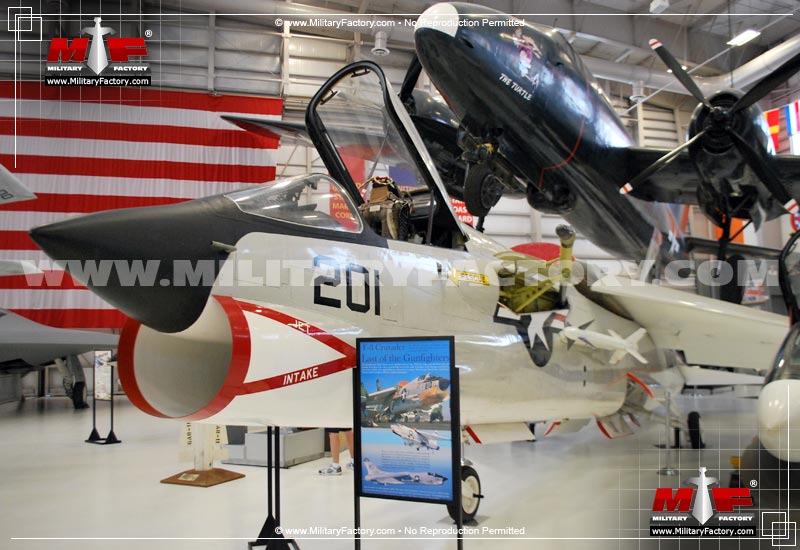
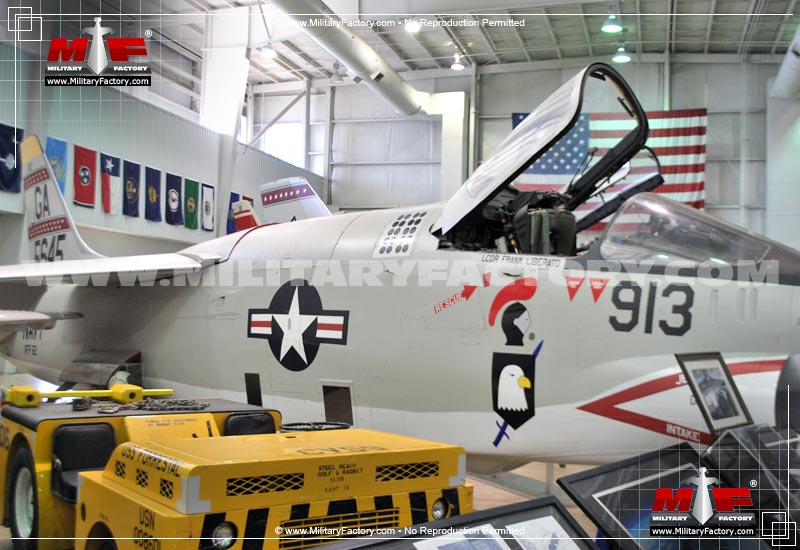
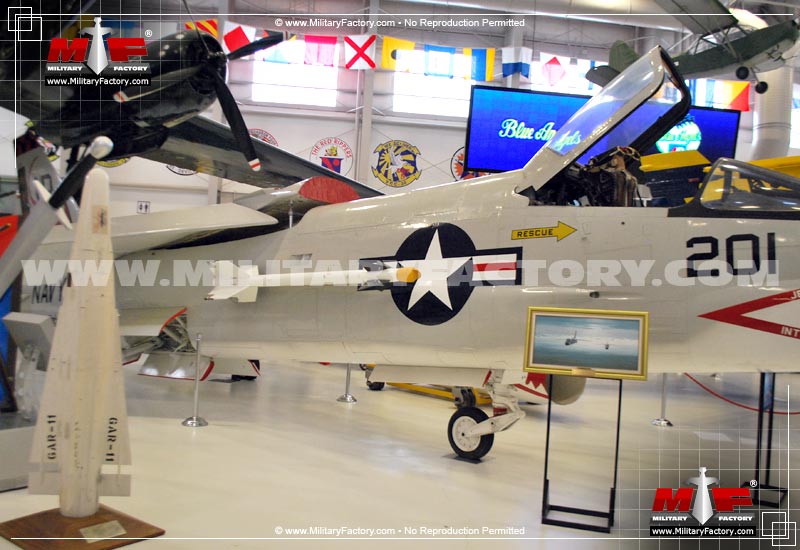
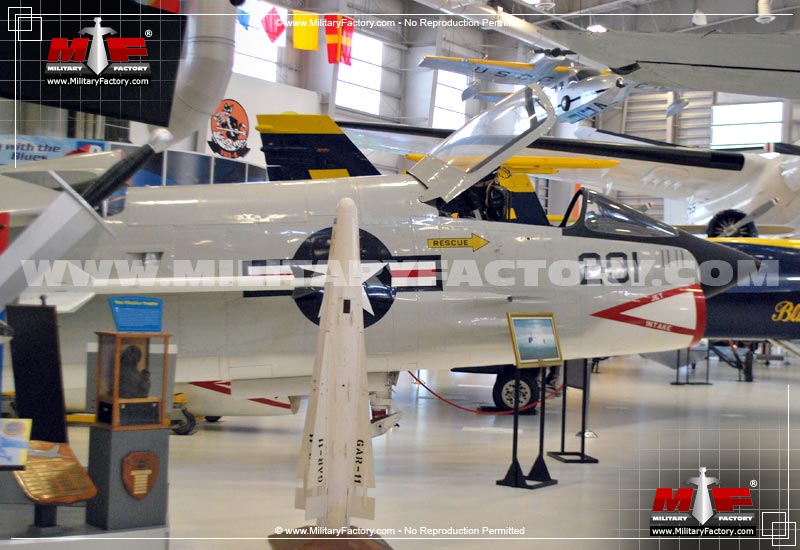
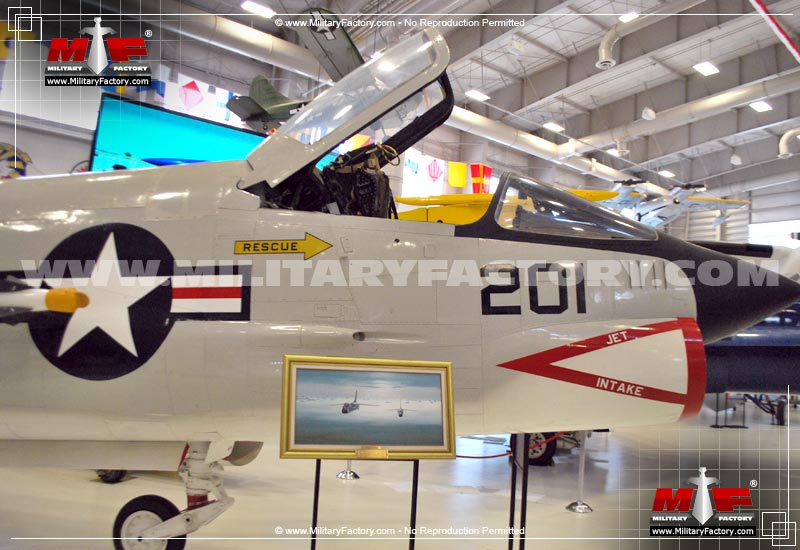
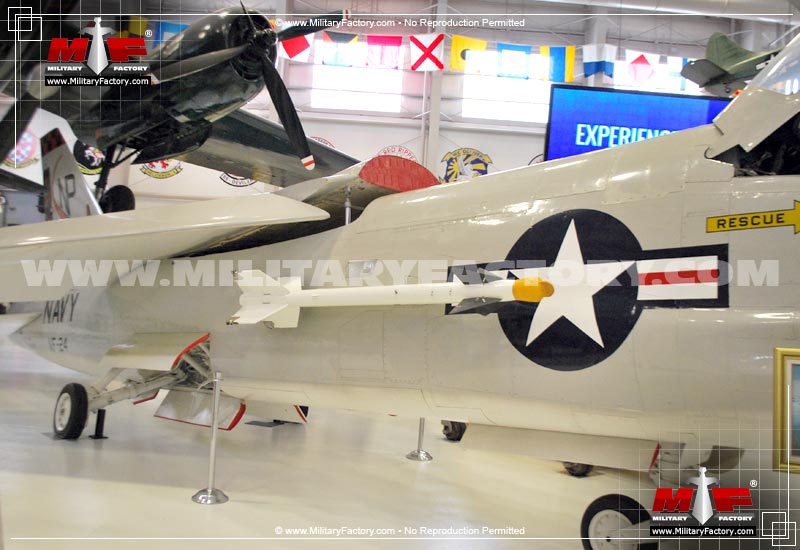
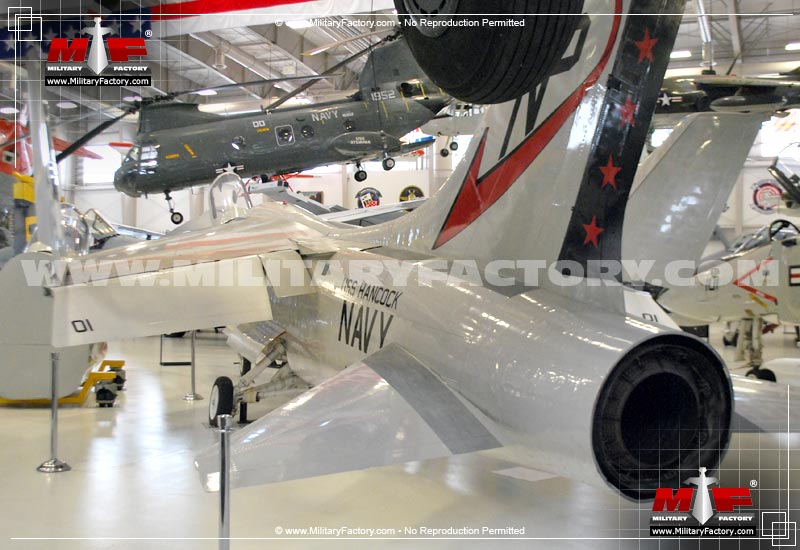
The Vought-produced F-8 Crusader was a direct response to a Navy need for a supersonic carrier-based fighter platform. Utilizing nearly the identical powerplant of the F-100 Super Sabre, the F-8 Crusader became the world's first carrier-based aircraft to break the speed of sound. Appearing like a conglomeration of the F-100 Super Sabre and A-7 Corsair II, the F-8 Crusader featured an elongated fuselage with a high wing assembly. A single rudder sat atop the powerplant that, in the end, would go on to generate 18,000 lbs of thrust with afterburn capability. The F-8 Crusader was piloted by a single crewmember and fitted with a standard array of weapons for air-to-air and air-to-surface duty. The system would go on to see combat action in the skies over Vietnam with the United States Marine Corps and the United States Navy.
Of eight initial submissions, the Vought F-8 was selected by the United States Navy for prototype development. Carrier operations required specialized subsystems of aircraft, none more so important than the ability to take off from a short distance, have an integrated tailhook system for short-based landings and feature reinforced landing gear systems capable of withstanding the force of carrier-based landings. The F-8 Crusader fit the bill with the initial production version billed as the F8U-1.
The F8U-1 featured additional underwing-based missile rails, a feature not found on the initial prototypes. The aircraft itself proved quite capable of supersonic flight and set various speed and endurance records in its infancy. In fact, it would be future astronaut and future United States Senator John Glenn would pilot a reconnaissance version from one coast to the other in just over 3 hours. 1962 saw the United States Navy adapt the more accepted aircraft designation system of the United States Air Force. Thusly all Crusader variants would inherit new designations based on this change.
The F-8 Crusader sought to overcome a few engineering issues. Most notably was weight incurred from integrated folding wings for carrier storage, arrestor hook landing system and the reinforced landing gear components. The F-8 was engineering with a special tilting wing assembly that could move up 7 degrees from its resting position. This minor movement allowed the Crusader the ability to achieve the short take off and landings consistent with carrier operations.
The United States Navy and the United States Marines both utilized the F-8 Crusader in the Vietnam War, with its first use of combat on August 2 or 1964. After an attack by four North Vietnamese patrol boats on the USS Destroyer Maddox, four Crusaders dispatched from the USS Ticonderoga were able to sink one of the escaping vessels. The US Navy would go on to utilize the Crusader in more of a traditional dogfighting interceptor role whilst the US Marines operated it as a strike / attack aircraft.
In the end, the Crusader proved its worth and investment through action and resiliency. The F-8 would see frontline service for over four decades. The French Navy - Aeronavale - received a specially produced export version designated as the F-8E(FN). This system featured blown flaps to assist the aircraft in landing and taking off from the shorter and smaller French-made carriers. Fourty-two such examples were produced. France would eventually replace their F-8 Crusaders with the more modern Rafale fighters from 2000 onwards, being the last official operators of the F-8 weapon system.
Text ©2003-2009 www.MilitaryFactory.com • All Rights Reserved •
No Reproduction Without Permission • Corrections / Comments to MilitaryFactory at Gmail dot com
Last Revision: 9/18/2009
|
| |
|
|
| |
| Specifications for the Vought F-8 Crusader |
Dimensions: |
Length: 54.49ft (16.61m)
Width:35.17ft (10.72m)
Height: 15.75ft (4.80m)
|
Performance: |
About MACH |
Max Speed: 1,118mph (1,800kmh; 972kts)
Max Range: 600miles (966km)
Rate-of-Climb: 19,000ft/min (5,791m/min)
Service Ceiling: 58,704ft (17,893m; 11.1miles)
|
|
Structure: |
Accommodation: 1
Hardpoints: 4
Empty Weight: 19,925lbs (9,038kg)
MTOW: 34,000lbs (15,422kg)
|
Powerplant: |
| Engine(s): 1 x Pratt & Whitney J57-P-20A turbojet engine with afterburn generating 18,000lbs of thrust. |
|
Armament Suite: |
4 x 20mm cannons
Mission-specific armament included:
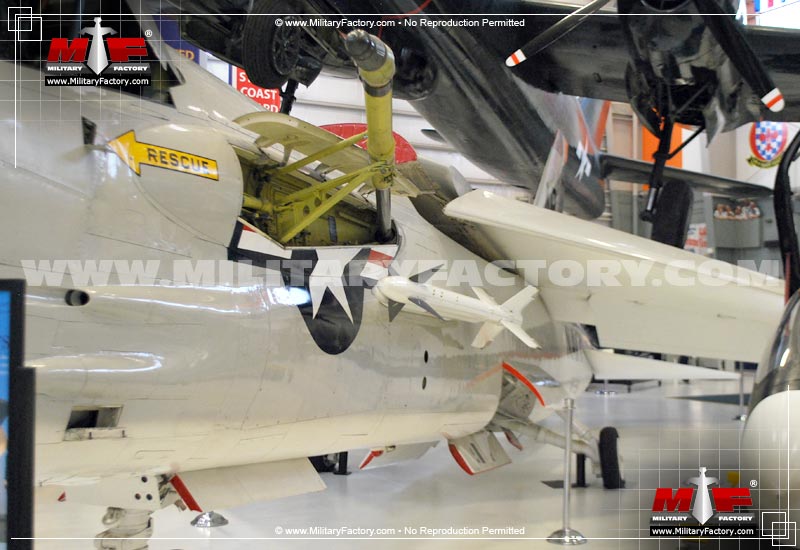
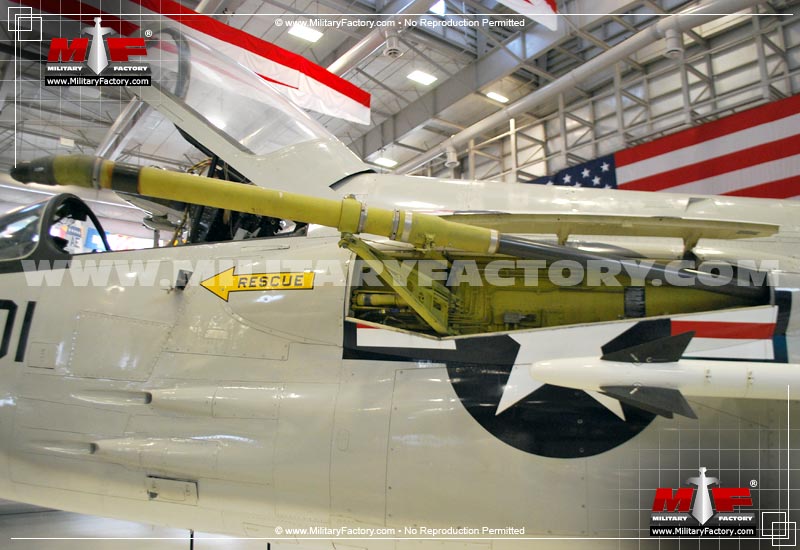
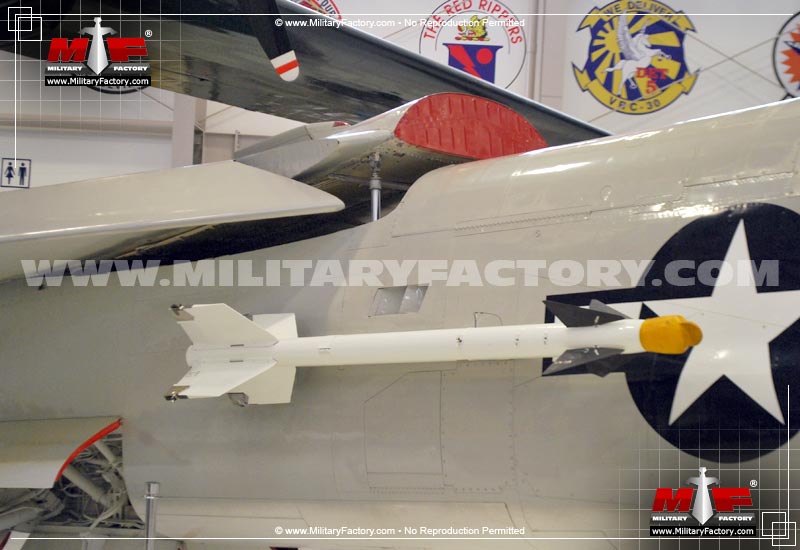
2 OR 4 x AIM-9 Sidewinder air-to-air missiles
2 x AGM12 Bullpup air-to-surface missiles
French Naval Variant consisted of:
4 x 20mm cannons
2 x Matra R.530 air-to-air missiles
4 x Matra Magic R.550 air-to-air missiles
|
|
|
| Pictures of the Vought F-8 Crusader |
|
| Special Aircraft Collections |
|
|
| Recent Military Aircraft Additions |
|
| Contacting MilitaryFactory.com |
| We can only get better if you tell us how. You can contact MilitaryFactory.com at MilitaryFactory at gmail dot com (replace "at" with "@" and "dot with ".") with any questions, comments or corrections. We also accept related military imagery that you approve for us to use on our website. Keep in mind, however, that due to volume, we may not directly respond to your inquiry. Please add us to your list of non-blocked recipients! |
|
|

Aircraft Quick Profile |

Image courtesy of the United States Department of Defense.
|
 |
 |
| 1957 |
Designation: Vought F-8 Crusader
Classification Type: Carrier-Borne Fighter
Contractor: Vought - USA
Country of Origin: United States
Production Total: 1,261 |
 |
|
Operators: France; Philippines; United States
|
|
|
|
| Variants |
F8U-1 - Initial Production Model
F8U-1P - Reconnaissance Variant
F8U-1E - Limited All-Weather Model with improved radar system.
F8U-2 - Improved radar system; Improved fire control system; Uprated J57-P-16 powerplant generating 16,900lbs of thrust with afterburn.
F8U-2N - Updated avionics systems; Uprated J57-P-20 powerplant increasing thrust to 18,000lbs.
F8U-2NE - Improved all-weather model with updated radar and fire control systems.
F-8A - F8U-1 Model Redesignated
F-8B - F8U-1E Model Redesignated
F-8C - F8U-2 Model Redesignated
F-8D - F8U-2N Model Redesignated
F-8E - F8U-2NE Model Redesignated
RF-8A - F8U-1P Model Redesignated
F-8E(FN) - French Naval Export Version; blown flaps for reduced landing speeds and provision for French-based Matra air-to-air missile systems to replace AIM-9 Sidewinders.
F-8P - Refurbished F-8H models exported to the Philippine Air Force.
|
|
|