Military Factory
Military Pay Chart
Global Firepower
Military Industrial Complex
Second World War
Home
Military Pay Scale
Military Ranks
Small Arms
Aircraft
Land Systems
Navy
Education
Military Factory Facebook Logo
flag of United States

McDonnell Douglas / Boeing T-45 Goshawk Naval Advanced Trainer Aircraft (1991)

Authored By Staff Writer | Last Updated: 12/3/2010

The US Navy T-45 Goshawk is a highly-modified version of the BAe Hawk land-based trainer - revised for the rigors of carrier operations.

Find a School Near You
Follow Military Factory on Facebook:
Trending on Military Factory:
Recent Articles:
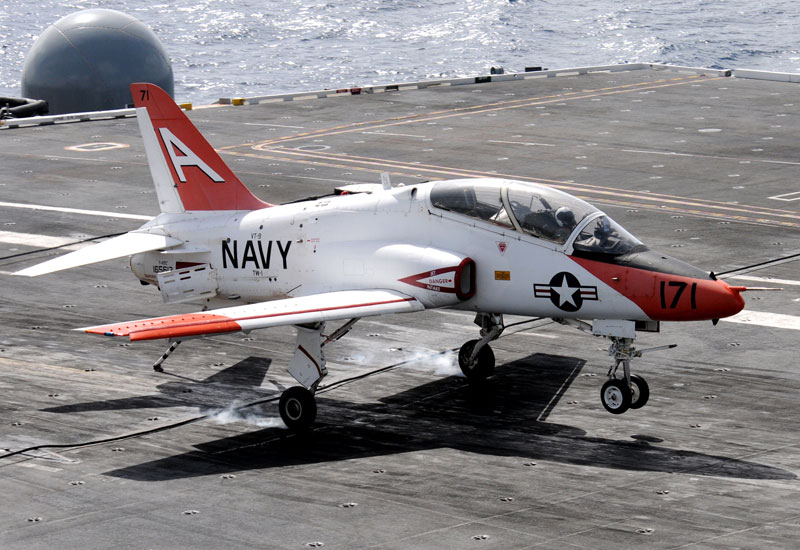
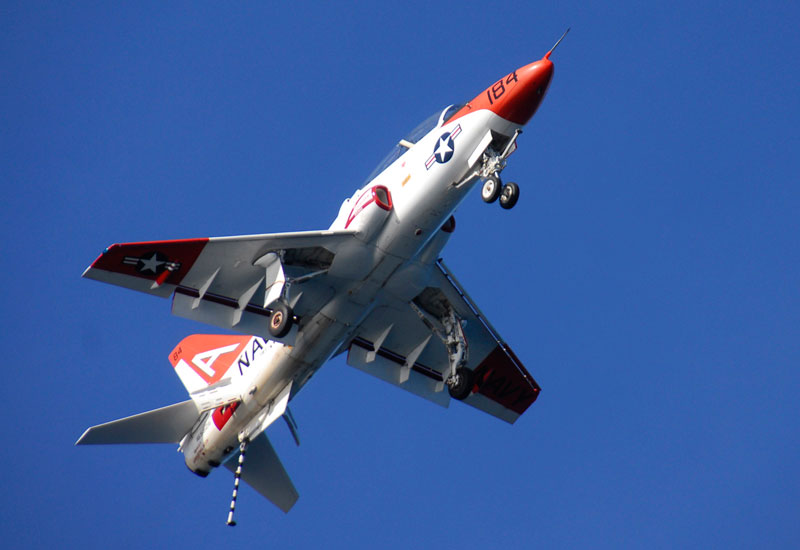
The McDonnell Douglas/Boeing T-45 Goshawk is a navalized version of the land-based British Aerospace (now BAe Systems) Hawk - specifically the Hawk Mk.60 mark. Unlike the land-based Hawk, however, the Goshawk is utilized by the United States Navy as a carrier-borne trainer. BAe Systems and McDonnell Douglas, the latter now serving as a subsidiary of The Boeing Company, have jointly produced the Goshawk trainer which serves both the US Navy and USMC aviation training programs. Despite its 1990s pedigree, the T-45 is expected to serve the American military well into 2035. To date, over 200 Goshawk airframes have been delivered.

The original BAe Systems Hawk - debuting on August 21st, 1974 - is used by Australia, Bahrain, Canada, Finland, India, Indonesia, Kenya, Kuwait, Malaysia, Oman, Saudi Arabia, South Africa, South Korea, the United Kingdom, the United Arab Emirates and Zimbabwe. These often retain their ground attack capabilities to serve as a cost-effective, dual-role performer. Finland became the first foreign recipient of the Hawk and the aircraft also forms the inventory of the famed British Royal Air Force's "Red Arrows" acrobatic team as well as acting as the primary jet trainer of the Royal Air Force proper. Switzerland at one point fielded Hawks beginning in 1992 but have since retired their fleet in 2002 and sold several to Finland in 2007.

In 1977, the United States Navy found itself probing for solutions to upgrade its existing fleet of aging North American T-2C "Buckeye" and Douglas TA-4J "Skyhawk II" jet-powered trainers with a modernized advanced carrier-based type. The next logical step became the formation of the "VTXTS" program in 1978 to oversee the requirement. British Aerospace seized the opportunity and forged an alliance with American-based McDonnell Douglas to promote the aircraft as a possible development. The USN took to the proposal and thusly awarded the joint venture a production contract in 1981 - this version of the Hawk to be a heavily modified form to fulfill the USN requirement for carrier-based operations.

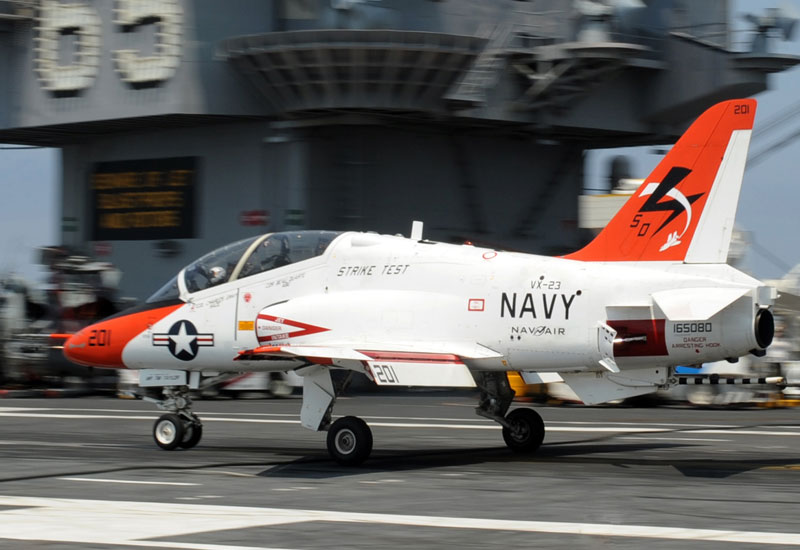
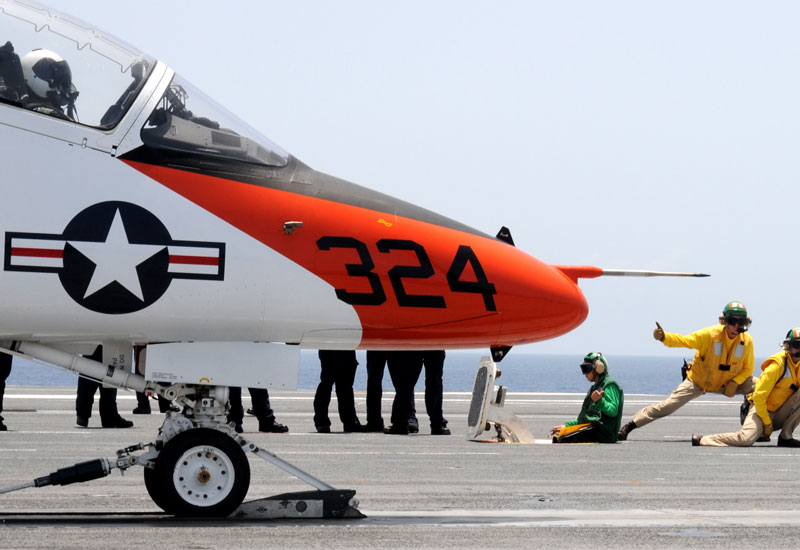
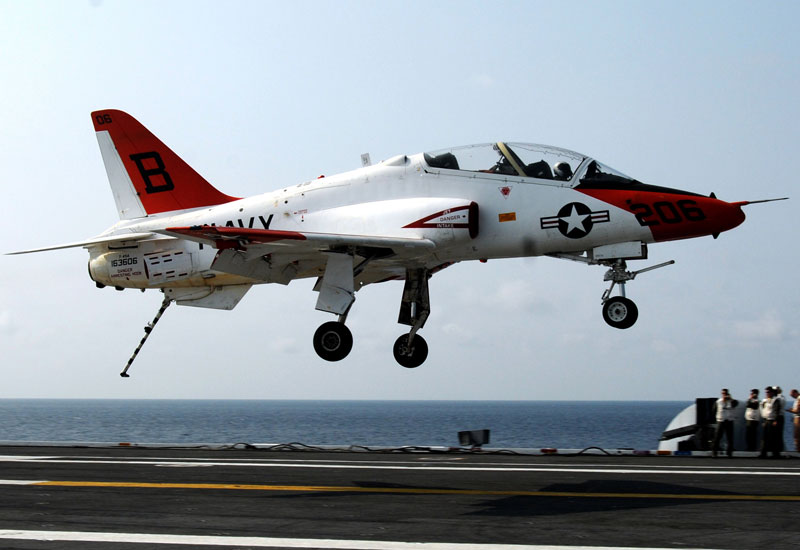
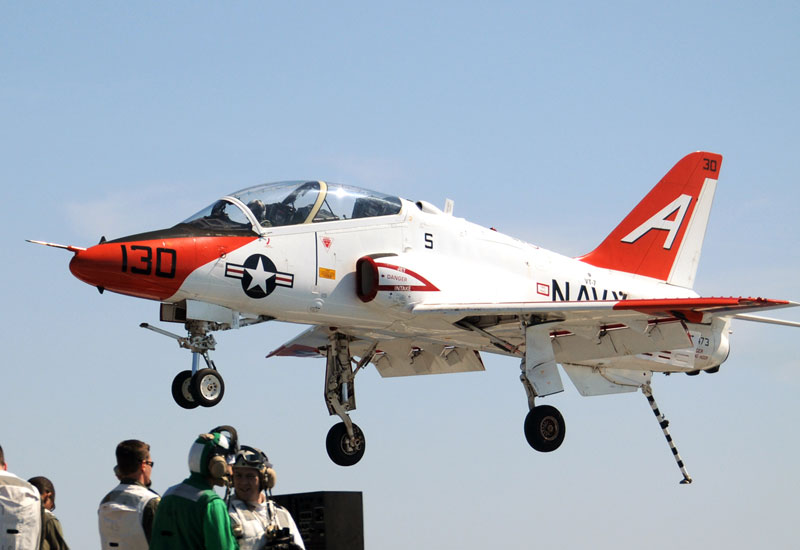
While the base Hawk airframe was left relatively untouched, revisions were enacted to include a reinforced structure applicable to the rigors of carrier work. A tail arrestor hook and catapult provisions were installed and the landing gear spacing was revised. Improvements were made to the aircraft's low-speed qualities to be more in line with those as required by carrier landings. First flight of the revised Hawk occurred on April 16th, 1988 and formal introduction into USN service followed in 1991 under the nickname of "Goshawk". Component production was split between facilities in England and in the United States with the British handling the wings, main fuselage, intakes and the vertical tail fin while the Americans took to installation of the tail wings, cockpit and nose assembly, the undercarriage and engines as well as final assembly. British Aerospace became BAe Systems while McDonnell Douglas was eventually absorbed by aviation giant Boeing in the late 1990s - thusly changing the formal designation of the T-45 Goshawk only by brand name.

The Goshawk has existed in only two major variants beginning with the base T-45A two-seat advanced jet trainer. These were originally fielded with analog-based cockpits consistent with the time. The T-45C was later developed as an upgraded and improved version of the T-45A series. Improvements included the introduction of inertial navigation and a digital cockpit. As such, the T-45C model now represents the newest Goshawk standard to which all previous T-45A models are being upgraded to via the T-45 "RAMP" initiative ("Required Avionics Modernization Program"). The T-45C began deliveries in December of 1997.

It is of note that the designation of "T-45B" did exist. This was a proposed Goshawk development that would have produced a land-based variant of the T-45A sans the inherent carrier capabilities. The initiative began in 1994 though any fruitful development on the T-45B was eventually halted in favor of more cost effective alternatives.

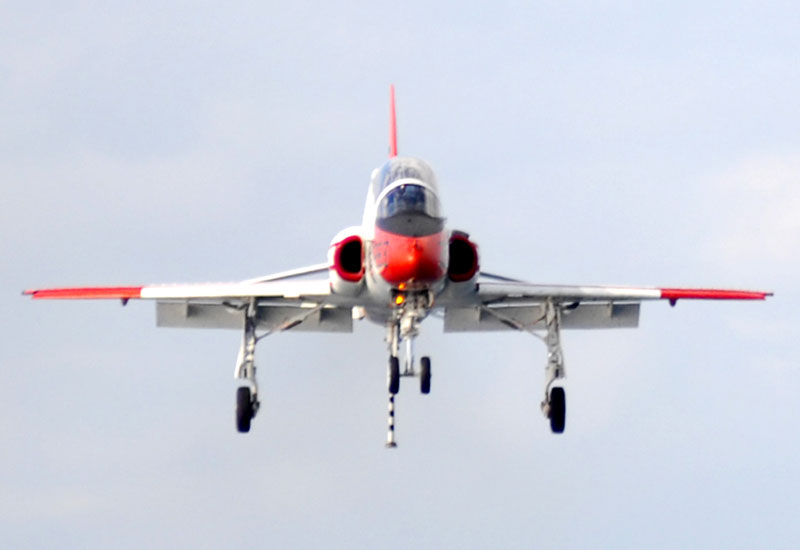
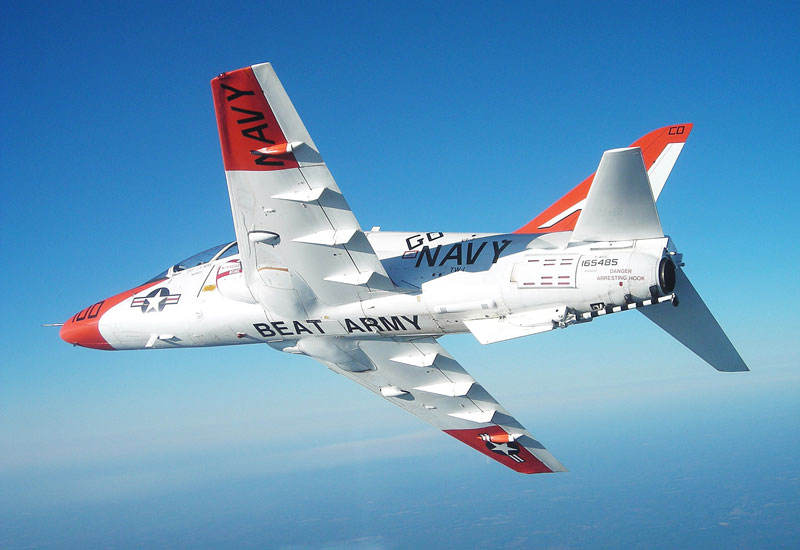
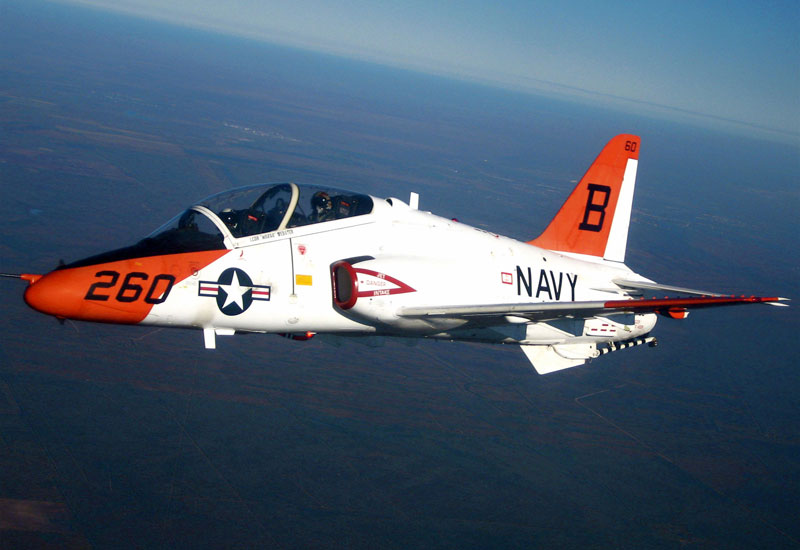
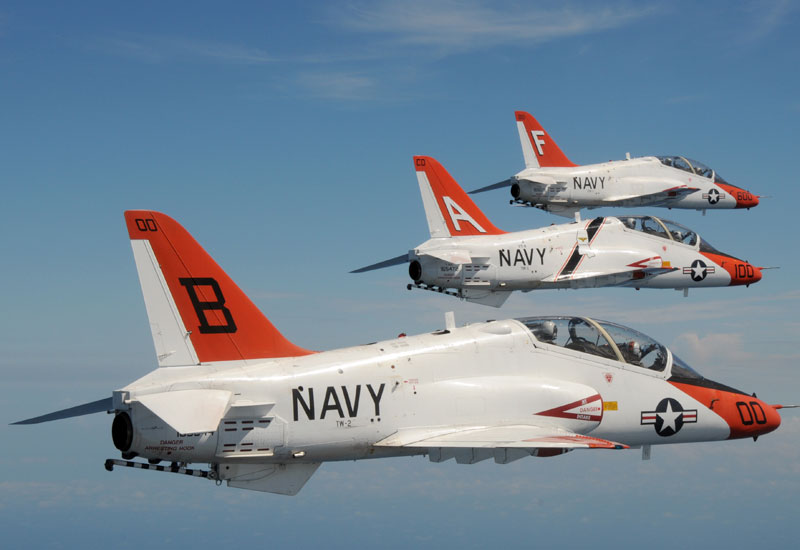
Externally, the T-45 series features twin seating for student (front) and instructor (rear) in a tandem arrangement. Design of the aircraft is quite conventional by any standard and sports a forward-set cockpit with excellent visibility over the nose and to the sides. The instructor maintains a commanding view up and over the forward cockpit. The fuselage is relatively short and sports two small, oval intakes to each side, aspirating the single engine mounting buried within the middle-aft fuselage. Wings are low-mounted with sweep along the leading edge and a straight trailing edge. The fuselage spine tapers down to form the base of the single vertical tail fin which is further complemented by a pair of swept horizontal tail surfaces mounted higher than the main wing assemblies. The engine exhausts through a ring at the extreme aft of the fuselage. The undercarriage is fully retractable and is of a tricycle arrangement. The nose leg retracts upwards under the cockpit floor while the main legs fold towards centerline. All landing gear legs are single-wheeled. An arrestor hook for snatching deck cables is fitted to the rear underside under the empennage base.

The aircraft is powered by a British/French Rolls-Royce Turbomeca F405-RR-401 turbofan engine (also known as the "Adour") delivering up to 5,527 lbs of thrust. Maximum speed is listed at 645 miles per hour with a range out to 805 miles. Service ceiling is approximately 42,500 feet with a rate-of-climb nearing 8,000 feet per minute.

As a dedicated trainer aircraft, the Goshawk does not carry any official USN inventory armament but can be fitted with ordnance loads in the form of practice bombs or rocket pods as well as external fuel stores for increased ranges. Beyond this capability, cargo pods may also be carried as required.

Incidentally, the term "Goshawk" is related to a bird of prey species.
Text ©2003-2013 www.MilitaryFactory.com • All Rights Reserved • No Reproduction Permitted
MilitaryFactory.com does NOT sell equipment/weaponry. Material presented throughout this website is for historical and entertainment value and should not to be construed as usable for hardware restoration, maintenance or general operation. Please consult manufacturers for such information. Our disclaimer. Email corrections / Comments to MilitaryFactory at Gmail dot com.
Picture of McDonnell Douglas / Boeing T-45 Goshawk
Pic of the McDonnell Douglas / Boeing T-45 Goshawk
Image of the McDonnell Douglas / Boeing T-45 Goshawk
View All Images (17)

Specifications for the
McDonnell Douglas / Boeing T-45 Goshawk
Naval Advanced Trainer Aircraft


Country of Origin: United States
Manufacturer: British Aerospace - UK / McDonnell Douglas / Boeing - USA
Initial Year of Service: 1991
Production: 207


Focus Model: McDonnell Douglas / Boeing T-45A Goshawk
Crew: 2


Length: 39.34ft (11.99m)
Width: 30.81ft (9.39m)
Height: 13.39ft (4.08m)
Weight (Empty): 9,833lbs (4,460kg)
Weight (MTOW): 14,081lbs (6,387kg)


Powerplant: 1 x Rolls-Royce Turbomeca F405-RR-401 turbofan developing 5,527lbf of thrust.


Maximum Speed: 645mph (1,038kmh; 560kts)
Maximum Range: 800miles (1,288km)
Service Ceiling: 42,487ft (12,950m; 8.0miles)
Rate-of-Climb: 8,000 feet per minute (2,438m/min)


Hardpoints: 3
Armament Suite:
None. Practice bombs, rocket pods and fuel tanks possible as is a cew equipment cargo pod.


Variants:
T-45A - Initial Production Model Designation; base trainer.


T-45B - Proposed land-based T-45A version for use by the USN; since abandoned.

T-45C - Based on T-45A with revised glass cockpit and improvements throughout; currently the standardized Goshawk.


Operators: United States

ALL AIRCRAFT CATEGORIES

BY DECADE:


1900 to 1909
1910 to 1919
1920 to 1929
1930 to 1939
1940 to 1949
1950 to 1959
1960 to 1969
1970 to 1979
1980 to 1989
1990 to 1999
2000 to 2009
2010 to 2019
2020 to 2029
VIEW ALL
Compare Aircraft


BY TYPE:


Anti-Submarine Warfare (ASW)
Attack Helicopters
Bomber Aircraft
Medium Bombers
Heavy Bombers
Close-Air Support (CAS)
Commercial Aircraft
Dive Bombers
Electronic Warfare Aircraft (EWA)
Experimental / X-Planes
Fighter Aircraft
Floatplane Aircraft
Flying Boat Aircraft
Aerial Refueling Tankers
Helicopters (ALL)
Interceptor Aircraft
Multi-Role Aircraft
Navy Carrier Aircraft
Night Fighters
Reconnaissance / Scout
Search & Rescue (SAR)
Scout Helicopters
Special Purpose
Torpedo Bombers
Trainer Aircraft
Transport Aircraft
Transport Helicopters
Unmanned Aerial Vehicles (UAVs)
Unmanned Combat Air Vehicles (UCAVs)


COLLECTIONS:


4th Generation Fighter Aircraft
5th Generation Fighter Aircraft
US X-Planes
Classic US Warbirds
French Military Helicopters
Grumman "Cats"
Howard Hughes Aircraft
Indian Air Force
Israeli Air Force
Libyan Aircraft
Modern Chinese Aircraft
Modern Chinese Fighters
Modern Military Aircraft
Modern North Korean Aircraft
Modern Trainer Aircraft
Modern US Aircraft
Mikoyan Aircraft
Sukhoi Aircraft
Syrian Aircraft
Top 10 Fighter Aircraft of All Time


AIRCRAFT BY CONFLICT:


Arab-Israeli War (1948)
Cuban Missile Crisis (1959-1962)
Falklands War (1982)
Indo-Pak War (1965, 1971)
Iran-Iraq War (1980-1988)
Lebanon War (1982)
Operation Allied Force (1999)
Operation Desert Storm (1991)
Six Day War (1967)
Spanish Civil War (1936)
Soviet-Afghan War (1979-1989)
Yom Kippur War (1973)


MISCELLANEOUS:


Aircraft Cockpits
Aircraft Manufacturers List
Aircraft Timeline

WORLD WAR 2:


1939 Aircraft
1940 Aircraft
1941 Aircraft
1942 Aircraft
1943 Aircraft
1944 Aircraft
1945 Aircraft
1946 Aircraft
Australian Aircraft
Battle of Britain Aircraft
Bombers
Four-Engine Bombers
British Aircraft
British Bombers
British Transports
Dive Bombers
Canadian Aircraft
Fighters
Chinese Aircraft
French Aircraft
German Aircraft
German Fighters
German Flying Boats
German Jets
Secret Weapons of the Luftwaffe
Italian Aircraft
Imperial Japanese Aircraft
Imperial Japanese Fighters
Mitsubishi Bombers
Navy Aircraft
Pearl Harbor
Polish Aircraft
Romanian Aircraft
US Aircraft
US Bombers
US Navy Aircraft
Soviet Aircraft
Torpedo Bombers
Transport Aircraft
Tuskegee Airmen Aircraft
W.A.S.P. Aircraft
WW2 Aircraft Ranked by Speed
VIEW ALL


WORLD WAR 1:


1914 Aircraft
1915 Aircraft
1916 Aircraft
1917 Aircraft
1918 Aircraft
Aircraft Timeline
Austro-Hungarian Aircraft
Bomber Aircraft
British Aircraft
Fighters
Flying Boats
French Aircraft
Imperial German Aircraft
Italian Aircraft
Scout Aircraft
Russian Empire Aircraft
US Aircraft
WW1 Aircraft Ranked by Speed
VIEW ALL


KOREAN WAR:


Australian Aircraft
Korean War Aces
Korean War Jets
North Korean Aircraft
US Military Aircraft
VIEW ALL


VIETNAM WAR:


Helicopters
North Vietnam Air Force
US Airpower
VIEW ALL


COLD WAR:


1950s French Aircraft
British V-Bombers
Cold War Bombers
Soviet Aircraft
Soviet Bombers
Soviet Interceptors
Soviet Helicopters
Strategic Air Command
US Aircraft
US Bombers
US Interceptors
VIEW ALL

Site Disclaimer | Privacy Policy | Site Map | MF Origins


©2013 www.MilitaryFactory.com • Content ©2003-2013 MilitaryFactory.com • All Rights Reserved • Site Contact Email: militaryfactory at gmail dot com. The "Military Factory" name and MilitaryFactory.com logo are registered ® trademarks and protected by all applicable domestic and international intellectual property laws.


Top MF Stuff: 2013 Military Pay Scale | Military Ranks | WW2 Weapons | Sniper Rifles | Kts to Mph | WW1 Aircraft | Automatic Rifles | Aircraft Cockpits | Vietnam War Weapons | Main Battle Tanks | Submachine Guns | Shotguns | French Military Victories


Most photographic images appearing on this site are courtesy of the United States Department of Defense and are approved for public use. Other images acquired through the public domain. Digital art work courtesy of Dan Alex. Business Consulting by Kyle Williams. Material presented throughout this website is for historical and entertainment value and should not to be construed as usable for hardware restoration, maintenance or general operation. Please consult manufacturers for such information.


eXTReMe Tracker