Military Factory
Military Pay Chart
Global Firepower
Military Industrial Complex
Second World War
Home
Military Pay Scale
Military Ranks
Small Arms
Aircraft
Land Systems
Navy
Education
Military Factory Facebook Logo
flag of United States

Boeing E-6 Mercury Naval Communications Relay / Airborne Command Post (1989)

Authored By Staff Writer | Last Updated: 11/15/2012

The Boeing E-6 Mercury was developed to a US Navy requirement and has been serving actively since August of 1989.

Find a School Near You
Follow Military Factory on Facebook:
Trending on Military Factory:
Recent Articles:
The Boeing E-6 Mercury was original developed for the United States Navy as an airborne command and communications relay platform to replace the outgoing Lockheed EC-130Q "TACAMO" ("Take Charge And Move Out") series. The EC-130Q was a C-130H production model outfitted with VLF transmitters which allowed for direct communications with ballistic missile submarines to which 18 of the type were eventually delivered. This level of secure, high-level communications was of paramount interest during the dark days of the Cold War, particularly concerning launching of nuclear weapons. If ground-based communications were to be wiped out in an attack, such aircraft would be called upon to fill the void. The E-6, therefore, served in the same principle role as the EC-130Q before it, the newer airframe being based on the capable Boeing 707-320 series. However, the E-6 further broadened communications capabilities to interact with other command aircraft in the skies.

NOTE: The E-6 initiative was originally slated to carry the name of "Hermes" though this was later given up for the "Mercury" name at the behest of the USN.

Boeing took to modifying their existing 707-320 airframe to incorporate all manner of advanced hardware to suit the US Navy requirement. First flight for the aircraft was recorded on February 19th, 1987 and, following several years of active testing, the E-6 Hermes was formally introduced into USN service in August of 1989. The initial squadron receiving the type was VQ-3 (the "Ironmen") in 1991 followed by VQ-4 ("Shadows"). It was also in 1991 that the "Hermes" name was dropped in favor of the "Mercury" name. Initial production forms - 16 of them emerging from Boeing facilities - were formally designated as "E-6A".

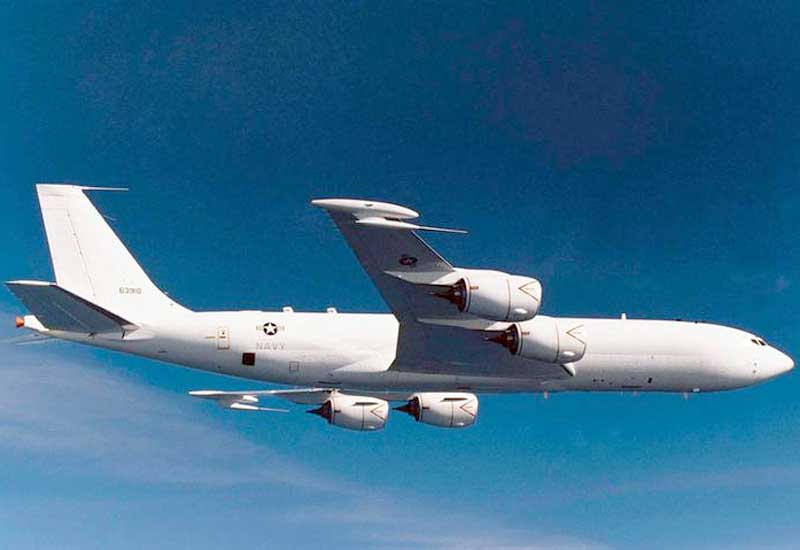
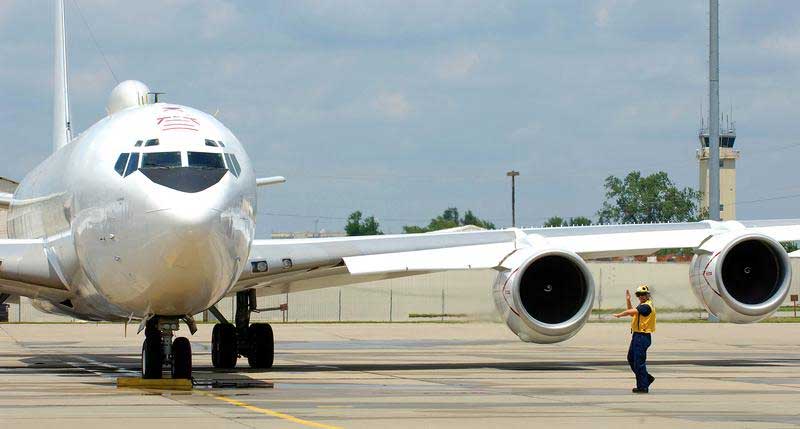
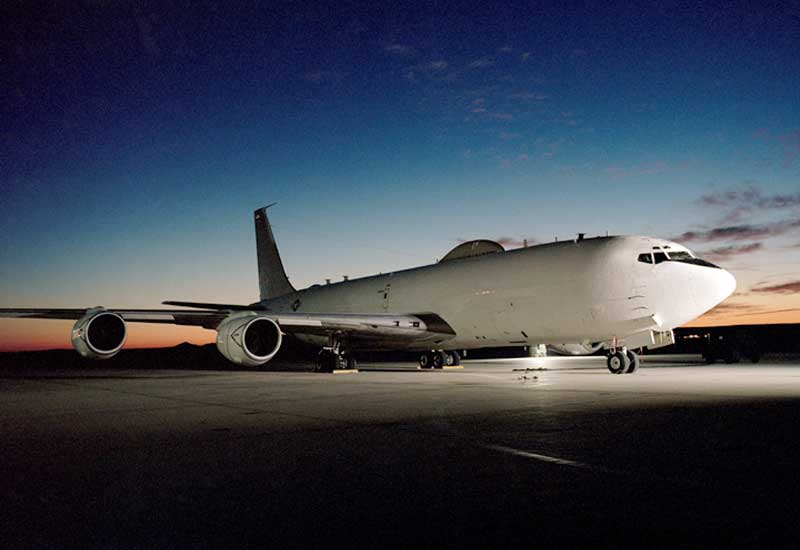
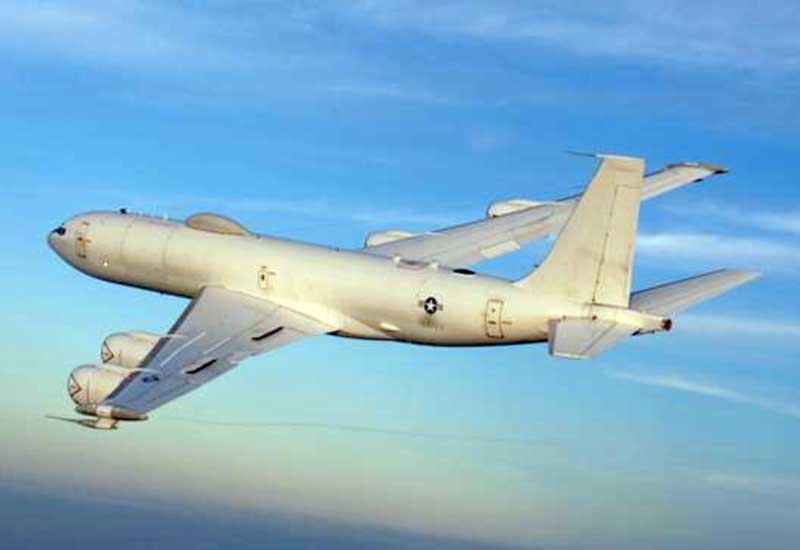
Aside from the occasional communications protrusions, the E-6 carried the same general appearance of the Boeing 707-320 model. The fuselage was tubular, long and sleek with the flight deck hell well forward, aft of a short nose cone assembly. The empennage consisted of a single tall vertical tail fin with a low-set pair of horizontal tailplanes. Dual-trailing antennas are noted at the rear of the fuselage. The main wings were low-mounted along the fuselage sides and well-swept rear-wards. Each wing carried a pair of underslung engine nacelles. Power was delivered through the four-engined configuration via 4 x CFM International F108-CF-100 series turbofan engines. This provided the airframe with a top speed of 600 miles per hour out to a range of 7,300. Internally, the E-6 housed a fully-secure communications suite incorporating UHF, VHF and base High-Frequency channels. A pair of underwing pods were fitted to house the required UHF satellite and ESM (Electronic Support Measures) receivers. The base crew included two pilots, two flight crew and up to twenty mission specialists. Workstations numbered four and eight bed bunks were set aside for sleep as required, allowing the E-6 to remain on station for hours on end.

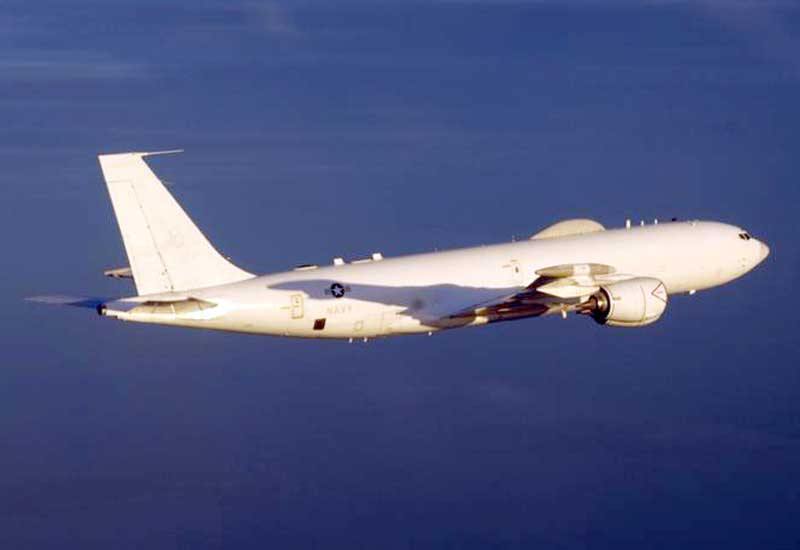
In the early 2000s, Raytheon was charged with upgrading the existing E-6A fleet with UHF C3FDM radio equipment, new workstation consoles ("battlestaff"), the Airborne Launch Control System (ALCS) and the Digital Airborne Intercommunications Switching System (DIASS). Inclusion of the ALCS was of particular note for it now supplied the E-6 management over land-based ballistic missile launching as well, further broadening the strategic scope of the E-6 family. In this way, the E-6 now became a "dual-role" performer over that of the original design. The cockpit was further upgraded to the all-glass look and function of the Boeing 737 "Next Generation" series (this primarily in response to the requirement of Global Air Traffic Management (GATM)). Key physical changes to the E-6 structure included a bulged section of fuselage spine located aft of the cockpit, easily identifying the new "E-6B" standard - the bulge housing a new SATCOM antenna array. Engines were 4 x CFM International CFM-56-2A-2 series high-bypass turbofans providing a maximum speed of 600 miles per hour with a range out to 7,600 miles and service ceiling of 40,000 feet. Initial E-6B models were delivered in December of 1997 and all of the remaining original E-6A production models have since been upgraded to the newer E-6B standard (the final E-6B was delivered in 2003).

In September of 1998, the E-6B was selected to replace the Lockheed EC-135 "Looking Glass" airborne command post system for the United States Air Force. The Looking Glass initiative was put in place to counter the loss of the Global Operations Center (GOC) out of Offutt AFB, Nebraska in the event of all-out war - giving the E-6 fleet control over much of America's nuclear ballistic capability.

The E-6 maintains an active status in the US military inventory as of November 2012. VQ-3 and VQ-4 remain the only squadrons managing E-6 usage and are based out of Tinker AFB in Oklahoma.
Text ©2003-2013 www.MilitaryFactory.com • All Rights Reserved • No Reproduction Permitted
MilitaryFactory.com does NOT sell equipment/weaponry. Material presented throughout this website is for historical and entertainment value and should not to be construed as usable for hardware restoration, maintenance or general operation. Please consult manufacturers for such information. Our disclaimer. Email corrections / Comments to MilitaryFactory at Gmail dot com.
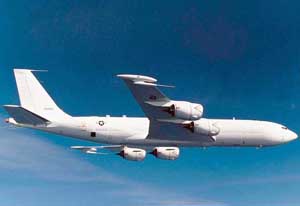
Picture of Boeing E-6 Mercury
Pic of the Boeing E-6 Mercury
Image of the Boeing E-6 Mercury
View All Images (5)

Specifications for the
Boeing E-6 Mercury
Naval Communications Relay / Airborne Command Post


Country of Origin: United States
Manufacturer: Boeing Company - USA
Initial Year of Service: 1989
Production: 16


Focus Model: Boeing E-6B Mercury
Crew: 4 + 20


Length: 150.26ft (45.8m)
Width: 148.29ft (45.20m)
Height: 42.65ft (13.00m)
Weight (Empty): 172,842lbs (78,400kg)
Weight (MTOW): 340,394lbs (154,400kg)


Powerplant: 4 x CFM International CFM-56-2A-2 turbofan engines developing 20,000lbs thrust each.


Maximum Speed: 603mph (970kmh; 524kts)
Maximum Range: 7,519miles (12,100km)
Service Ceiling: 40,026ft (12,200m; 7.6miles)
Rate-of-Climb: 0 feet per minute (0m/min)


Hardpoints: 0
Armament Suite:
None.


Variants:
E-6A - Initial production model; based on the Boeing 707-320 airliner; 4 x CFM International F108-CF-100 turbofan engines; HF, VHF and UHF radio; UHF satellite communications; underwing pods for ESM and UHF receivers.


R-6B - Upgraded (Raytheon) standard appearing in 1997; all-glass 737NG cockpit; ALCS; DAISS; UHF C3FDM radio suite; "battlestaff" operator consoles; identified by the bulge fuselage spine housing the SATCOM array.


Operators: United States

ALL AIRCRAFT CATEGORIES

BY DECADE:


1900 to 1909
1910 to 1919
1920 to 1929
1930 to 1939
1940 to 1949
1950 to 1959
1960 to 1969
1970 to 1979
1980 to 1989
1990 to 1999
2000 to 2009
2010 to 2019
2020 to 2029
VIEW ALL
Compare Aircraft


BY TYPE:


Anti-Submarine Warfare (ASW)
Attack Helicopters
Bomber Aircraft
Medium Bombers
Heavy Bombers
Close-Air Support (CAS)
Commercial Aircraft
Dive Bombers
Electronic Warfare Aircraft (EWA)
Experimental / X-Planes
Fighter Aircraft
Floatplane Aircraft
Flying Boat Aircraft
Aerial Refueling Tankers
Helicopters (ALL)
Interceptor Aircraft
Multi-Role Aircraft
Navy Carrier Aircraft
Night Fighters
Reconnaissance / Scout
Search & Rescue (SAR)
Scout Helicopters
Special Purpose
Torpedo Bombers
Trainer Aircraft
Transport Aircraft
Transport Helicopters
Unmanned Aerial Vehicles (UAVs)
Unmanned Combat Air Vehicles (UCAVs)


COLLECTIONS:


4th Generation Fighter Aircraft
5th Generation Fighter Aircraft
US X-Planes
Classic US Warbirds
French Military Helicopters
Grumman "Cats"
Howard Hughes Aircraft
Indian Air Force
Israeli Air Force
Libyan Aircraft
Modern Chinese Aircraft
Modern Chinese Fighters
Modern Military Aircraft
Modern North Korean Aircraft
Modern Trainer Aircraft
Modern US Aircraft
Mikoyan Aircraft
Sukhoi Aircraft
Syrian Aircraft
Top 10 Fighter Aircraft of All Time


AIRCRAFT BY CONFLICT:


Arab-Israeli War (1948)
Cuban Missile Crisis (1959-1962)
Falklands War (1982)
Indo-Pak War (1965, 1971)
Iran-Iraq War (1980-1988)
Lebanon War (1982)
Operation Allied Force (1999)
Operation Desert Storm (1991)
Six Day War (1967)
Spanish Civil War (1936)
Soviet-Afghan War (1979-1989)
Yom Kippur War (1973)


MISCELLANEOUS:


Aircraft Cockpits
Aircraft Manufacturers List
Aircraft Timeline

WORLD WAR 2:


1939 Aircraft
1940 Aircraft
1941 Aircraft
1942 Aircraft
1943 Aircraft
1944 Aircraft
1945 Aircraft
1946 Aircraft
Australian Aircraft
Battle of Britain Aircraft
Bombers
Four-Engine Bombers
British Aircraft
British Bombers
British Transports
Dive Bombers
Canadian Aircraft
Fighters
Chinese Aircraft
French Aircraft
German Aircraft
German Fighters
German Flying Boats
German Jets
Secret Weapons of the Luftwaffe
Italian Aircraft
Imperial Japanese Aircraft
Imperial Japanese Fighters
Mitsubishi Bombers
Navy Aircraft
Pearl Harbor
Polish Aircraft
Romanian Aircraft
US Aircraft
US Bombers
US Navy Aircraft
Soviet Aircraft
Torpedo Bombers
Transport Aircraft
Tuskegee Airmen Aircraft
W.A.S.P. Aircraft
WW2 Aircraft Ranked by Speed
VIEW ALL


WORLD WAR 1:


1914 Aircraft
1915 Aircraft
1916 Aircraft
1917 Aircraft
1918 Aircraft
Aircraft Timeline
Austro-Hungarian Aircraft
Bomber Aircraft
British Aircraft
Fighters
Flying Boats
French Aircraft
Imperial German Aircraft
Italian Aircraft
Scout Aircraft
Russian Empire Aircraft
US Aircraft
WW1 Aircraft Ranked by Speed
VIEW ALL


KOREAN WAR:


Australian Aircraft
Korean War Aces
Korean War Jets
North Korean Aircraft
US Military Aircraft
VIEW ALL


VIETNAM WAR:


Helicopters
North Vietnam Air Force
US Airpower
VIEW ALL


COLD WAR:


1950s French Aircraft
British V-Bombers
Cold War Bombers
Soviet Aircraft
Soviet Bombers
Soviet Interceptors
Soviet Helicopters
Strategic Air Command
US Aircraft
US Bombers
US Interceptors
VIEW ALL

Site Disclaimer | Privacy Policy | Site Map | MF Origins


©2013 www.MilitaryFactory.com • Content ©2003-2013 MilitaryFactory.com • All Rights Reserved • Site Contact Email: militaryfactory at gmail dot com. The "Military Factory" name and MilitaryFactory.com logo are registered ® trademarks and protected by all applicable domestic and international intellectual property laws.


Top MF Stuff: 2013 Military Pay Scale | Military Ranks | WW2 Weapons | Sniper Rifles | Kts to Mph | WW1 Aircraft | Automatic Rifles | Aircraft Cockpits | Vietnam War Weapons | Main Battle Tanks | Submachine Guns | Shotguns | French Military Victories


Most photographic images appearing on this site are courtesy of the United States Department of Defense and are approved for public use. Other images acquired through the public domain. Digital art work courtesy of Dan Alex. Business Consulting by Kyle Williams. Material presented throughout this website is for historical and entertainment value and should not to be construed as usable for hardware restoration, maintenance or general operation. Please consult manufacturers for such information.


eXTReMe Tracker