Military Factory
Military Pay Chart
Global Firepower
Military Industrial Complex
Second World War
Home
Military Pay Scale
Military Ranks
Small Arms
Aircraft
Land Systems
Navy
Education
Military Factory Facebook Logo
flag of United States

North American Rockwell OV-10 Bronco Observation / Light Attack Aircraft (1966)

Authored By Staff Writer | Last Updated: 10/17/2012

Boeing is considering bringing back the OV-10 Bronco due to increased global interest in a light strike aircraft of this type.

Find a School Near You
Follow Military Factory on Facebook:
Trending on Military Factory:
Recent Articles:
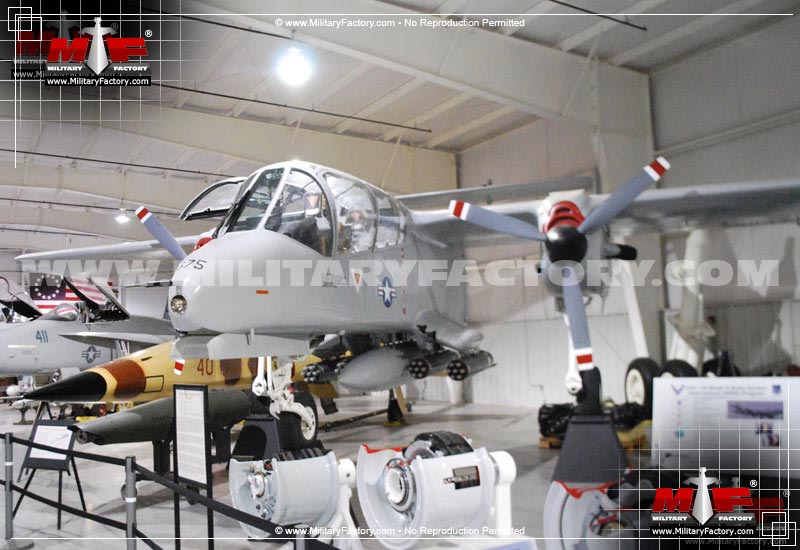
The North American/Rockwell OV-10 Bronco was developed through the United States Marine Corps Light Armed Reconnaissance Aircraft (LARA) program to provide the service branch with a multi-faceted performer that could handle armed reconnaissance and light strikes while operating with high loitering times from short and rugged runways. North American produced the NA-300, which was ultimately selected to become the Bronco in August of 1964. Seven YOV-10A prototypes emerged from the development of the NA-300 . First flight of the Bronco was achieved on July 16th, 1965 and was followed by a production contract in 1966 for the initial OV-10A models.

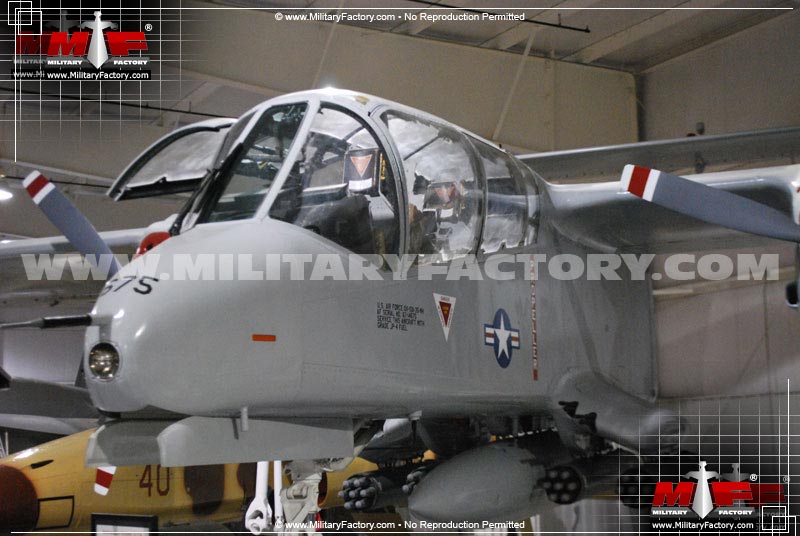
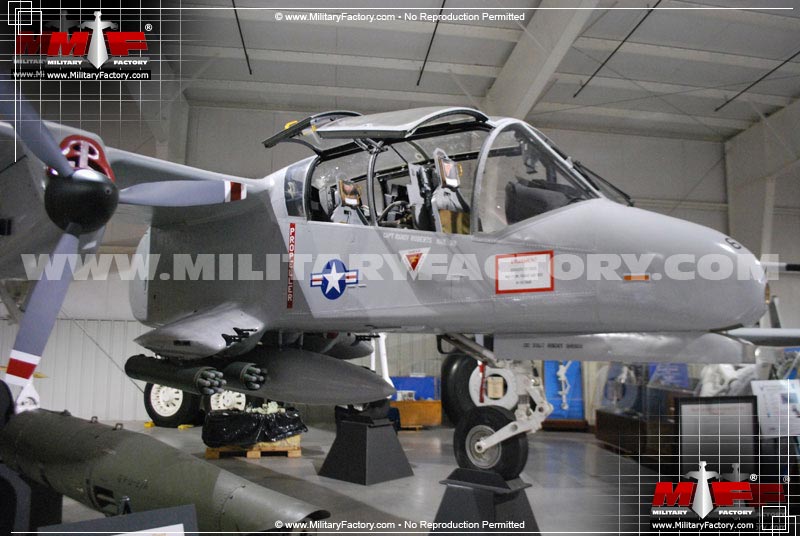
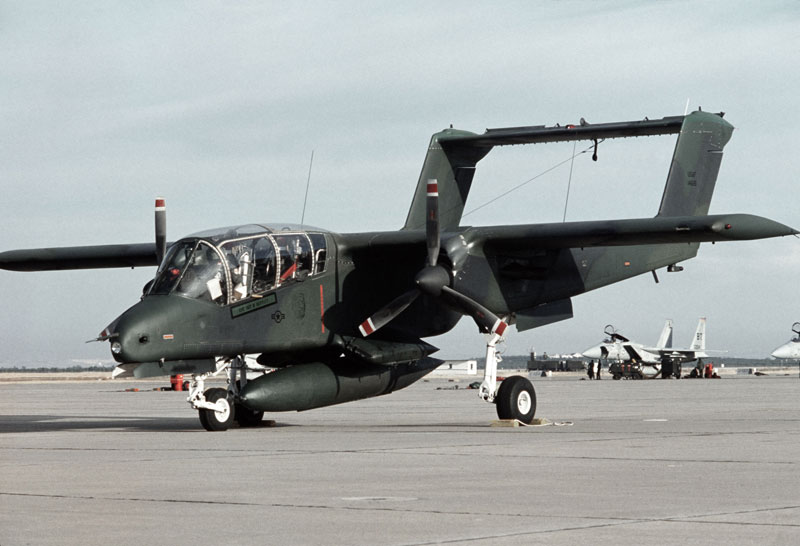
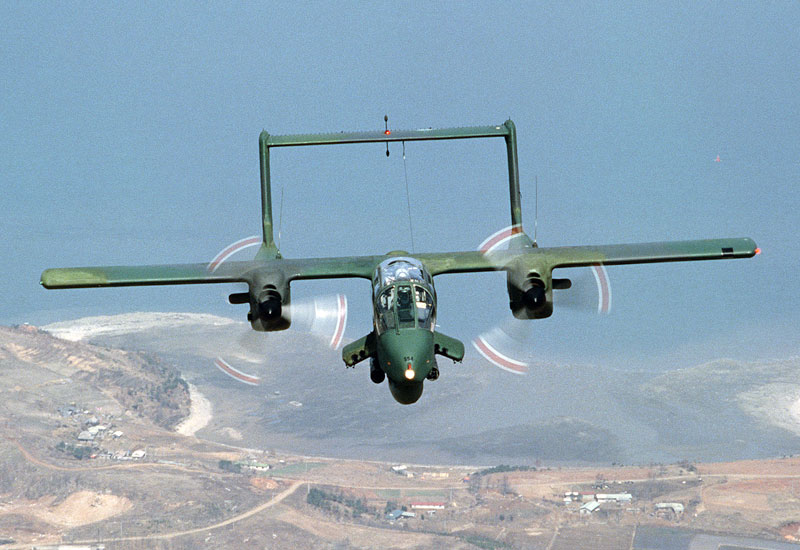
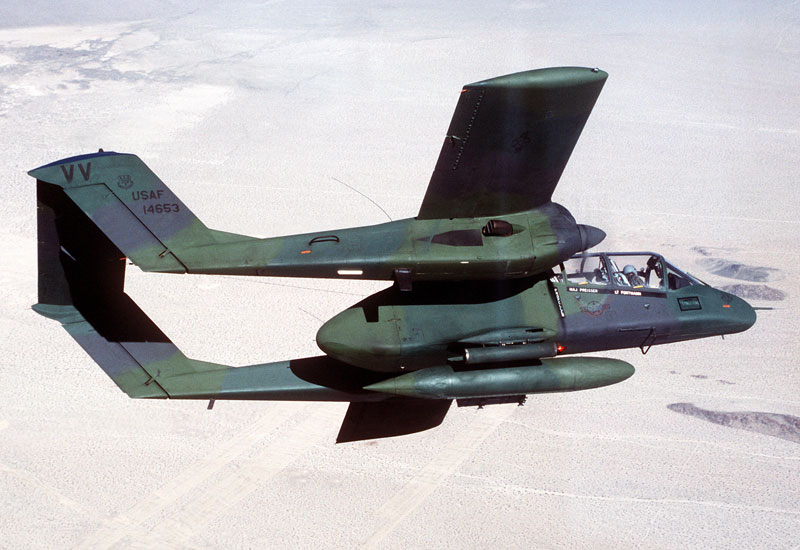
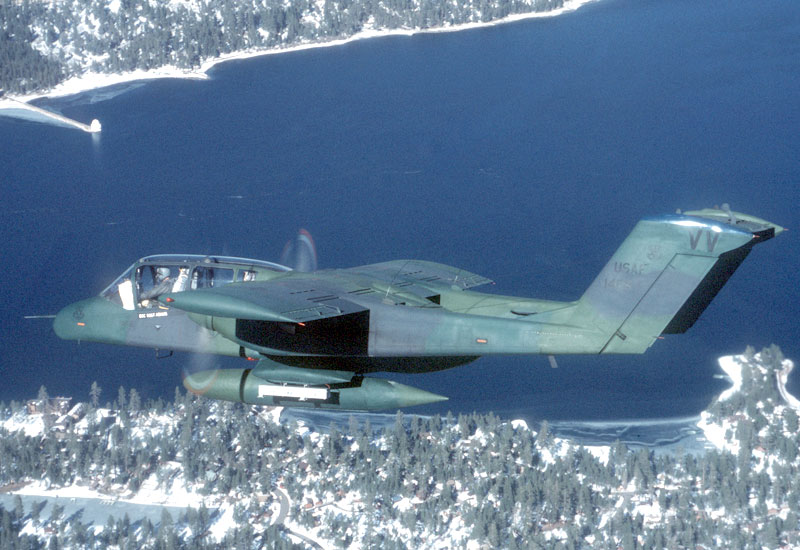
Externally, design of the Bronco was very unique in nature, sporting a high-mounted, straight monoplane wing assembly with cut-off wing tips. Each wing fitted underslung engine nacelles with powerplants mounting three-bladed propeller systems. The undercarriage was conventional with two main gears (fitted with single wheels) retracting into each engine nacelle underside and a nose gear (also fitting a single wheel)retracting forward. The Bronco maintained a twin boom layout extending aft to two vertical tail fins with the booms joined by a high-mounted horizontal tailplane. The fuselage was made up of a central nacelle fitted between the engines and positioned at the middle of the wing span. Side fuselage "sponsons", containing the 7.62mm M60 machine gun armament, protruded from the lower rear fuselage area. The sponsons also contained four weapon station hardpoints underneath.

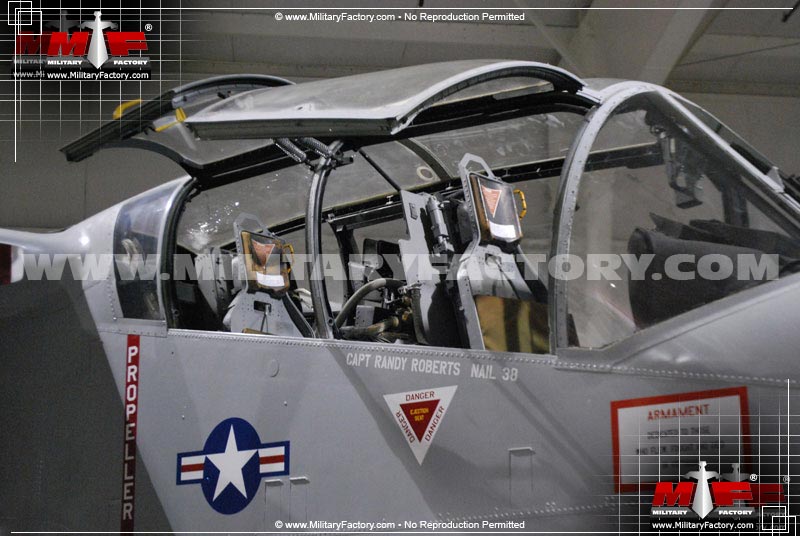
The pilot and co-pilot sat in tandem in a full-windowed "greenhouse-style" cockpit with generally great visibility from any direction but to the rear. The cockpit was positioned as such that forward seat was held out well past the engines themselves. Both cockpit positions were afforded ejection seats for improved crew survivability ( helped along by the Broncos inherently rugged design and construction). The fuselage nacelle featured a cabin area at rear with space for could fit two medical litters and one medical attendant or five combat-ready infantrymen. Up to 3,200lbs of supplies could also be taken aboard if need be.

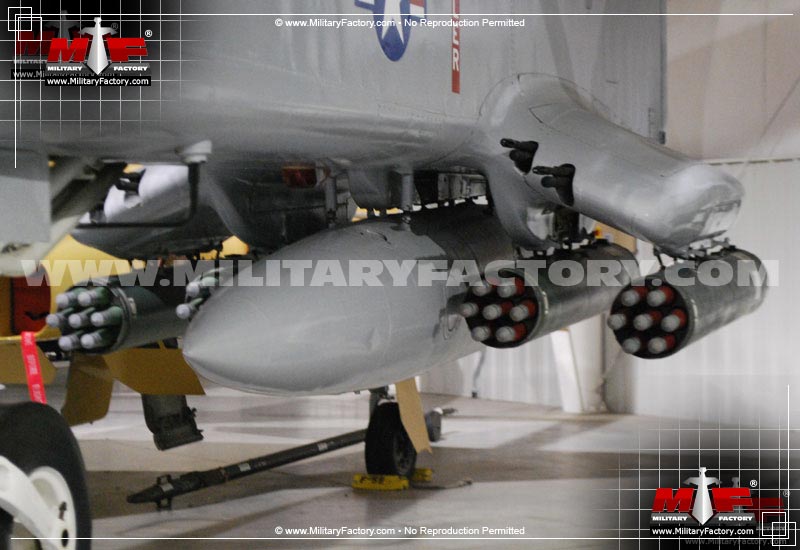
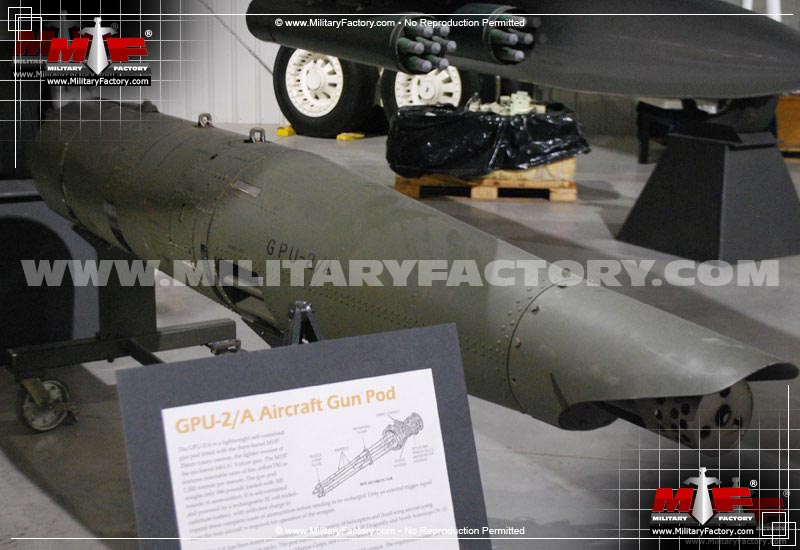
As a close-support, low-flying, light strike aircraft, armament of the Bronco naturally became the system's forte. Standard fittings included 4 x 7.62x51mm M60C machine guns in fuselage sponsons (the prototype YOV-10D trialed a 1 x 20mm M197 cannon in their place). Up to 3,600lbs of mixed ordnance could be carried externally on one under-fuselage, four under-sponson and two underwing weapons store stations. Armament included air-to-surface rockets in 7- or 19-tube launchers firing 2.75" rockets or 2- or 4-shot launchers firing 5" rockets in either their Folding-Fin Aerial Rocket (FFAR - otherwise known as "Zuni") or WAFARs (Wrap-Around Fin Aircraft Rockets). The Bronco was also given the capability to engage aerial inbound targets by its provision for 2 x wing-mounted AIM-9 Sidewinder short-ranged air-to-air missiles. Other munitions include the mounting of the SUU-11/A or Mk 4 Mod 0 series gun pods while use of conventional bombs rounded out armament capabilities. External fuel tanks could take the place of armament if needed.

The OV-10A fitted two Garret-brand T76-G-410/412 series turboprops delivering up to 715 horsepower each engine. Performance included a top speed of 281 miles-per-hour, a cruise speed of 223 miles-per-hour, an operational range of 576 miles and a service ceiling upwards of 26,000 feet. The OV-10A represented the initial Bronco production model. The OV-10B and OV-10B(Z) were both target tugs produced for Germany, the latter fitted with a J85-GE-4 turbojet engine. Designations for the C-, E- and F-models were all for export to Thailand, Venezuela and Indonesia respectively and all based on the OV-10A production model.

The OV-10M was a modified OV-10A model exclusively for the Philippines Air Force. These Broncos were fitted with a new four-blade propeller system. Work was handled by Marsh Aviation.

The YOV-10D appeared as two modified OV-10A prototype forms for the USMC Night Observation Gunship System (NOGS) program during the Vietnam War. They were used operationally in the war and proved successful, being outfitted with an experimental 20mm XM197 three-barreled Gatling cannon in a belly-mounted turret and a combination FLIR/laser target designator in a nose-mounted turret. Engines were the standard 715 horsepower installations used prior. Despite their positive performance in combat, the design did not enter serial production and, instead, led to the OV-10D production variant which lacked the 20mm XM197 turreted cannon (the M197 was later featured on the Bell AH-1J Cobra attack helicopter).

The OV-10D-model was a second generation design developed for the United States Marine Corps based on the OV-10A, mounting FLIR for night operations, larger engines and larger fiberglass propeller blades. This model also featured a lengthened nose assembly for the extra equipment. Heat suppressors were also fitted to the exhaust stacks to reduce the threat of heat-seeking missiles. The OV-10D has since been upgraded in the OV-10+ variant program, also for the United States Marine Corps. This program consists of upgraded existing A- and D-models to a new standard that includes reinforced wing assemblies and new wiring throughout. The cockpit instrumentation has also been modernized. The lead in this upgrade project has been the MCAS Cherry Point Naval Air Rework Facility. The OV-10D fitted two Garrett T76-G-420/421 series turboprops delivering 1,040 horsepower each engine. Performance included an increased top speed of 288 miles-per-hour, an impressive range increase of 1,382 miles and a heightened service ceiling of up to 30,000 feet.

The United States Air Force utilized the OV-10 primarily for its Forward Air Control role. The first USAF OV-10A was delivered in July of 1968 and was pressed into service in the Vietnam War on July 31st. These Broncos were part of the 19th Tactical Air Support Squadron taking part in active operational combat evaluation of the OV-10A through Operation Combat Bronco, conducting all sorts of combat-related sorties. By October of 1969, the Bronco was being fielded for the light strike role where its 4 x machine gun and rocket armament could be brought to effective bear. Laser targeting pods were eventually fitted to Broncos through project Pave Nail. The USAF received up to 157 OV-10As during their usage term of which at least 64 of these were lost in the conflict. USAF Broncos were replaced by OA-10A Thunderbolt II and OA-37B Dragonfly observation/close-support aircraft in the early 1990's.

The United States Navy utilized the OV-10A Broncos as light attack aircraft, generally in support of related ground elements such as marine infantrymen and special force Navy SEAL teams. Operating as Light Attack Squadron FOUR (VAL-4), these Broncos were fielded in this fashion from April 1969 through April of 1972 to which some seven Broncos were lost.

The USMC was the first US service branch to receive the Bronco, delivered in both standard OV-10A and OV-10D night observation models. Combat losses in Vietnam amounted to 10 units.

The last combat engagement for United States Broncos was in Operation Desert Storm. Desert Storm proved a mish-mash of old and new aircraft technologies for the F-117 Nighthawk stealth fighter was equally fielded alongside the likes of Vietnam-era aircraft such as A-6 Intruders, F-4 Phantoms, B-52 Stratofortresses and the OV-10 Broncos. As the Bronco was originally designed for the rigors of tropical jungle operations, Desert Storm proved to be an "acting experiment" for the Bronco system. Some in the USAF were even reluctant to field the type for fear that the system would not match well in the modern conflict across unforgiving desert terrain.

Nevertheless, the USMC sent their Broncos into Saudi Arabia making up USMC VMO-1 and VMO-2. In the conflict, the first aircraft lost to enemy fire was an OV-10A from VMO-2. Since this aircraft was an A-model lacking the infrared suppressors on its exhaust stacks, it made relatively easy pickings for shoulder-launched heat-seeking missiles. These shoulder-launched mobile missile platforms were not yet a technological threat in the Vietnam conflict so it was a new threat to original Broncos int he Persian Gulf.

Despite both pilots ejecting safely, they were captured an tortured as Iraqi POWs till the end of the war. Typical Bronco weapon loadouts in the conflict included a single AIM-9 Sidewinder to counter enemy aircraft threats as well as rocket armament and their standard machine gun arrangements to counter ground elements. Broncos also spent their time assisting A-6 Intruders and AV-8B Harriers along with marking targets via white phosphorous rockets as well as spotting for naval-based artillery guns.

Over the run of her production life, operators of the OV-10 Bronco have also included Colombia, Germany, Indonesia, Morocco, Philippines, Thailand and Venezuela. Colombia, Philippines and Venezuela have kept active air branches of the type while Germany, Morocco and Thailand have since replaced theirs. Indonesian Broncos are currently listed as "grounded" and their replacement is forthcoming. Some American-fielded military-based Broncos have gone on to serve with other air forces as well as with the US State Department in drug interdiction roles throughout Latin America while others have also stood in as research assistants in NASA projects.

As of this writing (2012), interest in the OV-10 series is growing to the point that talk of restarting the production lines have been tossed about for both domestic and global markets. Boeing is currently considering such plans and would involve a complete redesign of the internal systems to bring the Bronco up to modern status. These revisions would include a complete all-digital cockpit and support for "smart" guided munitions. By all accounts, the external appearance of the new Bronco would stay the same as their Vietnam-era brethren.

Individual Bronco units carried a price tag of $480,000. Production completed in April of 1969.

Rockwell International merged with North American Aviation in 1967 to become North American Rockwell. Any future OV-10 production would fall under the Boeing Integrated Defense Systems banner as most of North American Rockwell's defense business had been sold to Boeing.
Text ©2003-2013 www.MilitaryFactory.com • All Rights Reserved • No Reproduction Permitted
MilitaryFactory.com does NOT sell equipment/weaponry. Material presented throughout this website is for historical and entertainment value and should not to be construed as usable for hardware restoration, maintenance or general operation. Please consult manufacturers for such information. Our disclaimer. Email corrections / Comments to MilitaryFactory at Gmail dot com.
Picture of North American Rockwell OV-10 Bronco
Pic of the North American Rockwell OV-10 Bronco
Image of the North American Rockwell OV-10 Bronco
View All Images (19)

Specifications for the
North American Rockwell OV-10 Bronco
Observation / Light Attack Aircraft


Country of Origin: United States
Manufacturer: North American Rockwell - USA
Initial Year of Service: 1966
Production: 356


Focus Model: North American Rockwell OV-10A Bronco
Crew: 2


Length: 41.67ft (12.7m)
Width: 39.70ft (12.10m)
Height: 15.29ft (4.66m)
Weight (Empty): 6,969lbs (3,161kg)
Weight (MTOW): 14,442lbs (6,551kg)


Powerplant: 2 x Garrett T76-G-416/417 turboprop engines driving three-blade propellers.


Maximum Speed: 281mph (452kmh; 244kts)
Maximum Range: 228miles (367km)
Service Ceiling: 23,999ft (7,315m; 4.5miles)
Rate-of-Climb: 2,650 feet per minute (808m/min)


Hardpoints: 7
Armament Suite:
STANDARD:
4 x 7.62mm M60C General Purpose Machine Guns in side fuselage sponsons.

OPTIONAL:
Mission-specific armament can include a combination of the following:

2 x AIM-9 Sidewinder short-range air-to-air missiles.
Conventional Light-Weight Drop Bombs
7-Shot 2.75" FFAR/WAFAR Rocket Pods
19-Shot 2.75" FFAR/WAFAR Rocket Pods
2-Shot 5" FFAR/WAFAR Rocket Pods
4-Shot 5" FFAR/WAFAR Rocket Pods
SUU-11/A Machine Gun Pods
Mk 4 Mod 0 Machine Gun Pods

OPTIONAL:
External Fuel Tanks
White Phosphorous Marking Rockets
LUU-2 Parachute Flare Dispenser

OF NOTE:
1 x 20mm M197 cannon (YOV-10D)


Variants:
NA-300 - North American Company Model Designation.


YOV-10A - Prototype Designation; seven prototypes produced.

OV-10A - First Production Model

OV-10B - German Export Target Towing Variants; 6 examples delivered.

OV-10B(Z) - German Export Target Tug Model; fitted with J85-GE-4 series auxiliary turbojet in upper fuselage; 18 examples delivered.

OV-10C - Thailand Export Model; based on OV-10A

YOV-10D - Second Generation Bronco Prototype

OV-10D - Improved Bronco for USMC; revised airframe; fitted with FLIR night-vision and camera in elongated nose assembly; larger engines with fiberglass propellers; infrared exhaust suppression.

OV-10D "NOGS" - Proposed Bronco Program; "Night Observation Gunship System" model for potential use by the USMC; four OV-10A models converted to use a turreted FLIR system with slaved 20mm M197 cannon; funding issues cancelled further conversions.

NOS OV-10D - Evolved form of OV-10D NOGS program aircraft also fitting a laser target designator and removing the 20mm cannon armament.

OV-10D+ - Upgraded USMC Bronco A- and D-models; reinforced wings; revised wiring and instrument panel.

OV-10E - Venezuelan Export Model; based on OV-10A

OV-10F - Indonesian Export Model; based on OV-10A

OV-10M - Philippine Air Force Bronco; modified with four-bladed propellers as handled by the March Aviation company.

OV-10(X) - Proposed Modernized and Improved Light Attack Variant for the USAF; glass-cockpit; revised sensor equipment; provision for smart bombs.


Operators: Colombia; Germany; Indonesia; Morocco; Philippines; Thailand; United States; Venezuela

ALL AIRCRAFT CATEGORIES

BY DECADE:


1900 to 1909
1910 to 1919
1920 to 1929
1930 to 1939
1940 to 1949
1950 to 1959
1960 to 1969
1970 to 1979
1980 to 1989
1990 to 1999
2000 to 2009
2010 to 2019
2020 to 2029
VIEW ALL
Compare Aircraft


BY TYPE:


Anti-Submarine Warfare (ASW)
Attack Helicopters
Bomber Aircraft
Medium Bombers
Heavy Bombers
Close-Air Support (CAS)
Commercial Aircraft
Dive Bombers
Electronic Warfare Aircraft (EWA)
Experimental / X-Planes
Fighter Aircraft
Floatplane Aircraft
Flying Boat Aircraft
Aerial Refueling Tankers
Helicopters (ALL)
Interceptor Aircraft
Multi-Role Aircraft
Navy Carrier Aircraft
Night Fighters
Reconnaissance / Scout
Search & Rescue (SAR)
Scout Helicopters
Special Purpose
Torpedo Bombers
Trainer Aircraft
Transport Aircraft
Transport Helicopters
Unmanned Aerial Vehicles (UAVs)
Unmanned Combat Air Vehicles (UCAVs)


COLLECTIONS:


4th Generation Fighter Aircraft
5th Generation Fighter Aircraft
US X-Planes
Classic US Warbirds
French Military Helicopters
Grumman "Cats"
Howard Hughes Aircraft
Indian Air Force
Israeli Air Force
Libyan Aircraft
Modern Chinese Aircraft
Modern Chinese Fighters
Modern Military Aircraft
Modern North Korean Aircraft
Modern Trainer Aircraft
Modern US Aircraft
Mikoyan Aircraft
Sukhoi Aircraft
Syrian Aircraft
Top 10 Fighter Aircraft of All Time


AIRCRAFT BY CONFLICT:


Arab-Israeli War (1948)
Cuban Missile Crisis (1959-1962)
Falklands War (1982)
Indo-Pak War (1965, 1971)
Iran-Iraq War (1980-1988)
Lebanon War (1982)
Operation Allied Force (1999)
Operation Desert Storm (1991)
Six Day War (1967)
Spanish Civil War (1936)
Soviet-Afghan War (1979-1989)
Yom Kippur War (1973)


MISCELLANEOUS:


Aircraft Cockpits
Aircraft Manufacturers List
Aircraft Timeline

WORLD WAR 2:


1939 Aircraft
1940 Aircraft
1941 Aircraft
1942 Aircraft
1943 Aircraft
1944 Aircraft
1945 Aircraft
1946 Aircraft
Australian Aircraft
Battle of Britain Aircraft
Bombers
Four-Engine Bombers
British Aircraft
British Bombers
British Transports
Dive Bombers
Canadian Aircraft
Fighters
Chinese Aircraft
French Aircraft
German Aircraft
German Fighters
German Flying Boats
German Jets
Secret Weapons of the Luftwaffe
Italian Aircraft
Imperial Japanese Aircraft
Imperial Japanese Fighters
Mitsubishi Bombers
Navy Aircraft
Pearl Harbor
Polish Aircraft
Romanian Aircraft
US Aircraft
US Bombers
US Navy Aircraft
Soviet Aircraft
Torpedo Bombers
Trainer Aircraft
Transport Aircraft
Tuskegee Airmen Aircraft
W.A.S.P. Aircraft
WW2 Aircraft Ranked by Speed
VIEW ALL


WORLD WAR 1:


1914 Aircraft
1915 Aircraft
1916 Aircraft
1917 Aircraft
1918 Aircraft
Aircraft Timeline
Austro-Hungarian Aircraft
Bomber Aircraft
British Aircraft
Fighters
Flying Boats
French Aircraft
Imperial German Aircraft
Italian Aircraft
Scout Aircraft
Russian Empire Aircraft
US Aircraft
WW1 Aircraft Ranked by Speed
VIEW ALL


KOREAN WAR:


Australian Aircraft
Korean War Aces
Korean War Jets
North Korean Aircraft
US Military Aircraft
VIEW ALL


VIETNAM WAR:


Helicopters
North Vietnam Air Force
US Airpower
VIEW ALL


COLD WAR:


1950s French Aircraft
British V-Bombers
Cold War Bombers
Soviet Aircraft
Soviet Bombers
Soviet Interceptors
Soviet Helicopters
Strategic Air Command
US Aircraft
US Bombers
US Interceptors
VIEW ALL

Site Disclaimer | Privacy Policy | Site Map | MF Origins


©2013 www.MilitaryFactory.com • Content ©2003-2013 MilitaryFactory.com • All Rights Reserved • Site Contact Email: militaryfactory at gmail dot com. The "Military Factory" name and MilitaryFactory.com logo are registered ® trademarks and protected by all applicable domestic and international intellectual property laws.


Top MF Stuff: 2013 Military Pay Scale | Military Ranks | WW2 Weapons | Sniper Rifles | Kts to Mph | WW1 Aircraft | Automatic Rifles | Aircraft Cockpits | Vietnam War Weapons | Main Battle Tanks | Submachine Guns | Shotguns | French Military Victories


Most photographic images appearing on this site are courtesy of the United States Department of Defense and are approved for public use. Other images acquired through the public domain. Digital art work courtesy of Dan Alex. Business Consulting by Kyle Williams. Material presented throughout this website is for historical and entertainment value and should not to be construed as usable for hardware restoration, maintenance or general operation. Please consult manufacturers for such information.


eXTReMe Tracker